Two Stroke Marine Engine: Working, Uniflow Cycle, Designers
Marine engineers & industry writers
Updated
Nov 27, 2026
A two-stroke marine engine is a low-speed crosshead diesel engine that completes one working cycle in every revolution of the crankshaft. The two-stroke marine engine turns the propeller shaft directly, without a reduction gearbox, and is the usual main engine of tankers, bulk carriers and container ships.
The engine clears the exhaust gas from each cylinder with uniflow scavenging. Three companies design the engines: Everllence (formerly MAN Energy Solutions), WinGD and J-ENG.
Key facts
| Attribute | Value |
|---|---|
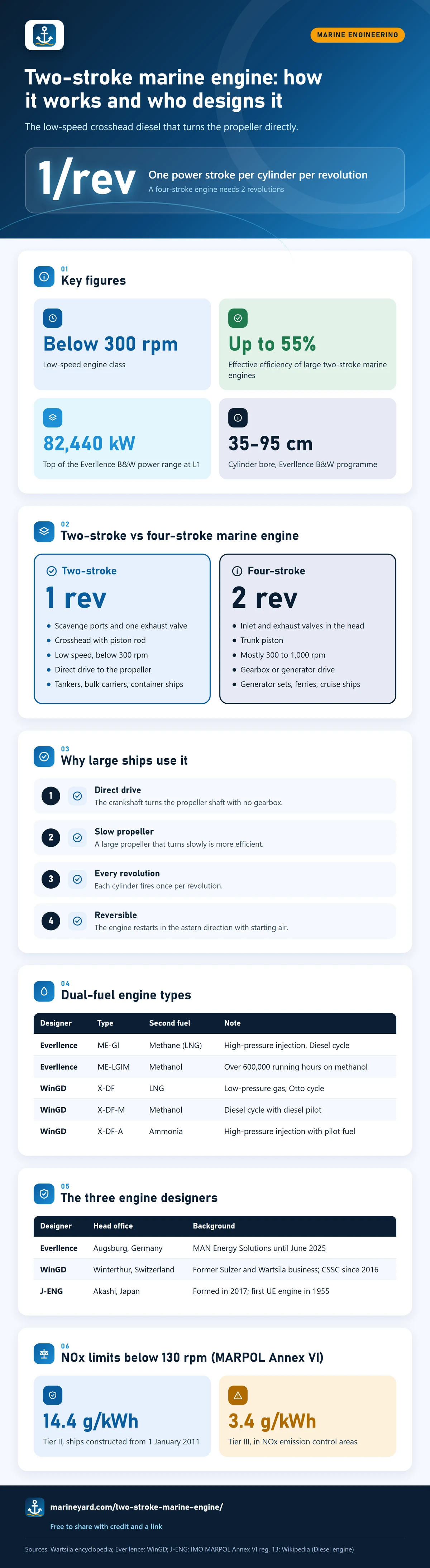
| Working cycle | One power stroke per cylinder in every crankshaft revolution (360°) |
| Scavenging method | Uniflow: air enters through ports at the lower end of the cylinder and leaves through one exhaust valve at the top |
| Speed class | Low speed, below 300 rpm; the Everllence B&W programme runs at 56 to 167 rpm |
| Power range | 4,350 to 82,440 kW at the L1 rating (Everllence B&W programme) |
| Cylinder bore | 35 to 95 cm (Everllence B&W programme) |
| Effective efficiency | Up to 55% for large two-stroke marine engines |
| Drive | Crankshaft coupled directly to the propeller shaft, no gearbox |
| Engine designers | Everllence (Germany), WinGD (Switzerland), J-ENG (Japan) |
| NOx limit below 130 rpm | 14.4 g/kWh (Tier II) and 3.4 g/kWh (Tier III), MARPOL Annex VI regulation 13 |
What is a two-stroke marine engine?
A two-stroke marine engine is a diesel engine in which each piston delivers power on every downward stroke. The piston makes two strokes, one up and one down, in one crankshaft revolution. A four-stroke engine needs four strokes and two revolutions for the same cycle.
The engine ignites the fuel by the heat of compression. The engine is built as a crosshead engine. A piston rod joins the piston to a crosshead, and a connecting rod joins the crosshead to the crankshaft. The crosshead takes the side forces, so the piston does not press on the liner wall.
Engines that run below 300 rpm are classed as slow-speed or low-speed engines. The stroke of a low-speed engine is much longer than the bore.
What are the main parts of a two-stroke marine engine?
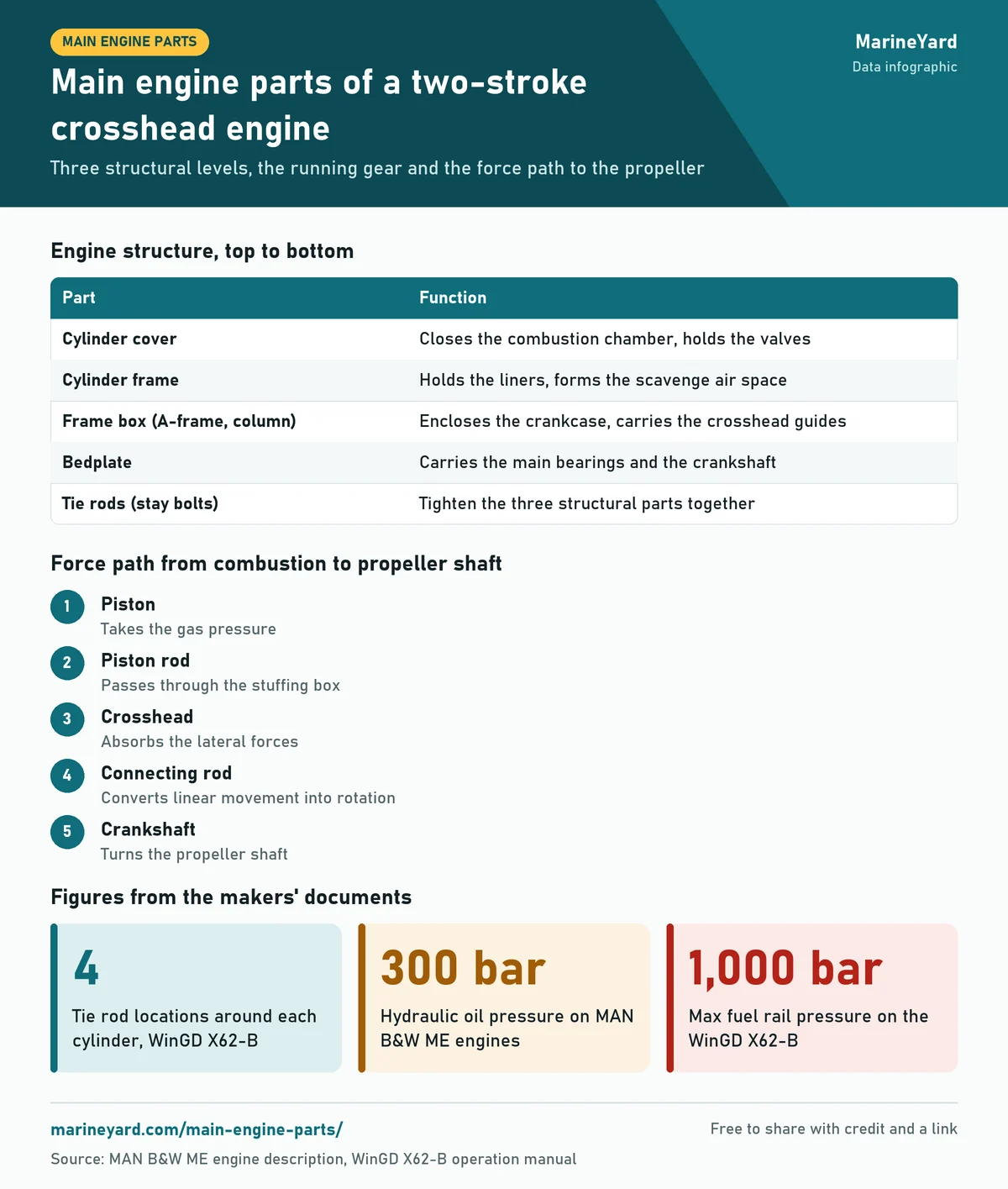
The main parts of a two-stroke marine engine are the bedplate, crankshaft, connecting rod, crosshead, piston rod, piston, cylinder liner, cylinder cover with exhaust valve, fuel injection valves, scavenge air receiver and turbocharger.
| Part | Function in the cycle |
|---|---|
| Cylinder liner with scavenge ports | Guides the piston; ports near the bottom admit the scavenge air |
| Exhaust valve | One valve in the centre of the cylinder cover releases the exhaust gas |
| Fuel injection valves | Spray fuel into the compressed air near top dead centre |
| Piston and piston rod | Receive the gas pressure and pass the force down to the crosshead |
| Crosshead and guides | Change the straight motion of the piston rod into the swing of the connecting rod |
| Piston rod stuffing box | Seals the scavenge air space from the crankcase |
| Turbocharger and air cooler | Use exhaust gas energy to compress and cool the scavenge air |
The cylinder liner receives its own cylinder lubricating oil through quills in the liner wall.
How does a two-stroke marine engine work?
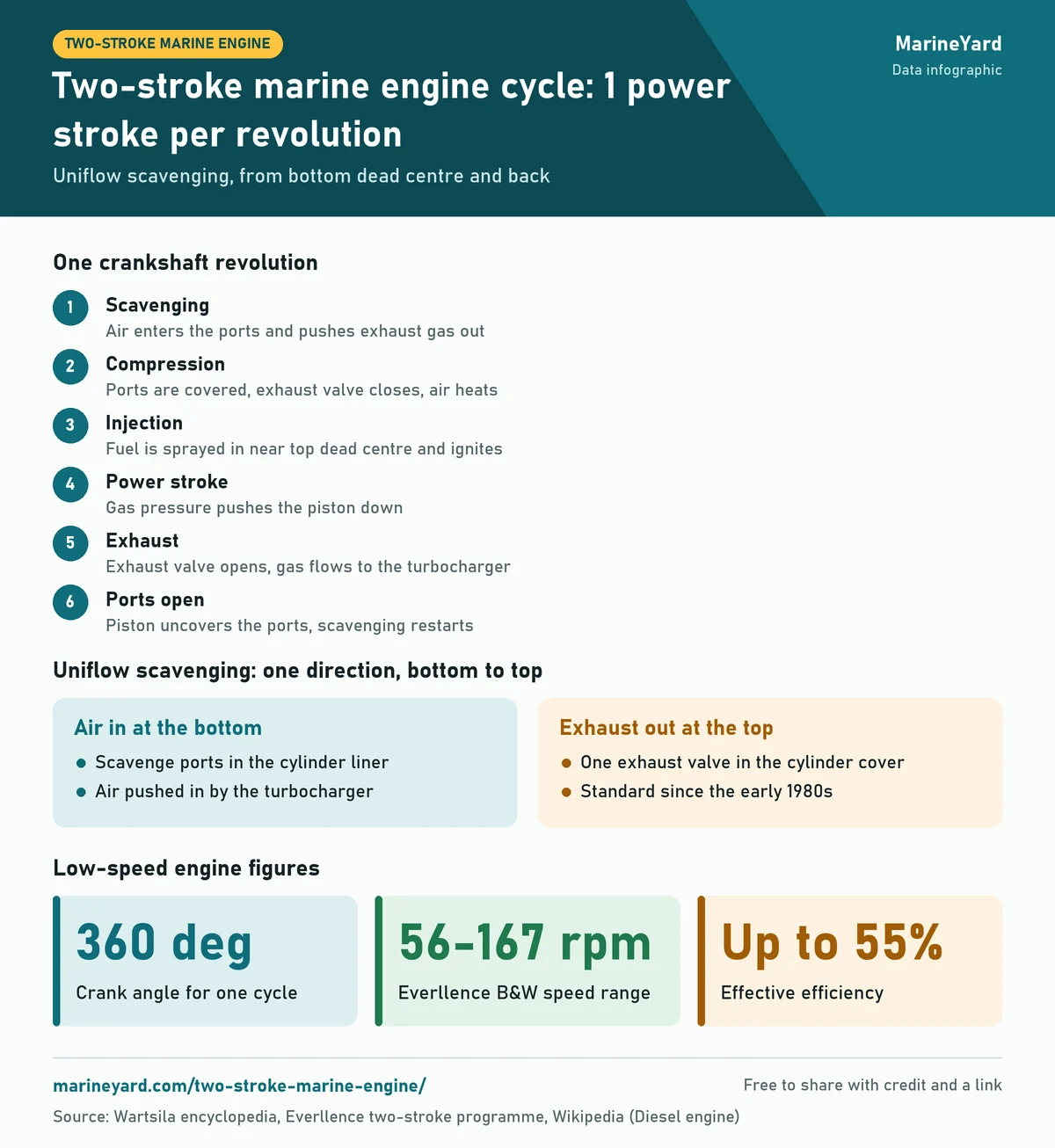
A two-stroke marine engine works by compressing fresh air on the upward stroke and burning fuel on the downward stroke. The exhaust gas leaves and the fresh air enters while the piston is near bottom dead centre. All events of the cycle fit into one crankshaft revolution.
- Scavenging. The piston is near bottom dead centre. The scavenge ports are uncovered and the exhaust valve is open. Air from the scavenge air receiver flows up the cylinder and pushes the exhaust gas out.
- Ports close. The piston rises and covers the scavenge ports. The exhaust valve closes.
- Compression. The piston compresses the trapped air. The air temperature rises above the ignition temperature of the fuel.
- Injection. The fuel injection valves spray fuel into the cylinder near top dead centre. The fuel ignites.
- Power stroke. The gas pressure pushes the piston down. The force passes through the piston rod, crosshead and connecting rod to the crankshaft.
- Exhaust. The exhaust valve opens before the piston reaches the scavenge ports. The cylinder pressure falls, and the exhaust gas flows to the turbocharger.
- Ports open. The piston uncovers the scavenge ports, and scavenging starts again.
A two-stroke diesel engine has no suction stroke, so the engine needs pressurised air to run. The marine turbocharger supplies this air. Electric auxiliary blowers support the turbocharger at low load.
What is uniflow scavenging?
Uniflow scavenging is the gas exchange method in which air and exhaust gas move through the cylinder in one direction, from bottom to top. The Wärtsilä encyclopedia entry on scavenging methods states that the air enters at the lower end of the cylinder and leaves at the top.
The same entry calls uniflow the most efficient scavenging system and notes that the system requires an exhaust valve in the cylinder head. Older engines used cross-flow or loop (reverse-flow) scavenging, with both inlet and exhaust ports in the liner and no exhaust valve. Uniflow scavenging has been the standard for marine two-stroke engines since the early 1980s.
Why do large ships use low-speed two-stroke engines for propulsion?
Large ships use low-speed two-stroke engines for propulsion because the engine combines the highest efficiency of any diesel engine with a direct drive to the propeller. Large two-stroke marine engines reach an effective efficiency of up to 55%, according to the Wikipedia article on the diesel engine.
- Direct drive. The crankshaft turns the propeller shaft at propeller speed. No gearbox or clutch stands between the engine and the shaft that runs through the stern tube.
- Propeller efficiency. A large propeller that turns slowly is more efficient than a small, fast propeller. A long piston stroke gives the low shaft speed.
- Power per cylinder. Each cylinder fires on every revolution, so one engine can propel a large ship.
- Fuel tolerance. Low-speed engines burn heavy fuel oil as their primary liquid fuel.
- Reversing. The engine is reversible. With a fixed-pitch propeller, the crew stops the engine and restarts it in the astern direction with starting air.
The piston rod and crosshead make the engine tall. Passenger ships and ferries often use medium-speed four-stroke engines instead.
What is the difference between a two-stroke and a four-stroke marine engine?
The difference between a two-stroke and a four-stroke marine engine is the number of piston strokes in one working cycle. A two-stroke engine fires once per revolution in each cylinder. A four-stroke engine fires once in two revolutions and uses separate strokes to expel the exhaust gas and draw in air.
| Feature | Two-stroke marine engine | Four-stroke marine engine |
|---|---|---|
| Revolutions per power stroke | 1 | 2 |
| Gas exchange | Scavenge ports and one exhaust valve; air pushed in by the turbocharger | Inlet and exhaust valves in the cylinder head; piston strokes move the gas |
| Piston connection | Crosshead with piston rod | Trunk piston on the connecting rod |
| Speed class | Low speed, below 300 rpm | Mostly medium speed, 300 to 1,000 rpm, or high speed |
| Drive to the propeller | Direct | Through a reduction gearbox, or electric through generators |
| Usual duty | Main engine of tankers, bulk carriers and container ships | Generator sets; main engines of ferries, cruise ships and smaller vessels |
How does electronic control work on a two-stroke marine engine?
Electronic control on a two-stroke marine engine replaces the camshaft with hydraulic actuators that a computer commands. The engine control system reads the crankshaft position and sets the timing of fuel injection and exhaust valve opening for each cylinder.
The first RT-flex engine, a Sulzer design that is now part of the WinGD line, entered service in September 2001. The RT-flex engine uses common-rail technology for fuel injection and valve actuation. MAN B&W followed with the camshaft-less 7S50ME-C in 2003. A Maritime Reporter article from April 2003 describes a hydraulic oil loop at about 200 bar that powers fuel injection and exhaust valve lift on that engine.
Which fuels does a two-stroke marine engine burn?
A two-stroke marine engine burns heavy fuel oil or distillate marine fuel in its standard form. Dual-fuel versions burn liquefied natural gas (LNG), methanol, LPG, ethane or ammonia, and ignite the alternative fuel with a small pilot injection of liquid fuel.
| Designer | Engine type | Second fuel | Note |
|---|---|---|---|
| Everllence | ME-GI | Methane (LNG) | High-pressure gas injection, Diesel cycle |
| Everllence | ME-LGIM | Methanol | More than 600,000 running hours on methanol (maker's figure) |
| WinGD | X-DF | LNG | Low-pressure gas admission, lean-burn Otto cycle |
| WinGD | X-DF-M | Methanol | Diesel-cycle combustion with diesel pilot |
| WinGD | X-DF-A | Ammonia | High-pressure ammonia injection with pilot fuel |
The Everllence two-stroke engine programme states that dual-fuel engines make up more than 50% of the company's order book, measured in power. The WinGD page on LNG engines states that X-DF engines admit the gas at low pressure before compression and have been in operation since 2016.
What NOx limits apply to two-stroke marine engines?
The NOx limits for two-stroke marine engines are set by MARPOL Annex VI regulation 13. Engines with a rated speed below 130 rpm must meet 14.4 g/kWh under Tier II and 3.4 g/kWh under Tier III. The regulation covers marine diesel engines with an output above 130 kW.
Tier II applies to ships constructed on or after 1 January 2011. Tier III applies in NOx emission control areas. The IMO page on regulation 13 lists the North American and United States Caribbean Sea areas for ships constructed from 1 January 2016, and the Baltic Sea and North Sea areas for ships constructed from 1 January 2021.
Engines that burn fuel on the Diesel cycle reach Tier III with selective catalytic reduction (SCR) or exhaust gas recirculation (EGR). WinGD states that X-DF engines meet Tier III in gas mode without these systems.
Who designs two-stroke marine engines?
Two-stroke marine engines are designed by three companies: Everllence, WinGD and J-ENG. Everllence and WinGD work mainly as licensors. Licensed engine builders manufacture the engines. J-ENG designs, builds and licenses its own UE engine.
| Designer | Head office | Engine brand | Background |
|---|---|---|---|
| Everllence | Augsburg, Germany | Everllence B&W (formerly MAN B&W): ME-C, ME-GI, ME-LGIM | MAN Energy Solutions took the name Everllence in June 2025; part of the Volkswagen Group |
| WinGD (Winterthur Gas & Diesel) | Winterthur, Switzerland | X, X-DF, RT-flex | Former Sulzer, then Wärtsilä two-stroke business; owned 100% by CSSC of China since June 2016 |
| J-ENG (Japan Engine Corporation) | Akashi, Japan | UE (UEC types) | Formed in 2017 from Kobe Diesel and the Mitsubishi marine engine business; first UE engine in 1955 |
The WinGD statement of June 2016 records the transfer of Wärtsilä's 30% share to China State Shipbuilding Corporation (CSSC). The J-ENG company history lists the 2017 merger and the first UE engine, the 9UEC75/150.
Which two-stroke marine engine spare parts are ordered most often?
Two-stroke marine engine spare parts ordered most often are piston rings, cylinder liners, exhaust valve spindles and seats, fuel injection valves and nozzles, piston rod stuffing box rings, fuel pump parts, starting air valves, bearings and turbocharger parts. The maker's manual sets the overhaul interval for each part.
A correct order states the following data:
- Ship name and IMO number.
- Engine designer, engine builder (licensee) and engine number.
- Full engine type. In the J-ENG type 7UEC50LSJA, the figure 7 is the number of cylinders and 50 is the bore in centimetres.
- Part name, plate number and item number from the maker's spare parts book.
- Condition wanted: new, reconditioned or used, with the certificate required.
Where can two-stroke marine engine parts be bought or sold?
Two-stroke marine engine parts are bought from engine designers, licensed engine builders, service companies and surplus stockists. MarineYard is a ship spare parts marketplace where sellers list new, reconditioned and used main engine parts. Sellers get 9 free listings per account. MarineYard takes no commission and is not a party to any sale. Buyers should confirm the engine type, the part number and the certificate with the seller before payment.
Frequently Asked Questions
How many crankshaft revolutions does a two-stroke marine engine need for one cycle?
A two-stroke marine engine needs one crankshaft revolution for one working cycle. Each cylinder gives one power stroke in every revolution. A four-stroke engine needs two revolutions for one power stroke in each cylinder.
Why does a two-stroke marine engine need a turbocharger?
A two-stroke marine engine needs a turbocharger because the cycle has no suction stroke. Air must enter the cylinder under pressure through the scavenge ports to push out the exhaust gas. The turbocharger compresses this air with energy from the exhaust gas.
What rpm does a two-stroke marine engine run at?
A two-stroke marine engine runs at a low speed, below 300 rpm. The engines in the Everllence B&W programme have rated speeds of 56 to 167 rpm. The propeller turns at the same speed as the engine, because no gearbox is fitted.
What is a crosshead in a marine engine?
A crosshead in a marine engine is the sliding block that joins the piston rod to the connecting rod. The crosshead runs in guides and takes the side forces of the connecting rod. The piston therefore moves in a straight line and does not press sideways on the liner.
What is the difference between ME-GI and X-DF engines?
The difference between ME-GI and X-DF engines is the gas combustion principle. The Everllence ME-GI injects gas at high pressure and burns it on the Diesel cycle. The WinGD X-DF admits gas at low pressure before compression and burns a lean mixture on the Otto cycle.
Is MAN B&W the same as Everllence?
MAN B&W two-stroke engines are now named Everllence B&W engines. The designer, MAN Energy Solutions, took the name Everllence in June 2025. The company remains part of the Volkswagen Group, and the engine type names such as ME-C and ME-GI did not change.
Related guides
- Ballast Water Treatment System: Types, Parts and D-2 Rules
- Sewage Treatment Plant on Ship: Working, Parts and MARPOL Rules
- Marine Incinerator on Ships: Parts, Working and MARPOL Rules
- Oil Mist Detector on Ships: Working, Rules and Alarm Levels
- ISSA Code: Meaning, Catalogue and Difference from IMPA Code
- Crankcase Explosion: Causes, Relief Valves and Alarm Actions
- Scavenge Fire: Causes, Indications, Actions and Prevention
- Main Engine Parts of a Ship: Names, Functions and Spares
- Stern tube: parts, bearings, seals and lubrication
- IMPA code: meaning and structure
- Ship chandler: meaning and services
- Oily water separator: working, parts and the 15 ppm rule
- Marine turbocharger: parts, working and surging
- Purifier in ship: working principle, parts and faults
- Cylinder liner: function, wear and gauging
- Ship boiler: types, mountings and water treatment
- Anchor windlass: parts, working and class rules
- Bow thruster: how it works, types and failures
- Steering gear: parts, types and SOLAS tests
- Marine air compressor: starting air, parts and safety
Sources
- Wärtsilä Encyclopedia of Marine and Energy Technology, scavenging methods
- Wikipedia, Diesel engine (speed classes, efficiency, uniflow scavenging)
- Everllence, two-stroke engines
- Maritime Reporter, April 2003, Electronic Milestone for Two-Stroke Champ
- WinGD, LNG engines (X-DF)
- WinGD, Full steam ahead for Winterthur Gas & Diesel, 20 June 2016
- Japan Engine Corporation, company history
- IMO, Nitrogen Oxides (NOx), Regulation 13
Sign in to leave a comment and join the discussion.
 Ship Machinery
Main engine parts are the components of the diesel engine that turns a ship's propeller. The main engine of a large merchant ship is usually a slow-speed...
 Maintenance & Repair
A scavenge fire is a fire in the scavenge air space of a two-stroke crosshead diesel engine. A scavenge fire burns the oily deposit of cylinder oil, unburnt...
 Maintenance & Repair
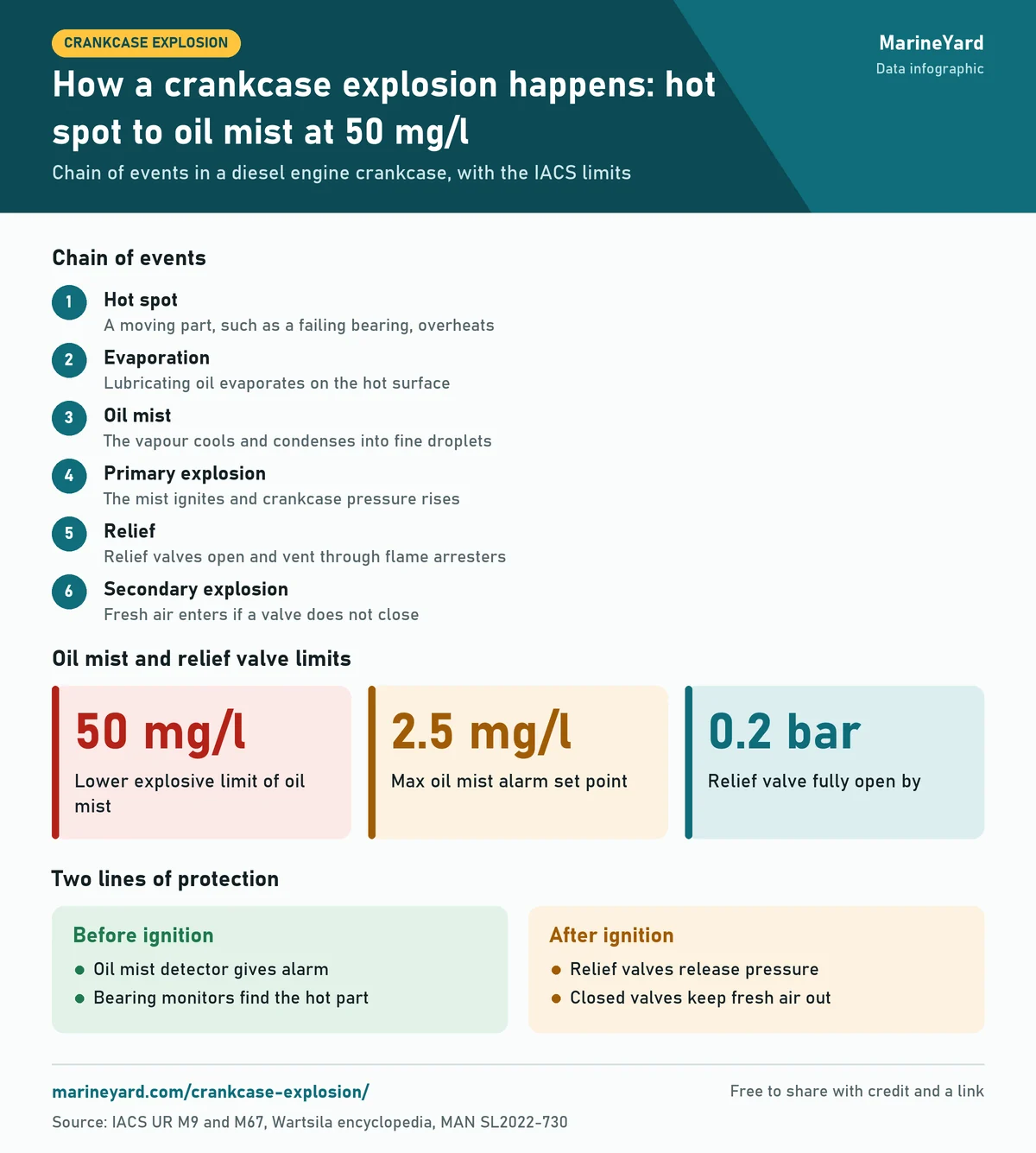
A crankcase explosion is the ignition of oil mist inside the crankcase of a diesel engine. A hot spot evaporates lubricating oil, the vapour condenses into...