Ship Chandler: Meaning, Services and How Ship Supply Works
Marine engineers & industry writers
Updated
Nov 18, 2026
A ship chandler is a dealer that supplies commercial vessels in port with the stores they consume and use: provisions for the crew, bonded stores, deck, engine and cabin consumables, safety items and nautical publications. A ship chandler takes the vessel's requisition, sources every line, clears the goods through port controls and delivers them on board before sailing.
Ship chandlers are also called ship suppliers or marine suppliers. The trade serves tankers, bulk carriers, container ships and other merchant vessels during short port calls. One order can hold several hundred lines, so requisitions use standard catalogue codes.
Key facts
| Attribute | Value |
|---|---|
| Definition | Dealer that supplies ships with stores and equipment in port |
| Other names | Ship supplier, marine supplier |
| Word origin | Latin candela (candle), through Old French chandelier and Middle English chaundeler |
| Global trade body | ISSA, founded in 1955, with 40 national associations and nearly 2,000 members (ISSA) |
| Main requisition code | IMPA Marine Stores Guide: six-digit codes, more than 50,000 items, first published in 1978 |
| Second catalogue | ISSA Ship Stores Catalogue with ISSA's own item numbering |
| Customs document for stores | IMO FAL Form 3, Ship's Stores Declaration (FAL Convention adopted on 9 April 1965) |
| Quality benchmark | ISSA Quality Standard; ISO 9001:2015 certificates are accepted in place of an ISSA audit |
| Usual payer | Ship owner or ship manager, normally on a credit account |
What is a ship chandler?
A ship chandler is a specialist trader that sells and delivers ship stores to vessels calling at a port. A ship chandler holds stock in a warehouse near the port, buys the remaining items from local merchants and delivers one consolidated order to the ship. The customer is the ship owner or the ship manager, not the crew.
Wikipedia's ship chandler article describes the modern trade as focused on fuel-powered commercial ships such as oil tankers, container ships and bulk carriers.
Where does the word "chandler" come from?
The word "chandler" comes from the Latin "candela", which means candle. The Latin "candelarius" meant a candle maker. The word passed into Old French as "chandelier" and into Middle English as "chaundeler". A chandler was first a person who made or sold candles, or the head of the candle office in a large medieval household.
By the 18th century, commercial chandlers sold candles, oils, soap and paint. Ships needed all of these goods, so shops near the waterfront began to specialise in ship supply. The name "ship-chandlery" separated these shops from candle sellers, according to the history of the chandlery.
What does a ship chandler supply?
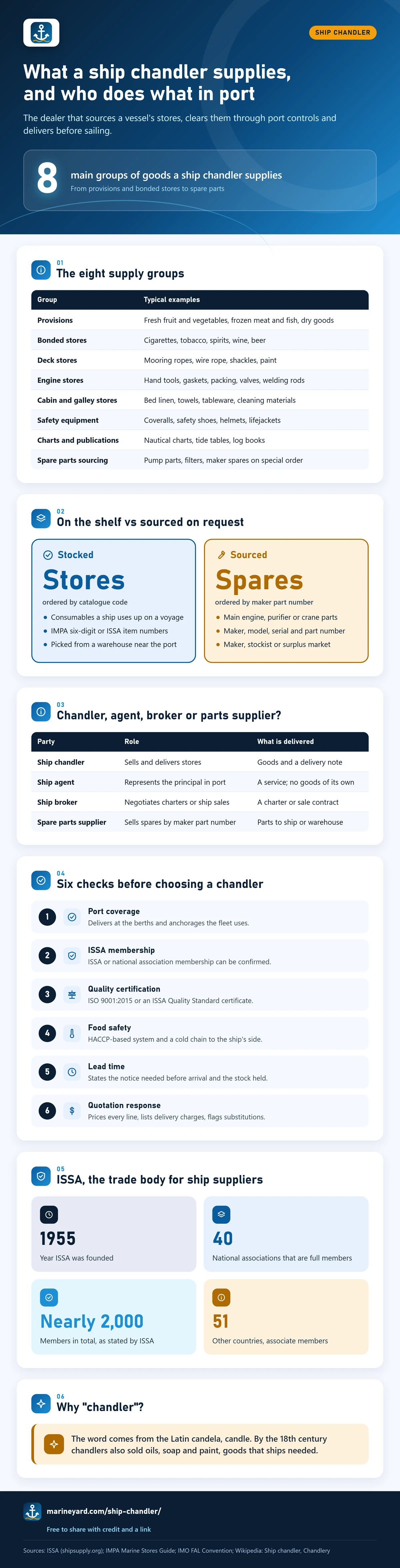
A ship chandler supplies eight main groups of goods: provisions, bonded stores, deck stores, engine stores, cabin stores, safety equipment, charts and publications, and sourced spare parts. Most groups are consumables that a ship uses up during a voyage and replaces at a later port.
| Category | What it covers | Typical examples |
|---|---|---|
| Provisions | Food and drink for the crew | Fresh fruit and vegetables, frozen meat and fish, dry goods, dairy, drinking water |
| Bonded stores | Dutiable goods supplied free of duty | Cigarettes, tobacco, spirits, wine, beer |
| Deck stores | Consumables for deck work and mooring | Mooring ropes, wire rope, shackles, paint, brushes, chipping tools, rags |
| Engine stores | Consumables for the engine room | Hand tools, gaskets, packing, valves, pipe fittings, welding rods, bearings, chemicals |
| Cabin and galley stores | Accommodation and catering items | Bed linen, towels, tableware, galley utensils, cleaning materials, stationery |
| Safety equipment | Personal protection and replaceable safety items | Coveralls, safety shoes, helmets, gloves, lifejackets, pyrotechnics, fire hoses |
| Charts and publications | Navigation and regulatory documents | Nautical charts, tide tables, IMO publications, log books |
| Spare parts sourcing | Parts bought on request from a third party | Pump parts, filters, electrical components, maker spares on special order |
Buyers that need larger items can compare listings for safety and lifesaving equipment before asking a chandler to deliver.
What does a ship chandler usually not stock?
A ship chandler usually does not stock maker-specific machinery spares. Parts for a main engine, an auxiliary engine, a purifier, a compressor or a crane are identified by the maker's part number and drawing. These parts come from the original maker, an authorised stockist or the second-hand and surplus market.
A chandler can still act as a buying channel for these parts. A liner for a stern tube seal or a winch brake band for deck machinery are examples of sourced items, not shelf items. The enquiry needs the maker, the model, the serial number and the part number from the instruction manual.
How does ship supply work from requisition to delivery?
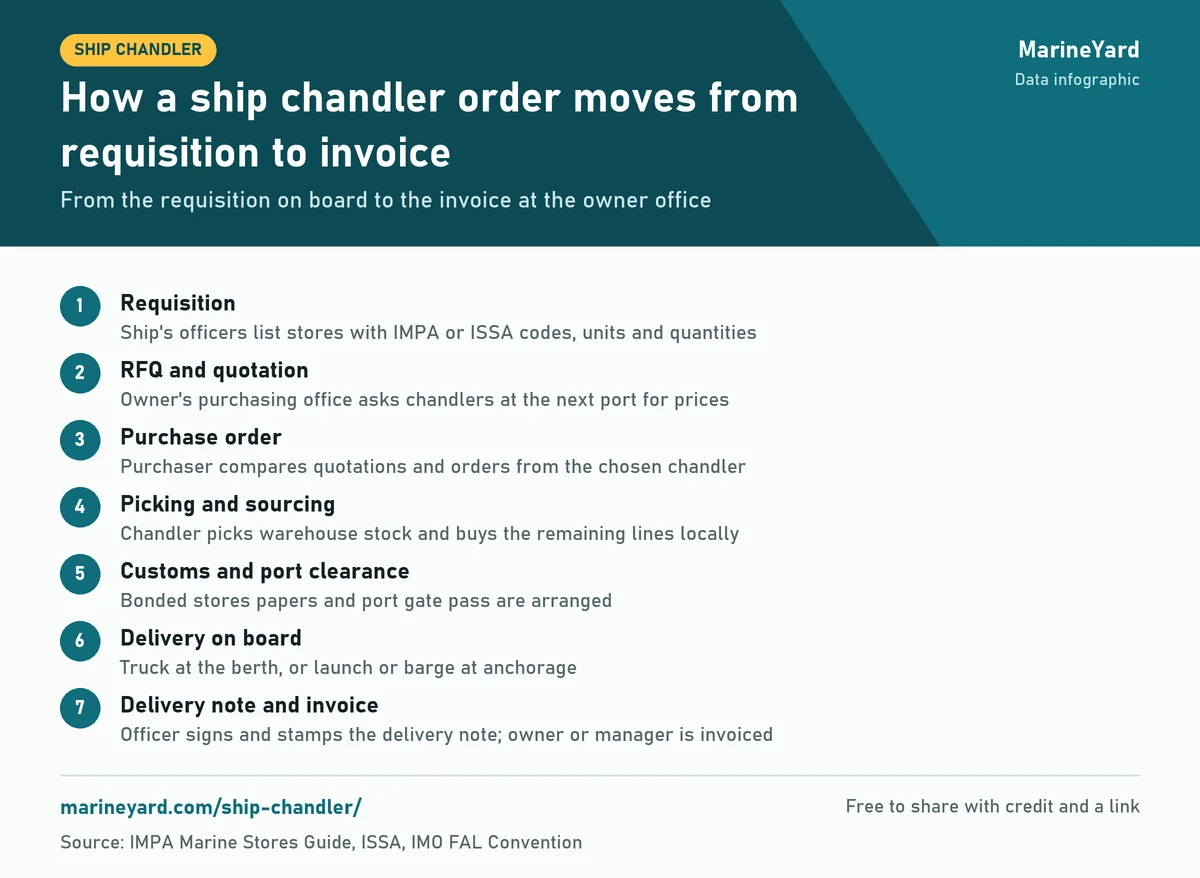
Ship supply works as a chain of eight steps that starts with a requisition on board and ends with an invoice to the owner. The ship's officers list the needed items, the purchasing office asks chandlers for prices, and the chosen chandler delivers at the next port call.
- Requisition. The chief officer, chief engineer and cook list the stores needed. Each line shows a catalogue code, a unit and a quantity.
- Request for quotation (RFQ). The owner's or manager's purchasing office sends the requisition to one or more chandlers at the next port.
- Quotation. Each chandler prices every line. The quotation states the currency, the delivery charges, the validity period and any lines that cannot be supplied.
- Purchase order. The purchaser compares the quotations and sends a purchase order to the chosen chandler.
- Picking and sourcing. The chandler picks stock items from the warehouse and buys the other items locally.
- Customs and port clearance. The chandler prepares the customs papers for bonded stores and arranges a gate pass or port security clearance for the vehicle.
- Delivery. A truck delivers alongside when the ship is at a berth. A launch or supply barge delivers when the ship is at anchor.
- Delivery note and invoice. A ship's officer checks the goods against the order, then signs and stamps the delivery note. The chandler sends the invoice with the signed delivery note to the owner or manager.
The crew should note shortages, damaged items and substitutions on the delivery note before signing.
What are bonded stores and duty-free ship supply?
Bonded stores are dutiable goods, mainly alcohol and tobacco, that a ship receives without payment of customs and excise duty. Bonded stores stay under customs control from the bonded warehouse to the ship. The duty relief applies because the goods are consumed outside the country, on a ship that sails to a foreign port.
The rules differ by country. In the United Kingdom, the law defines stores as "goods for use in a ship or aircraft", and HMRC Excise Notice 69A allows duty-free stores for ships that leave for a port outside the UK. The notice requires the goods to stay under lock and key on board in port. Other customs authorities set their own conditions, forms and limits.
The ship declares its stores to customs on arrival. The IMO FAL Convention provides a standard document for this purpose, FAL Form 3, the Ship's Stores Declaration.
Which codes are used on a ship stores requisition?
Ship stores requisitions use two catalogue systems: the IMPA Marine Stores Guide and the ISSA Ship Stores Catalogue. Both catalogues give each standard item a number, a description and a picture. A coded line tells the chandler exactly which item the ship needs, in any language and at any port.
- IMPA Marine Stores Guide. The Marine Stores Guide was first published in 1978 and is now in its eighth edition. The guide holds more than 50,000 items, each with a unique six-digit number. The IMPA code article explains the structure of that number.
- ISSA Ship Stores Catalogue. ISSA publishes this catalogue with its own item numbering system and photographs of the items. ISSA also publishes a separate Provisions and Bonded Stores Catalogue.
Maker spare parts are outside both catalogues. A requisition for maker spares uses the maker's part number.
How is a ship chandler paid?
A ship chandler is paid by the ship owner or the ship manager after delivery, against an invoice supported by the signed delivery note. Most regular customers buy on a credit account. The credit account removes the need for cash and currency exchange on board.
The price of an order has two parts: the unit price of each line and the delivery cost. Delivery cost can include truck transport, launch or barge hire for anchorage delivery, port entry fees, customs documentation and overtime for night or weekend delivery. A quotation should show these charges separately.
ISSA publishes the ISSA Conditions of Sale as a standard basis for supply contracts between a ship supplier and a buyer.
What is the difference between a ship chandler, a ship agent, a ship broker and a spare parts supplier?
A ship chandler sells and delivers goods, while a ship agent and a ship broker sell services. A ship agent represents the owner or charterer during a port call. A ship broker negotiates charters or ship sales. A spare parts supplier sells maker-specific machinery parts. The table compares the four roles.
| Party | Role | Who pays | What is delivered |
|---|---|---|---|
| Ship chandler | Sells and delivers stores and provisions to the ship | Owner or manager, per invoice | Physical goods on board with a delivery note |
| Ship agent | Represents the principal in port: berth, pilot, tugs, customs and port documents | Owner or charterer, as an agency fee plus port costs | A service; no goods of its own |
| Ship broker | Negotiates between owners and charterers, or between buyers and sellers of ships | The principals to the deal, normally as a commission | A concluded charter or sale contract |
| Spare parts supplier | Sells machinery spares by maker part number: new, reconditioned or used | Owner or manager, per invoice | Parts sent to the ship, an agent or a warehouse |
The roles meet in port. A shipping agency can arrange fresh water and provisions for the ship, but the agent normally orders them from a chandler.
How do you choose a ship chandler?
A ship chandler is chosen on six checkable criteria: port coverage, trade membership, quality certification, food safety, lead time and quotation quality. A purchaser can verify each criterion from documents before the first order. Price alone is a weak test of a supplier.
- Port coverage. The chandler should deliver at the berths and anchorages the fleet uses.
- ISSA membership. Membership of ISSA or a national association can be confirmed with the association.
- Quality certification. An ISO 9001:2015 certificate or an ISSA Quality Standard certificate shows an audited quality system.
- Food safety. A provisions supplier should show a HACCP-based food safety system and a temperature-controlled cold chain to the ship's side.
- Lead time. The chandler should state the notice needed before arrival and the items held in stock.
- Quotation response. A good quotation prices every line, lists delivery charges and flags substitutions.
Which trade bodies represent ship chandlers?
The International Shipsuppliers and Services Association (ISSA) represents ship chandlers worldwide. ISSA states that the association was founded in 1955, has 40 national associations as full members and has nearly 2,000 members in total. Suppliers in 51 other countries join as associate members.
The ISSA Quality Standard sets a minimum benchmark for ship supply companies. A company with an ISO 9001:2015 certificate obtains the ISSA certificate after ISSA verifies the ISO certificate. A company without ISO 9001 is audited by the ISSA Quality Manager.
The buyer side has a separate body. The International Marine Purchasing Association (IMPA) was founded in 1978 and has more than 1,000 purchaser and supplier members in over 90 countries.
Where can ship chandlers buy and sell ship spare parts online?
Ship chandlers and surplus dealers can list and find maker spares and equipment on MarineYard, a worldwide ship spare parts marketplace. A chandler can source a machinery part there or sell surplus stock. Each seller account includes 9 free listings, and paid plans start at $4.99 a month. MarineYard takes no commission and is a listing platform, not a party to any sale.
Frequently Asked Questions
Is a ship chandler the same as a ship supplier?
Ship chandler and ship supplier mean the same business. "Ship chandler" is the traditional name, and "ship supplier" is the term used by ISSA, the International Shipsuppliers and Services Association. Both terms describe a dealer that delivers provisions, stores and equipment to vessels in port.
Why is a ship supplier called a chandler?
A chandler was originally a candle maker or candle seller, from the Latin "candela" for candle. By the 18th century chandlers also sold oils, soap and paint. Ships bought these goods, so the dealers near ports became known as ship chandlers.
Who pays the ship chandler, the master or the owner?
The ship owner or the ship manager pays the ship chandler. The master or another officer only signs the delivery note to confirm receipt. The chandler then invoices the owner's office, usually on a credit account, so no cash changes hands on board.
Can a ship chandler deliver to a ship at anchor?
A ship chandler can deliver to a ship at anchor by launch or supply barge where the port allows it. Anchorage delivery adds boat hire to the cost and depends on weather and port permission. The quotation should show the launch charge as a separate line.
What is the difference between IMPA and ISSA?
IMPA is the International Marine Purchasing Association, founded in 1978, and its Marine Stores Guide uses six-digit item codes. ISSA is the association of ship suppliers, founded in 1955, and publishes the ISSA Ship Stores Catalogue. Many chandlers accept codes from both catalogues.
Does a ship chandler supply engine spare parts?
A ship chandler supplies general engine stores such as gaskets, packing, tools and fittings from stock. Maker-specific engine spares are normally not stocked. The chandler sources these parts on request from the maker, a stockist or the second-hand and surplus market.
Related guides
- Stern tube: parts, bearings, seals and lubrication
- IMPA code: meaning and structure
- Oily water separator: working, parts and the 15 ppm rule
- Marine turbocharger: parts, working and surging
- Purifier in ship: working principle, parts and faults
Sources
- Wikipedia: Ship chandler
- Wikipedia: Chandlery
- Wiktionary: chandler (etymology)
- ISSA: About the International Shipsuppliers and Services Association (shipsupply.org)
- ISSA: Quality Standard (shipsupply.org)
- IMPA Marine Stores Guide: About
- IMPA: About
- HMRC: Excise Notice 69A, duty-free ship's stores
- IMO: Convention on Facilitation of International Maritime Traffic (FAL)
- Wikipedia: Shipping agency
Sign in to leave a comment and join the discussion.
 Ship Machinery
A purifier in a ship is a centrifugal separator that removes water and solid particles from fuel oil and lubricating oil. The purifier spins the oil in a...
 Ship Machinery
A marine turbocharger is an exhaust-driven air compressor fitted to a ship's diesel or dual-fuel engine. The exhaust gas turns a turbine, and the turbine...
 Ship Machinery
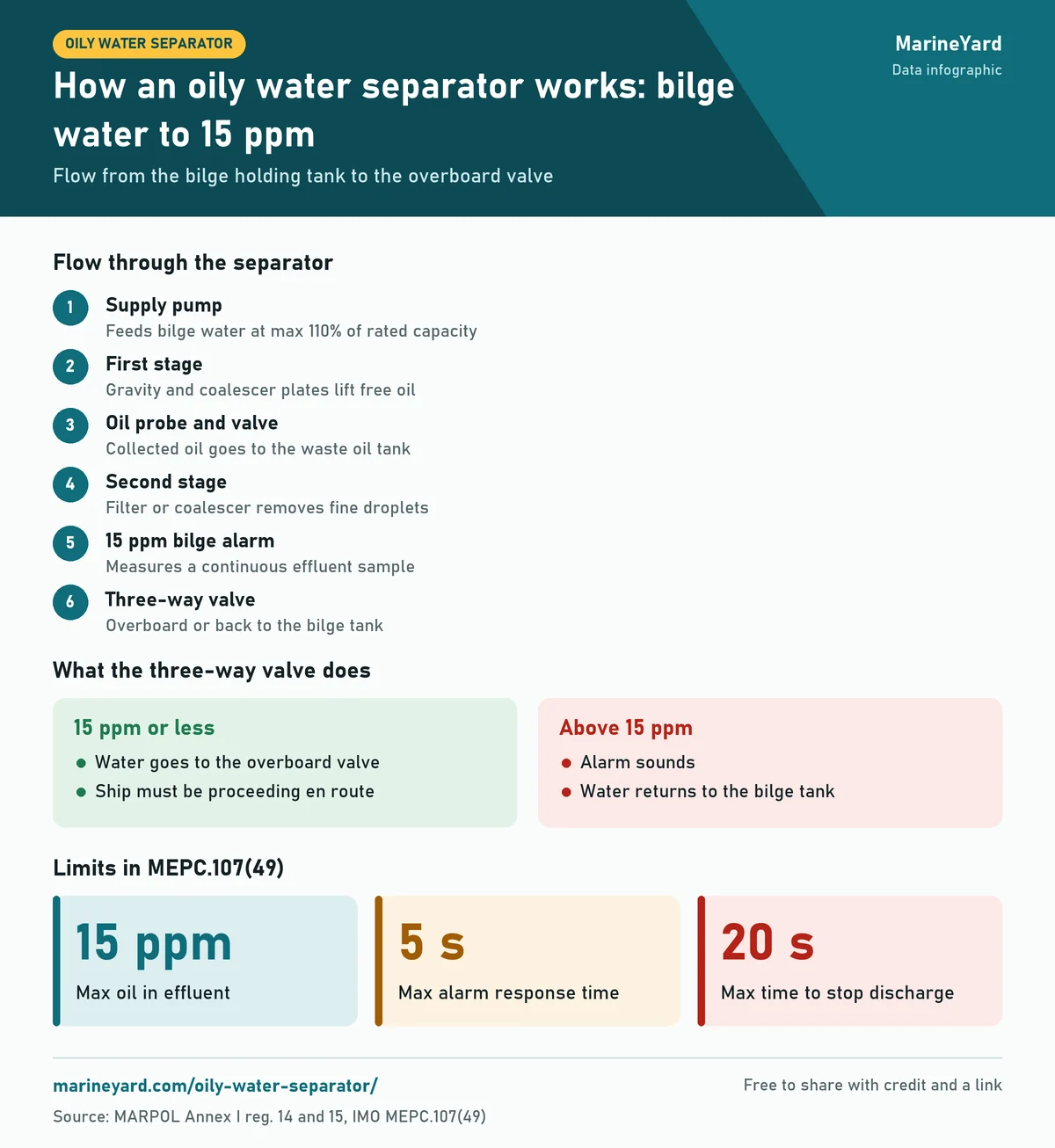
An oily water separator (OWS) is the machine on a ship that removes oil from machinery space bilge water before the water is pumped overboard. The oily...