Windlass on a Ship: Parts, Working, Types and Brake Rules
Marine engineers & industry writers
Updated
Nov 19, 2026
A windlass is the deck machine on a ship that heaves up, lowers and holds the anchor and its chain cable. The windlass stands on the forecastle deck. A notched wheel called the cable lifter grips the chain links. A band brake controls the chain while the anchor runs out.
IACS Unified Requirement A3 sets the class rules for the pull, the hoisting speed and the brake capacity of an anchor windlass. The word windlass also names a simple hand-cranked lifting machine, such as the well windlass that winds a bucket rope on a horizontal barrel.
Key facts
| Attribute | Value |
|---|---|
| Location | Forecastle deck, above the chain locker and aft of the hawse pipes |
| Class rule | IACS UR A3, Anchor Windlass Design and Testing (June 2017, Rev.1 June 2019) |
| Continuous duty pull | 37.5d², 42.5d² or 47.5d² newtons for chain grade 1, 2 or 3 (d = chain diameter in mm), held for at least 30 minutes |
| Overload pull | At least 1.5 times the continuous duty pull for at least 2 minutes |
| Mean hoisting speed | At least 0.15 m/s (9 m/min) |
| Design anchorage depth | Down to 82.5 m, equal to three shots of chain (45 fathoms) |
| Brake capacity | 80% of the chain breaking strength without a chain stopper, 45% with a chain stopper |
| Chain stopper strength | 80% of the chain breaking strength without permanent deformation |
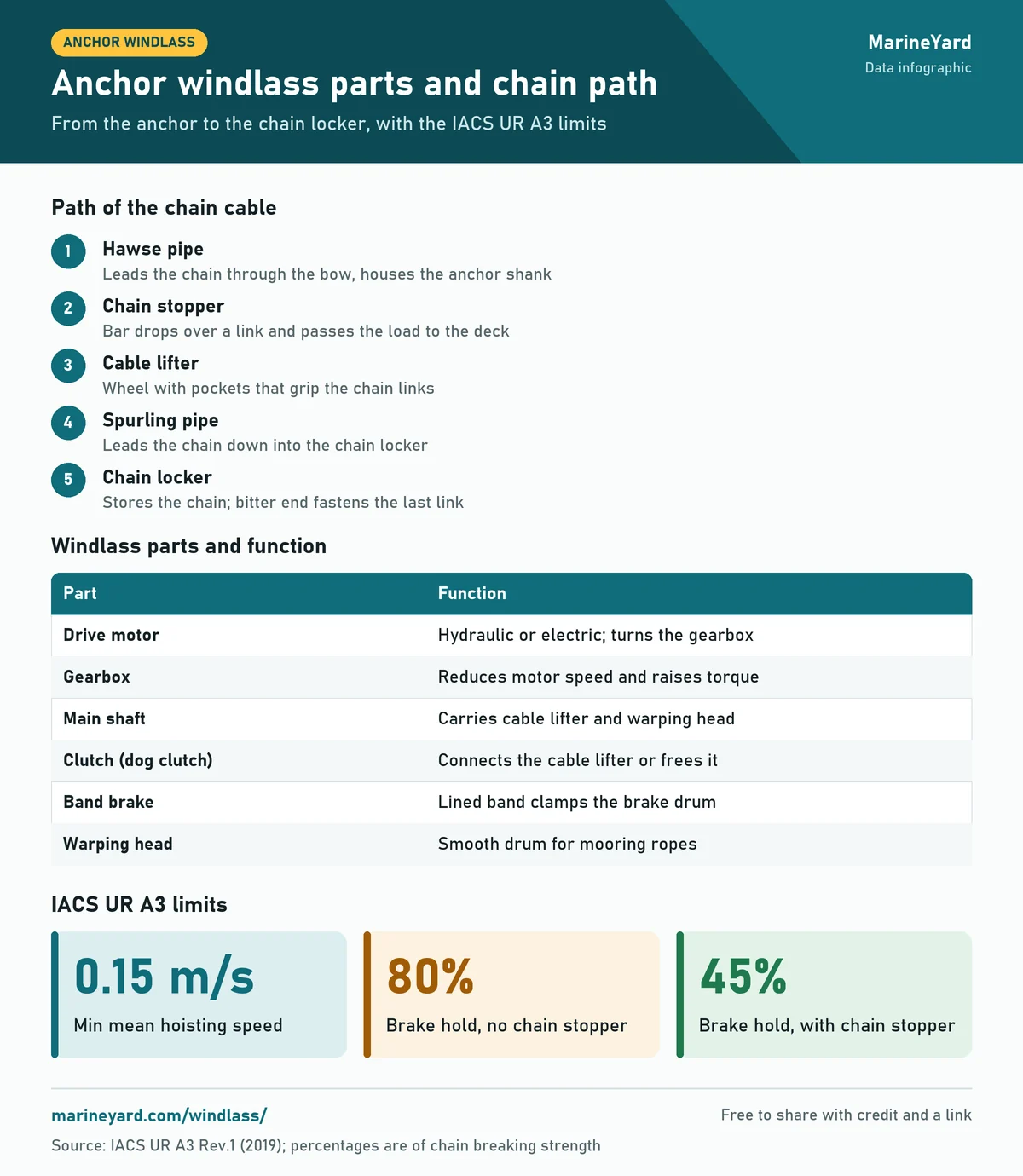
What is a windlass on a ship?
A windlass on a ship is the machine that handles the anchor chain between the hawse pipe and the chain locker. The windlass pays the chain out under control, holds the chain with a brake and heaves the anchor back on board.
IACS UR A1 on anchoring equipment states that the equipment is intended for temporary mooring in a harbour or sheltered area, not for holding a ship off an exposed coast in rough weather.
What are the parts of an anchor windlass?
The parts of an anchor windlass are a drive motor, a gearbox, a main shaft, a cable lifter, a clutch, a band brake and a control stand. The anchoring system around the windlass adds a chain stopper, a hawse pipe, a spurling pipe and a chain locker with the bitter end fastening.
| Part | Function |
|---|---|
| Cable lifter (gypsy, wildcat) | Wheel with pockets that grip the chain links |
| Main shaft | Carries the cable lifter, warping head and any mooring drum |
| Gearbox | Reduces motor speed and raises torque |
| Clutch (dog clutch) | Connects the cable lifter to the shaft or frees it |
| Band brake and brake lining | Lined steel band that clamps the brake drum of the cable lifter |
| Chain stopper (bow stopper, guillotine) | Bar that drops over a link and passes the chain load to the deck |
| Hawse pipe | Leads the chain through the bow and houses the anchor shank |
| Spurling pipe | Leads the chain down into the chain locker |
| Chain locker and bitter end | Stores the chain; the bitter end fastens the last link to the ship |
| Warping head (drum end) | Smooth drum on the shaft end for hauling mooring ropes |
| Mooring drum | Rope drum on a combined windlass and mooring winch |
| Drive motor | Hydraulic or electric motor that turns the gearbox |
| Control stand | Lever for heave, lower and speed |
Gypsy is the UK term for the cable lifter and wildcat is the North American term. The ribs between the pockets are called whelps. The Wikipedia article on the anchor windlass notes that a wheel that does not match the chain pitch wears and can let the chain jump during pay-out.
What are the types of windlass?
The types of windlass are grouped by shaft position, by layout and by drive. A horizontal-shaft windlass has the cable lifter beside the gearbox on deck. A vertical-shaft unit is an anchor capstan. A combined unit adds mooring drums. The drive is electro-hydraulic, electric or, on old ships, steam.
| Group | Type | Arrangement |
|---|---|---|
| Shaft | Horizontal shaft | Motor, gearbox and cable lifter above deck; one unit can serve two anchors |
| Shaft | Vertical shaft (anchor capstan) | Cable lifter on deck; motor and gearbox usually below deck |
| Layout | Single windlass | One cable lifter with its own drive |
| Layout | Combined windlass and mooring winch | Cable lifter, mooring drums and warping head on one drive |
| Drive | Electro-hydraulic | Pump unit feeds a hydraulic motor at 64 bar (low pressure) or 250 bar (high pressure) |
| Drive | Electric | Pole-changing motor, or a motor with a frequency converter for stepless speed |
| Drive | Steam | Steam engine on the windlass; old ships only |
A steam windlass took steam from the ship boiler. The Kongsberg Maritime page on modular anchor and mooring winches gives the two hydraulic pressures.
How does a windlass work?
A windlass works by turning a cable lifter that grips the chain links. The motor drives the main shaft through the gearbox. The clutch connects the cable lifter to the shaft for heaving and for lowering under power. The band brake controls the cable lifter when the clutch is out.
Letting go the anchor on the brake
- The crew starts the drive and engages the clutch with the brake applied.
- The crew takes the load on the gear, releases the brake and opens the chain stopper.
- The motor walks the anchor out until it is clear of the hawse pipe.
- The crew applies the brake and disengages the clutch.
- The operator releases the brake on the order from the bridge, and the weight of the anchor pulls the chain out.
- The operator tightens the brake when the ordered length is out, and the crew lowers the chain stopper bar.
Walking out under power
Walking out means that the clutch stays engaged and the motor lowers the anchor to the seabed. The motor limits the chain speed. A Washington State deep water anchoring bulletin cites one seamanship text that advises walking out in depths of 70 to 90 m and another that advises it in any depth over 40 m.
Heaving up the anchor
- The crew engages the clutch, takes the load on the gear, releases the brake and opens the chain stopper.
- The bridge uses the main engine to relieve the tension in the chain.
- The cable lifter heaves the chain, which drops through the spurling pipe into the chain locker.
- The operator stops heaving and applies the brake if the chain comes under heavy tension.
- The crew houses the anchor, applies the brake, closes the chain stopper and fits the lashings.
The brake holds the cable lifter against rotation. The chain stopper holds the chain itself and passes the load into the deck. The INTERTANKO anchoring guidelines state that the chain stopper is not the primary securing arrangement at sea.
What is the difference between a windlass, a winch and a capstan?
A windlass, a winch and a capstan differ in shaft position and in the line each machine handles. A windlass has a horizontal shaft and grips anchor chain. A winch winds wire or rope on a drum and stores it. A capstan has a vertical shaft and hauls rope by friction.
| Feature | Windlass | Winch | Capstan |
|---|---|---|---|
| Shaft | Horizontal | Horizontal | Vertical |
| Line handled | Anchor chain cable | Wire or fibre rope | Rope; chain if a cable lifter is fitted |
| Gripping element | Cable lifter with pockets | Drum | Barrel with turns of rope |
| Storage of the line | None; chain falls into the chain locker | On the drum | None |
| Main use | Anchoring | Mooring, towing, cargo work | Warping; anchoring on smaller vessels |
What does IACS UR A3 require for an anchor windlass?
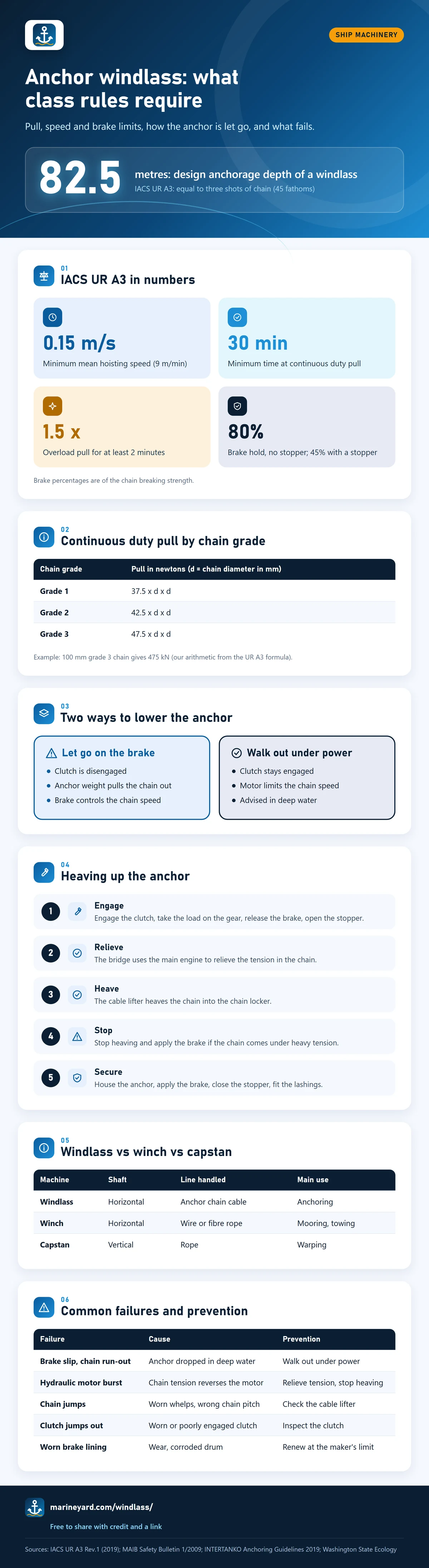
IACS UR A3 requires an anchor windlass to deliver a continuous duty pull for at least 30 minutes, an overload pull of 1.5 times that value for at least 2 minutes, and a mean hoisting speed of at least 0.15 m/s. UR A3 also sets the brake capacity and the chain stopper strength.
- Continuous duty pull. The pull is 37.5d² N for grade 1 chain, 42.5d² N for grade 2 and 47.5d² N for grade 3, with d in mm. The figures apply to anchorage depths down to 82.5 m.
- Deeper anchorage. The pull rises by (D - 82.5) × 0.27d² N, where D is the anchorage depth in metres.
- Hoisting speed. The test measures the speed over two shots of chain, starting with at least three shots (82.5 m) out and the anchor hanging free.
- Brake. The brake stops the anchor and chain during pay-out. The brake withstands 80% of the chain breaking strength without slip, or 45% where a chain stopper is fitted. The stopper itself withstands 80%.
- Marking. The windlass is marked with the chain size, for example 100/3/45, and the maximum anchorage depth in metres.
A 100 mm grade 3 chain gives a continuous duty pull of 47.5 × 100² = 475,000 N (475 kN) and an overload pull of 712.5 kN. The text of IACS UR A3 Rev.1 applies where the application for certification, or the shipbuilding contract, is dated on or after 1 July 2020.
How is a windlass brake tested?
A windlass brake is tested first at the maker's works and then on board. UR A3 requires the maker to verify the holding power of the brake by test or by calculation. The on-board test pays out the chain in steps and stops it with the brake each time.
In service, the brake loses holding power as the lining wears and the drum corrodes. The INTERTANKO anchoring guidelines list brake band thickness, the drum surface and a periodic test of the brake holding capacity as planned maintenance items. The windlass maker sets the minimum lining thickness and the test method.
What are common windlass failures?
Common windlass failures are brake slip with a chain run-out, a burst hydraulic motor, a worn cable lifter, a clutch that jumps out and a worn brake lining. The reported cases happened in deep water or in bad weather, when the chain load exceeded the load the windlass was designed for.
| Failure | Cause | Sign | Prevention |
|---|---|---|---|
| Brake slip and chain run-out | Anchor dropped on the brake in deep water, for example 125 m; worn or badly adjusted brake | Brake has no effect | Walk out under power |
| Hydraulic motor burst | Chain tension turns the motor backwards while it is set to heave; overspeed and over-pressure | Chain pays out with the lever at heave | Relieve tension with the main engine; stop heaving; apply the brake |
| Chain jumps on the cable lifter | Worn whelps; wrong chain pitch | Chain slips over the wheel | Check the cable lifter for wear |
| Clutch jumps out | Worn or poorly engaged clutch | Cable lifter runs free | Inspect the clutch |
| Worn brake lining | Wear; corroded drum; wrong adjustment | Full brake force not reached | Renew at the maker's limit |
MAIB Safety Bulletin 1/2009 describes four failures of high pressure hydraulic windlass motors between 2007 and 2009. On the tanker Stellar Voyager, on 23 March 2009, the motor casing shattered and threw debris as far as 40 m. UR A3 now requires a protection system that limits the speed and torque at the prime mover.
What maintenance does a windlass need?
Windlass maintenance consists of greasing, brake lining and drum checks, gearbox and hydraulic oil checks, and inspection of the clutch, cable lifter and chain stopper. The maker's manual sets the intervals. The INTERTANKO guidelines list the routine inspection items below.
- Greasing. The crew greases all grease points as the maker recommends.
- Brake. The crew measures the lining, checks the drum for corrosion and adjusts the band. The guidelines give an ideal gap of 1 to 2 mm at the band support adjusting screw.
- Gearbox and hydraulics. The crew checks the oil levels, looks for leaks, listens for abnormal gear noise and samples the hydraulic oil.
- Clutch, cable lifter and stopper. The crew checks the clutch, the wear of the cable lifter pockets, and the stopper bar, hinge and securing pin.
What is a windlass on a small boat?
A windlass on a small boat is a compact electric, hydraulic or manual unit that handles an anchor rode of chain, rope or both. Some small-craft windlasses use one drum for chain and rope. Smaller boats often use a vertical capstan type.
Who makes ship windlasses?
Ship windlasses are made by deck machinery companies that also build mooring winches. MacGregor deck machinery covers the Hatlapa, Pusnes and TTS brands, with electric units for 62 to 147 mm stud link chain. Kongsberg Maritime builds modular anchor and mooring winches with cable lifters, mooring drums and warping heads.
Which windlass spare parts are ordered most often?
Windlass spare parts ordered most often are brake linings and brake bands, hydraulic motor and pump parts, seals, clutch parts, bearings, gears and cable lifters. Brake linings are wear parts. A cable lifter is ordered when the pockets are worn.
A correct order states the following data:
- Ship name and IMO number.
- Maker, type and serial number of the windlass, from the nameplate.
- Chain cable diameter and grade, as in the marking 100/3/45.
- Drive type, with the motor or pump model.
- Drawing number and part number from the manual.
Grease, bolts and other general consumables may carry an IMPA code and can come from a ship chandler. Brake linings, clutch parts and motor parts are ordered by the maker's part number.
Where can windlass parts be bought or sold?
Windlass parts are bought from makers, service companies and surplus stockists. MarineYard is a ship spare parts marketplace where sellers list new, reconditioned and used deck machinery and cranes and pumps and hydraulics. Sellers get 9 free listings per account. MarineYard takes no commission and is not a party to any sale. Buyers should confirm the maker, type, serial number and chain size with the seller before payment.
Frequently Asked Questions
What is the gypsy on a windlass?
The gypsy on a windlass is the wheel with pockets that grips the links of the anchor chain. Gypsy is the UK term and wildcat is the North American term. Class rules call the same part the cable lifter.
What is the minimum hoisting speed of an anchor windlass?
The minimum mean hoisting speed of an anchor windlass is 0.15 m/s, which equals 9 m/min. IACS UR A3 sets this figure. The speed test starts with at least three shots (82.5 m) of chain out and the anchor hanging free.
How deep can a ship anchor with a standard windlass?
A standard windlass is designed for an anchorage depth down to 82.5 m, which equals three shots of chain. IACS UR A3 requires a higher pull for deeper water. The maximum anchorage depth is marked on the windlass.
What does 100/3/45 mean on a windlass?
The marking 100/3/45 on a windlass means a chain cable of 100 mm diameter, IACS grade 3, and a holding load of 45% of the chain breaking load. IACS UR A3 requires this permanent marking.
Why do hydraulic windlass motors explode?
Hydraulic windlass motors explode when heavy chain tension drives the motor backwards while the control is set to heave. The pressure inside the motor rises until the casing breaks. MAIB Safety Bulletin 1/2009 links the failures to heaving in bad weather.
Should a ship let go or walk out the anchor in deep water?
A ship should walk out the anchor under power in deep water. Seamanship texts cited by Washington State advise walking out in depths over 40 m, or in depths of 70 to 90 m.
Related guides
- Stern tube: parts, bearings, seals and lubrication
- IMPA code: meaning and structure
- Ship chandler: meaning and services
- Oily water separator: working, parts and the 15 ppm rule
- Marine turbocharger: parts, working and surging
- Purifier in ship: working principle, parts and faults
- Cylinder liner: function, wear and gauging
- Ship boiler: types, mountings and water treatment
Sources
- IACS UR A3 Rev.1 (June 2019), Anchor Windlass Design and Testing (copy published by Türk Loydu)
- IACS UR A1 Rev.7 Corr.1 (2021), Anchoring Equipment (copy published by ABS)
- UK MAIB, Safety Bulletin 1/2009, Catastrophic Failure of High Pressure Hydraulic Anchor Windlasses
- INTERTANKO, Anchoring Guidelines: A Risk-Based Approach (2019)
- Washington State Department of Ecology, Safety Advisory Bulletin: Deep Water Anchoring
- Kongsberg Maritime, Modular anchor and mooring winches for merchant vessels
- MacGregor, Deck machinery
- Wikipedia, Anchor windlass
Sign in to leave a comment and join the discussion.
 Ship Machinery
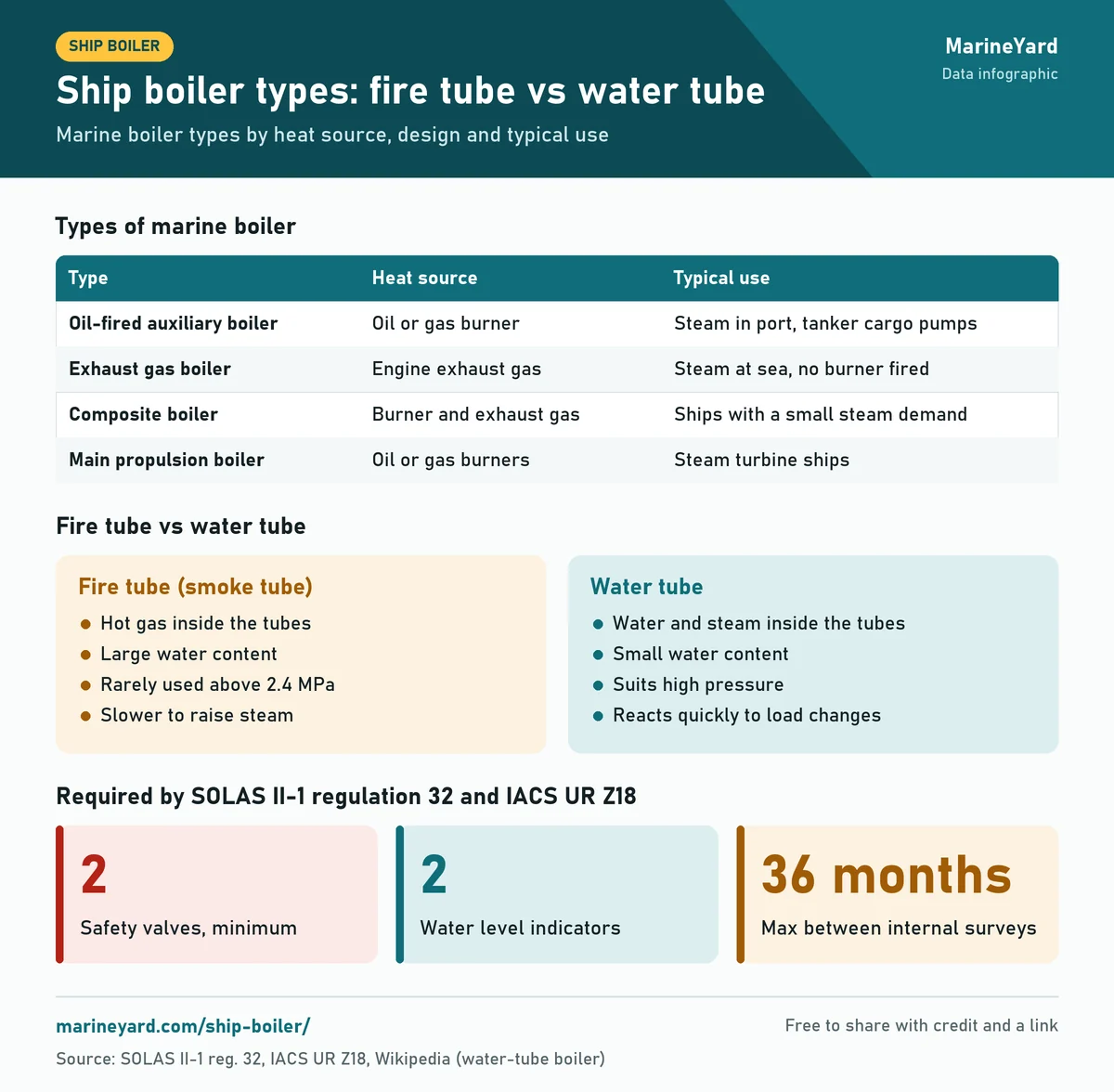
A ship boiler is a closed pressure vessel that turns feed water into steam with heat from an oil or gas burner, from engine exhaust gas, or from both. A...
 Ship Machinery
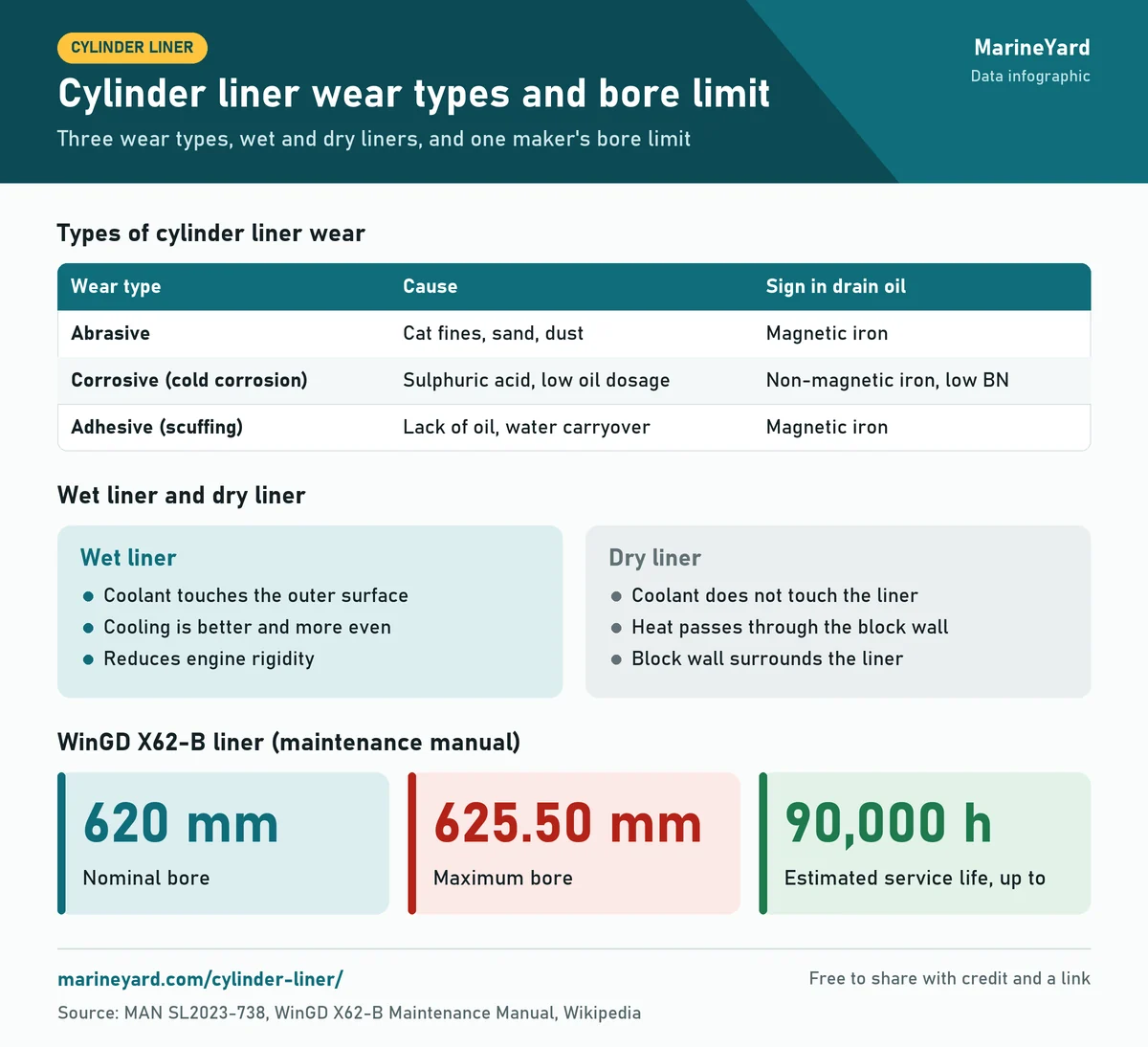
A cylinder liner is the replaceable cylindrical sleeve that forms the wall of an engine cylinder. The cylinder liner closes the side of the combustion...
 Ship Machinery
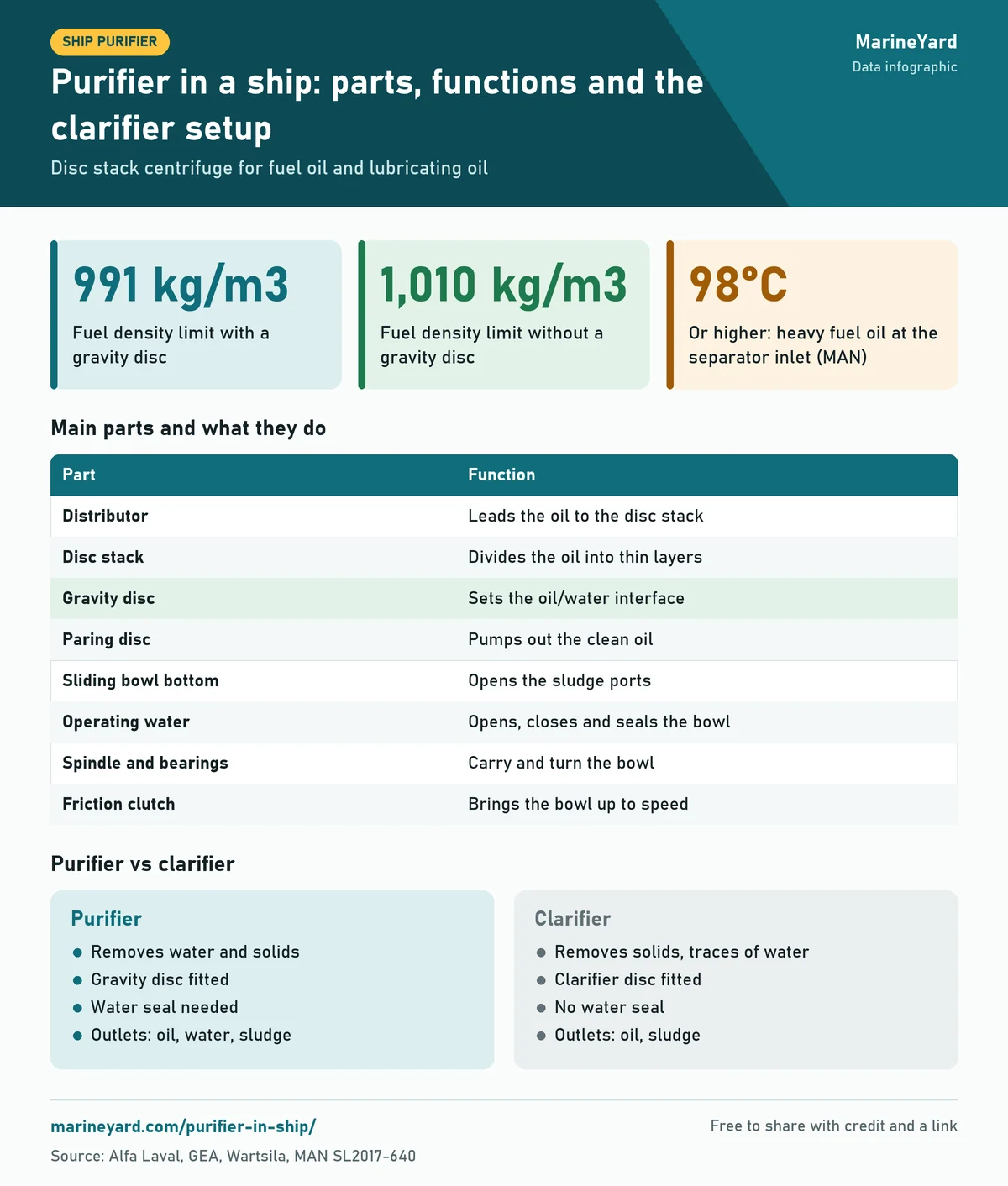
A purifier in a ship is a centrifugal separator that removes water and solid particles from fuel oil and lubricating oil. The purifier spins the oil in a...