IMPA Code: Meaning, Structure and How to Use It on an RFQ
Marine engineers & industry writers
Updated
Nov 18, 2026
An IMPA code is a six-digit number that identifies one item of ship stores in the Marine Stores Guide, the catalogue published by the International Marine Purchasing Association (IMPA). Ship purchasers and suppliers quote the code on requisitions, requests for quotation and purchase orders so that both sides refer to the same product description.
The Marine Stores Guide lists over 50,000 codes. The codes cover consumable stores and general equipment such as tableware, rope, paint, hand tools and safety gear. The codes do not replace the maker part number that is needed for engine and machinery spare parts.
Key facts
| Attribute | Value |
|---|---|
| Issuer | International Marine Purchasing Association (IMPA), founded in 1978 |
| IMPA office | Colchester, Essex, United Kingdom |
| Code length | 6 digits, format unchanged for over 40 years (source: Marine Stores Guide) |
| Catalogue | Marine Stores Guide (MSG), first published in 1978 |
| Current printed edition | 8th edition; the 7th edition was published in 2018 |
| Number of codes | Over 50,000 unique six-digit codes |
| Product categories | 34 categories, from clothing to machinery (source: MSG FAQ) |
| Data updates | Every 6 months for data licence holders |
| Copyright | The six-digit code is copyright of Fuji Trading Co., Japan, and is published jointly with IMPA |
What is an IMPA code?
An IMPA code is a unique six-digit reference for one product description in the Marine Stores Guide. The code links a number to a fixed item description, so a purchaser in one country and a supplier in another country can identify the same item without relying on a free-text name or a local trade term.
An IMPA code identifies a generic product description, not a brand or a supplier. The industry also calls the numbers "MSG codes".
Who publishes the IMPA code and the Marine Stores Guide?
The International Marine Purchasing Association publishes the Marine Stores Guide together with Fuji Trading Co. of Japan. IMPA is a non-profit trade association for marine procurement that was founded in 1978 by senior purchasing executives. IMPA states that the association has more than 1,000 purchaser and supplier members in over 90 countries.
The original guide was first published in 1978. The Marine Stores Guide FAQ states that IMPA has been the joint publisher since 1993. The same source states that the printed guide is produced about every five years.
The IMPA association profile states that membership is open to ship owners, operators, managers, suppliers and manufacturers. The published office address is in Colchester, Essex, United Kingdom.
How is an IMPA code structured?
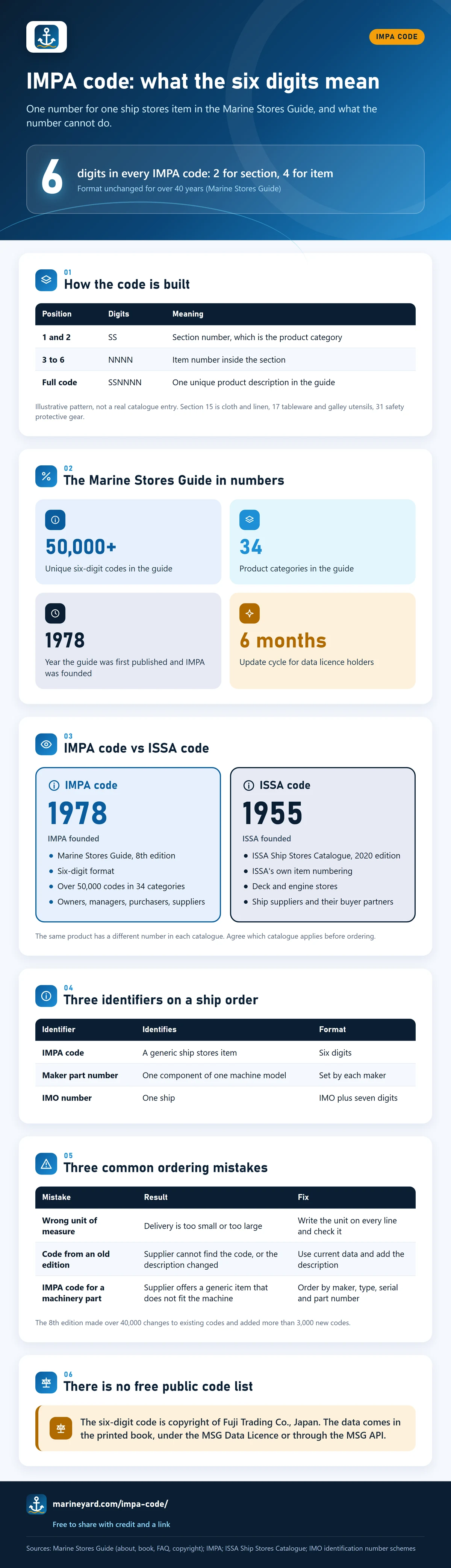
An IMPA code has six digits and is read from left to right. The first two digits give the section of the Marine Stores Guide, which is the product category. The remaining four digits identify the individual item inside that section. The code is written as one block or in pairs, for example in the pattern 00 00 00.
The pattern below is illustrative and does not show a real catalogue entry.
| Position | Digits | Meaning |
|---|---|---|
| 1 and 2 | SS | Section number, which is the product category |
| 3 to 6 | NNNN | Item number inside the section, tied to one description |
| Full code | SSNNNN | One unique product description in the guide |
Section 15 holds cloth and linen products. Section 17 holds tableware and galley utensils. Section 31 holds safety protective gear. Section 33 holds safety equipment. Section 37 holds nautical equipment.
What does the Marine Stores Guide cover?
The Marine Stores Guide covers ship stores and general equipment in 34 product categories. The publisher describes the range as running from tableware to welding equipment. The 8th edition added more than 3,000 new codes and made over 40,000 changes to existing codes compared with the 7th edition.
The publisher's page for the 8th edition book names categories that include cloth and linen products, tableware and galley utensils, clothing, rope and hawsers, rigging equipment, marine paint, painting equipment, safety protective gear, safety equipment, hose and couplings, nautical equipment and medicine.
How do you access IMPA codes?
IMPA codes are accessed in three ways: the printed Marine Stores Guide book, the MSG Data Licence and the MSG API. The book is sold through distributors. The data licence supplies the catalogue as Excel or CSV files for import into procurement software. The API gives live access to the data for platform developers.
Licence holders receive updates every six months. The publisher states that these updates remove obsolete items and add new items, and that the updates are available only in electronic form.
The data is licensed and protected by copyright. The Marine Stores Guide copyright notice states that the six-digit code remains the copyright of Fuji Trading Co., Japan. A separate Publisher Licence applies to suppliers and manufacturers that show the codes on a website or in a publication.
An "IMPA code list" or "IMPA code search" therefore requires a licensed source. IMPA licenses the data to software and catalogue providers.
How do you use an IMPA code in a requisition or RFQ?
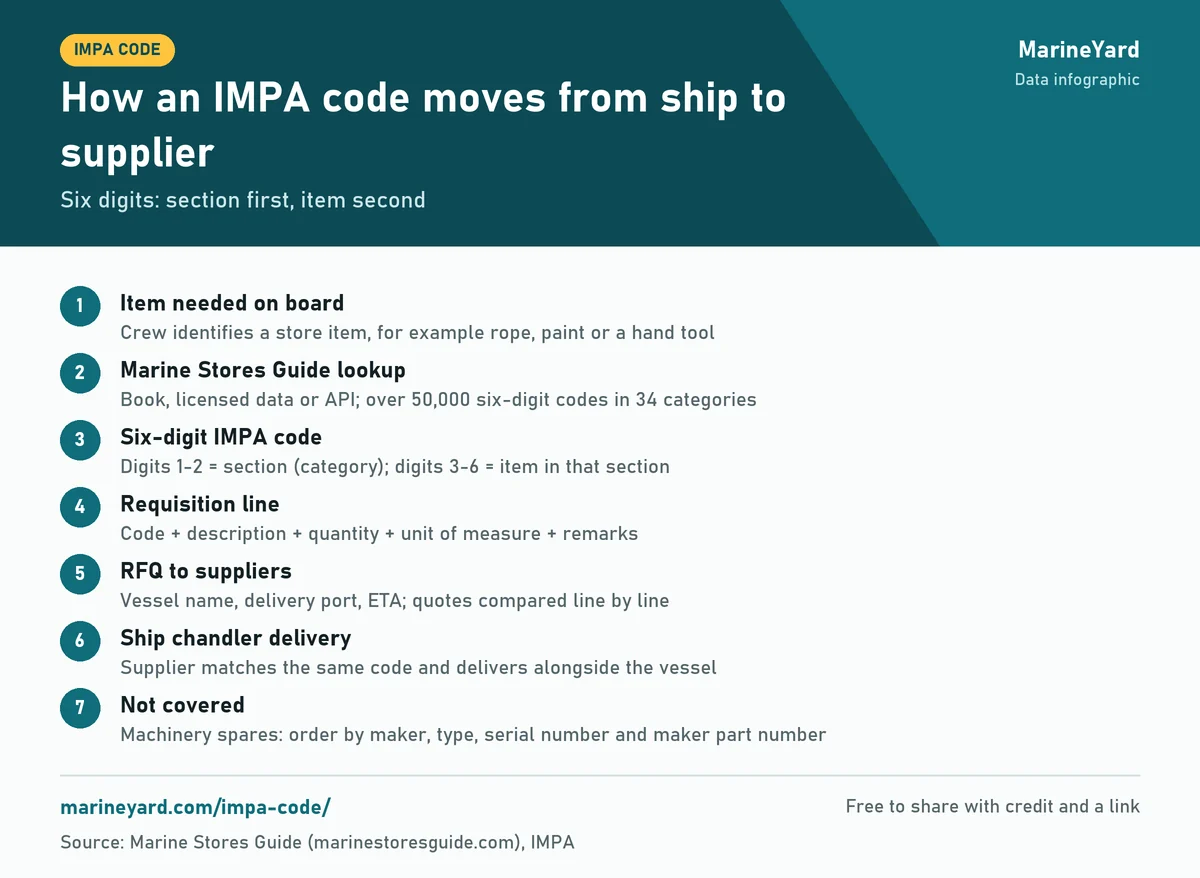
An IMPA code is used on a requisition or request for quotation as the item reference on each order line. The code is written next to the description, the quantity and the unit of measure. The supplier matches the code against the same catalogue and quotes a product that meets the catalogue description.
- Identify the item on board and find the item in the Marine Stores Guide book or in the licensed data inside the ship's procurement system.
- Check that the catalogue description matches the item needed, including size, material, rating and standard.
- Write the six-digit IMPA code on the order line.
- Add the short description from the catalogue next to the code. The description lets the supplier detect a mistyped digit.
- State the quantity and the unit of measure, for example piece, set, metre, litre, kilogram, roll or box.
- State the vessel name, the delivery port, the estimated time of arrival (ETA) and the estimated time of departure.
- Add any brand or certificate requirement as a remark, then send the RFQ and compare the quotes line by line.
A ship chandler usually receives the RFQ, quotes each line and delivers the goods alongside the vessel.
What is the difference between an IMPA code and an ISSA code?
An IMPA code and an ISSA code are item numbers from two different catalogues. IMPA is an association of marine purchasers and suppliers and issues the Marine Stores Guide. ISSA is the International Shipsuppliers & Services Association and issues the ISSA Ship Stores Catalogue. The same product has a different number in each catalogue.
| Attribute | IMPA code | ISSA code |
|---|---|---|
| Issuer | International Marine Purchasing Association, founded in 1978 | International Shipsuppliers & Services Association, founded in 1955 |
| Catalogue | Marine Stores Guide, 8th edition | ISSA Ship Stores Catalogue, 2020 edition |
| Code format | Six digits | ISSA's own item numbering system |
| Scope | Over 50,000 codes in 34 categories | Deck and engine stores; provisions and bonded stores are in a separate ISSA catalogue |
| Typical users | Ship owners, managers, purchasers and suppliers | Ship suppliers and their buyer partners |
The ISSA catalogue page describes the 2020 edition as an indexed, illustrated catalogue with its own numbering.
The Marine Stores Guide copyright notice warns that a cross-reference between the IMPA six-digit data and the ISSA catalogue system can breach copyright. A buyer and a supplier should agree which catalogue applies before an order is placed.
What is the difference between an IMPA code, a maker part number and an IMO number?
An IMPA code, a maker part number and an IMO number identify three different things. An IMPA code identifies a generic store item. A maker part number identifies one component of one manufacturer's machine. An IMO number identifies a ship. A complete spare parts order often carries more than one of these identifiers.
| Identifier | What it identifies | Issued by | Format | Used for |
|---|---|---|---|---|
| IMPA code | A generic ship stores item | IMPA and Fuji Trading Co. | Six digits | Consumables, tools, deck, cabin, galley and safety stores |
| Maker part number | One component of a specific machine model | The equipment manufacturer | Set by each maker | Engine, pump, compressor, purifier and other machinery spares |
| IMO number | One ship | S&P Global on behalf of IMO | The letters IMO and seven digits | Identifying the vessel on orders, certificates and delivery documents |
The IMO ship identification number scheme is mandatory under SOLAS regulation XI-1/3. The regulation entered into force on 1 January 1996.
What does an IMPA code not cover?
An IMPA code does not cover maker-specific spare parts for engines and machinery. A piston ring, a fuel injection valve, a turbocharger bearing or a purifier bowl part is ordered by the maker part number together with the equipment maker, the type or model and the serial number. The Marine Stores Guide lists generic stores and equipment, not the parts lists of individual engine makers.
A machinery spare parts order states the equipment maker, the type or model, the serial number, the part name, the maker part number and the drawing or plate reference from the instruction manual.
A stern tube seal is one example. A stern tube seal is specified by the seal maker, the seal type, the size and the drawing, because the part must fit one shaft line. An IMPA code cannot carry that information.
An IMPA code also does not state a brand, a price, a stock level or an approval certificate. Any approval requirement must be written on the order line.
What are the common mistakes when ordering with IMPA codes?
The common mistakes when ordering with IMPA codes are a wrong unit of measure, a code taken from an outdated edition and the use of an IMPA code for machinery spare parts. Each mistake causes a wrong delivery, a delay in port or a quote that cannot be compared with other quotes.
| Mistake | Result | Corrective action |
|---|---|---|
| Wrong unit of measure, for example "piece" where the item is supplied by the box, roll or metre | The delivered quantity is too small or too large | Write the unit on every line and check the unit against the catalogue entry and the supplier's quote |
| Code from an old edition or an old data file | The supplier cannot find the code, or the description has changed | Use the current edition or current licensed data and always add the description |
| IMPA code used for a maker-specific machinery part | The supplier offers a generic item that does not fit the machine | Order by maker, type, serial number and maker part number |
The publisher reports over 40,000 changes to existing codes between the 7th and 8th editions. A ship that uses an older book can therefore send codes or descriptions that differ from the supplier's current data.
Who uses IMPA codes?
IMPA codes are used by ship owners, ship managers, purchasers, ship's officers, ship chandlers, manufacturers and the software systems that connect these parties. The Marine Stores Guide overview states that the guide is used by more than 5,000 vessels and more than 300 shipping companies.
Ship's officers raise the requisition. Purchasers and technical superintendents approve the requisition and send the RFQ. Suppliers match the codes to stock and quote each line. ERP and procurement systems hold the licensed data so that codes, descriptions and units stay the same in every document.
How does an IMPA code help when buying or selling ship stores on a marketplace?
An IMPA code helps a marketplace buyer and seller confirm that a listing and an enquiry describe the same store item. A seller of tools and workshop equipment or safety and lifesaving equipment can state the item reference that a purchaser already uses. Machinery spares need the maker part number instead. MarineYard is a listing platform and ship spare parts marketplace that takes no commission and is not a party to any sale.
Frequently Asked Questions
How many digits does an IMPA code have?
An IMPA code has six digits. The first two digits give the section of the Marine Stores Guide, which is the product category. The last four digits identify the individual item. The publisher states that the six-digit format has stayed the same for over 40 years.
Is an IMPA code the same as a part number?
An IMPA code is not a maker part number. An IMPA code identifies a generic ship stores item in the Marine Stores Guide. A maker part number identifies one component of one manufacturer's machine. Engine and machinery spares are ordered by maker, type, serial number and maker part number.
Is there a free IMPA code list?
IMPA does not publish a free public list of all codes. The six-digit code data is protected by copyright and is supplied in the printed Marine Stores Guide, under the MSG Data Licence or through the MSG API. Websites that display the codes need a Publisher Licence.
How often is the Marine Stores Guide updated?
The printed Marine Stores Guide is produced about every five years, according to the publisher. The 7th edition was published in 2018 and the 8th edition is the current book. Data licence holders receive electronic updates every six months, with new codes added and obsolete items removed.
Can one product have both an IMPA code and an ISSA code?
One product can appear in both the Marine Stores Guide and the ISSA Ship Stores Catalogue with a different number in each. The two numbering systems are separate. The buyer and the supplier should state on the RFQ which catalogue the codes come from.
What information should an RFQ line with an IMPA code contain?
An RFQ line with an IMPA code should contain the six-digit code, the short catalogue description, the quantity and the unit of measure. The RFQ header should give the vessel name, the delivery port and the ETA. Any brand or certificate requirement belongs in the remarks.
Related guides
- Stern tube: parts, bearings, seals and lubrication
- Ship chandler: meaning and services
- Oily water separator: working, parts and the 15 ppm rule
- Marine turbocharger: parts, working and surging
- Purifier in ship: working principle, parts and faults
Sources
- IMPA: About the International Marine Purchasing Association
- Marine Stores Guide: Introducing the Marine Stores Guide
- Marine Stores Guide: 8th edition book
- Marine Stores Guide: FAQ
- Marine Stores Guide: Copyright
- ISSA: Ship Stores Catalogue (shipsupply.org)
- IMO: Identification number schemes
- Wikipedia: IMPA coding
Sign in to leave a comment and join the discussion.
 Ship Machinery
A purifier in a ship is a centrifugal separator that removes water and solid particles from fuel oil and lubricating oil. The purifier spins the oil in a...
 Ship Machinery
A marine turbocharger is an exhaust-driven air compressor fitted to a ship's diesel or dual-fuel engine. The exhaust gas turns a turbine, and the turbine...
 Ship Machinery
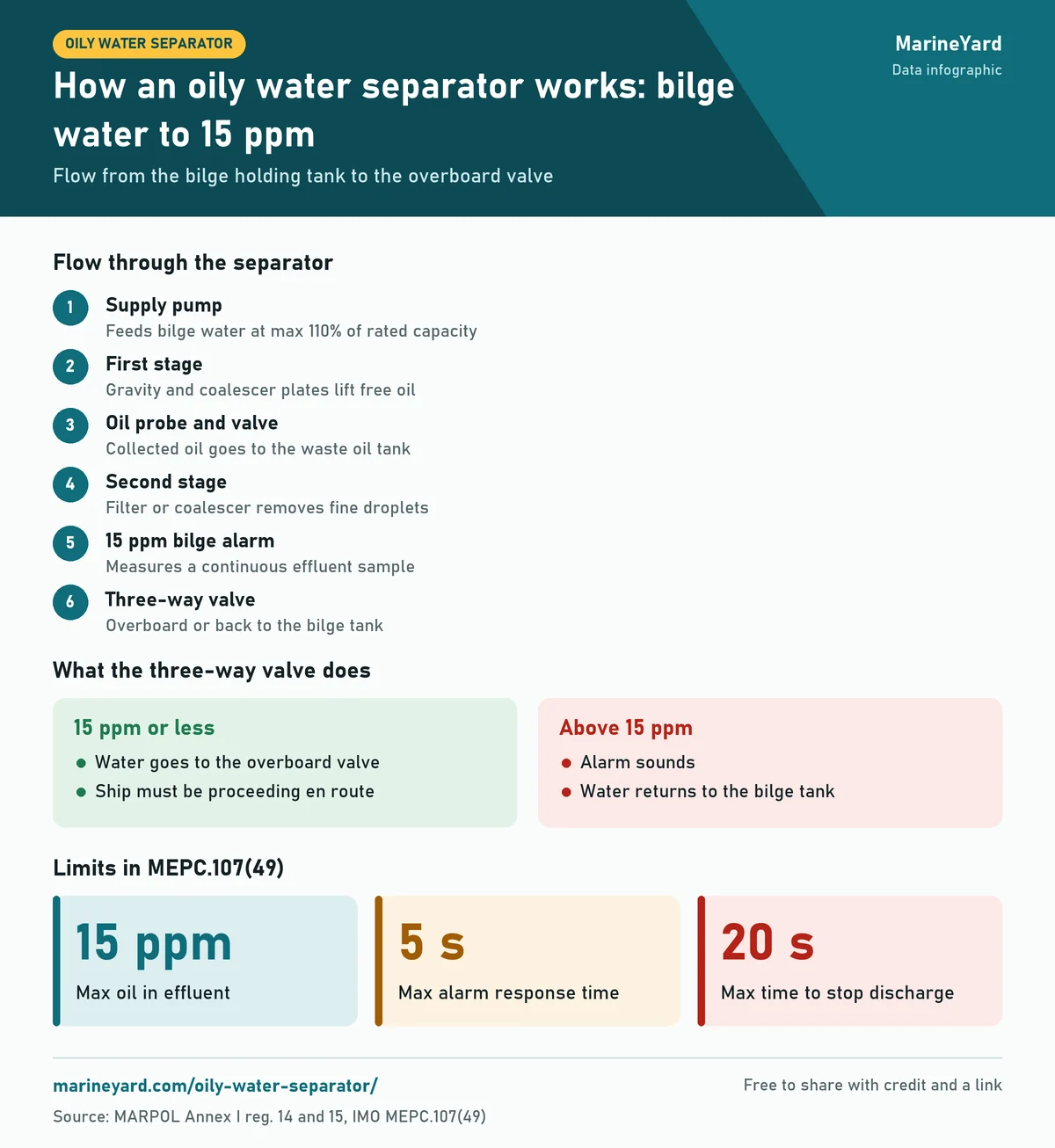
An oily water separator (OWS) is the machine on a ship that removes oil from machinery space bilge water before the water is pumped overboard. The oily...