Purifier in Ship: Working Principle, Parts, Types and Faults
Marine engineers & industry writers
Updated
Nov 18, 2026
A purifier in a ship is a centrifugal separator that removes water and solid particles from fuel oil and lubricating oil. The purifier spins the oil in a bowl fitted with a stack of conical discs. Centrifugal force throws the heavier water and sludge outwards, and the cleaned oil leaves near the centre of the bowl.
Ships fit purifiers between the settling tank and the service tank for fuel, and in a bypass loop on the engine sump for lubricating oil. A purifier that is set up to remove only solids is called a clarifier.
Key facts
| Attribute | Value |
|---|---|
| Bowl type | Disc stack bowl; disc-stack centrifuges develop 5,000 to 15,000 g (Wikipedia) |
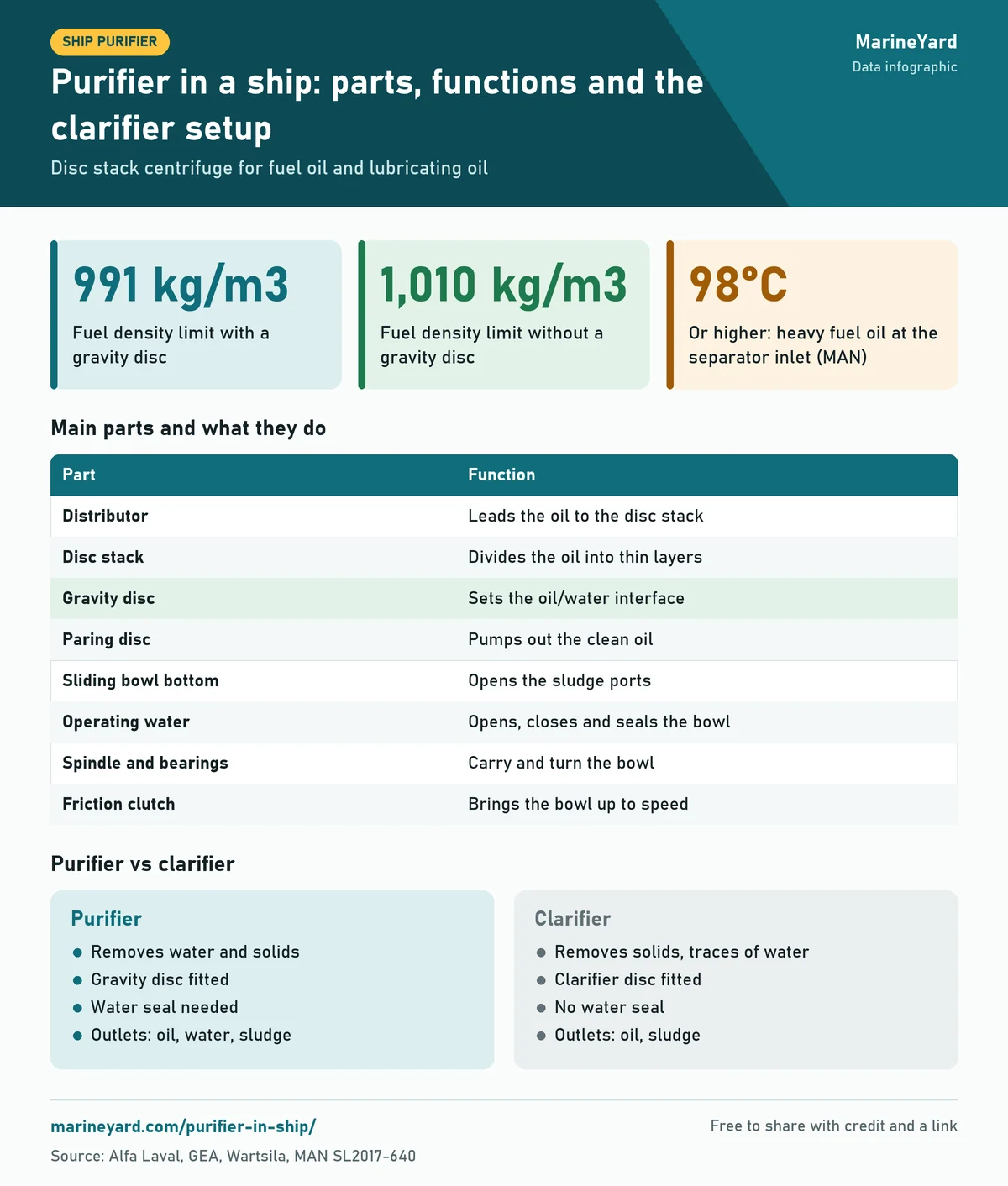
| Fuel density limit with a gravity disc | 991 kg/m3 at 15°C (Alfa Laval P separators; Wärtsilä) |
| Fuel density limit without a gravity disc | 1,010 kg/m3 (Alfa Laval S separators; GEA OSE with unitrolplus; Mitsubishi H-HIDENS) |
| Heavy fuel oil temperature at the separator inlet | 98°C or higher (MAN Service Letter SL2017-640) |
| Smallest particle removed | About 5 µm with a properly maintained separator (MAN) |
| Fuel quality after separation | Water under 0.2 vol %, aluminium plus silicon under 15 mg/kg (MAN requirement) |
| Service intervals, Alfa Laval P 605/615/617 | Intermediate every 2,000 h or 3 months; Major every 8,000 h or 12 months |
What is a purifier in a ship?
A purifier in a ship is a disc-stack centrifuge that separates three phases: clean oil, water and sludge. The purifier discharges the separated water continuously through its own outlet. The Wärtsilä encyclopedia defines a purifier as a separator that cleans oil from water and solid particles "with continuous removal of separated water".
Settling by gravity alone is too slow for ship fuel. Large particles and water sink in the settling tank, but fine catalyst particles stay in the oil, and rough seas stir the tank bottom. A MAN service letter on heavy fuel oil cleaning states that abrasive particles left in the fuel wear fuel pumps, injector nozzles, piston rings and turbocharger nozzle rings.
What are the parts of a purifier and their functions?
The parts of a purifier are the bowl, the disc stack, the gravity disc, the paring discs, the sliding bowl bottom, the vertical shaft with its bearings, and the drive. The purifier unit also includes a feed pump, a heater, an operating water system and a control unit.
| Part | Function |
|---|---|
| Bowl body and bowl hood | Form the rotating chamber; a lock ring joins them |
| Distributor | Accelerates the feed and leads the oil to the disc stack |
| Disc stack | Divides the oil into thin layers, so particles and water settle over a short distance |
| Top disc | Separates the oil path from the water path |
| Gravity disc (dam ring, regulating ring) | Sets the position of the oil/water interface in a purifier |
| Paring disc (centripetal pump) | Stationary pump that discharges clean oil under pressure |
| Sliding bowl bottom and seal ring | Open and close the sludge discharge ports |
| Operating water system | Supplies opening, closing and sealing water through solenoid valves |
| Vertical shaft (spindle) and bearings | Carry and turn the bowl |
| Belt drive, or horizontal shaft with worm wheel | Transfers motor power to the vertical shaft |
| Friction clutch and brake | The clutch brings the bowl up to speed gradually; the brake shortens the run-down |
| Feed pump and heater | Deliver oil at a steady flow and at the separation temperature |
| Control unit | Times sludge discharge, controls water valves, gives alarms |
| Water transducer | Detects water in the clean oil outlet on systems without a gravity disc |
The Alfa Laval P separator leaflet describes a bowl fixed on top of a spindle and driven by an electric motor through a friction clutch and a belt.
What are the types of purifier in a ship?
The types of purifier in a ship are manual-cleaning (solid bowl) and self-cleaning machines. Self-cleaning purifiers discharge sludge automatically, by total discharge or by partial discharge. Conventional purifiers use a gravity disc, and ALCAP-type separators use a water sensor instead.
| Type | How sludge and water are handled | Typical use |
|---|---|---|
| Manual-cleaning (solid bowl) | Sludge stays in the bowl until the crew stops and opens the machine | Small diesel oil and lubricating oil duties |
| Self-cleaning, total discharge | The bowl opens and empties its full content | Fuel oil and lubricating oil |
| Self-cleaning, partial discharge | The bowl opens briefly and ejects only part of its content | Fuel oil and lubricating oil |
Lubricating oil purifiers clean the oil of trunk-piston and cross-head engines. The Wärtsilä 14 product guide recommends disc stack separators for marine diesel fuel as well. Engine room bilge water is treated by a different machine, the oily water separator.
How does a purifier in a ship work?
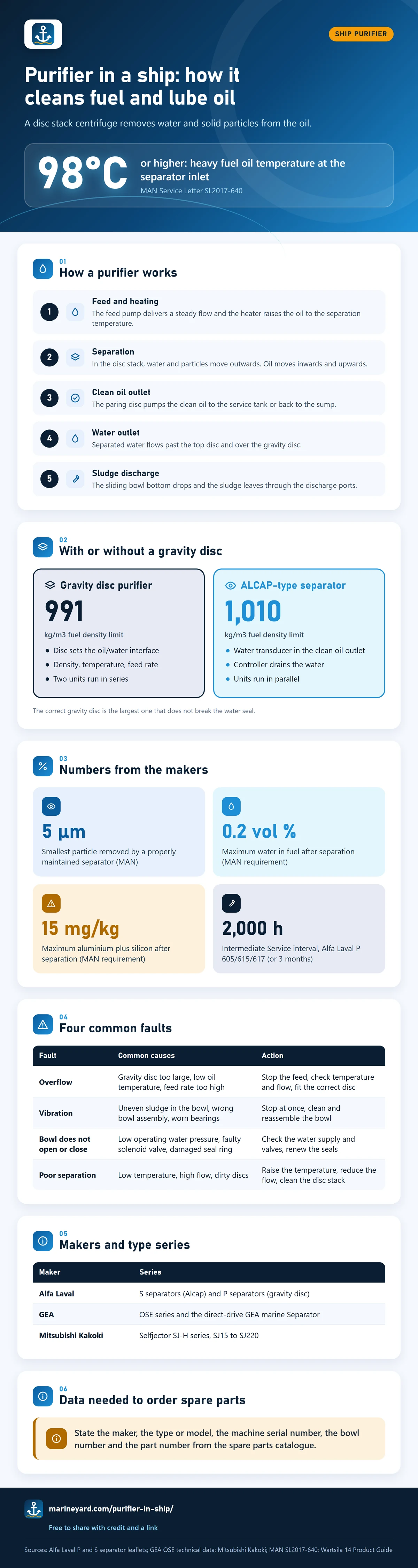
A purifier in a ship works by spinning heated oil at high speed inside a disc stack bowl. Centrifugal force moves water and solids, which are denser than oil, to the outside of the bowl. Clean oil flows inwards between the discs and leaves at the top through a paring disc.
- Feed. The feed pump draws oil from the settling tank or the sump and delivers a steady flow.
- Heating. The heater raises the oil to the separation temperature, which lowers the viscosity.
- Distribution. The distributor leads the oil from the bowl centre to the disc stack.
- Separation. Water droplets and particles move outwards along the underside of each disc. Oil moves inwards and upwards.
- Light phase outlet. The paring disc pumps the clean oil to the service tank or back to the sump.
- Heavy phase outlet. Separated water flows past the top disc and over the gravity disc to the water outlet.
- Sludge discharge. Solids collect at the bowl periphery. At set intervals the control unit admits opening water, the sliding bowl bottom drops, and the sludge leaves through the discharge ports.
MAN recommends 98°C or higher at the separator inlet for heavy fuel oil and a flow reduced to the actual daily consumption.
What is the difference between a purifier and a clarifier?
A purifier separates oil, water and solids, and discharges the water continuously. A clarifier separates only solids and traces of water from oil. A purifier has a gravity disc and a water seal. A clarifier has a clarifier disc that blocks the water outlet, so water collects with the sludge.
| Attribute | Purifier | Clarifier |
|---|---|---|
| Purpose | Removes water and solids | Removes solids and traces of water |
| Disc at the bowl top | Gravity disc | Clarifier disc |
| Water seal | Needed before oil is fed | Not needed |
| Outlets | Clean oil, water, sludge | Clean oil, sludge |
Two gravity-disc separators are run in series, with the first as a purifier and the second as a clarifier. Wärtsilä allows this arrangement for fuel up to 991 kg/m3 at 15°C and requires separators of the same size. Separators without a gravity disc are run in parallel, which lowers the flow through each machine.
How is a gravity disc selected?
A gravity disc is selected from the maker's nomogram by oil density, separation temperature and feed rate. The gravity disc sets the position of the oil/water interface in the bowl. The correct disc is the one with the largest hole diameter that does not break the water seal.
A larger hole moves the interface outwards, towards the bowl periphery. An interface too far out lets oil escape through the water outlet. An interface inside the disc stack lets water leave with the clean oil. Denser oil needs a smaller hole.
In the Alfa Laval S separator, which works on the Alcap principle without a gravity disc, a water transducer in the clean oil outlet signals changes in water content to the EPC 60 controller. The controller opens a drain valve or expels the water with the sludge. The GEA OSE separator with unitrolplus uses a water monitoring sensor and operates without regulating rings.
How do you start and stop a purifier?
A purifier is started by running the bowl up to full speed, closing the bowl with operating water, forming the water seal and then admitting heated oil. The maker's manual gives the exact sequence for each model. The steps below are general.
- Check the oil level in the bearing sump and confirm that the brake is released.
- Open the oil, operating water and heating valves. Start the feed pump with the oil recirculating to the tank.
- Start the motor and wait until the bowl reaches full speed.
- Admit closing water, then sealing water until water shows at the water outlet.
- Feed oil to the bowl when the oil reaches the separation temperature. Open the feed valve slowly.
- Set the back pressure and check the water and sludge outlets for oil.
Stopping follows the reverse order:
- Shut the oil feed and carry out a sludge discharge.
- Stop the motor, the heater and the feed pump. Close the operating water.
- Apply the brake only as the manual allows. Open the machine only after the bowl has stopped completely.
What are the common purifier faults?
Common purifier faults are overflow from a lost water seal, vibration, a bowl that fails to open or close, and poor separation. Most faults come from wrong settings, low oil temperature, worn seal rings or a weak operating water supply.
| Fault | Common causes | Action |
|---|---|---|
| Overflow: oil at the water or sludge outlet | Gravity disc too large, low oil temperature, feed rate too high, worn bowl seal ring, no sealing water | Stop the feed, check temperature and flow, fit the correct disc |
| Vibration | Uneven sludge in the bowl, wrong bowl assembly, worn bearings or buffers | Stop at once, clean and reassemble the bowl |
| Bowl does not open or close | Low operating water pressure, blocked water passages, faulty solenoid valve, damaged seal ring | Check the water supply and valves, renew the seals |
| Poor separation | Low temperature, high flow, dirty disc stack, gravity disc too small | Raise the temperature, reduce the flow, clean the disc stack |
What maintenance does a purifier need?
Purifier maintenance consists of bowl cleaning, renewal of seal rings and O-rings, and renewal of bearings, belt and friction pads at the maker's intervals. Deposits on the discs raise the flow velocity and lower the separation efficiency, according to MAN.
Alfa Laval sets an Intermediate Service for P 605/615/617 separators every 2,000 hours or 3 months, and a Major Service every 8,000 hours or 12 months. The Intermediate Service Kit holds O-rings and seals. The Major Service Kit holds drive parts, the belt, bearings and friction pads. S 921 to 987 separators have an Inspection Service every 4,000 hours or 6 months and an Overhaul Service every 12,000 hours or 18 months.
Who makes ship purifiers?
Ship purifiers are made mainly by Alfa Laval, GEA and Mitsubishi Kakoki. Alfa Laval builds S separators (Alcap) and P separators (gravity disc). GEA builds the OSE series under the Westfalia Separator name and the direct-drive GEA marine Separator. Mitsubishi Kakoki builds the Selfjector SJ-H series.
The Selfjector SJ-H series runs from model SJ15 at 1,400 litres per hour to model SJ220 at 22,500 litres per hour on IF380 fuel.
Which purifier spare parts are ordered, and how are they specified?
Purifier spare parts ordered most often are service kits, bowl seal rings, O-rings, gravity discs, friction pads, bearings, belts and paring discs. Purifier spares are specified by maker, type, serial number and part number. The spare parts catalogue for the exact machine gives the part number.
- State the ship name and IMO number.
- State the maker and the type or model from the nameplate, for example P 615 or SJ60.
- State the machine serial number and the bowl number.
- Give the part number and description from the spare parts catalogue, or the service kit name.
General O-rings and consumables may carry an IMPA code and can come from a ship chandler.
Where can purifier parts be bought or sold?
Purifier parts are bought from makers, authorised service companies and surplus stockists. MarineYard is a ship spare parts marketplace where sellers list new, reconditioned and used separators and purifiers, and feed pumps under pumps and compressors. Sellers get 9 free listings per account. MarineYard takes no commission and is not a party to any sale. Buyers should confirm the type, serial number and part number with the seller before payment.
Frequently Asked Questions
What is the function of the gravity disc in a purifier?
The gravity disc sets the position of the oil/water interface inside the purifier bowl. The correct gravity disc is the largest one that does not break the water seal. Denser oil needs a smaller hole.
Why is sealing water needed in a purifier?
Sealing water fills the outer part of the purifier bowl before oil is fed. The water seal stops oil from escaping through the water outlet. A purifier without a water seal overflows.
What is the purifier temperature for heavy fuel oil?
The purifier inlet temperature for heavy fuel oil is 98°C or higher, according to MAN Service Letter SL2017-640. Heat lowers the oil viscosity. A lower flow rate also improves separation.
What does ALCAP mean on a purifier?
ALCAP is the Alfa Laval separation principle that works without a gravity disc. A water transducer in the clean oil outlet signals changes in water content. The controller then drains the water or expels the water during sludge discharge.
Can a purifier be used as a clarifier?
A purifier can be used as a clarifier on bowls designed for both modes. The crew replaces the gravity disc with a clarifier disc, which blocks the water outlet. The clarifier needs no water seal.
Why does a purifier overflow?
A purifier overflows when the water seal breaks and oil leaves through the water or sludge outlet. Common causes are an oversized gravity disc, low oil temperature, a high feed rate and a worn bowl seal ring.
Related guides
- Stern tube: parts, bearings, seals and lubrication
- IMPA code: meaning and structure
- Ship chandler: meaning and services
- Oily water separator: working, parts and the 15 ppm rule
- Marine turbocharger: parts, working and surging
Sources
- Alfa Laval, P separators 605/615/617 product leaflet
- Alfa Laval, Flex separation systems, S separators 921-987
- GEA, Mineral Oil Separators OSE technical data
- GEA, marine Separator
- Mitsubishi Kakoki, Mitsubishi Selfjector SJ-H series
- MAN Diesel & Turbo, Service Letter SL2017-640, Heavy Fuel Oil Cleaning
- Wärtsilä 14 Product Guide, fuel oil system
- Wikipedia, Conical plate centrifuge
Sign in to leave a comment and join the discussion.
 Ship Machinery
A marine turbocharger is an exhaust-driven air compressor fitted to a ship's diesel or dual-fuel engine. The exhaust gas turns a turbine, and the turbine...
 Ship Machinery
An oily water separator (OWS) is the machine on a ship that removes oil from machinery space bilge water before the water is pumped overboard. The oily...
 Ship Machinery
A stern tube is a hollow tube of cast or fabricated steel that passes through the aft end of a ship's hull, between the aft peak bulkhead and the stern...