Marine Incinerator on Ships: Parts, Working and MARPOL Rules
Marine engineers & industry writers
Updated
Nov 23, 2026
A marine incinerator is a shipboard furnace that burns waste generated during the normal operation of the ship, mainly sludge oil and solid garbage. MARPOL Annex VI regulation 16 lists the substances that a marine incinerator must not burn and requires an IMO Type Approval Certificate for each unit installed on or after 1 January 2000.
The type approval standard is IMO resolution MEPC.244(66), the 2014 Standard specification for shipboard incinerators. The standard covers units of up to 4,000 kW. The combustion chamber flue gas outlet temperature must stay between 850 °C and 1,200 °C.
Key facts
| Attribute | Value |
|---|---|
| Governing rule | MARPOL Annex VI, regulation 16 and appendix IV |
| Units that need IMO type approval | Incinerators on ships constructed on or after 1 January 2000, or installed on board on or after that date (regulation 16.6.1) |
| Type approval standard | MEPC.244(66), adopted 4 April 2014; it superseded MEPC.76(40) |
| Capacity covered by the standard | Up to 4,000 kW per unit |
| Flue gas outlet temperature range | 850 to 1,200 °C (appendix IV) |
| Continuous-feed rule | No waste is fed below 850 °C (regulation 16.9) |
| Batch-loaded rule | 600 °C within 5 minutes after start-up, then not less than 850 °C |
| Oxygen in the combustion chamber | 6 to 12% |
| Garbage Record Book retention | At least 2 years from the last entry (MARPOL Annex V, regulation 10) |
What is a marine incinerator on a ship?
A marine incinerator on a ship is the approved facility for shipboard incineration. MARPOL Annex VI defines a shipboard incinerator as a shipboard facility designed for the primary purpose of incineration. Regulation 16.1 allows shipboard incineration only in a shipboard incinerator, with one exception for sludge burned in the power plant or boilers.
The incinerator reduces two waste streams. The first stream is sludge oil from the fuel and lubricating oil purifier, from drip trays and from the oily water separator. The second stream is solid garbage such as food waste, paper and rags.
What are the parts of a marine incinerator?
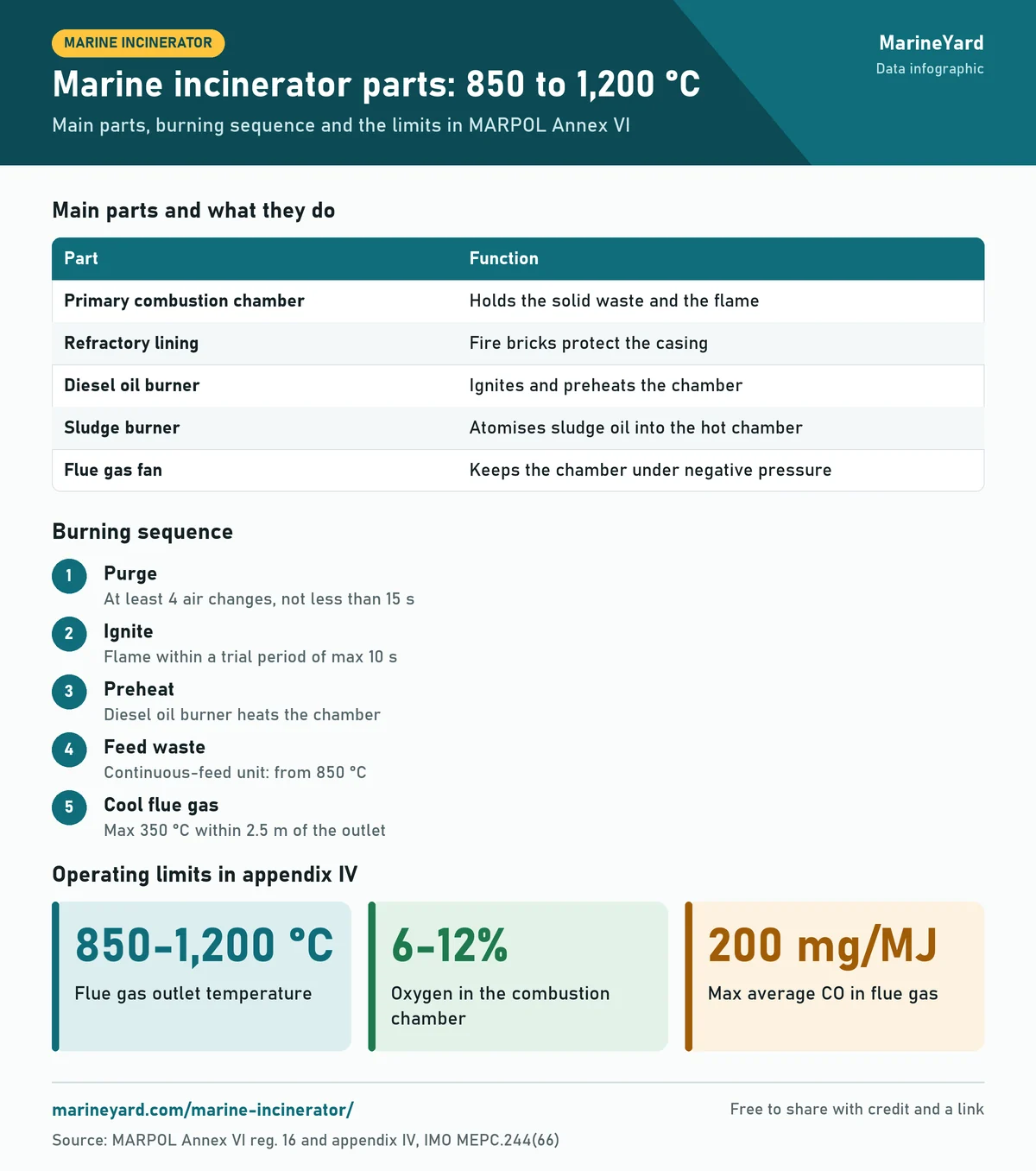
The parts of a marine incinerator are a refractory-lined primary combustion chamber, a diesel oil burner, a sludge burner, a flue gas fan, a charging door or sluice, an ash door, a sludge tank with a heater and pumps, and a control panel with flame, temperature and pressure safety devices.
| Part | Function |
|---|---|
| Primary combustion chamber | Holds the solid waste and the flame; the waste burns here |
| Secondary chamber (some designs) | Gives the flue gas more time to burn out |
| Refractory lining | Fire bricks protect the casing; the design temperature is the chamber design temperature plus 20% (MEPC.244(66)) |
| Diesel oil burner (primary burner) | Ignites and preheats the chamber and keeps liquid waste burning safely |
| Sludge burner | Atomises sludge oil into the hot chamber |
| Flue gas fan | Keeps the chamber under negative pressure so that no gas or smoke leaks into the room |
| Charging door or sluice | Admits solid waste; an interlock keeps the door shut during burning or above 220 °C when no charging lock is fitted |
| Sludge tank, heating coil and pumps | Heat, circulate and dose the sludge to the sludge burner |
| Flame sensor and two fuel solenoid valves | Shut off the fuel in not more than 4 seconds after a flame failure |
| Temperature sensors and negative pressure switch | Stop the burner on high temperature or loss of draft |
The TeamTec incinerator range shows a typical layout. The maker lists a sludge burner, a diesel oil burner, a flue gas fan, a sludge dosing pump and sludge tanks with steam, electric or thermal oil heating coils.
What are the types of marine incinerator?
The types of marine incinerator are continuous-feed incinerators and batch-loaded incinerators. Regulation 16.9 sets a different temperature rule for each type. Makers also build units for solid waste only and units that burn sludge oil and solid waste at the same time.
- Continuous-feed. Waste enters through a sluice during operation. No waste is fed while the flue gas outlet temperature is below 850 °C.
- Batch-loaded. The chamber is filled before start. The unit reaches 600 °C within five minutes after start-up and then stabilises at not less than 850 °C.
- With heat recovery. The flue gas passes a heat recovery unit. MEPC.244(66) requires that the incinerator can keep operating with the economiser coils dry.
How does a marine incinerator work?
A marine incinerator works by burning waste in a preheated, refractory-lined chamber under negative pressure. A diesel oil burner heats the chamber. Sludge oil and solid waste then burn at a flue gas outlet temperature of 850 to 1,200 °C. A fan draws the flue gas to the funnel.
The steps below use the values in MEPC.244(66). The ship's own procedures and the maker's manual govern the actual operation.
- The operator removes ash and slag and checks the combustion air openings.
- The flue gas fan purges the chamber and stack with at least 4 air changes, for not less than 15 seconds.
- The diesel oil burner ignites. The flame must be established within a trial period of not more than 10 seconds.
- The burner preheats the chamber. The standard gives a preheat temperature of 650 °C for the combustion chamber.
- Sludge oil or solid waste is fed to a continuous-feed unit once the flue gas outlet temperature reaches 850 °C.
- The flue gas is shock-cooled to a maximum of 350 °C within 2.5 m of the chamber outlet. The standard gives dioxin prevention as the reason.
- The fuel valve closes at shutdown. A postpurge of not less than 15 seconds follows.
- The ash door interlock releases only when burning has stopped and the furnace temperature is at or below 220 °C.
What can and cannot be burned in a marine incinerator?
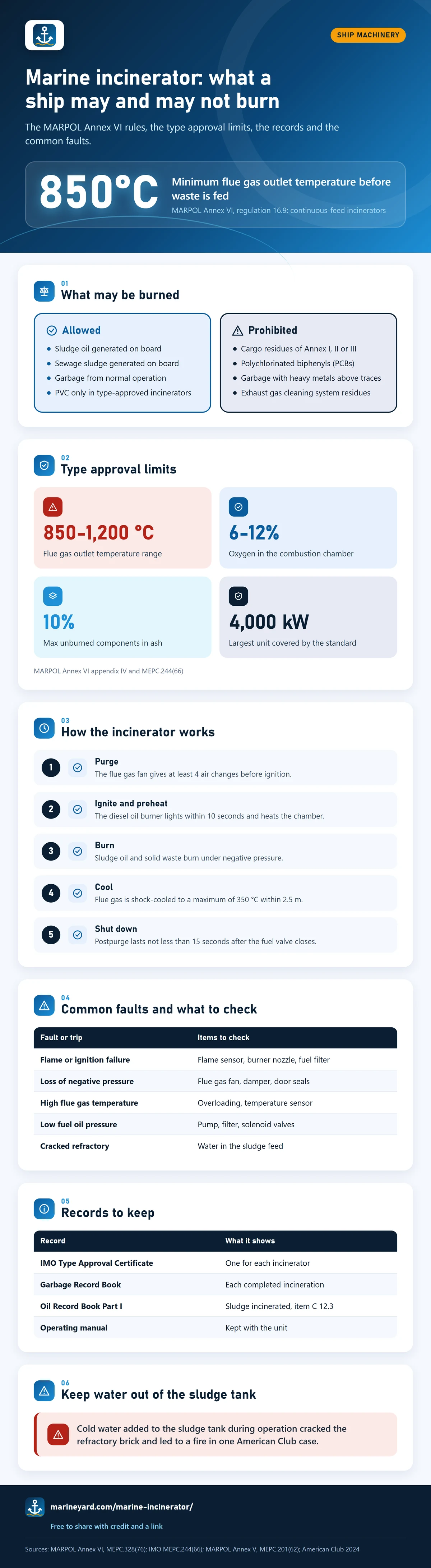
A marine incinerator can burn sludge oil, sewage sludge and garbage that were generated on board during normal operation. MARPOL Annex VI regulation 16.2 prohibits six groups of substances. Regulation 16.3 prohibits polyvinyl chloride (PVC), except in incinerators that hold an IMO Type Approval Certificate.
| Substance | Shipboard incineration | Regulation |
|---|---|---|
| Sludge oil and sewage sludge generated on board | Allowed | 16.1, 16.4 |
| Garbage from normal operation, for example food waste, paper, cardboard, rags | Allowed | 16.1 |
| Polyvinyl chloride (PVC) | Only in an incinerator with an IMO Type Approval Certificate | 16.3 |
| Residues of cargoes subject to Annex I, II or III, and contaminated packing materials | Prohibited | 16.2.1 |
| Polychlorinated biphenyls (PCBs) | Prohibited | 16.2.2 |
| Garbage with more than traces of heavy metals | Prohibited | 16.2.3 |
| Refined petroleum products that contain halogen compounds | Prohibited | 16.2.4 |
| Sewage sludge and sludge oil not generated on board the ship | Prohibited | 16.2.5 |
| Exhaust gas cleaning system residues | Prohibited | 16.2.6 |
The list is in regulation 16 of the 2021 Revised MARPOL Annex VI, resolution MEPC.328(76), which entered into force on 1 November 2022. Regulation 16.4 also allows sludge oil and sewage sludge to be burned in the main or auxiliary power plant or in a ship boiler. That option is not allowed inside ports, harbours or estuaries.
What does MEPC.244(66) require for type approval?
MEPC.244(66) requires each incinerator model to pass a type approval test at the factory or at an approved test facility, under the responsibility of the flag Administration. The test runs 6 to 8 hours on sludge oil and 6 to 8 hours on solid waste. The result is an IMO Type Approval Certificate.
Resolution MEPC.244(66) fixes the test waste. The sludge mix is 75% sludge oil from heavy fuel oil, 5% waste lubricating oil and 20% emulsified water. The solid waste is 50% food waste and 50% rubbish made of paper, cardboard, rags and plastic.
| Operating limit | Value |
|---|---|
| Oxygen in the combustion chamber | 6 to 12% |
| Carbon monoxide in flue gas, maximum average | 200 mg/MJ |
| Soot number, maximum average | Bacharach 3 or Ringelmann 1 (20% opacity) |
| Unburned components in ash residues | Maximum 10% by weight |
| Combustion chamber flue gas outlet temperature | 850 to 1,200 °C |
The same limits are in appendix IV of MARPOL Annex VI, so the limits are mandatory. The standard also requires an emergency stop switch outside the compartment. Resolution MEPC.368(79) later deleted the fire protection annex of the standard to remove discrepancies with SOLAS chapter II-2.
What records does a marine incinerator need?
A marine incinerator needs an IMO Type Approval Certificate, a maker's operating manual kept with the unit, Garbage Record Book entries for each completed incineration of garbage, and Oil Record Book Part I entries for incinerated sludge. Regulation 16.8 also requires training for the personnel who operate the incinerator.
- Garbage Record Book. Regulation 10 of the revised MARPOL Annex V, resolution MEPC.201(62), requires the book on ships of 400 gross tonnage and above and on ships certified to carry 15 or more persons.
- Entry content. Each entry gives the date, the time and the ship's position at the start and stop of incineration, the garbage categories and the estimated amount in cubic metres, as amended by resolution MEPC.277(70).
- Oil Record Book Part I. Item C 12.3 records sludge that was incinerated, with the total time of operation.
- IAPP Certificate. The Supplement states whether the incinerator complies with MEPC.76(40), as amended, or with MEPC.244(66).
What are the common faults of a marine incinerator?
The common faults of a marine incinerator are flame failure, loss of negative pressure, high flue gas temperature, low fuel oil pressure and cracked refractory. MEPC.244(66) requires the control system to cut off the fuel supply in each of the first four cases. A safety shutdown needs a manual reset.
| Fault or trip | What MEPC.244(66) requires | Items to check with the maker's manual |
|---|---|---|
| Flame or ignition failure | Fuel valves close in not more than 4 seconds; only one automatic restart | Flame sensor, burner nozzle, ignition electrodes, fuel filter |
| Loss of negative pressure | Pressure switch opens the burner circuit and gives an alarm | Flue gas fan, damper, door seals |
| High flue gas temperature | Burner shuts down above the maker's set temperature | Overloading with garbage, temperature sensor |
| Low fuel oil pressure | Failure and lockout of the program relay | Pump, filter, solenoid valves |
| Cracked refractory | Refractory must resist thermal shock and ship vibration | Water in the sludge feed, brick condition |
An American Club case report from November 2024 describes a fire in an incinerator room. The crew had added cold water to the sludge tank while the incinerator was running. The thermal shock cracked the refractory brick, and escaping heat ignited oil-soaked insulation nearby. The club advises crews not to add water to the sludge tank during sludge burning.
Which marine incinerator spare parts are ordered most often?
Marine incinerator spare parts ordered most often are burner nozzles, flame sensors, ignition electrodes, fuel solenoid valves, thermocouples, door gaskets, refractory bricks and castable, sludge pump wear parts and flue gas fan bearings. MEPC.244(66) requires the maker to supply a spare parts list in the instruction manual.
A correct order states the following data:
- Ship name and IMO number.
- Maker and model of the incinerator, from the nameplate.
- Serial number and capacity in kW or kcal/h.
- IMO Type Approval Certificate number and the standard, MEPC.76(40) or MEPC.244(66).
- Part number and drawing number from the manual.
Who makes marine incinerators?
Marine incinerators are made by a small group of specialist companies. TeamTec of Tvedestrand, Norway, makes the OG and GS series. Atlas Incinerators of Denmark, founded in 1974, is part of G&O Maritime Group. Detegasa makes the IRA series for solids and the IRLA series for solids and sludge. Miura of Japan makes the BGW-N shipboard incinerator.
Where can marine incinerator parts be bought or sold?
Marine incinerator parts are bought from makers, authorised service companies and surplus stockists. MarineYard is a ship spare parts marketplace where sellers list new, reconditioned and used incinerators, burners, pumps and compressors and electrical and automation parts. Sellers get 9 free listings per account. MarineYard takes no commission and is not a party to any sale. Buyers should confirm the model, the serial number and the type approval certificate with the seller before payment.
Frequently Asked Questions
What is the minimum temperature for feeding waste into a marine incinerator?
The minimum temperature for feeding waste into a continuous-feed marine incinerator is 850 °C at the combustion chamber gas outlet. MARPOL Annex VI regulation 16.9 sets this rule. The permitted operating range in appendix IV is 850 to 1,200 °C.
Can plastic be burned in a ship's incinerator?
Plastic can be burned in a ship's incinerator, and the type approval test waste contains plastic. PVC is the exception. MARPOL Annex VI regulation 16.3 allows PVC only in an incinerator that holds an IMO Type Approval Certificate.
Can a marine incinerator be used in port?
A marine incinerator is not banned in port by MARPOL Annex VI regulation 16. The in-port ban in regulation 16.4 covers sludge burned in the main or auxiliary power plant or boilers. MEPC.244(66) notes that port States may set their own limitations, so the crew checks local rules.
Where do incinerator ashes go?
Incinerator ashes go to a port reception facility. MARPOL Annex V lists incinerator ashes as garbage category E and does not permit their discharge into the sea. The crew records the delivery in the Garbage Record Book.
Is an incinerator approved to MEPC.76(40) still accepted?
An incinerator approved to MEPC.76(40) is still accepted. The Supplement to the IAPP Certificate has separate entries for units that comply with MEPC.76(40), as amended, and with MEPC.244(66). MEPC.244(66), adopted in 2014, superseded the older standard.
Why does a marine incinerator run under negative pressure?
A marine incinerator runs under negative pressure so that no gas or smoke leaks into the incinerator room. MEPC.244(66) requires the furnace pressure to stay below the room pressure under all circumstances. A negative pressure switch stops the burner if the draft fails.
Related guides
- Fresh Water Generator on Ships: Working, Parts and Types
- Ballast Water Treatment System: Types, Parts and D-2 Rules
- Sewage Treatment Plant on Ship: Working, Parts and MARPOL Rules
- Stern tube: parts, bearings, seals and lubrication
- IMPA code: meaning and structure
- Ship chandler: meaning and services
- Oily water separator: working, parts and the 15 ppm rule
- Marine turbocharger: parts, working and surging
- Purifier in ship: working principle, parts and faults
- Cylinder liner: function, wear and gauging
- Ship boiler: types, mountings and water treatment
- Anchor windlass: parts, working and class rules
- Bow thruster: how it works, types and failures
- Steering gear: parts, types and SOLAS tests
- Marine air compressor: starting air, parts and safety
Sources
- IMO, resolution MEPC.328(76), 2021 Revised MARPOL Annex VI (regulation 16 and appendix IV)
- IMO, resolution MEPC.244(66), 2014 Standard specification for shipboard incinerators
- IMO, resolution MEPC.368(79), amendments to the 2014 Standard specification
- IMO, resolution MEPC.201(62), revised MARPOL Annex V (regulation 10, Garbage Record Book)
- IMO, resolution MEPC.277(70), amendments to MARPOL Annex V (Garbage Record Book entries)
- American Club, Good Catch: Keep the fire inside the incinerator, November 2024
- TeamTec, incinerators
- Atlas Incinerators, about the company
Sign in to leave a comment and join the discussion.
 Ship Machinery
A sewage treatment plant on a ship is the machine that treats toilet and medical drainage with aerobic bacteria, settles the solids and disinfects the water...
 Ship Machinery
A fresh water generator is the machine on a ship that turns seawater into fresh water by vacuum distillation. The fresh water generator boils seawater at...
 Ship Machinery
A marine air compressor is the machine in a ship's engine room that compresses atmospheric air and stores it in air receivers. The stored air starts the...