Oil Mist Detector on Ships: Working, Rules and Alarm Levels
Marine engineers & industry writers
Updated
Nov 23, 2026
An oil mist detector (OMD) is a safety instrument on a marine diesel engine that measures the concentration of oil mist in the crankcase. The oil mist detector gives an alarm and starts an engine slowdown or shutdown before the mist reaches the concentration at which a crankcase explosion is possible.
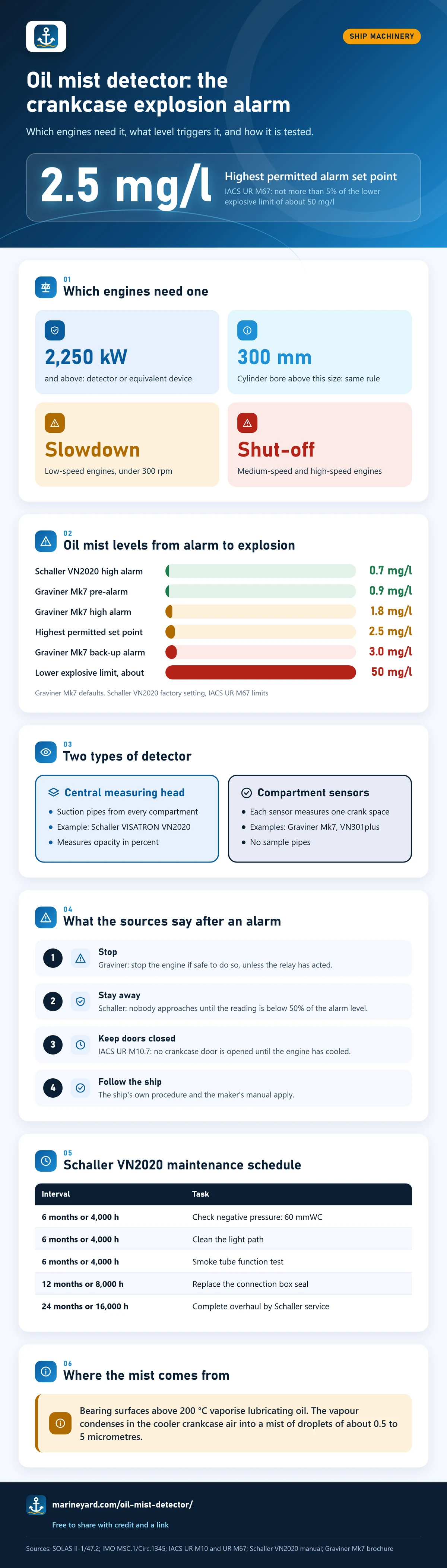
SOLAS and IACS Unified Requirement M10 require an oil mist detector, an engine bearing temperature monitor or an equivalent device on engines of 2,250 kW and above or with cylinders of more than 300 mm bore.
Key facts
| Attribute | Value |
|---|---|
| Purpose | Early warning of oil mist in the crankcase, to prevent a crankcase explosion |
| Engines covered | 2,250 kW and above, or cylinders of more than 300 mm bore (SOLAS II-1/47.2, IACS UR M10.8) |
| Lower explosive limit (LEL) of oil mist | About 50 mg/l of oil in air (IACS UR M67) |
| Highest permitted alarm set point | Not more than 5% of the LEL, about 2.5 mg/l (IACS UR M67) |
| Action on low-speed engines (under 300 rpm) | Alarm and slowdown (IACS UR M10.8) |
| Action on medium-speed and high-speed engines | Alarm and automatic shut-off (IACS UR M10.8) |
| Measuring methods | Light obscuration (opacity) or light scatter |
| Type approval test | IACS UR M67, applied to engines certified or contracted from 1 January 2007 |
What is an oil mist detector on a ship engine?
An oil mist detector on a ship engine is an optical monitoring system fitted to the crankcase of a main or auxiliary diesel engine. The oil mist detector checks the crankcase atmosphere continuously and reports a rise in oil mist to the engine alarm and safety system.
Oil mist forms when a part overheats. The Graviner Mk7 brochure states that bearing surfaces above 200 °C vaporise lubricating oil quickly. The vapour condenses in the cooler crankcase air into a mist with droplets of about 0.5 to 5 micrometres.
The brochure lists main, bottom end, top end, crosshead and camshaft bearings and seized pistons as failure areas. Piston blow-by also sends hot gas past the piston rings and the cylinder liner into the crankcase of a four-stroke engine.
What are the parts of an oil mist detection system?
The parts of an oil mist detection system are the crankcase sampling points, the optical measuring unit, an air-driven suction device, the control or central unit, the alarm and safety relays and a remote display.
| Part | Function |
|---|---|
| Sampling point or engine wall connection | Opens into one crankcase compartment; an intake funnel keeps splash oil out |
| Sampling pipes and header pipe | Carry the crankcase atmosphere to a central measuring head (pipe-type systems only) |
| Venturi air jet pump | Uses compressed air to create the suction that draws the sample |
| Optical measuring track | A light source and a receiver measure the mist in the sample |
| Control or central unit | Compares each reading with the alarm set points and stores events |
| Output relays | Send the pre-alarm, the high alarm, the fault alarm and the slowdown or shutdown signal |
| Remote display | Shows the oil mist level in the engine control room |
IACS UR M10 requires that the reading and the alarm can be read from a safe location away from the engine. Each engine has its own independent detection arrangement.
What are the types of oil mist detector?
The types of oil mist detector are pipe-type systems with one central measuring head and pipe-free systems with a sensor on each crankcase compartment. Both types measure the mist optically. One method measures the light blocked by the mist (obscuration or opacity). The other method measures the light scattered by the droplets.
| Feature | Central measuring head (pipe type) | Compartment sensors (pipe-free) |
|---|---|---|
| Sampling | Suction through pipes from every compartment to one head | Each sensor measures at its own compartment |
| Example | Schaller VISATRON VN2020 | Graviner Mk7, Schaller VISATRON VN301plus |
| Measuring method of the example | Opacity, in percent | Light scatter (Graviner Mk7) |
| Sample pipes | Required, with drains for condensed oil | Not required |
The Graviner Mk7 system description states that the detectors are mounted directly on the crankcases and that the system suits two-stroke and four-stroke engines. The Schaller VISATRON VN301plus uses one sensor unit per cylinder station and one or two central units.
How does an oil mist detector work?
An oil mist detector works by passing a sample of crankcase atmosphere through a light beam. Oil droplets block or scatter the light. The electronics convert the change in light into an oil mist value and compare the value with the alarm set points.
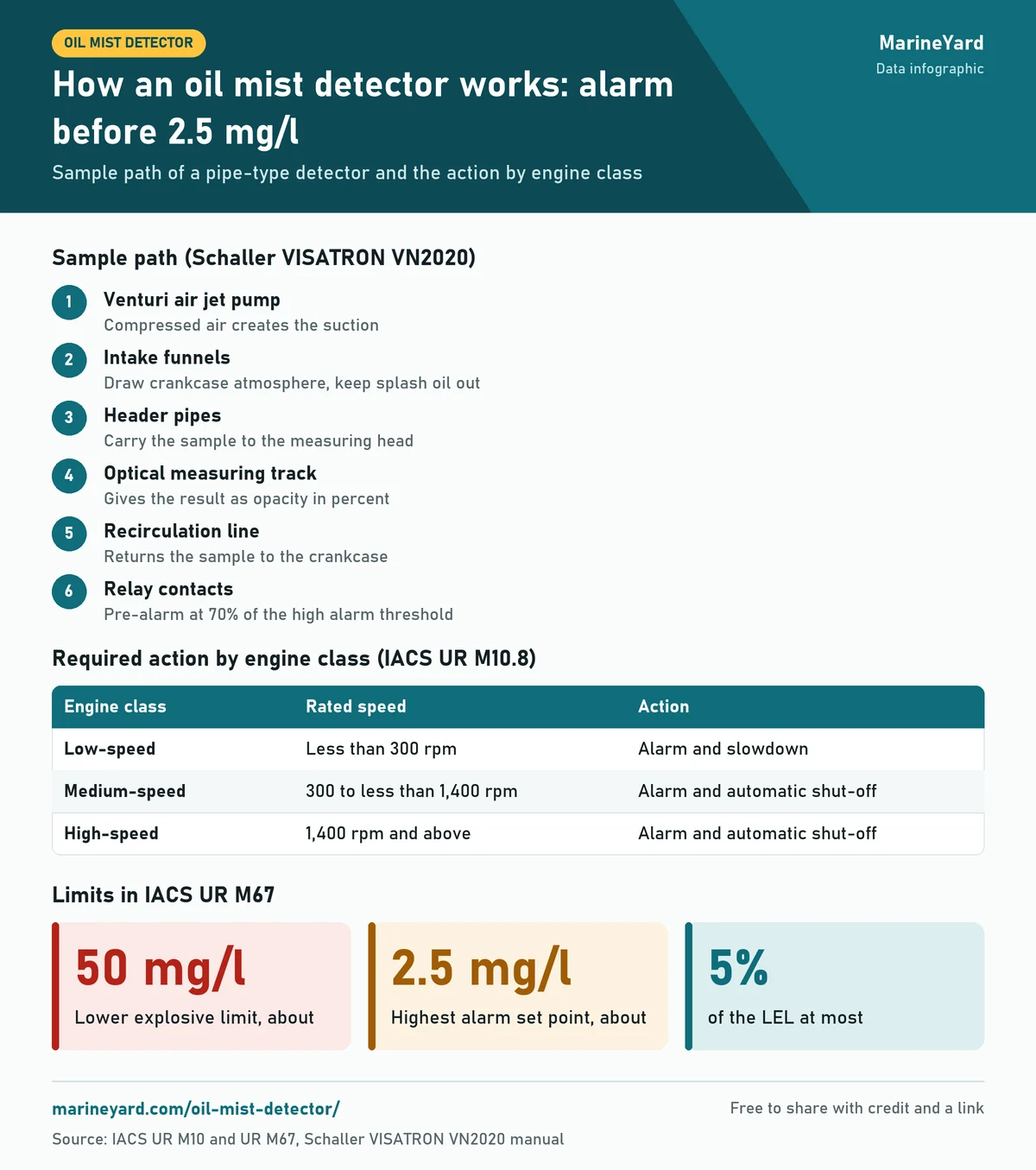
The Schaller VISATRON VN2020 operating manual describes this sequence for a pipe-type detector:
- Compressed air flows through the Venturi air jet pump and creates a negative pressure at the detector.
- The negative pressure draws crankcase atmosphere through the intake funnels and the engine wall connections.
- The sample flows through the header pipes and the intake line into the measuring head.
- The optical measuring track measures the sample continuously and gives the result as opacity in percent.
- The sample returns to the crankcase through the recirculation line.
- The detector gives a pre-alarm at 70% of the high alarm threshold and the high alarm at the threshold. Relay contacts signal the alarm and safety system.
A pipe-free detector such as the Graviner Mk7 measures the mist at its own crank space and sends a digital value to the control unit.
Which engines must have an oil mist detector?
Engines of 2,250 kW and above, or with cylinders of more than 300 mm bore, must have crankcase oil mist detectors, engine bearing temperature monitors or equivalent devices. SOLAS regulation II-1/47.2 sets this rule for ships with periodically unattended machinery spaces. IACS UR M10.8 sets the same limits in the class rules.
| Engine class (IACS UR M10.8) | Rated speed | Required action |
|---|---|---|
| Low-speed | Less than 300 rpm | Alarm and slowdown |
| Medium-speed | 300 rpm to less than 1,400 rpm | Alarm and automatic shut-off |
| High-speed | 1,400 rpm and above | Alarm and automatic shut-off |
The IMO confirmed the same split in MSC.1/Circ.1345, a unified interpretation of SOLAS regulation II-1/27.5 dated 2 June 2010. The circular also states that the consequences of overriding the automatic shut-off should be established and documented.
The text of UR M10 and UR M67 as published in the Türk Loydu machinery requirements adds that the detector must be type approved and tested to UR M67. IACS UR M36 refers to SOLAS regulation II-1/47.2 for auxiliary engines in unattended machinery spaces. IACS published Revision 5 of UR M10 in late 2024 with added rules for engines on gas and low-flashpoint fuels, as MarineLink reported on 1 December 2024.
What oil mist concentration triggers the alarm?
An oil mist concentration of not more than 5% of the lower explosive limit, about 2.5 mg/l, must trigger the alarm under IACS UR M67. The lower explosive limit of oil mist is about 50 mg/l. Makers set the alarm below this maximum.
| Level | Concentration | Source |
|---|---|---|
| Pre-alarm, default | 0.9 mg/l (adjustable 0.5 to 1.2 mg/l) | Graviner Mk7 |
| High alarm, default | 1.8 mg/l (adjustable 1.3 to 2.4 mg/l) | Graviner Mk7 |
| Back-up alarm | 3.0 mg/l (fixed) | Graviner Mk7 |
| High alarm, factory setting | 0.70 mg/l (2.0% opacity) | Schaller VN2020 |
| Highest permitted alarm set point | About 2.5 mg/l (5% of LEL) | IACS UR M67 |
| Explosive condition | 30 to 50 mg/l, depending on the oil | Graviner Mk7 brochure |
What happens when the oil mist alarm activates?
An oil mist alarm starts an automatic slowdown on a low-speed engine and an automatic shut-off on a medium-speed or high-speed engine of the regulated size. The alarm also sounds at the control station. The crew then follows the ship's own emergency procedure and the maker's manual.
The named sources state the following actions:
- Graviner. The engine should be stopped if safe to do so, unless the slowdown or shutdown relay has acted. The engine cools down before anyone enters the engine room.
- Schaller. Nobody approaches the engine until the reading has dropped below 50% of the alarm level. Schaller recommends waiting for 0%.
- IACS UR M10.7. A warning notice on the engine states that crankcase doors and sight holes are not opened until the engine has cooled for a reasonable time after stopping.
How is an oil mist detector tested and maintained?
An oil mist detector is tested with test smoke or mist at the sampling points and is maintained at the intervals in the maker's manual. IACS UR M10 requires a functional test on the engine test bed and on board, and a copy of the maintenance and test manual on the ship.
The Schaller VN2020 manual gives this schedule:
- Every 6 months or 4,000 operating hours: check the negative pressure at the measuring head (60 mmWC, tolerance 5 mmWC).
- At the same interval: clean the light path in the measuring head.
- At the same interval: do the function test with a smoke tube at each suction point.
- At the same interval: replace the air filter in the pressure regulator unit.
- Every 12 months or 8,000 hours: replace the connection box seal and clean the intake system with compressed air.
- Every 24 months or 16,000 hours: complete overhaul by authorised Schaller service.
Other makers and models have different intervals. The manual of the fitted model applies.
What causes oil mist detector faults and false alarms?
Oil mist detector faults are caused most often by dirty optics, blocked or flooded sampling pipes, oil splash and a wrong suction pressure. IACS UR M67 names these conditions and tests each detector type against them. UR M10 requires an alarm for any foreseeable functional failure.
| Condition | Effect | Rule or maker measure |
|---|---|---|
| Lens partly obscured by oil film | Unreliable reading | The system must indicate the obscuration (UR M10.16); clean the light path |
| Oil condensate pooling in a sampling pipe | Blocked pipe, no sample | Pipes are arranged to drain (UR M67); siphons return the oil |
| Splash and spray of lubricating oil | Blocked openings or false alarm | Splash test in UR M67; intake funnels on Schaller systems |
| Negative pressure outside the set range | Wrong sample flow | Check and adjust with a manometer (Schaller) |
Which oil mist detector spare parts are ordered most often?
Oil mist detector spare parts ordered most often are maintenance kits with seals and filter cartridges, cleaning kits for the optics, smoke tubes for the function test, complete detector or sensor heads, measuring heads and connecting cables. Schaller states that its smoke tubes must be used within 3 months of delivery.
A correct order states the following data:
- Ship name and IMO number.
- Engine maker, engine type and number of cylinders.
- Maker and model of the oil mist detector, for example VISATRON VN2020 or Graviner Mk7.
- Serial number of the measuring head or control unit.
- Part number or kit number from the maker's manual.
Maker-specific parts are ordered by the maker's part number. General consumables for the job may carry an IMPA code and can come from a ship chandler.
Who makes oil mist detectors?
Oil mist detectors for marine engines are made by a small number of specialist companies. Graviner makes the Mk7 system. Schaller Automation of Blieskastel, Germany, makes the VISATRON VN2020 and VN301plus. Schaller states that its systems have been in use since 1968.
Where can oil mist detector parts be bought or sold?
Oil mist detector parts are bought from the makers, their service partners and surplus stockists. MarineYard is a ship spare parts marketplace where sellers list new, reconditioned and used main engine parts and electrical and automation parts. Sellers get 9 free listings per account. MarineYard takes no commission and is not a party to any sale. Buyers should confirm the model, serial number and type approval of a detector with the seller before payment.
Frequently Asked Questions
Is an oil mist detector mandatory on auxiliary engines?
An oil mist detector, a bearing temperature monitor or an equivalent device is mandatory on an auxiliary engine of 2,250 kW and above or with cylinders of more than 300 mm bore. The engine size decides, not the duty. Smaller generator engines are outside this rule.
What is the lower explosive limit of oil mist in a crankcase?
The lower explosive limit of oil mist in a crankcase is about 50 mg of oil per litre of air, according to IACS UR M67. Schaller quotes 47 mg/l at 25 °C. The alarm must act at not more than 5% of this limit, about 2.5 mg/l.
Can a bearing temperature monitor replace an oil mist detector?
A bearing temperature monitor can replace an oil mist detector under SOLAS regulation II-1/47.2 and IACS UR M10.8. Both rules accept engine bearing temperature monitors or equivalent devices. The monitor must be type approved by the classification society for use as a safety device.
What is the difference between an oil mist detector pre-alarm and high alarm?
The pre-alarm warns that the oil mist level is rising and does not slow or stop the engine. The high alarm operates the slowdown or shutdown relay. The Graviner Mk7 default settings are 0.9 mg/l for the pre-alarm and 1.8 mg/l for the high alarm.
How often is an oil mist detector function test done?
An oil mist detector function test is done at the interval in the maker's manual. The Schaller VISATRON VN2020 manual requires a smoke tube test every 6 months or 4,000 operating hours, whichever comes first. Each suction point is tested separately.
Why must crankcase doors stay closed after an oil mist alarm?
Crankcase doors must stay closed after an oil mist alarm because the parts inside can still be hot enough to ignite oil mist when fresh air enters. IACS UR M10.7 requires a warning notice that forbids opening doors or sight holes until the engine has cooled for a reasonable time.
Related guides
- Fresh Water Generator on Ships: Working, Parts and Types
- Ballast Water Treatment System: Types, Parts and D-2 Rules
- Sewage Treatment Plant on Ship: Working, Parts and MARPOL Rules
- Marine Incinerator on Ships: Parts, Working and MARPOL Rules
- Stern tube: parts, bearings, seals and lubrication
- IMPA code: meaning and structure
- Ship chandler: meaning and services
- Oily water separator: working, parts and the 15 ppm rule
- Marine turbocharger: parts, working and surging
- Purifier in ship: working principle, parts and faults
- Cylinder liner: function, wear and gauging
- Ship boiler: types, mountings and water treatment
- Anchor windlass: parts, working and class rules
- Bow thruster: how it works, types and failures
- Steering gear: parts, types and SOLAS tests
- Marine air compressor: starting air, parts and safety
Sources
- IMO, MSC.1/Circ.1345, unified interpretation of SOLAS regulation II-1/27.5 (copy published by Traficom)
- Türk Loydu, TL-R M machinery requirements, with the text of IACS UR M10 and UR M67
- IACS UR M36 Rev.6, alarms and safeguards for auxiliary engines in unattended machinery spaces
- MarineLink, IACS updates unified requirement on crankcase explosions (UR M10 Rev.5)
- Schaller Automation, VISATRON VN2020 operating manual, version 3.0
- Schaller Automation, VISATRON VN301plus oil mist detector
- Graviner, Mk7 oil mist detection system brochure
- Survitec, Graviner Mk7 oil mist detector
Sign in to leave a comment and join the discussion.
 Ship Machinery
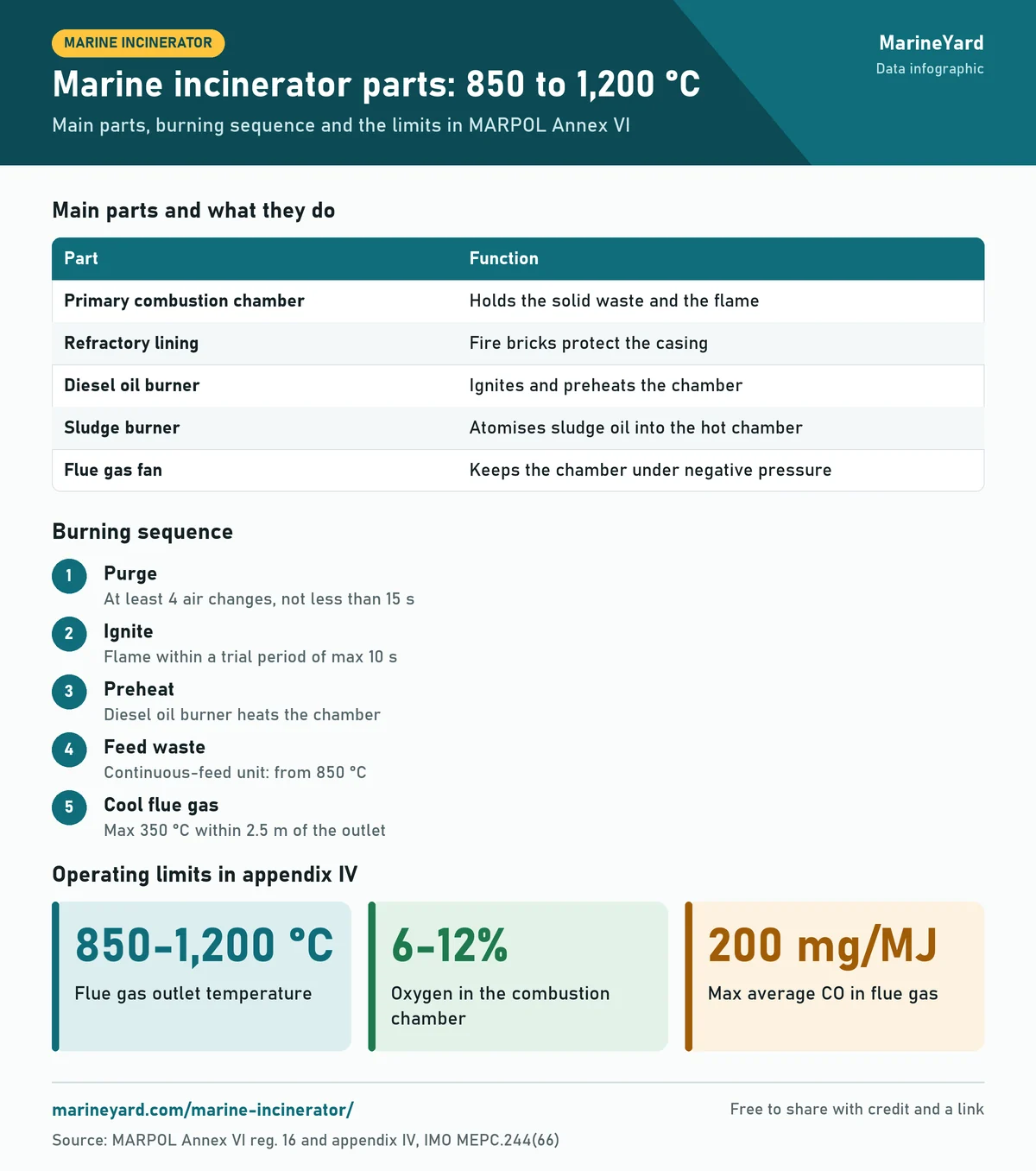
A marine incinerator is a shipboard furnace that burns waste generated during the normal operation of the ship, mainly sludge oil and solid garbage. MARPOL...
 Ship Machinery
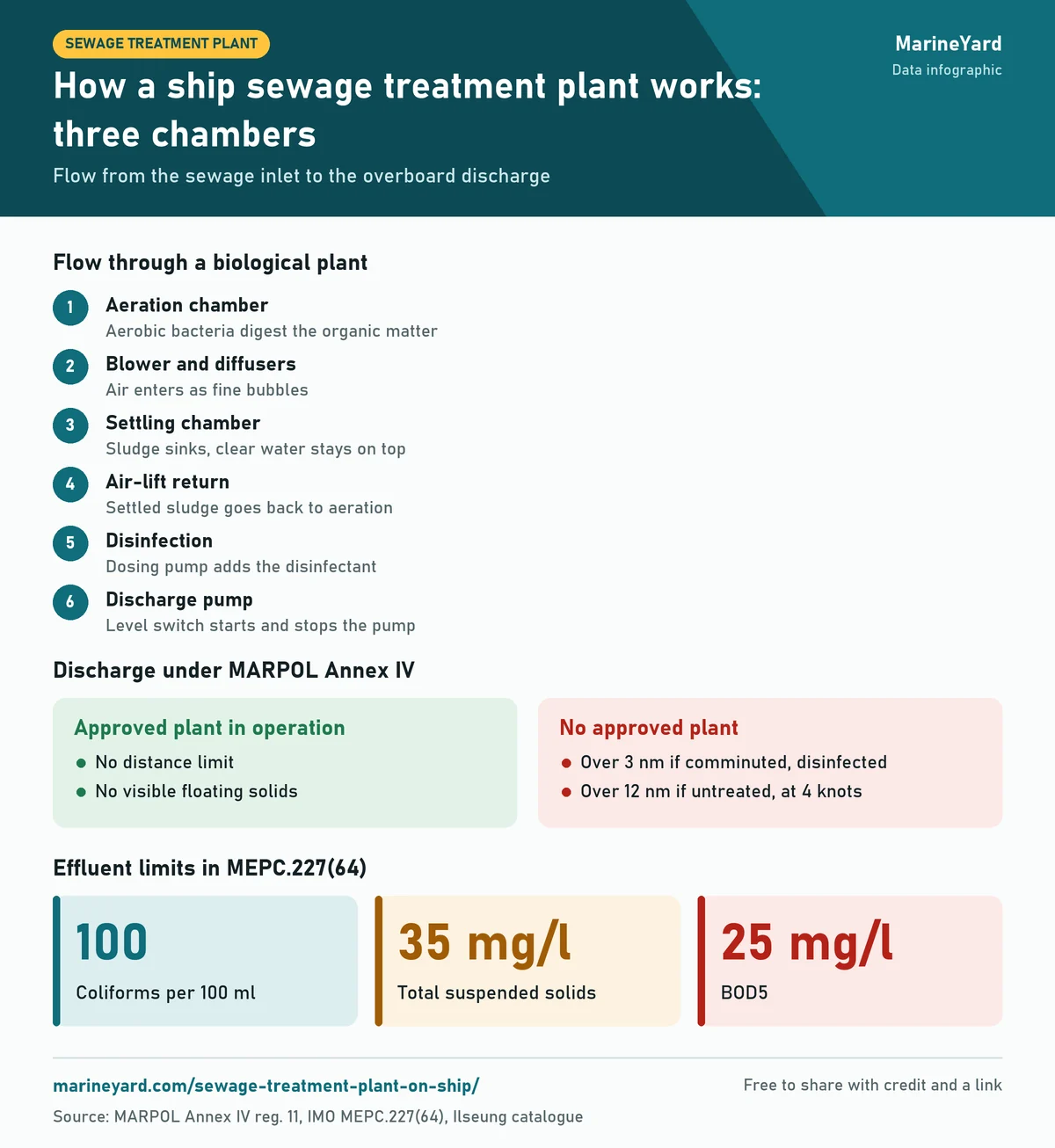
A sewage treatment plant on a ship is the machine that treats toilet and medical drainage with aerobic bacteria, settles the solids and disinfects the water...
 Ship Machinery
A fresh water generator is the machine on a ship that turns seawater into fresh water by vacuum distillation. The fresh water generator boils seawater at...