Ship Boiler: Types, Mountings, Working and Marine Boiler Rules
Marine engineers & industry writers
Updated
Nov 19, 2026
A ship boiler is a closed pressure vessel that turns feed water into steam with heat from an oil or gas burner, from engine exhaust gas, or from both. A ship boiler on a motor ship is an auxiliary boiler: the steam heats fuel, cargo and accommodation and does not drive the propeller.
Marine boilers are built as fire tube (smoke tube) or water tube units. SOLAS chapter II-1, regulation 32 sets the basic safety fittings, and the classification society surveys each boiler at fixed intervals.
Key facts
| Attribute | Value |
|---|---|
| Main types | Oil-fired auxiliary, exhaust gas (economizer) and composite; fire tube or water tube |
| Safety valves | Not less than two on every steam boiler and unfired steam generator (SOLAS II-1, regulation 32) |
| Water level indicators | At least two on a boiler designed to hold water at a set level, one of them a direct reading gauge glass (SOLAS II-1, regulation 32) |
| Internal survey | Minimum two in each 5-year class period, not more than 36 months apart (IACS UR Z18) |
| External survey | Every year, within the annual survey window (IACS UR Z18) |
| Large oil-fired auxiliary boiler | 12,500 to 45,000 kg/h of steam at 9 or 18 bar(g) design pressure (Alfa Laval Aalborg OL) |
| Soot ignition temperature | About 300 to 400 °C; as low as 150 °C with unburned oil in the soot (Alfa Laval) |
What is a ship boiler?
A ship boiler is an apparatus that produces steam for main propulsion or for auxiliary machinery, as the Wärtsilä encyclopedia entry on boilers defines it. The boiler has a steel shell or drums, tubes, a furnace with a burner or an exhaust gas passage, and a set of valves and gauges called mountings.
Why does a motor ship need steam?
A motor ship needs steam because steam is the usual heating medium on board. Heavy fuel oil must be heated before it can be pumped, cleaned and injected. Steam also heats cargo tanks and the accommodation and drives cargo pump turbines on tankers.
- Fuel heating. Steam heats heavy fuel oil in the storage, settling and service tanks, before each purifier and before the engine.
- Tankers. Steam heats the cargo tanks and drives the cargo oil pump turbines, so tankers carry the largest auxiliary boilers.
- Service loads. Steam heats the accommodation, hot water and, on some ships, the fresh water generator.
Main propulsion boilers are found on steam turbine ships. LNG carriers were traditionally steam ships, and the boilers burned the cargo boil-off gas.
What are the types of marine boiler?
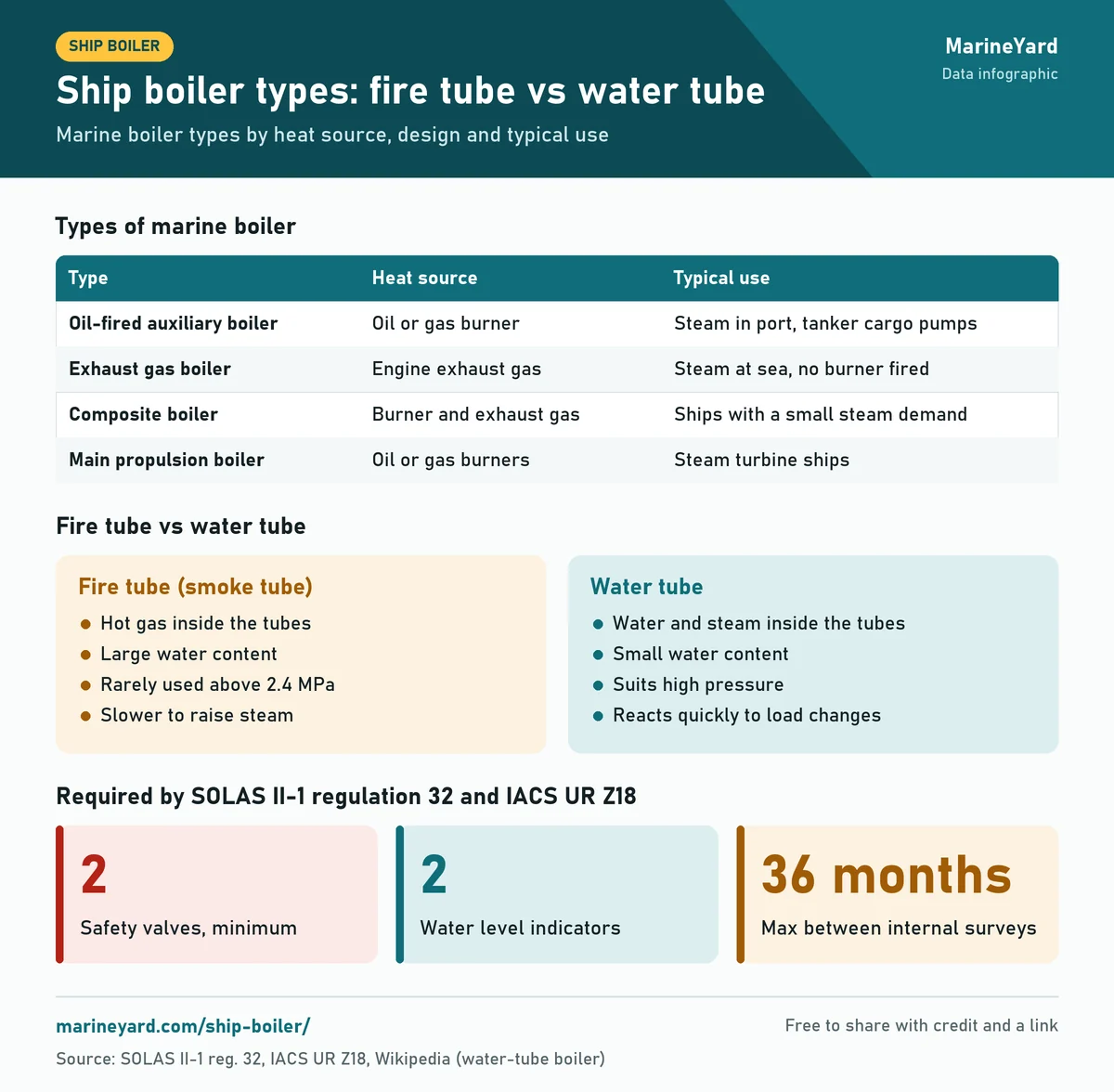
The types of marine boiler are the oil-fired auxiliary boiler, the exhaust gas boiler or economizer, the composite boiler and the main propulsion boiler. Each type is built as a fire tube (smoke tube) design, a water tube design or a mix of both.
| Type | Heat source | Design | Typical use |
|---|---|---|---|
| Oil-fired auxiliary boiler | Oil or gas burner | Vertical cylindrical, or two-drum water tube | Steam in port and at low engine load; tanker cargo pumps |
| Exhaust gas boiler (economizer) | Engine exhaust gas | Smoke tube or water tube | Steam at sea without firing a burner |
| Composite boiler | Burner and exhaust gas | Fired section and exhaust gas section in one shell | Ships with a small steam demand |
| Main propulsion boiler | Oil or gas burners | Water tube with superheater | Steam turbine ships |
The Alfa Laval Aalborg OL is a large top-fired boiler rated at 12,500 to 45,000 kg/h with a design pressure of 9 or 18 bar(g). The Aalborg OC-TCi composite boiler produces 1,200 to 6,500 kg/h on the oil-fired side and 300 to 5,000 kg/h on the exhaust gas side.
The Scotch marine boiler is the historic fire tube type, with a short horizontal shell, large furnaces below and many small return tubes above. The Wikipedia article on the Scotch marine boiler notes that RMS Titanic had 29 such boilers at a working pressure of 215 psi (1,480 kPa).
What is the difference between a fire tube and a water tube boiler?
A fire tube boiler passes the hot gas through tubes that are surrounded by water inside the shell. A water tube boiler passes the water through tubes that are heated from outside by the furnace gas. The water tube boiler holds less water and suits higher pressures and larger outputs.
| Attribute | Fire tube (smoke tube) | Water tube |
|---|---|---|
| Inside the tubes | Hot gas | Water and steam |
| Water content | Large | Small |
| Pressure capability | Rarely used above 2.4 MPa (350 psi) | High; no large thick-walled shell is needed |
| Raising steam and load changes | Slower, because more water is heated | Faster; reacts quickly to load changes |
| Typical marine use | Small auxiliary, composite and smoke tube exhaust gas boilers | Large auxiliary boilers, main boilers, economizers |
The pressure figure comes from the Wikipedia article on water-tube boilers.
What are the boiler mountings on a ship boiler?
Boiler mountings are the valves, gauges and fittings attached directly to the boiler shell or drum. SOLAS chapter II-1, regulation 32 requires not less than two safety valves on every steam boiler. A boiler designed to hold water at a set level needs at least two means of indicating the water level, one of which is a direct reading gauge glass.
| Mounting or fitting | Function |
|---|---|
| Safety valves (two or more) | Release steam to prevent overpressure |
| Main steam stop valve | Isolates the boiler from the steam line |
| Feed check valves | Admit feed water and prevent backflow |
| Water level gauges (two or more) | Show the water level; one is a direct reading gauge glass |
| Low water level alarm and burner cut-out | Gives an alarm and shuts off the fuel |
| Pressure gauge | Shows the steam pressure |
| Blowdown valve and scum valve | Remove bottom sludge and floating surface impurities |
| Air vent | Releases air during filling and steam raising |
| Manhole and handhole doors | Give access for inspection and cleaning |
| Burner with flame scanner | Burns the fuel; the scanner detects flame failure |
| Soot blowers | Clean the tubes with steam or compressed air |
Regulation 32 also requires an automatic fuel shut-off and an alarm on every oil-fired boiler that runs without manual supervision. The shut-off acts on low water level, air supply failure or flame failure. Flag state rules such as the Isle of Man cargo ship construction regulations carry the same requirements. The Administration may accept one safety valve on a small boiler with adequate overpressure protection.
How does a ship boiler work?
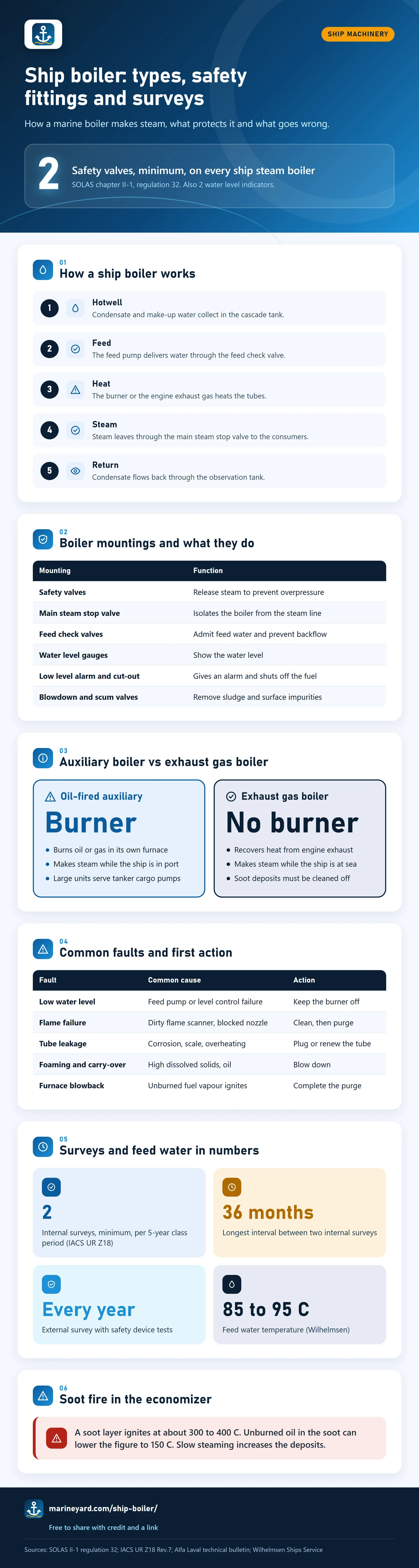
A ship boiler works in a closed loop. A feed pump delivers water from the hotwell to the boiler. The burner or the exhaust gas heats the water until it boils. Steam flows to the consumers, condenses and returns to the hotwell as condensate.
- Condensate and make-up water collect in the hotwell (cascade tank).
- The feed pump delivers the water through the feed check valve.
- The burner fires into the furnace after an air purge. In an exhaust gas boiler, engine exhaust heats the tubes.
- Heat passes through the furnace wall and the tubes, and steam rises to the steam space or steam drum.
- Steam leaves through the main steam stop valve and condenses in the heating coils, heaters or turbines.
- The condensate returns to the hotwell through an observation tank, which shows oil from a leaking heating coil.
- The controls hold the water level with the feed flow and the steam pressure with the burner load.
How is ship boiler water treated and tested?
Ship boiler water is treated with chemicals that control alkalinity, hardness and dissolved oxygen, and the crew tests a boiler water sample on board. The treatment prevents corrosion, scale and carry-over. The boiler maker and the chemical supplier state the limits for each boiler.
| Test | Why it is controlled |
|---|---|
| Alkalinity and pH | Alkaline water limits corrosion of steel |
| Chlorides | A rising value shows sea water contamination |
| Phosphate | A reserve turns hardness salts into sludge instead of scale |
| Oxygen scavenger reserve | Hydrazine or DEHA removes dissolved oxygen |
| Conductivity (total dissolved solids) | High dissolved solids cause foaming and carry-over |
Blowdown removes concentrated boiler water and sludge. The Wilhelmsen guide to corrosion prevention in steam boiler systems recommends a feed water temperature of 85 to 95 °C, which lowers the dissolved oxygen to about 2.3 to 1 ppm. The supplier recommends daily tests.
What are the common ship boiler faults?
Common ship boiler faults are low water level, flame failure, tube leakage, soot fire in the exhaust gas economizer, foaming with carry-over, and furnace blowback. Low water level is the most dangerous fault, because uncovered heating surfaces overheat.
| Fault | Common cause | Sign | Action |
|---|---|---|---|
| Low water level | Feed pump or level control failure, tube leak | Level alarm; burner trips | Keep the burner off; find the cause before refilling |
| Flame failure | Dirty flame scanner, blocked nozzle, water in fuel | Burner trips | Clean scanner and nozzle; purge before a new start |
| Tube leakage | Corrosion, scale, overheating | High feed water use; water in the furnace | Plug or renew the tube; inform class |
| Soot fire in the economizer | Soot deposits, slow steaming, unburned oil | High gas outlet temperature; sparks from the funnel | Follow the maker's emergency procedure |
| Foaming, priming and carry-over | High dissolved solids, oil in the water | Unsteady level; water in the steam lines | Blow down; use the scum valve |
| Furnace blowback | Unburned fuel vapour ignites after a failed start | Flame blows out of the furnace front | Complete the purge before each ignition |
An Alfa Laval technical bulletin for exhaust gas boilers states that a soot layer ignites at about 300 to 400 °C and that unburned oil can lower the figure to 150 °C. The bulletin recommends soot blowing at least two to three times a day during slow steaming, at an engine load of at least 75%.
How often is a ship boiler surveyed?
A ship boiler is surveyed internally at least twice in every 5-year class period, and the interval between two internal examinations must not exceed 36 months. A ship boiler is surveyed externally every year. IACS Unified Requirement Z18 sets these minimum intervals for member class societies.
- The internal survey covers all boilers of essential service, and other boilers above 3.5 bar working pressure and 4.5 m² heating surface.
- The surveyor examines the water-steam side and the fire side, and verifies the safety valve setting.
- The annual external survey includes tests of the safety devices and the safety valve easing gear.
Who makes marine boilers?
Marine boilers are made by specialist companies. Alfa Laval makes the Aalborg range of oil-fired boilers, composite boilers and exhaust gas economizers. Saacke makes marine boilers, burners and gas combustion units. Kangrim Heavy Industries makes auxiliary boilers, composite boilers and exhaust gas economizers. Mitsubishi Heavy Industries Marine Machinery and Equipment makes auxiliary boilers. Miura makes auxiliary and composite boilers.
Which ship boiler spare parts are ordered most often?
Ship boiler spare parts ordered most often are burner parts, gauge glasses, safety valve parts, door gaskets, feed pump parts, refractory and tubes. Burner nozzles, igniter electrodes and flame scanners wear in normal service. Door gaskets are renewed after an internal inspection.
- Burner. Nozzles, flame scanner (flame eye), igniter electrodes, solenoid valves.
- Mountings. Gauge glasses with packing, safety valve springs, discs and seats.
- Sealing and feed system. Manhole and handhole door gaskets, feed pump seals and bearings.
- Pressure parts and furnace. Tubes, tube plugs and refractory.
A correct order states the following data:
- Ship name and IMO number.
- Boiler maker, type or model, and serial number from the nameplate.
- Year of build and working pressure.
- Burner maker and burner type, for any burner part.
- Part number from the boiler manual.
Gaskets, packing and gauge glasses often carry an IMPA code and can come from a ship chandler. Burner parts, safety valve parts and pressure parts are ordered by the maker's part number.
Where can ship boiler parts be bought or sold?
Ship boiler parts are bought from boiler makers, authorised service companies and surplus stockists. MarineYard is a ship spare parts marketplace where sellers list new, reconditioned and used boilers and heat exchangers and valves and fittings. Sellers get 9 free listings per account. MarineYard takes no commission and is not a party to any sale. Buyers should confirm the boiler model, serial number and part number with the seller before payment.
Frequently Asked Questions
How many safety valves does a ship boiler need?
A ship boiler needs not less than two safety valves under SOLAS chapter II-1, regulation 32. The flag Administration may accept one valve on a small boiler. Class verifies the valve setting at each internal boiler survey.
What is the difference between an auxiliary boiler and an exhaust gas boiler?
An auxiliary boiler burns oil or gas in its own furnace and makes steam in port or at low engine load. An exhaust gas boiler has no burner and makes steam from engine exhaust heat while the ship is at sea.
What is a composite boiler on a ship?
A composite boiler on a ship is one boiler with two heating sections. The fired section has a burner, and the exhaust gas section takes engine exhaust. One unit replaces a separate auxiliary boiler and economizer.
Why is a ship boiler blown down?
A ship boiler is blown down to remove sludge and to lower the concentration of dissolved solids in the boiler water. High dissolved solids cause foaming and carry-over. The scum valve removes oil and floating impurities from the water surface.
What causes a soot fire in an exhaust gas economizer?
A soot fire in an exhaust gas economizer is caused by soot deposits that ignite on the tubes. Alfa Laval gives an ignition temperature of about 300 to 400 °C and as low as 150 °C when the soot holds unburned oil. Slow steaming increases the deposits.
What is a boiler hotwell on a ship?
A boiler hotwell on a ship is the tank that collects returning condensate and make-up water and supplies the feed pumps. The hotwell is also called the cascade tank. Heating the hotwell water lowers the dissolved oxygen content.
Related guides
- Stern tube: parts, bearings, seals and lubrication
- IMPA code: meaning and structure
- Ship chandler: meaning and services
- Oily water separator: working, parts and the 15 ppm rule
- Marine turbocharger: parts, working and surging
- Purifier in ship: working principle, parts and faults
- Cylinder liner: function, wear and gauging
- Anchor windlass: parts, working and class rules
Sources
- IMO, SOLAS chapter II-1, regulation 32, steam boilers and boiler feed systems (text as applied in the Isle of Man Merchant Shipping (Cargo Ship Construction) Regulations 1998, regulations 31 and 32)
- IACS Unified Requirement Z18, Periodical Survey of Machinery, Rev.7 (June 2017), section 2
- Wärtsilä Encyclopedia of Marine and Energy Technology, boiler
- Alfa Laval, Aalborg OL
- Alfa Laval, Aalborg OC-TCi
- Alfa Laval, Technical Bulletin for exhaust gas boilers (slow steaming and soot fires)
- Wilhelmsen Ships Service, Corrosion Prevention in Steam Boiler Systems
- Wikipedia, Scotch marine boiler
- Wikipedia, Water-tube boiler
Sign in to leave a comment and join the discussion.
 Ship Machinery
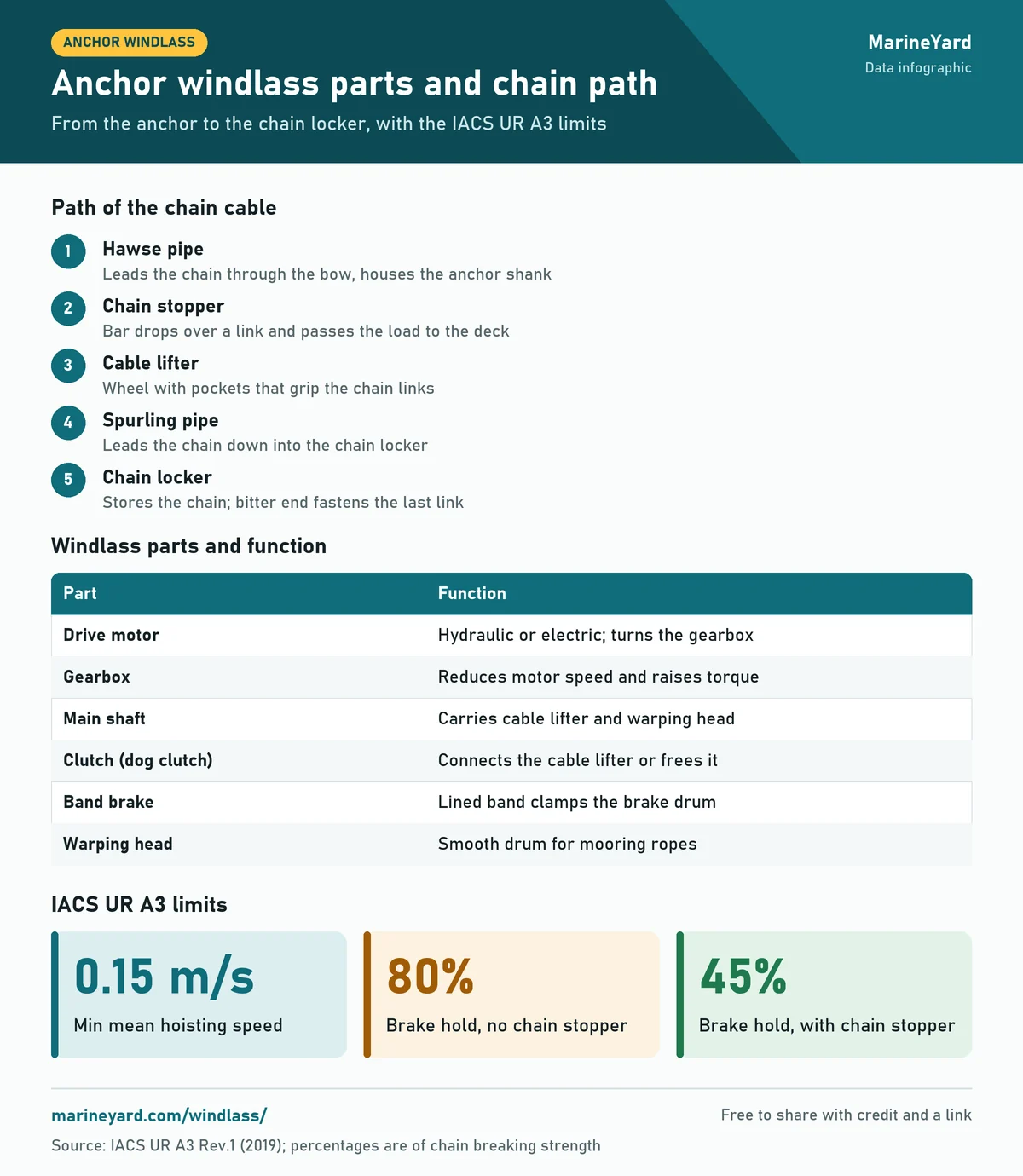
A windlass is the deck machine on a ship that heaves up, lowers and holds the anchor and its chain cable. The windlass stands on the forecastle deck. A...
 Ship Machinery
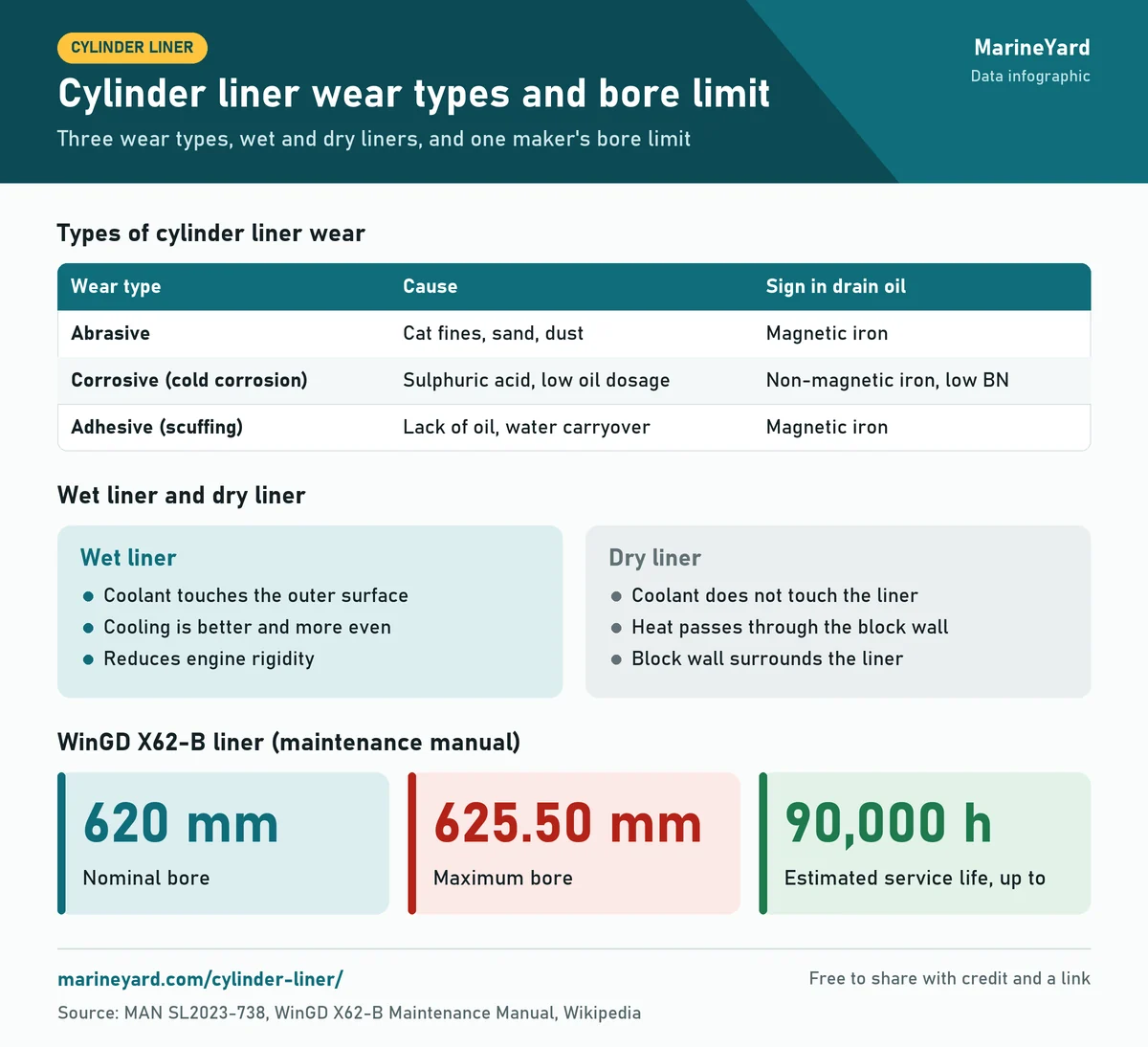
A cylinder liner is the replaceable cylindrical sleeve that forms the wall of an engine cylinder. The cylinder liner closes the side of the combustion...
 Ship Machinery
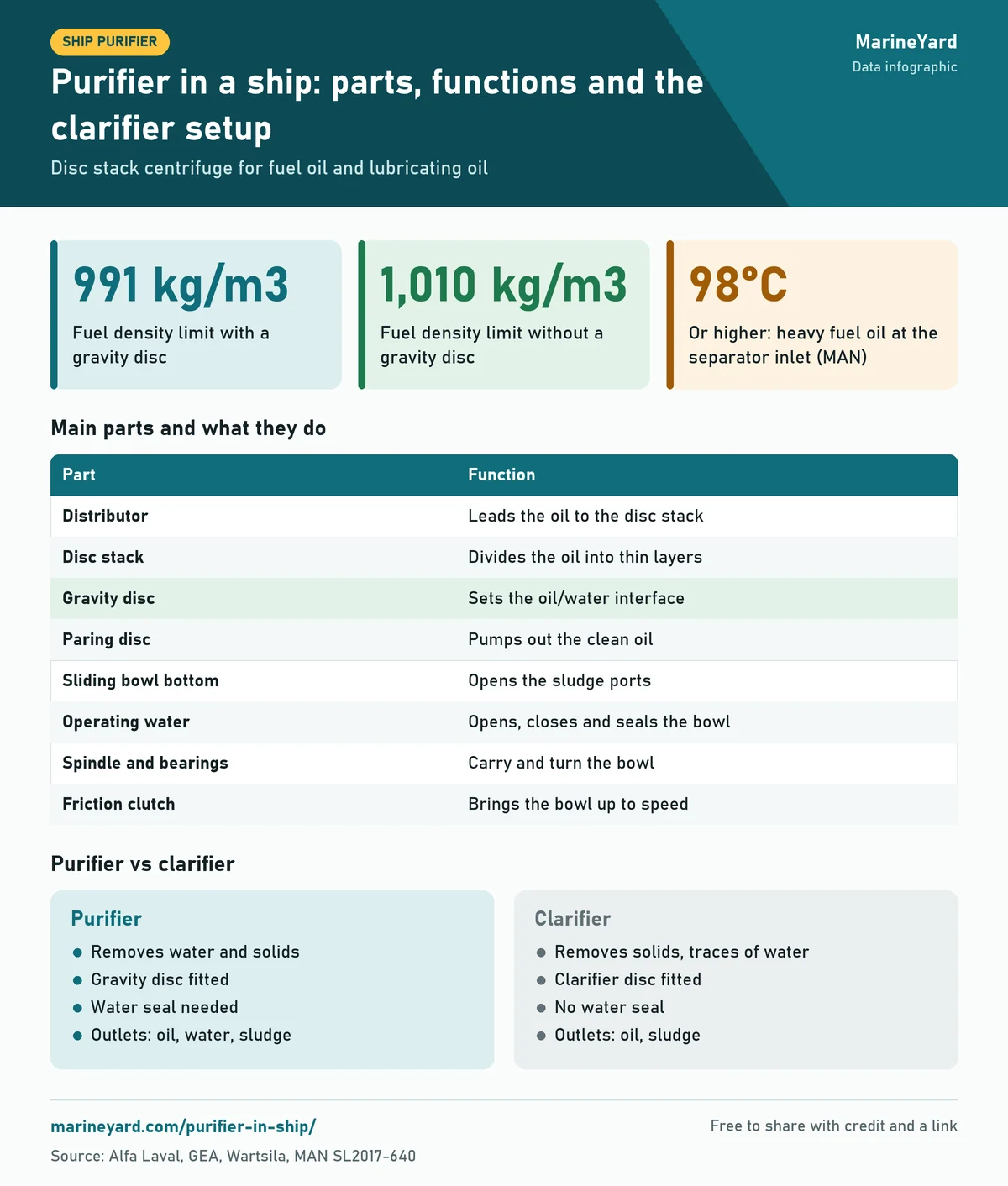
A purifier in a ship is a centrifugal separator that removes water and solid particles from fuel oil and lubricating oil. The purifier spins the oil in a...