Sewage Treatment Plant on Ship: Working, Parts and MARPOL Rules
Marine engineers & industry writers
Updated
Nov 22, 2026
A sewage treatment plant on a ship is the machine that treats toilet and medical drainage with aerobic bacteria, settles the solids and disinfects the water before discharge to the sea. A ship with an approved sewage treatment plant in operation may discharge the effluent at any distance from land under MARPOL Annex IV.
A ship without an approved plant must hold the sewage on board until the ship is more than 3 or 12 nautical miles from the nearest land. The 2012 IMO guidelines in resolution MEPC.227(64) set the effluent standard for plants installed on or after 1 January 2016.
Key facts
| Attribute | Value |
|---|---|
| Governing rule | MARPOL Annex IV, revised by MEPC.115(51), in force since 1 August 2005 |
| Ships covered | Ships on international voyages of 400 gross tonnage (GT) and above, or certified to carry more than 15 persons |
| Discharge with an approved plant in operation | No distance limit; no visible floating solids and no discoloration of the water (regulation 11) |
| Comminuted and disinfected sewage | More than 3 nautical miles from the nearest land |
| Untreated sewage | More than 12 nautical miles, ship en route at not less than 4 knots, at an approved moderate rate |
| Current type approval standard | MEPC.227(64), for plants installed on or after 1 January 2016 |
| Effluent limits in MEPC.227(64) | 100 thermotolerant coliforms per 100 ml, TSS 35 mg/l, BOD5 25 mg/l, COD 125 mg/l, pH 6 to 8.5 |
| Certificate | International Sewage Pollution Prevention Certificate, valid for not more than 5 years |
What is a sewage treatment plant on a ship?
A sewage treatment plant on a ship is a type-approved tank unit that receives sewage from the accommodation, breaks down the organic matter biologically and disinfects the treated water. The plant is one of three sewage systems that MARPOL Annex IV accepts. The other two are a comminuting and disinfecting system and a holding tank.
Annex IV defines sewage as drainage from toilets and urinals, drainage from medical premises, drainage from spaces with living animals, and other waste water mixed with these.
| Sewage system (regulation 9) | What the system does | Where discharge is allowed (regulation 11) |
|---|---|---|
| Approved sewage treatment plant | Treats and disinfects sewage to the IMO effluent standard | Any distance, with the plant in operation |
| Comminuting and disinfecting system | Cuts up the solids and disinfects the flow | More than 3 nautical miles from the nearest land |
| Holding tank | Stores all sewage on board | More than 12 nautical miles, en route at 4 knots or more, or to a reception facility |
What are the parts of a ship sewage treatment plant?
The parts of a ship sewage treatment plant are a tank divided into an aeration chamber, a settling chamber and a disinfection chamber, an air blower or compressor, aeration elements, an air-lift sludge return, a disinfectant dosing unit, level switches, a discharge pump and a control panel.
| Part | Function |
|---|---|
| Aeration chamber | Holds the sewage while aerobic bacteria digest the organic matter |
| Air blower or compressor | Delivers the air that the bacteria need |
| Aeration elements (diffusers) | Release the air as fine bubbles and mix the chamber |
| Settling chamber | Lets the sludge sink so that clear water flows on |
| Air-lift sludge return | Lifts settled sludge back to the aeration chamber with air |
| Dosing pump and chemical tank | Add a disinfectant such as sodium hypochlorite (NaOCl) |
| Level switches | Start the discharge pump at high level, stop the pump at low level and give a high level alarm |
| Discharge pump | Pumps the effluent overboard or to the shore connection |
The Ilseung sewage treatment plant catalogue shows this layout with a blower, fine-bubble aeration elements, an air-lift return and a level switch with high start, low stop and high alarm. The Hamworthy Super Trident scope of supply lists a main tank, an air compressor, a discharge pump, a control panel and chlorination systems.
What are the types of marine sewage treatment plant?
The types of marine sewage treatment plant are biological plants with chlorine disinfection, biofilm carrier plants, membrane bioreactors and maceration-chlorination units. The first three types use aerobic bacteria to digest the organic matter. A maceration-chlorination unit has no biological stage.
| Type | Treatment principle | Disinfection |
|---|---|---|
| Activated sludge | Aerobic bacteria in suspension, settling, sludge return | Chlorine, often with dechlorination |
| Biofilm carrier (MBBR) | Bacteria grow on carrier media in the aerated tank | Sodium hypochlorite on the Ilseung ISB series |
| Membrane bioreactor (MBR) | Aerobic biological treatment followed by ultrafiltration | UV light |
| Maceration-chlorination | Screening and maceration, no biological stage | Chlorine |
The US EPA Cruise Ship Discharge Assessment Report describes the biological type as aerobic treatment, clarification and final chlorine disinfection, with a return of biosolids.
How does a biological sewage treatment plant work?
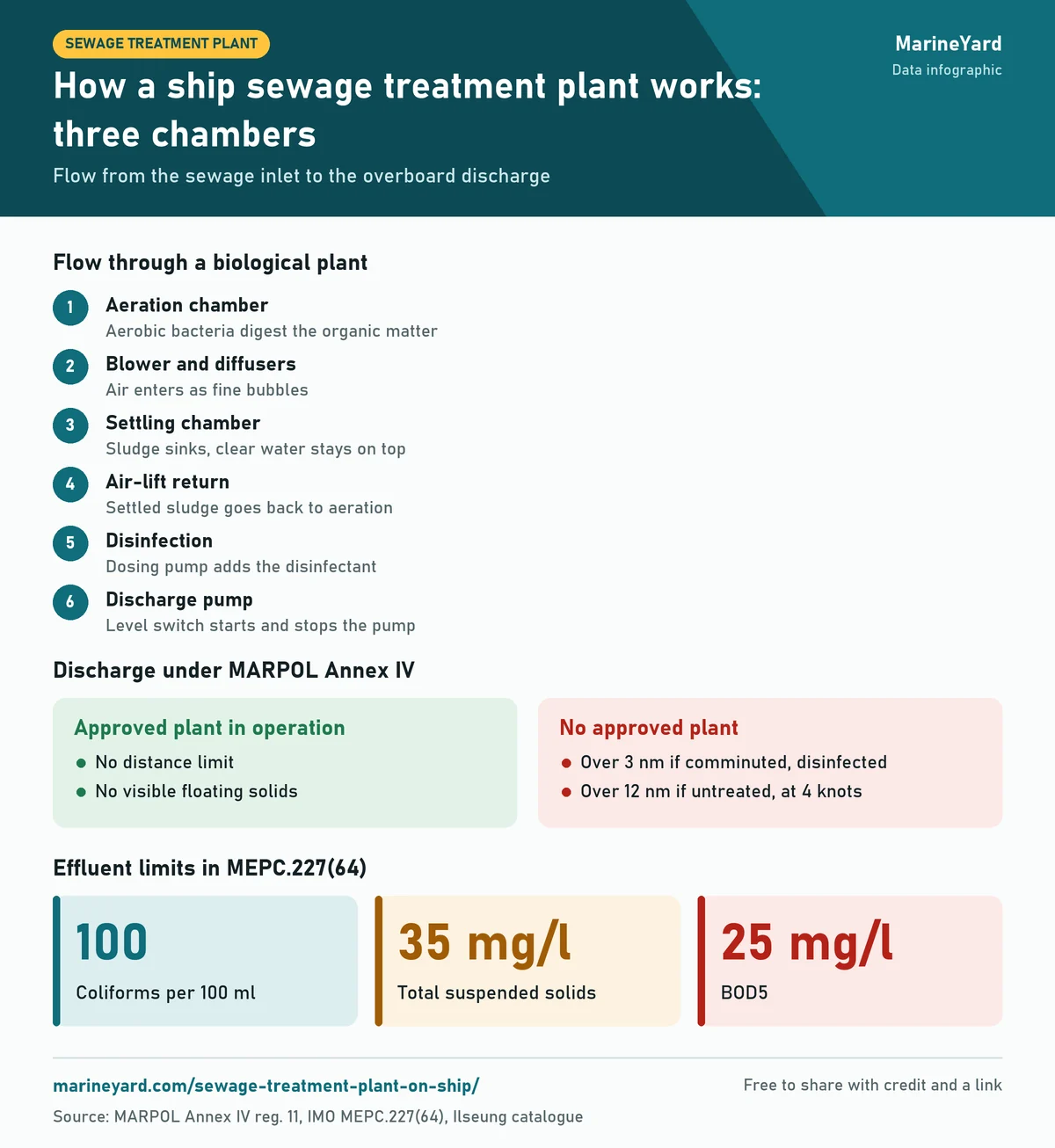
A biological sewage treatment plant works in three chambers. Aerobic bacteria digest the organic matter in the aeration chamber. Sludge settles in the settling chamber and returns to the aeration chamber. A disinfectant kills the remaining coliform bacteria in the last chamber, and a pump discharges the effluent.
- Sewage flows by gravity or from a vacuum collection system into the aeration chamber.
- The blower or compressor sends air to the aeration elements at the bottom of the chamber.
- Aerobic bacteria use the oxygen and digest the organic matter. The bacteria form the activated sludge.
- The mixture flows to the settling chamber. The sludge sinks and the clear water stays at the top.
- The air lift returns the settled sludge to the aeration chamber.
- The clear water overflows to the disinfection chamber. The dosing pump adds the disinfectant.
- The level switch starts the discharge pump at high level and stops the pump at low level.
IMO rules do not require a continuous effluent monitor on the plant. An oily water separator has a 15 ppm alarm that stops the discharge, but a sewage plant keeps discharging until a person stops the plant, as the Marinfloc handbook on black and grey water points out.
What does MARPOL Annex IV require for sewage discharge?
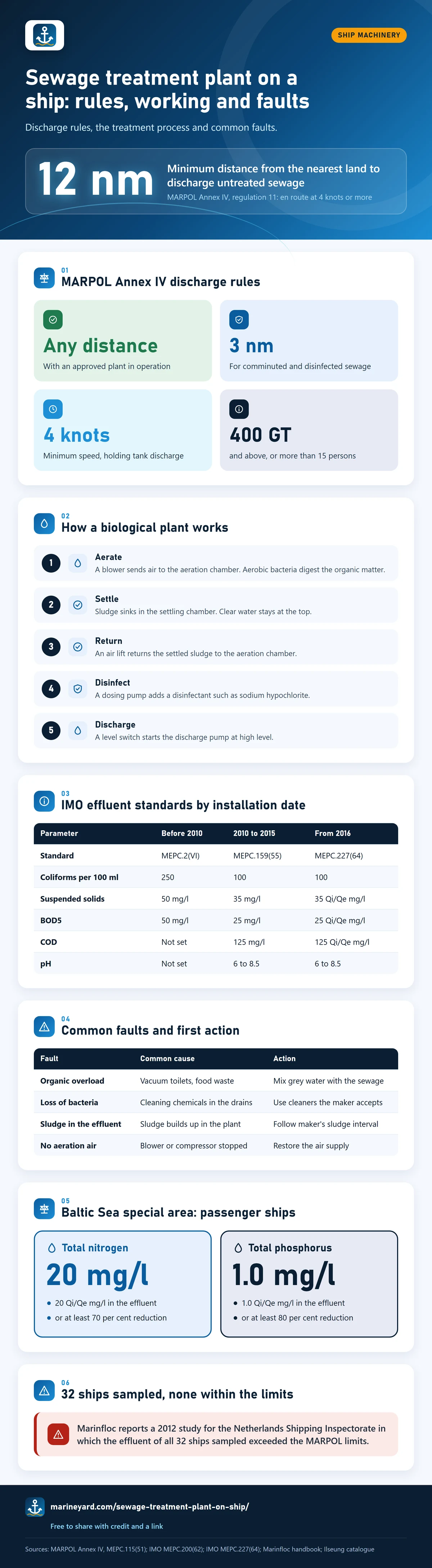
MARPOL Annex IV regulation 11 prohibits the discharge of sewage into the sea unless one of two conditions is met. The ship has an approved sewage treatment plant in operation, or the ship is more than 3 nautical miles from the nearest land with comminuted and disinfected sewage and more than 12 nautical miles with untreated sewage.
- Approved plant in operation. The effluent must not produce visible floating solids or discolour the surrounding water (regulation 11.1.2).
- Sewage from holding tanks. The discharge is not instantaneous. The ship is en route at not less than 4 knots and uses a moderate rate approved by the flag Administration.
- Baltic Sea special area. A passenger ship may discharge only through an approved plant that also meets the nitrogen and phosphorus standard.
The distances are in regulation 11 of the revised MARPOL Annex IV, resolution MEPC.115(51). Resolution MEPC.157(55) sets the moderate rate at 1/200,000 of the swept volume.
Resolution MEPC.200(62) made the Baltic Sea a special area and entered into force on 1 January 2013. The IMO page on sewage from ships gives the dates when the Baltic rule took effect: 1 June 2019 for new passenger ships and 1 June 2021 for most existing passenger ships.
States may apply their own rules inside their waters, so the crew checks the local requirements before discharge.
What effluent standard does MEPC.227(64) set?
MEPC.227(64) sets five effluent limits for type approval: a geometric mean of 100 thermotolerant coliforms per 100 ml, 35 mg/l total suspended solids, 25 mg/l BOD5, 125 mg/l chemical oxygen demand and a pH between 6 and 8.5. The solids and oxygen demand limits are multiplied by the dilution compensation factor Qi/Qe.
| Parameter | MEPC.2(VI), before 2010 | MEPC.159(55), 2010 to 2015 | MEPC.227(64), from 2016 |
|---|---|---|---|
| Coliforms per 100 ml | 250 (faecal) | 100 (thermotolerant) | 100 (thermotolerant) |
| Total suspended solids | 50 mg/l (test ashore) | 35 mg/l | 35 Qi/Qe mg/l |
| BOD5 | 50 mg/l | 25 mg/l | 25 Qi/Qe mg/l |
| COD | Not set | 125 mg/l | 125 Qi/Qe mg/l |
| pH | Not set | 6 to 8.5 | 6 to 8.5 |
The standard that applies to a plant depends on the installation date, not on the age of the ship. Resolution MEPC.227(64) was adopted on 5 October 2012. The type approval test lasts at least 10 days.
Section 4.2 adds a nutrient standard for passenger ships that discharge in a special area. Total nitrogen is 20 Qi/Qe mg/l or at least 70 per cent reduction. Total phosphorus is 1.0 Qi/Qe mg/l or at least 80 per cent reduction.
How is a sewage treatment plant operated and maintained?
A sewage treatment plant is operated automatically and runs unattended in normal service. The crew keeps the air supply, the disinfectant and the sludge level in order. MEPC.227(64) requires an operation and maintenance manual on board at all times. The maker defines the routine maintenance, and the crew records all routine and repair maintenance.
- Keep the air supply running. Aerobic bacteria need oxygen.
- Use only the toilet and drain cleaners that the plant maker accepts.
- Do not route food waste to the plant. Fit a grease trap on galley water.
- Do not drain the whole plant at sea. The biological stage needs several days to recover.
- Check the clarity of the effluent. A turbidity tube gives a quick indication of the suspended solids.
The ship's own procedures and the maker's manual take priority over any general guide.
What are the common faults of a ship sewage treatment plant?
The common faults of a ship sewage treatment plant are organic overload, loss of the bacteria after chemical use, sludge carry-over into the effluent and loss of aeration air. Marinfloc reports a 2012 study for the Netherlands Shipping Inspectorate in which the effluent of all 32 ships sampled exceeded the MARPOL limits.
| Fault | Common cause | Action |
|---|---|---|
| Organic overload | Vacuum toilet sewage of 3,000 to 5,000 mg/l BOD5 against a type test value of 500 mg/l; food waste | Mix grey water with the sewage; keep food waste out |
| Loss of bacteria | Cleaning chemicals in the drains; whole plant drained at sea | Change to cleaners that the maker accepts |
| Sludge in the effluent | Sludge builds up in the plant; no sludge tank | Remove sludge at the maker's interval |
| No air to the aeration chamber | Blower or compressor stopped; blocked aeration elements | Restore the air supply; start the standby unit |
Which sewage treatment plant spare parts are ordered most often?
Sewage treatment plant spare parts ordered most often are blower or compressor service parts, aeration elements, discharge pump seals and impellers, level switches, dosing pump parts, solenoid valves, manhole gaskets and the disinfectant chemical.
A correct order states the following data:
- Ship name and IMO number.
- Maker, model and serial number of the plant from the nameplate.
- Rated capacity in litres per day or in persons.
- Type approval standard on the certificate, for example MEPC.159(55) or MEPC.227(64).
- Part number and drawing number from the manual.
Gaskets, hoses and general consumables may carry an IMPA code and can come from a ship chandler. Blowers, level switches and aeration elements are ordered by the maker's part number.
Who makes marine sewage treatment plants?
Marine sewage treatment plants are made by specialist water and waste companies. Hamworthy makes the Super Trident activated sludge plant. ACO Marine makes the Maripur NF and Clarimar MF ranges. Evac makes membrane bioreactors and moving bed biofilm reactors. Marinfloc makes the Neptumatic ASTS. Ilseung of Korea makes the ISB and ISS series.
Where can sewage treatment plant parts be bought or sold?
Sewage treatment plant parts are bought from makers, authorised service companies and surplus stockists. MarineYard is a ship spare parts marketplace where sellers list new, reconditioned and used equipment, including pumps and compressors. Sellers get 9 free listings per account. MarineYard takes no commission and is not a party to any sale. Buyers should confirm the model, serial number and type approval certificate with the seller before payment.
Frequently Asked Questions
How far from land can a ship discharge sewage?
A ship can discharge untreated sewage more than 12 nautical miles from the nearest land, en route at not less than 4 knots. Comminuted and disinfected sewage needs more than 3 nautical miles. A ship with an approved sewage treatment plant in operation has no distance limit under MARPOL Annex IV.
What is the difference between black water and grey water on a ship?
Black water is drainage from toilets, urinals and medical premises, and MARPOL Annex IV regulates black water as sewage. Grey water is drainage from showers, washbasins, laundry and galley sinks. Grey water that is mixed with sewage is treated as sewage.
Why is air supplied to a sewage treatment plant?
Air is supplied to a sewage treatment plant because the aerobic bacteria need oxygen to digest the organic matter. The blower or compressor sends air through aeration elements in the aeration chamber. An air lift also returns the settled sludge to the aeration chamber.
Which ships must comply with MARPOL Annex IV?
MARPOL Annex IV applies to ships on international voyages of 400 gross tonnage and above. The Annex also applies to ships of less than 400 gross tonnage that are certified to carry more than 15 persons. Each ship carries an International Sewage Pollution Prevention Certificate.
Can a passenger ship discharge sewage in the Baltic Sea?
A passenger ship can discharge sewage in the Baltic Sea special area only through an approved sewage treatment plant that meets the nitrogen and phosphorus standard in section 4.2 of MEPC.227(64). A passenger ship without this plant delivers the sewage to a port reception facility.
Is the effluent of a ship sewage treatment plant measured continuously?
The effluent of a ship sewage treatment plant is not measured continuously under IMO rules. The limits are checked in the type approval test. A laboratory measures BOD5 over five days, so crews use the clarity of the effluent as a quick check.
Related guides
- Fresh Water Generator on Ships: Working, Parts and Types
- Ballast Water Treatment System: Types, Parts and D-2 Rules
- Stern tube: parts, bearings, seals and lubrication
- IMPA code: meaning and structure
- Ship chandler: meaning and services
- Oily water separator: working, parts and the 15 ppm rule
- Marine turbocharger: parts, working and surging
- Purifier in ship: working principle, parts and faults
- Cylinder liner: function, wear and gauging
- Ship boiler: types, mountings and water treatment
- Anchor windlass: parts, working and class rules
- Bow thruster: how it works, types and failures
- Steering gear: parts, types and SOLAS tests
- Marine air compressor: starting air, parts and safety
Sources
- IMO, Prevention of Pollution by Sewage from Ships
- IMO, resolution MEPC.115(51), revised MARPOL Annex IV (regulations 2, 9, 10 and 11)
- IMO, resolution MEPC.200(62), special area provisions and the Baltic Sea
- IMO, resolution MEPC.227(64), 2012 guidelines on effluent standards and performance tests for sewage treatment plants
- US EPA, Cruise Ship Discharge Assessment Report, section 2: sewage (EPA 842-R-07-005)
- Marinfloc, Black and Grey Water handbook, 2nd edition
- Hamworthy, Super Trident sewage treatment plant
- Ilseung, product catalogue: sewage treatment plant ISB and ISS series
Sign in to leave a comment and join the discussion.
 Ship Machinery
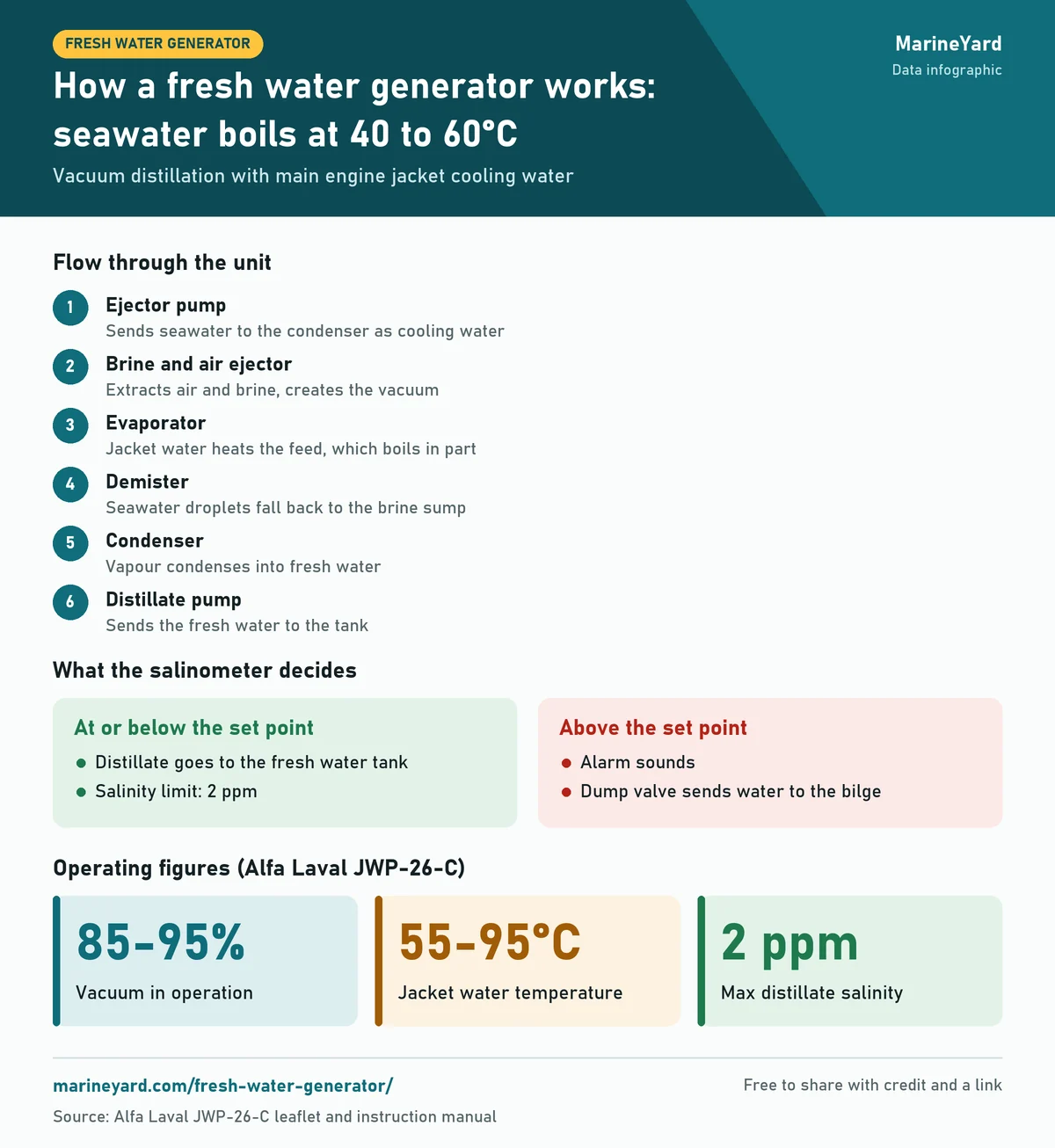
A fresh water generator is the machine on a ship that turns seawater into fresh water by vacuum distillation. The fresh water generator boils seawater at...
 Ship Machinery
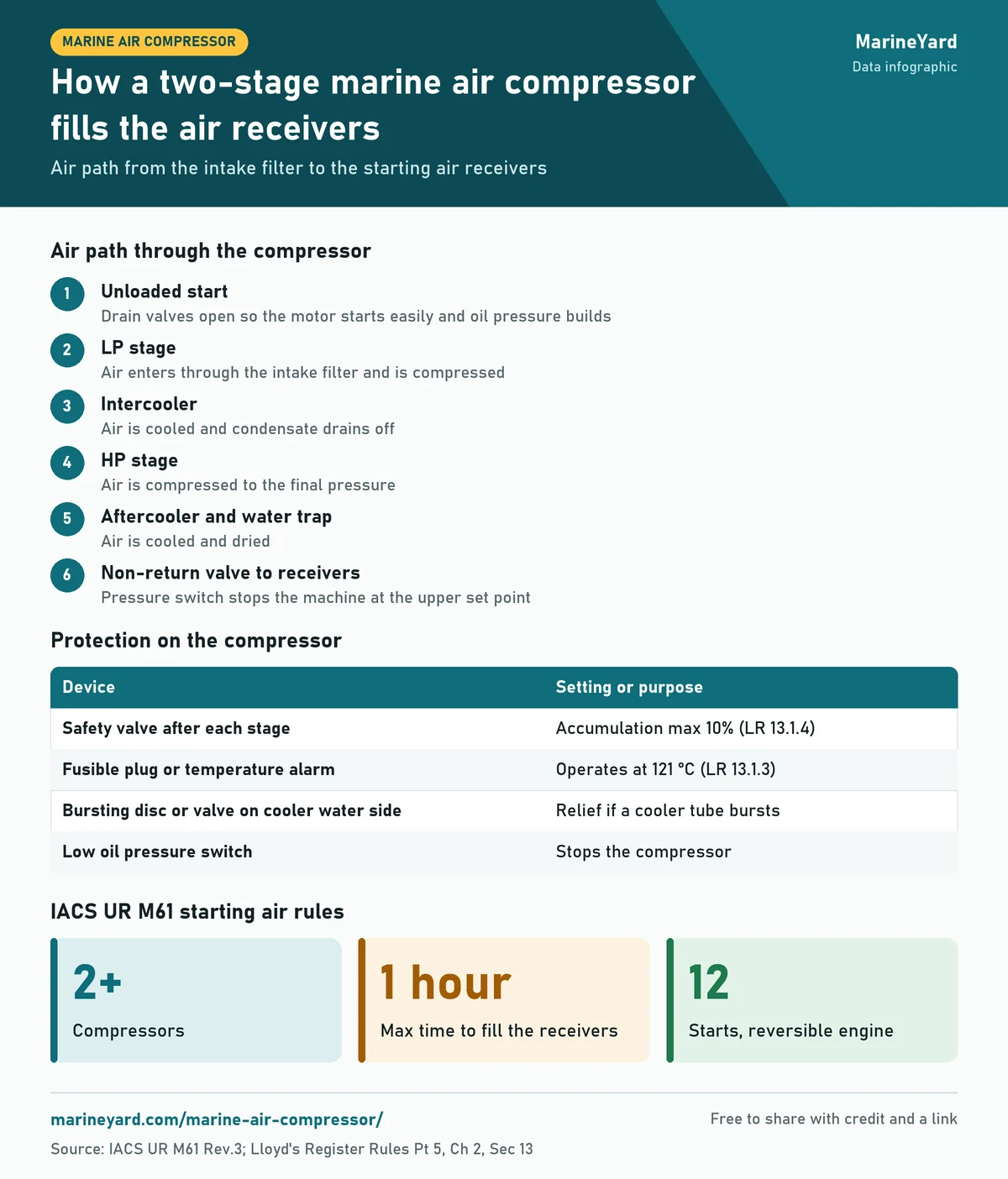
A marine air compressor is the machine in a ship's engine room that compresses atmospheric air and stores it in air receivers. The stored air starts the...
 Ship Machinery
A steering gear is the machinery on a ship that turns the rudder on orders from the bridge. The steering gear comprises the rudder actuators, the power...