Stern Tube in Ships: Parts, Bearings, Seals and Lubrication
Marine engineers & industry writers
Updated
Nov 18, 2026
A stern tube is a hollow tube of cast or fabricated steel that passes through the aft end of a ship's hull, between the aft peak bulkhead and the stern frame boss. The stern tube carries the propeller shaft, supports the shaft on one or two bearings, and seals the hull opening against sea water.
Most ocean-going ships run the shaft in oil inside the stern tube. Other ships run the shaft in sea water or fresh water. The lubricant decides the bearing material, the seal type and the spare parts on board.
Key facts
| Attribute | Value |
|---|---|
| Location | Aft peak bulkhead to stern frame boss |
| Standard bearing options | Centrifugally cast white metal or composite (Wärtsilä) |
| Average oil consumption | 2.6 litres per day; range under 1 to 20 litres per day (EPA 800-R-11-002) |
| US rule | 2013 Vessel General Permit, Part 2.2.9: EAL in all oil-to-sea interfaces unless technically infeasible |
| Class survey rule | IACS Unified Requirement Z21, Surveys of Propeller Shafts and Tube Shafts |
| Sea water flow, open system | Minimum 0.15 litre per minute per mm of shaft diameter (Thordon) |
What is a stern tube in a ship?
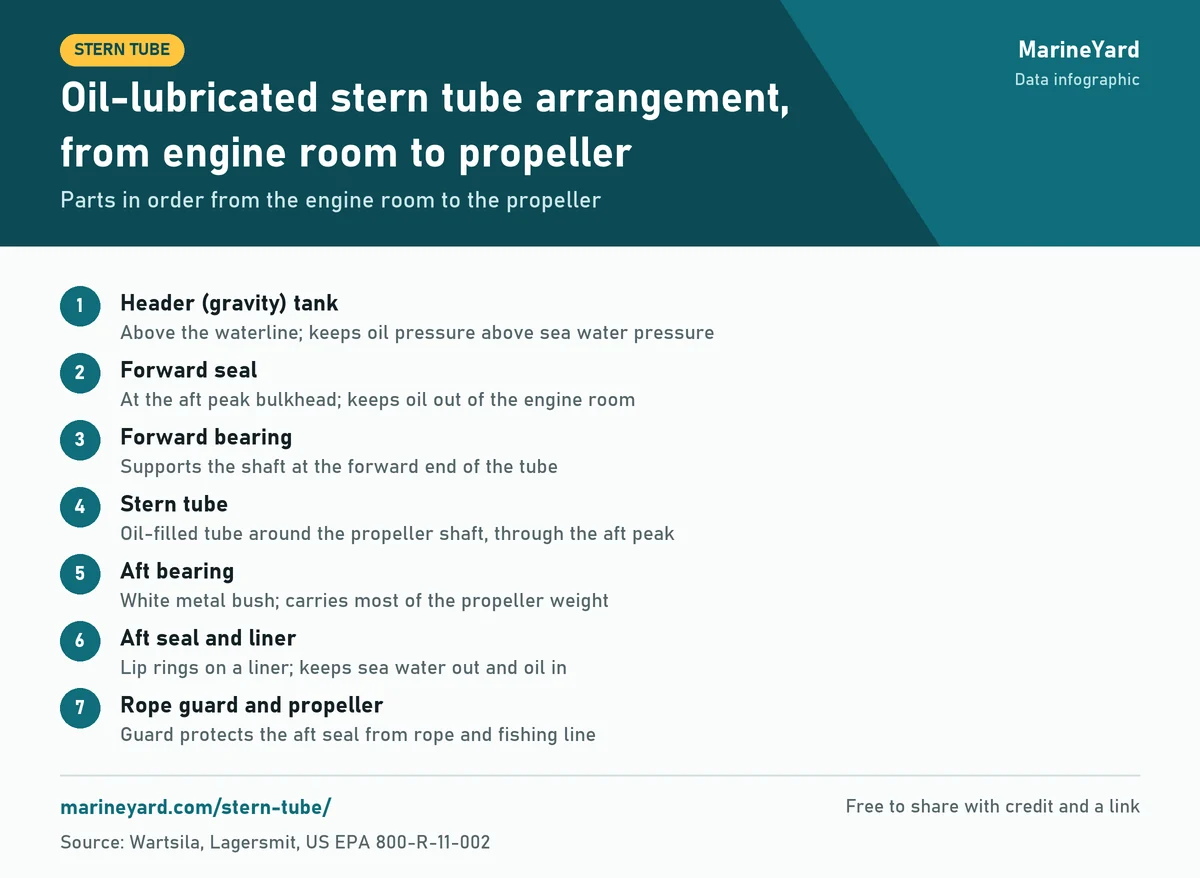
A stern tube in a ship is the watertight tube that lets the propeller shaft leave the hull. The stern tube is fixed at the forward end to the aft peak bulkhead and at the aft end to the stern frame boss. Bearings inside the tube carry the weight of the shaft and the propeller.
What are the parts of a stern tube?
The parts of a stern tube are the tube itself, an aft bearing, a forward bearing, an aft seal, a forward seal and the shaft liners that the seal rings run on. An oil-lubricated stern tube also has a header tank, pipework, temperature sensors and, on some ships, a circulating pump and cooler.
| Part | Function |
|---|---|
| Stern tube (casting or fabricated tube) | Forms the watertight passage and holds the bearings |
| Aft bush or bearing | Carries the largest load, including most of the propeller weight |
| Forward bush or bearing | Supports the shaft at the forward end |
| Aft (outboard) seal | Keeps sea water out of the tube and lubricant out of the sea |
| Forward (inboard) seal | Stops lubricant leaking into the engine room |
| Seal liners | Give the seal rings a hard running surface and protect the shaft |
| Header (gravity) tank | Keeps a static oil pressure in the tube and shows the oil level |
| Oil pump and cooler, where fitted | Circulate and cool the oil |
| Temperature sensors | Measure aft bearing temperature and feed the alarm system |
| Rope guard and net cutter | Protect the aft seal from ropes, nets and fishing line |
The aft liner is fixed to the propeller hub. The forward seal is connected to the aft peak bulkhead inside the engine room, as shown in the Lagersmit guide to stern tube seal arrangements.
What materials are stern tube bearings made of?
Stern tube bearings are made of white metal, rubber, or composite and polymer materials. White metal bearings run in oil. Rubber, composite and polymer bearings run mainly in water. Lignum vitae, a dense self-lubricating wood, was the usual water-lubricated bearing material on older ships and is now historic.
| Bearing material | Lubricant | Typical use |
|---|---|---|
| White metal (babbitt) lined shell | Mineral oil or EAL | Most merchant ships |
| Lignum vitae staves | Sea water | Older ships; historic |
| Rubber | Sea water or fresh water | Workboats, inland vessels, smaller ships |
| Composite or polymer | Water or oil, depending on grade | Water-lubricated ships, oil-to-water conversions |
Wärtsilä stern tube assemblies are supplied with centrifugally cast white metal bearings or composite bearings, depending on the lubricating medium.
How does stern tube lubrication work?
Stern tube lubrication works by keeping a film of oil or water between the rotating shaft and the bearing. In an oil system, a header tank above the waterline fills the tube and keeps the oil pressure above the sea water pressure. In a water system, pumped or flowing water lubricates and cools the bearings.
The header tank is a gravity tank. The height of the oil column sets the pressure at the shaft. A small positive pressure means that a worn aft seal leaks oil outwards instead of letting sea water in. The EPA report on environmentally acceptable lubricants describes the same principle for all pressurised oil systems below the waterline.
What is the difference between oil-lubricated and water-lubricated stern tubes?
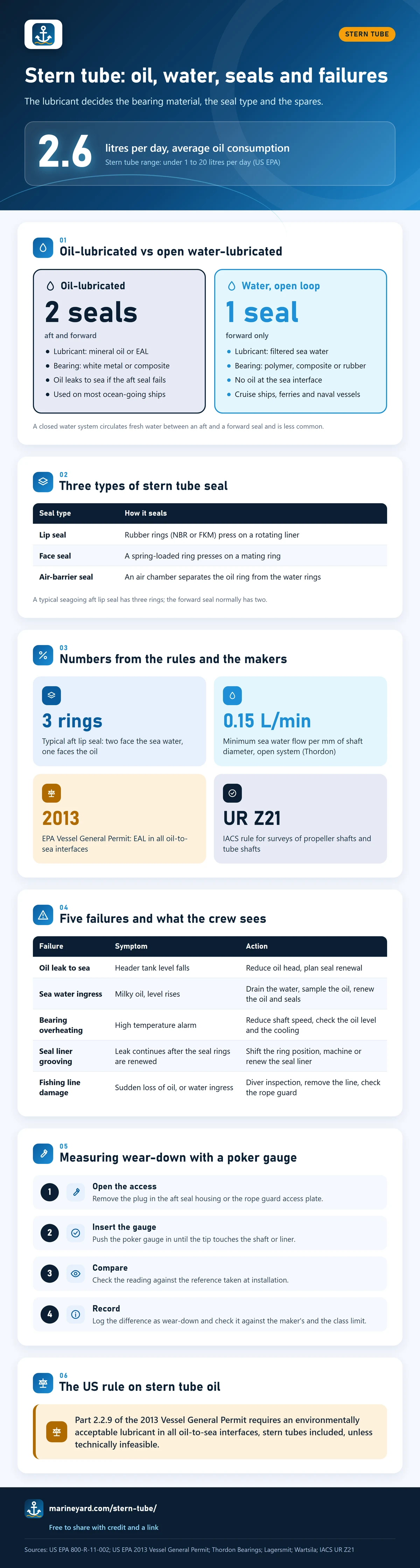
Oil-lubricated stern tubes run a white metal bearing in oil and need an aft seal and a forward seal. Water-lubricated stern tubes run a non-metallic bearing in water. An open water system discharges sea water at the aft end and needs only a forward seal. A closed water system circulates fresh water between two seals.
| Attribute | Oil-lubricated | Water, open loop | Water, closed loop |
|---|---|---|---|
| Lubricant | Mineral oil or EAL | Filtered sea water | Circulated fresh water |
| Bearing | White metal or composite | Polymer, composite or rubber | Polymer or composite |
| Seals | Aft and forward | Forward only | Aft and forward |
| Pollution risk | Oil leaks to sea if the aft seal fails | No oil at the sea interface | No oil at the sea interface |
| Where used | Majority of ocean-going ships | Cruise ships, ferries, naval vessels, some merchant ships | Less common |
The Thordon COMPAC open sea water system consists of polymer bearings, shaft liners, a water quality package, a shaft coating and a forward seal.
What are the types of stern tube seal?
The types of stern tube seal are lip seals, face seals and air-barrier seals. Lip seals use rubber rings that press on a rotating liner. Face seals use two flat rings that press against each other. Air-barrier seals are lip seals with an air chamber between the water side and the oil side.
- Lip seals. A typical seagoing aft seal has three rings: two face the sea water and one faces the oil. The forward seal normally has two rings.
- Face (mechanical) seals. A spring-loaded ring presses on a mating ring at right angles to the shaft.
- Air-barrier seals. A constant flow of air separates the oil ring from the water rings. Leakage from either side goes to a drain tank inside the ship.
Lip seal rings are made of NBR or FKM (Viton is one FKM trade name). EALs can degrade seal rings by hydrolysis when water enters the oil, so Lagersmit recommends a dedicated FKM compound for EAL service.
How is a stern tube monitored and inspected?
A stern tube is monitored by bearing temperature, header tank oil level, oil consumption and oil analysis while the ship is in service. A stern tube is inspected in dry dock by wear-down measurement and seal examination. The classification society surveys the propeller shaft at an interval that depends on the shaft arrangement.
A falling header tank level indicates an oil leak. A rising level or milky oil indicates water ingress. Oil samples are tested for water and metals; IACS Recommendation 36 gives a procedure.
Wear-down, the drop of the shaft in the aft bearing, is measured with a poker gauge:
- Remove the plug in the aft seal housing or the rope guard access plate.
- Insert the poker gauge until the tip touches the shaft or liner.
- Compare the reading with the reference taken at installation.
- Record the difference as the wear-down and check the value against the maker's and the class limit.
IACS Unified Requirement Z21 is the common basis for propeller shaft surveys. The interval and the survey method are set by the classification society and depend on the lubricant, the propeller connection and the service records. Allowable clearances come from the bearing maker and the class rules.
What causes a stern tube to fail?
Stern tube failures are caused mainly by seal damage, water in the oil, loss of the lubricating film and shaft misalignment. Fishing line and rope damage the aft seal from outside. Worn seal rings and grooved liners leak. Water-contaminated or overheated oil damages the white metal of the aft bearing.
| Failure | Common cause | Symptom | Action |
|---|---|---|---|
| Oil leak to sea | Worn aft seal rings, grooved liner | Header tank level falls | Reduce oil head, plan seal renewal |
| Sea water ingress | Aft seal damage, low oil pressure | Milky oil, level rises | Drain water, sample oil, renew oil and seals |
| Bearing overheating | Low oil level, misalignment, heavy weather | High temperature alarm | Reduce shaft speed, check oil level and cooling |
| Seal liner grooving | Abrasive particles, long running hours | Leak continues after new rings | Shift the ring position, machine or renew the liner |
| Fishing line damage | Line wound between propeller and seal | Sudden oil loss or water ingress | Diver inspection, remove line, check rope guard |
What environmental rules apply to stern tube oil?
Stern tube oil is covered in United States waters by the EPA 2013 Vessel General Permit, which requires environmentally acceptable lubricants in all oil-to-sea interfaces unless technically infeasible. MARPOL Annex I sets the international framework for preventing oil pollution from ships. Stern tube leakage is now treated as oil pollution, not as normal consumption.
Part 2.2.9 of the 2013 Vessel General Permit states that all vessels "must use an EAL in all oil to sea interfaces, unless technically infeasible". The permit names stern tubes as an oil-to-sea interface. An EAL is biodegradable, minimally toxic and not bioaccumulative under the permit definitions. An operator that cannot use an EAL must record the reason and report it in the annual report.
The EPA vessel permit page states that the 2013 permit stays in force until the regulations under the Vessel Incidental Discharge Act are final, effective and enforceable. MARPOL Annex I entered into force on 2 October 1983.
Which stern tube spare parts are ordered most often?
Stern tube spare parts ordered most often are seal rings, liners, O-rings and gaskets for the aft and forward seals. Bearing bushes are ordered less often because bearings last many years in clean oil. Seal rings are normally renewed at dry docking, and one spare set is commonly kept on board.
Common consumables such as O-rings and gland packing may carry an IMPA code. Seal kits and liners are ordered by the maker's reference.
How do you specify stern tube spares?
Stern tube spares are specified by the ship's identity, the seal or bearing maker, the model and size, and the drawing number. A seal ring that fits one size of one maker's seal does not fit another maker's housing. A complete data set prevents a wrong delivery before dry dock.
- State the ship name, IMO number, shipyard and hull number.
- State the maker, seal type, size and position (aft or forward) from the nameplate or drawing.
- Give the shaft diameter and the liner outside diameter in mm.
- Give the drawing number and the part number from the parts list.
- State the lubricant in use and the ring material required (NBR or FKM).
General consumables can come from a ship chandler.
Who makes stern tube seals and bearings?
Stern tube seals and bearings are made by a small group of specialist companies. Wärtsilä, Lagersmit, SKF Marine (Simplex seals) and KEMEL make oil-lubricated and air-type seals. Thordon Bearings and Duramax Marine make water-lubricated bearing and seal systems. Each maker uses its own seal sizes, so parts are not interchangeable between brands.
Do small boats have a stern tube?
Small boats have a stern tube in a simpler form. The tube is slightly larger than the propeller shaft and ends inboard in a stuffing box or a mechanical shaft seal. A water-lubricated rubber bearing supports the shaft at the aft end. Small-boat stern tubes have no header tank and no oil system.
Where can stern tube parts be bought or sold?
Stern tube parts are bought from makers, service companies and surplus stockists, and unused spares from sold or scrapped ships are resold. MarineYard is a ship spare parts marketplace where sellers list new, reconditioned and used items, including propulsion and steering parts. Sellers get 9 free listings per account. MarineYard takes no commission and is not a party to any sale. Buyers should confirm the maker, seal size and drawing number with the seller before payment.
Frequently Asked Questions
What is the function of the stern tube header tank?
The stern tube header tank keeps the oil pressure inside the tube slightly above the sea water pressure at the shaft. The tank stands above the waterline and works by gravity.
Why is stern tube oil milky?
Milky stern tube oil contains emulsified water. Sea water normally enters through a worn or damaged aft seal. Water damages white metal bearings, so the crew drains the water and plans seal renewal.
Is an environmentally acceptable lubricant required in a stern tube?
An environmentally acceptable lubricant is required in US waters. The EPA 2013 Vessel General Permit requires an EAL in all oil-to-sea interfaces, including stern tubes, unless technically infeasible. Elsewhere, the requirement depends on local rules and the charterer.
How many seal rings does a stern tube aft seal have?
A stern tube aft seal of the lip type typically has three seal rings on seagoing ships. Two rings face the sea water and one ring faces the oil. Air-type seals add an air chamber.
Can a stern tube seal be repaired without dry docking?
A stern tube aft seal can be repaired afloat in some cases, by divers or with the ship trimmed by the head. Forward seal rings are renewed from inside the engine room.
What is the difference between a tail shaft and a stern tube?
A tail shaft is the rotating propeller shaft that carries the propeller. A stern tube is the fixed tube around the tail shaft. The stern tube holds the bearings and seals.
Related guides
- IMPA code: meaning and structure
- Ship chandler: meaning and services
- Oily water separator: working, parts and the 15 ppm rule
- Marine turbocharger: parts, working and surging
- Purifier in ship: working principle, parts and faults
Sources
- US EPA, 2013 Vessel General Permit
- US EPA, Vessels: VGP and VIDA status
- US EPA, Environmentally Acceptable Lubricants, EPA 800-R-11-002
- IMO, MARPOL convention
- Wärtsilä, stern tube solutions
- Lagersmit, seal applications for stern tube systems
- Lagersmit, oil-lubricated seals
- Thordon Bearings, COMPAC bearing system
Sign in to leave a comment and join the discussion.
 Ship Machinery
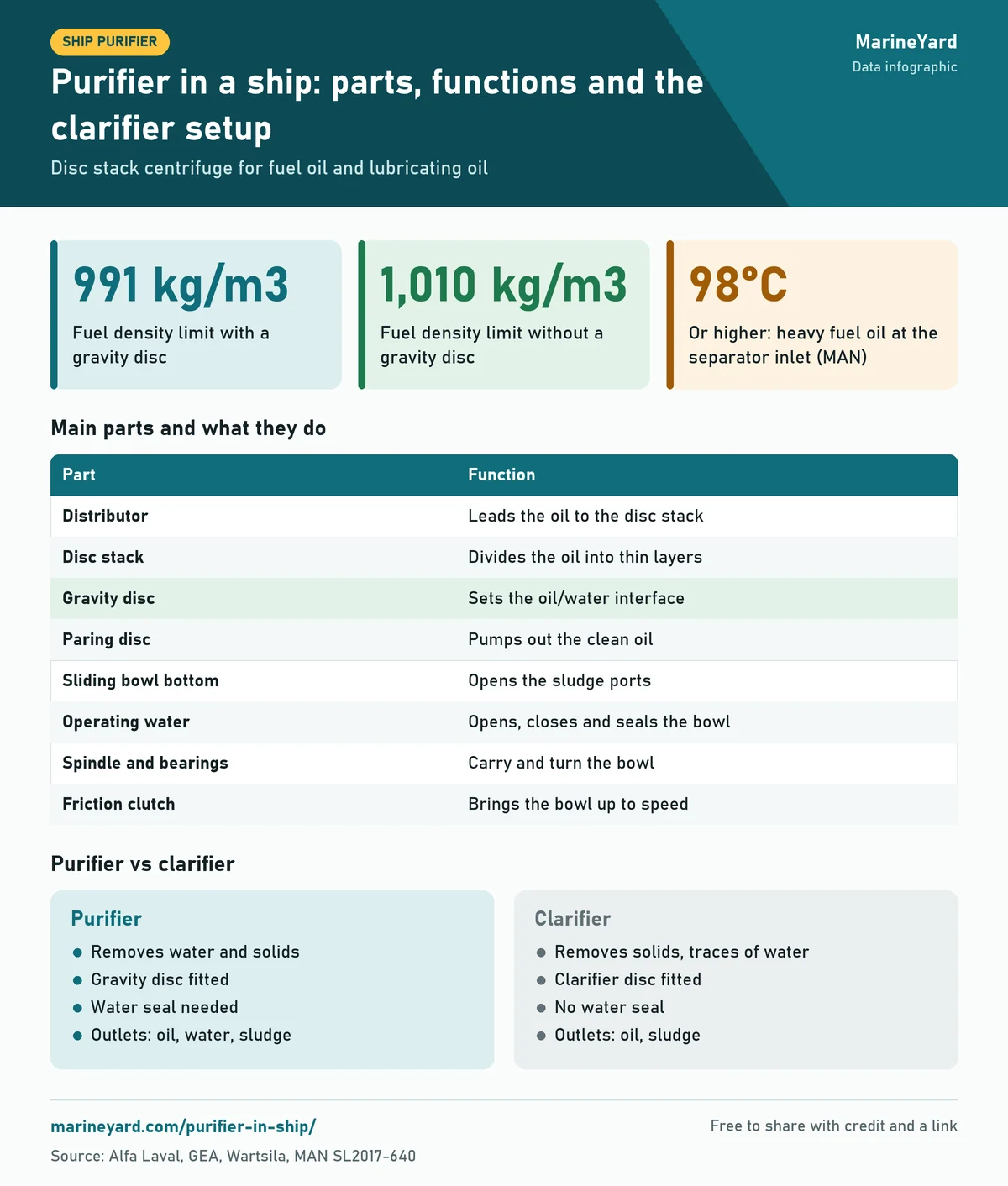
A purifier in a ship is a centrifugal separator that removes water and solid particles from fuel oil and lubricating oil. The purifier spins the oil in a...
 Ship Machinery
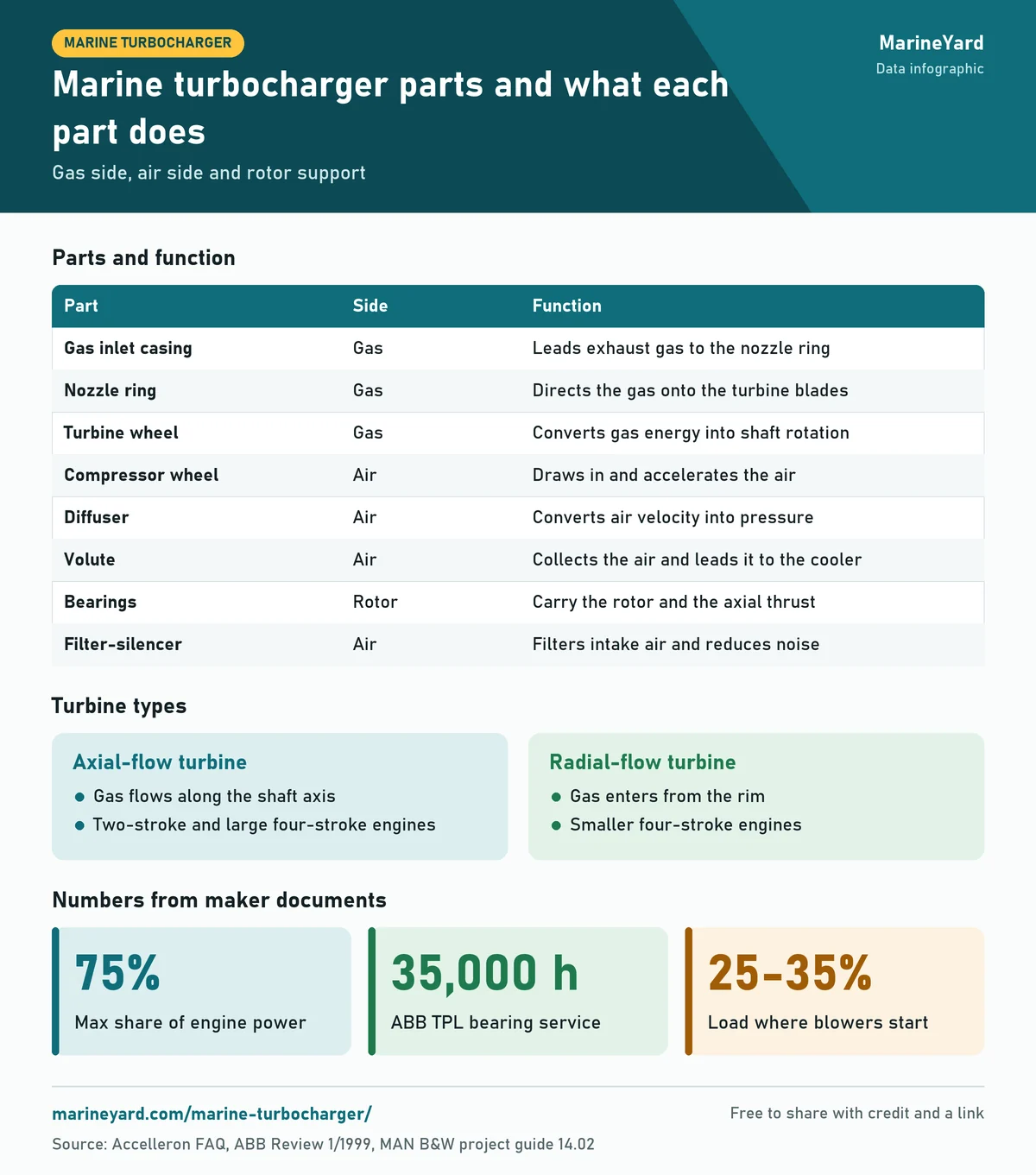
A marine turbocharger is an exhaust-driven air compressor fitted to a ship's diesel or dual-fuel engine. The exhaust gas turns a turbine, and the turbine...
 Ship Machinery
An oily water separator (OWS) is the machine on a ship that removes oil from machinery space bilge water before the water is pumped overboard. The oily...