Scavenge Fire: Causes, Indications, Actions and Prevention
Marine engineers & industry writers
Updated
Nov 26, 2026
A scavenge fire is a fire in the scavenge air space of a two-stroke crosshead diesel engine. A scavenge fire burns the oily deposit of cylinder oil, unburnt fuel and carbon that collects under the pistons. Hot combustion gas that blows past worn or broken piston rings normally ignites the deposit.
The fire is fought with a fixed extinguishing system that is fitted to the engine and uses steam, water mist or CO2. Engine makers publish the alarm values and the fire-fighting steps in the operation manual of each engine type.
Key facts
| Attribute | Value |
|---|---|
| Engine type affected | Two-stroke crosshead diesel engines (UK P&I Club, ABS) |
| Fuel of the fire | Cylinder oil, unburnt fuel and carbon in the scavenge space (Wärtsilä) |
| Usual ignition source | Blow-by of hot combustion products between piston and liner (UK P&I Club) |
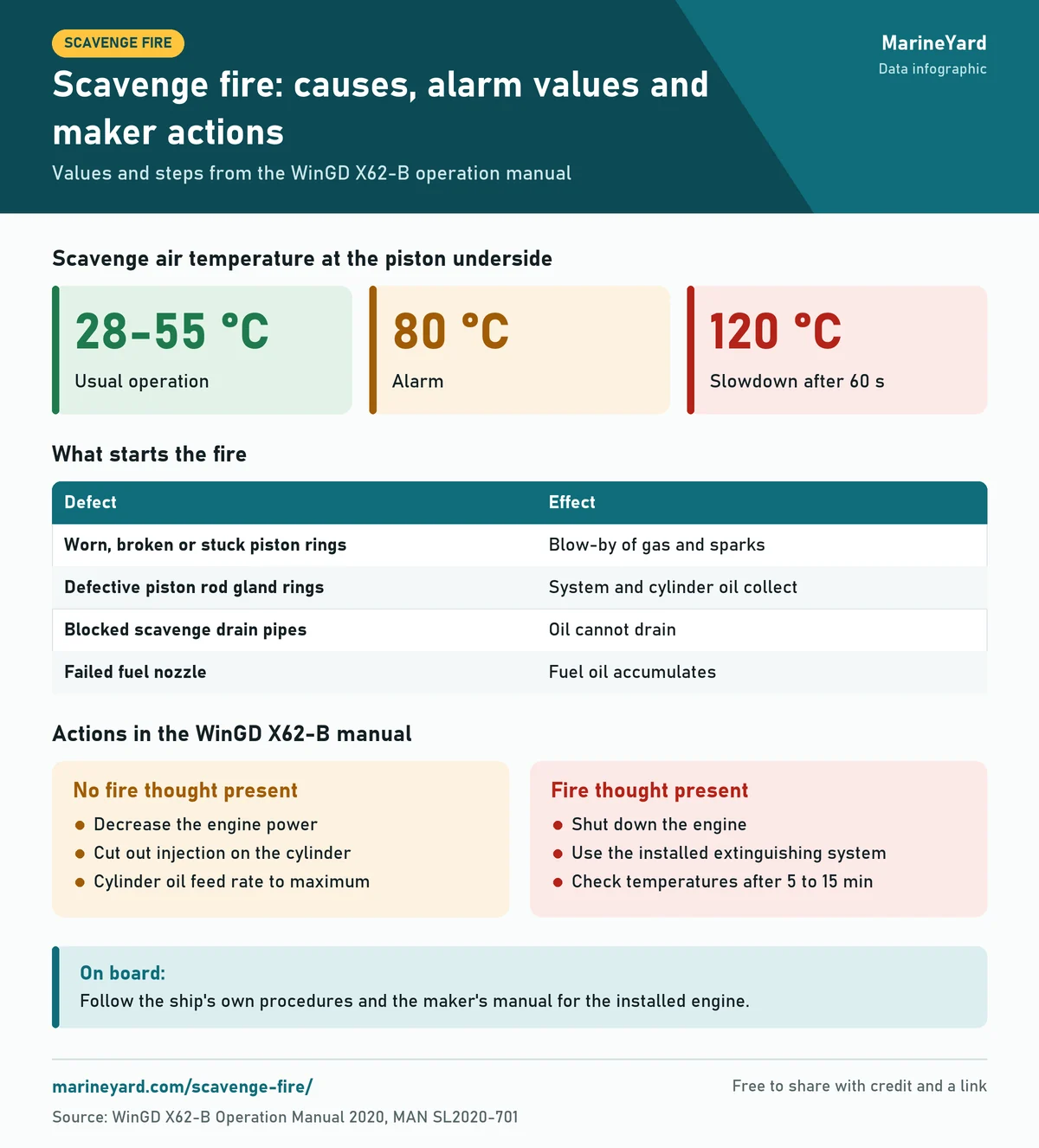
| Normal air temperature at the piston underside | 28 to 55 °C (WinGD X62-B operation manual) |
| Piston underside temperature alarm | 80 °C or more (WinGD X62-B) |
| Automatic slowdown | 120 °C or more, after a 60-second delay (WinGD X62-B) |
| Basic extinguishing medium on MAN B&W engines | Steam at 3 to 10 bar; water mist, CO2 and Argonite are options |
| Checks after fire-fighting | After approximately 5 to 15 minutes (WinGD X62-B) |
| Class rule | Permanent extinguishing system, separate from the engine room system (ABS 4-2-1/7.11) |
What is a scavenge fire?
A scavenge fire is the burning of flammable deposits inside the scavenge space of a two-stroke engine. The Wärtsilä encyclopedia entry on scavenge fire describes the deposit as a mixture of cylinder oil, unburnt fuel and carbon. The UK P&I Club states that heavy deposits of this oily sludge typically build up before a fire occurs.
Where is the scavenge space and which parts form it?
The scavenge space is the air chamber around the lower part of each cylinder, below the piston and above the piston rod stuffing box. The scavenge space receives charge air from the scavenge air receiver and passes the air through the scavenge ports into the cylinder. WinGD calls the same chamber the piston underside.
The MAN B&W ME engine description states that the cylinder frame and the cylinder liner form the scavenge air space. The drains for the scavenge air space and the stuffing box are in the bottom of the cylinder frame.
| Part | Function | Link to a scavenge fire |
|---|---|---|
| Piston rings | Seal the combustion gas above the piston | Worn, broken or stuck rings cause blow-by |
| Cylinder liner with scavenge ports | Running surface; ports admit scavenge air | Wear or surface damage causes blow-by; ports collect deposits |
| Piston rod stuffing box | Sealing rings hold scavenge air; scraper rings hold back crankcase oil | Defective rings let oil collect in the space |
| Scavenge space drains | Carry dirty oil out of the space | A blocked drain keeps the oil in the space |
| Scavenge air receiver and flaps | Supply air to all cylinders | Deposits collect in the receiver; flaps are checked after a fire |
| Fuel injection nozzles | Atomise the fuel | A failed nozzle leaves fuel that is not burnt |
What causes a scavenge fire?
A scavenge fire is caused by two conditions that occur together: a deposit of oil and carbon in the scavenge space, and a source of heat. Blow-by past the piston rings supplies both. Blow-by carries combustion residue into the space and later brings the hot gas and sparks that ignite the deposit.
The WinGD X62-B operation manual names two direct causes of fire. Defective sealing rings in the piston rod gland let system oil and cylinder oil collect in the piston underside, and blocked drain pipes stop the oil from draining. Defective piston rings let combustion gases and sparks enter the piston underside.
| Cause | Effect | Source |
|---|---|---|
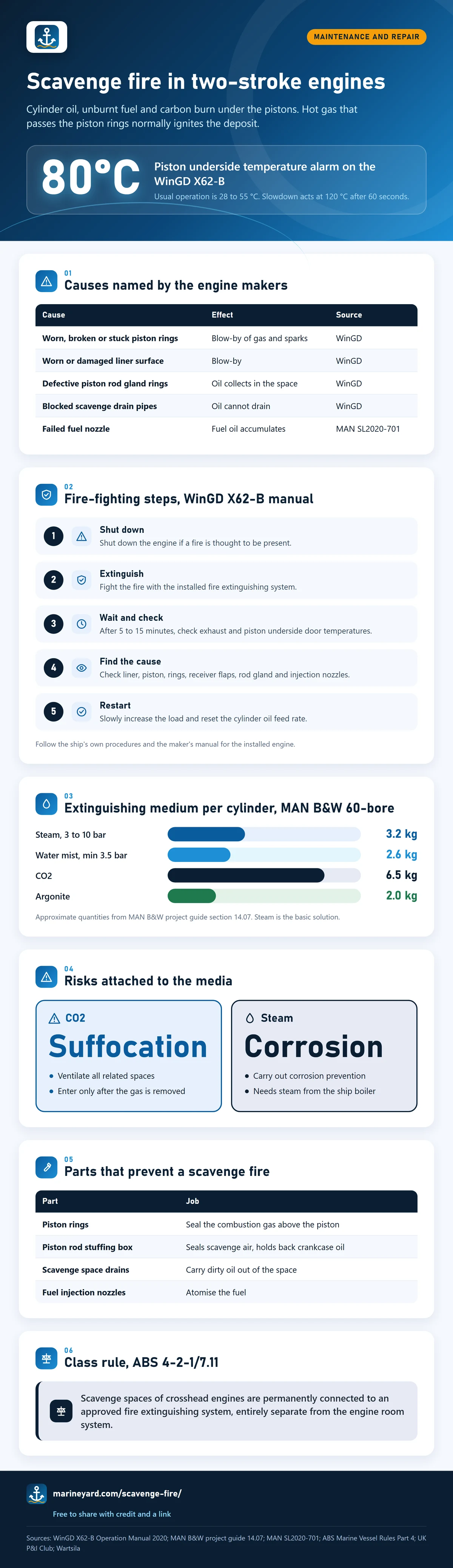
| Worn, broken or stuck piston rings | Blow-by of gas and sparks | WinGD |
| Worn or damaged liner running surface | Blow-by | WinGD |
| Incorrect operation of a lubricating quill | Blow-by | WinGD |
| Defective piston rod gland rings | System oil and cylinder oil collect | WinGD |
| Blocked scavenge drain pipes | Oil cannot drain | WinGD |
| Worn injection nozzles, cold fuel or improper timing | Poor combustion, more residue | WinGD, UK P&I Club |
| Failed fuel nozzle | Fuel oil accumulates | MAN service letter SL2020-701 |
Wear of the cylinder liner has the same effect as ring wear. Low air supply raises the amount of residue. WinGD lists a fouled silencer or nozzle ring on the marine turbocharger, a fouled air cooler and fouled scavenge ports among the causes of unsatisfactory combustion.
What are the indications of a scavenge fire?
The indications of a scavenge fire are temperature alarms, a large increase in the exhaust gas temperature of the affected cylinder and an increase in the piston underside temperature. WinGD lists these three indications in section 2.2.3 of the X62-B operation manual.
The manual also lists a fire in the piston underside as a possible cause of a high exhaust gas temperature downstream of one cylinder. The manual gives a usual scavenge air temperature of 28 to 55 °C at the piston underside of each cylinder. The alarm acts at 80 °C or more. The engine slows down automatically at 120 °C or more after a delay of 60 seconds.
A MAN Diesel operation manual (section 703-04) describes an earlier sign. Piston ring blow-by can produce a hissing sound at the opened drain cock of the scavenge air box, and smoke and sparks may appear. The section warns the crew to keep clear of the drain, because burning oil can be blown out.
What actions does the engine maker state for a scavenge fire?
The actions for a scavenge fire in the WinGD X62-B operation manual depend on whether the crew thinks a fire is burning. Without a fire, the crew reduces power and cuts out fuel injection on the affected cylinder. With a fire, the crew shuts down the engine and uses the installed fire extinguishing system.
Section 2.3 of the WinGD manual gives the procedure in this order:
- If no fire is thought to be present, decrease the engine power.
- Cut out the fuel injection of the affected cylinder.
- Increase the cylinder lubricating oil feed rate of the affected cylinder to the maximum.
- If a fire is thought to be present, shut down the engine.
- Fight the fire with the installed fire extinguishing system.
- After approximately 5 to 15 minutes, check the exhaust gas temperature and carefully check the temperature of the doors to the piston underside space.
- Find the cause and clean or repair the defective items.
- Start the engine, slowly increase the load and set the cylinder oil feed rate back to the applicable value.
The procedure above belongs to one engine type. The crew follows the ship's own procedures and the maker's manual for the installed engine. The UK P&I Club Risk Focus on engine room fires adds three points for a serious fire: boundary cooling may be necessary, crew stand clear of the scavenge space relief valves in case of explosion, and the space stays closed until it has adequately cooled.
Which fire-fighting media are used in the scavenge space?
The fire-fighting media used in the scavenge space are steam, water mist, CO2 and Argonite. The MAN B&W project guide section 14.07 names steam as the basic solution and the other three media as options. The piping is delivered with the engine and fitted on it.
| Medium | Status on MAN B&W engines | Supply data | Approx. quantity, 60-bore engines | Approx. quantity, S90ME-C and K90ME |
|---|---|---|---|---|
| Steam | Basic solution | 3 to 10 bar | 3.2 kg per cylinder | 7.8 kg per cylinder |
| Water mist | Option | Freshwater, minimum 3.5 bar | 2.6 kg per cylinder | 6.3 kg per cylinder |
| CO2 | Option | Test pressure 150 bar | 6.5 kg per cylinder | 15.7 kg per cylinder |
| Argonite | Option | Test pressure 150 bar | 2.0 kg per cylinder | Not listed |
The quantities for the larger bore come from the MAN B&W S90ME-C and K90ME project guide section. The same document states that at least two CO2 bottles ought to be installed. One bottle is in most cases sufficient for a fire in three cylinders. Steam extinguishing depends on steam being available from the ship boiler plant.
Class rules require the system. The ABS Marine Vessel Rules, Part 4, section 4-2-1/7.11, require that scavenge spaces in open connection to the cylinder on crosshead engines are permanently connected to an approved fire extinguishing system. The system is entirely separate from the engine room system. ABS accepts steam smothering and requires explosion relief valves in these spaces (4-2-1/7.1.5).
WinGD attaches two warnings to the media. CO2 creates a risk of suffocation, so all related spaces need good airflow before anyone enters the engine. Steam can cause corrosion, so the crew carries out corrosion prevention after steam has been used.
What is inspected after a scavenge fire?
The items inspected after a scavenge fire are the cylinder liner running surface, the piston and piston rings, the flaps in the scavenge air receiver, the piston rod gland and the injection nozzles. WinGD lists these checks, with a check for leaks, to find the cause before the restart.
- The scavenge space is opened only after it has adequately cooled (UK P&I Club).
- The space is ventilated before entry if CO2 was used (WinGD).
- The cylinder oil feed rate returns to the applicable value after the restart. WinGD warns against long operation with a high cylinder oil setting.
How is a scavenge fire prevented?
A scavenge fire is prevented by keeping the scavenge space clean, keeping the drains open and keeping the piston rings, liner, stuffing box, fuel system and cylinder lubrication in good order. The UK P&I Club names these five maintenance areas.
- Clean and inspect. Scavenge spaces and the drain pockets are inspected and cleaned regularly (UK P&I Club).
- Check the drains in operation. WinGD tells the crew to check the dirty oil drain pipes for differences in temperature. A different temperature shows a blockage, which is removed as soon as possible.
- Watch the exhaust. Dark exhaust smoke shows fuel that is not fully burnt. WinGD tells the crew to find the cause and repair the fault.
- Act on exhaust temperature deviation alarms. MAN service letter SL2020-701 of August 2020 warns that a failed fuel nozzle stops atomisation and that the accumulated fuel oil creates a risk of scavenge space fire.
- Use approved fuel valve parts. The same letter covers MC, MC-C, ME and ME-C engines and recommends original spindle guides and nozzles only.
Which spare parts are ordered to prevent scavenge fires?
Spare parts ordered to prevent scavenge fires are piston rings, piston rod stuffing box sealing rings and scraper rings, fuel valve nozzles and spindle guides, cylinder lubricator parts, scavenge air receiver flaps and piston underside temperature sensors. These parts match the causes of fire that the engine makers name.
A correct order states the following data:
- Ship name and IMO number.
- Engine maker, engine type and number of cylinders, for example WinGD X62-B or MAN B&W S60ME-C.
- Engine serial number from the nameplate.
- Part name and part number from the maker's spare parts manual.
Piston rings and stuffing box rings are ordered by the maker's part number. General consumables for the cleaning work, such as rags and gasket sheet, can be ordered by IMPA code.
Where can scavenge space and piston parts be bought or sold?
Scavenge space and piston parts are bought from engine makers, licensees and surplus stockists. MarineYard is a ship spare parts marketplace where sellers list new, reconditioned and used main engine parts, including piston rings, stuffing boxes and fuel valves. Sellers get 9 free listings per account. MarineYard takes no commission and is not a party to any sale. Buyers should confirm the engine type, the part number and the origin of fuel valve parts with the seller before payment.
Frequently Asked Questions
What is the difference between a scavenge fire and a crankcase explosion?
A scavenge fire burns oil and carbon deposits in the air space under the pistons, above the piston rod stuffing box. A crankcase explosion happens below the stuffing box. WinGD states that the cause of a crankcase explosion is oil mist from components that have become unusually hot.
Is the main engine stopped during a scavenge fire?
The main engine is shut down when the crew thinks a fire is burning, according to the WinGD X62-B operation manual. The crew only reduces power and cuts out injection on the affected cylinder when no fire is thought to be present. The ship's own procedures decide the action on board.
At what temperature does a scavenge fire alarm activate?
A scavenge fire alarm on the WinGD X62-B activates when the scavenge air temperature at a piston underside reaches 80 °C. The engine slows down at 120 °C after 60 seconds. The usual temperature is 28 to 55 °C. Other engines have different settings.
How much steam or CO2 is needed to extinguish a scavenge fire?
The steam quantity for a scavenge fire is approximately 3.2 kg per cylinder at 3 to 10 bar on MAN B&W 60-bore engines. The CO2 quantity for the same engines is approximately 6.5 kg per cylinder. The S90ME-C needs approximately 7.8 kg of steam per cylinder.
When can the scavenge space be opened after a fire?
The scavenge space can be opened for inspection only after the space has adequately cooled, as the UK P&I Club states. WinGD adds that all related spaces need good airflow to remove CO2 gas before a person goes into the engine.
Do class rules require a scavenge fire extinguishing system?
Class rules require a scavenge fire extinguishing system on crosshead engines. ABS rule 4-2-1/7.11 requires a permanent connection to an approved system that is entirely separate from the engine room fire extinguishing system. ABS accepts a steam smothering system for this purpose.
Related guides
- Fresh Water Generator on Ships: Working, Parts and Types
- Ballast Water Treatment System: Types, Parts and D-2 Rules
- Sewage Treatment Plant on Ship: Working, Parts and MARPOL Rules
- Marine Incinerator on Ships: Parts, Working and MARPOL Rules
- Oil Mist Detector on Ships: Working, Rules and Alarm Levels
- ISSA Code: Meaning, Catalogue and Difference from IMPA Code
- Crankcase Explosion: Causes, Relief Valves and Alarm Actions
- Stern tube: parts, bearings, seals and lubrication
- IMPA code: meaning and structure
- Ship chandler: meaning and services
- Oily water separator: working, parts and the 15 ppm rule
- Marine turbocharger: parts, working and surging
- Purifier in ship: working principle, parts and faults
- Cylinder liner: function, wear and gauging
- Ship boiler: types, mountings and water treatment
- Anchor windlass: parts, working and class rules
- Bow thruster: how it works, types and failures
- Steering gear: parts, types and SOLAS tests
- Marine air compressor: starting air, parts and safety
Sources
- WinGD, X62-B Operation Manual, Issue 002 2020-01 (sections 2.2, 2.3, 8.5 and 11)
- MAN B&W project guide section 14.07, Fire Extinguishing System for Scavenge Air Space (60MC/MC-C/ME-C/ME-B)
- MAN B&W project guide section 14.07 (S90ME-C, K90ME)
- Everllence (MAN B&W), ME Engine description, section 1.06
- MAN Energy Solutions, Service Letter SL2020-701, third-party spindle guides and nozzles
- ABS, Rules for Building and Classing Marine Vessels 2018, Part 4 (4-2-1/7.1.5 and 7.11)
- UK P&I Club and Burgoynes, Risk Focus: Engine Room Fires
- Wärtsilä Encyclopedia of Marine and Energy Technology, scavenge fire
Sign in to leave a comment and join the discussion.
 Maintenance & Repair
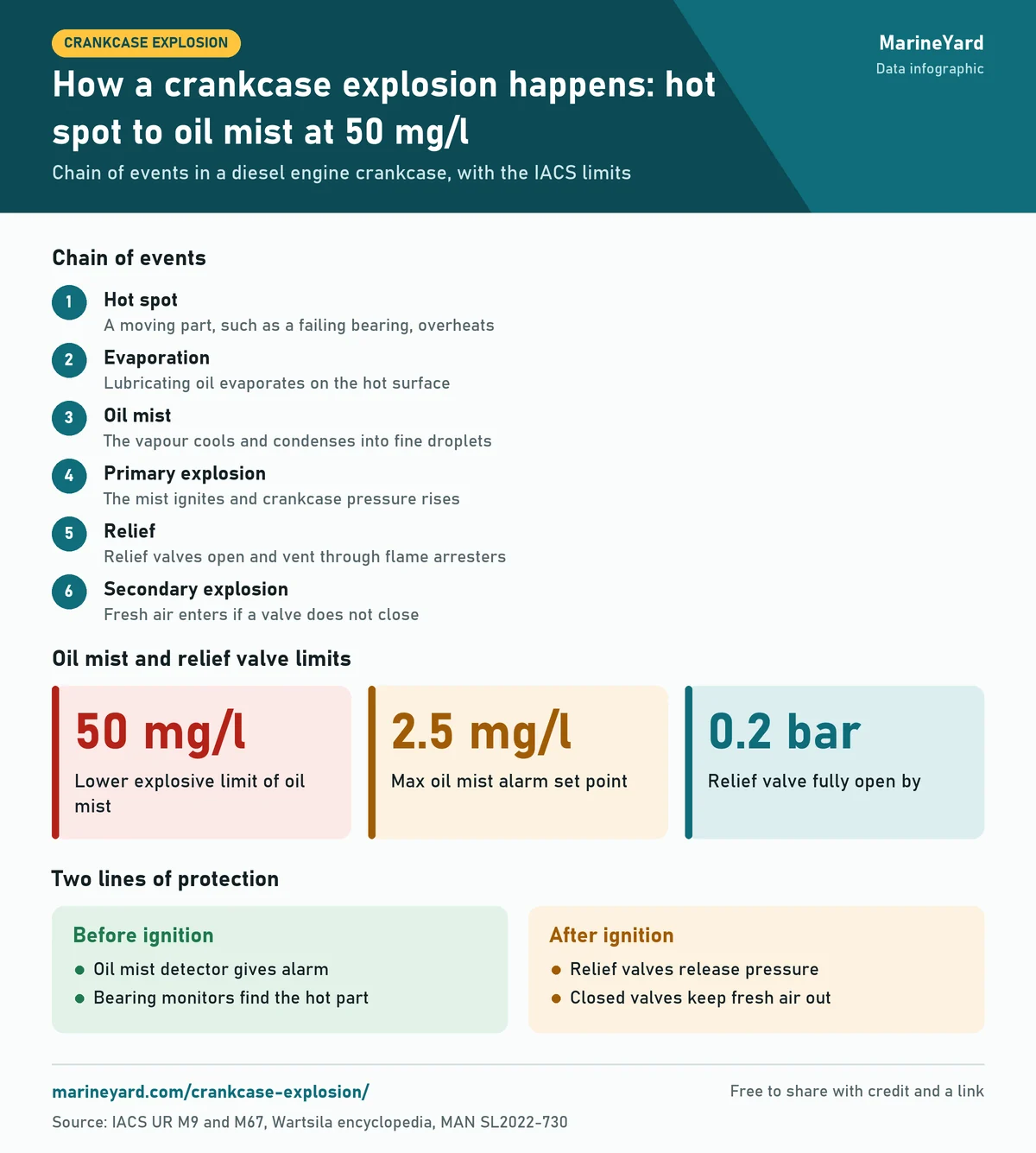
A crankcase explosion is the ignition of oil mist inside the crankcase of a diesel engine. A hot spot evaporates lubricating oil, the vapour condenses into...
 Spare Parts Guides
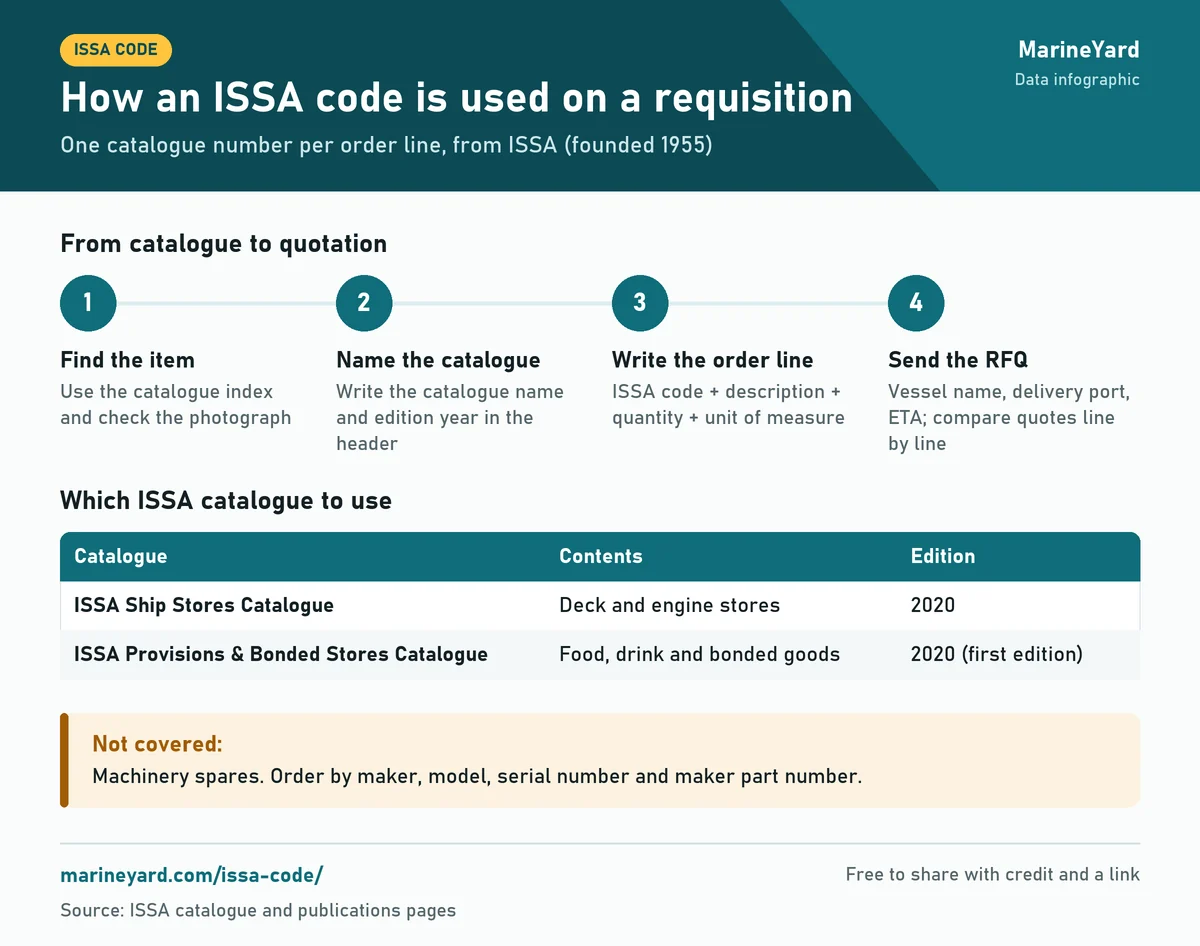
An ISSA code is the item number that identifies one product in the ISSA Ship Stores Catalogue, the illustrated catalogue published by the International...
 Ship Machinery
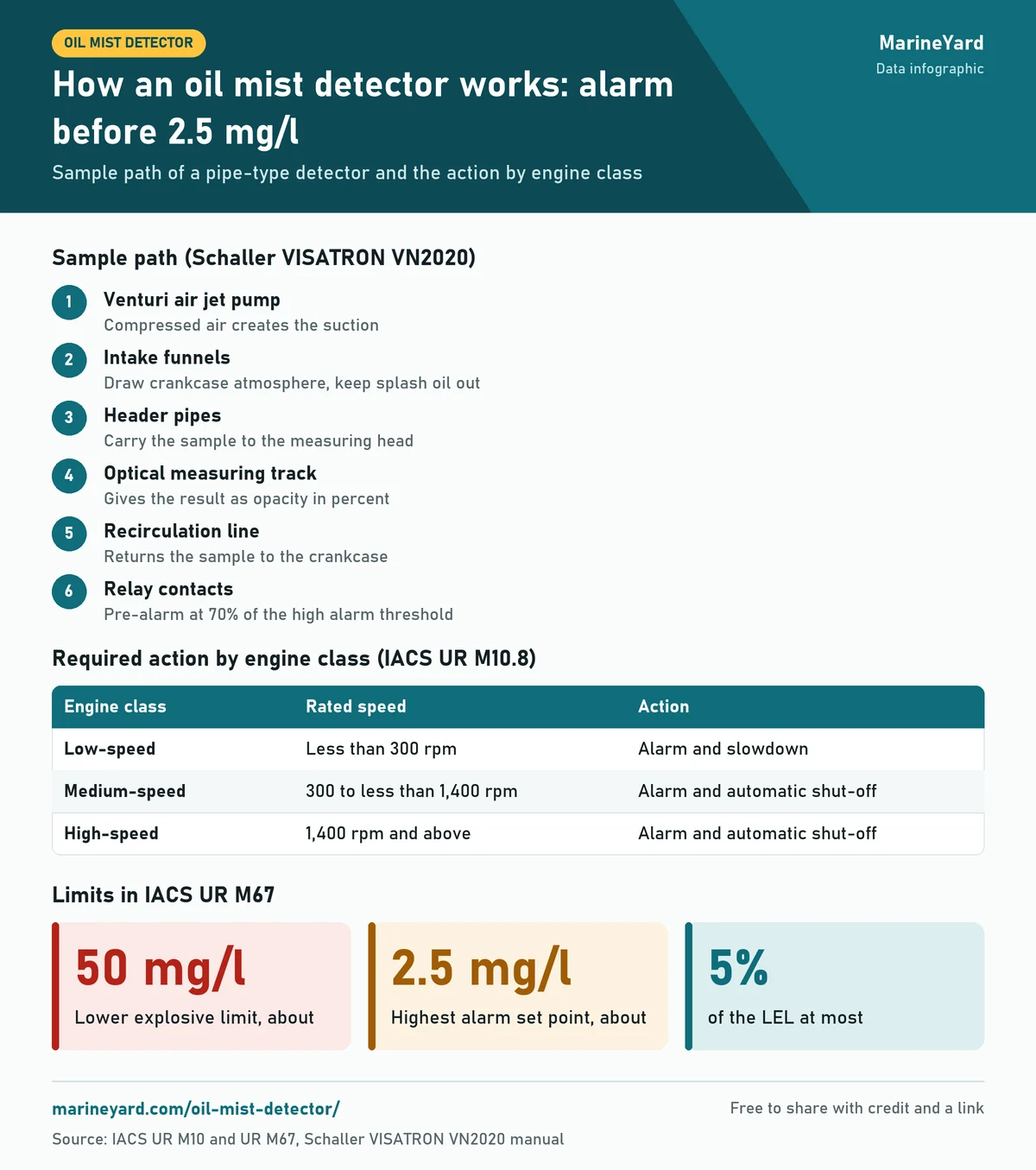
An oil mist detector (OMD) is a safety instrument on a marine diesel engine that measures the concentration of oil mist in the crankcase. The oil mist...