Oily Water Separator on Ships: Working, Parts and 15 ppm Rules
Marine engineers & industry writers
Updated
Nov 18, 2026
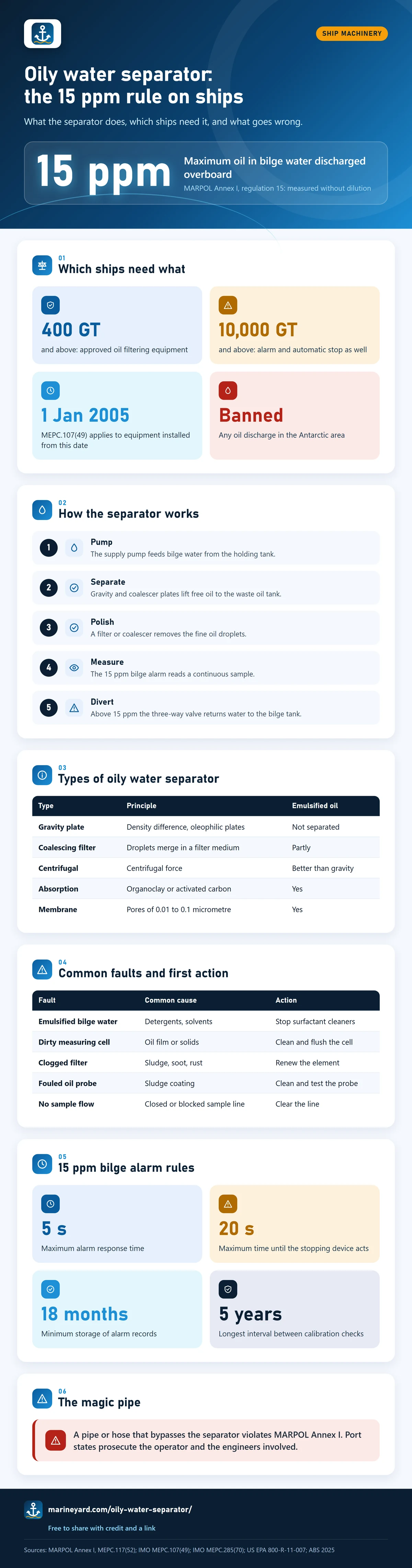
An oily water separator (OWS) is the machine on a ship that removes oil from machinery space bilge water before the water is pumped overboard. The oily water separator must produce an effluent with an oil content of 15 parts per million (ppm) or less, the limit set by MARPOL Annex I.
The separator works together with a 15 ppm bilge alarm and an automatic stopping device. IMO resolution MEPC.107(49) names the three items together as pollution prevention equipment for machinery space bilges.
Key facts
| Attribute | Value |
|---|---|
| Discharge limit | 15 ppm oil in the effluent, without dilution (MARPOL Annex I, regulation 15) |
| Ships that need oil filtering equipment | 400 gross tonnage (GT) and above (regulation 14) |
| Alarm and automatic stop required | Ships of 10,000 GT and above, and any discharge in a special area (regulations 14.7 and 15.3) |
| Type approval standard | MEPC.107(49), for equipment installed on or after 1 January 2005 |
| Bilge alarm response time | 5 seconds maximum; 20 seconds maximum until the stopping device acts |
| Alarm data storage | At least 18 months (date, time, alarm status, operating status) |
| Alarm calibration interval | Not more than 5 years, or the maker's term if shorter (MEPC.285(70)) |
What is an oily water separator on a ship?
An oily water separator on a ship is the treatment unit between the bilge holding tank and the overboard discharge valve. The separator takes water that has collected in the engine room bilges, separates the oil, sends the oil to a waste oil tank and releases only water that meets the 15 ppm limit.
MEPC.107(49) defines a 15 ppm bilge separator as any combination of a separator, filter, coalescer or other means that produces an effluent of not more than 15 ppm.
What are the parts of an oily water separator?
The parts of an oily water separator are a supply pump, a first-stage gravity chamber with coalescer plates, a second-stage filter or coalescer, oil level probes, an oil discharge valve, a heater, a 15 ppm bilge alarm with a sample line, and a three-way valve that acts as the automatic stopping device.
| Part | Function |
|---|---|
| Supply (bilge) pump | Feeds bilge water to the separator; often a positive-displacement type, which emulsifies the oil less |
| First-stage chamber and coalescer plates | Separate free oil by gravity; oil droplets join on the plates and rise |
| Second-stage filter, coalescer or adsorber | Removes the fine oil droplets that pass the first stage |
| Oil level probes | Detect the oil layer at the top of the chamber |
| Oil discharge valve | Opens on the probe signal and releases collected oil to the waste oil tank |
| Heater (steam or electric) | Warms the mixture; heating to about 49 °C (120 °F) or higher improves separation (EPA) |
| Sample line | Carries a continuous sample of the effluent to the bilge alarm |
| 15 ppm bilge alarm (oil content monitor) | Measures the oil content, shows ppm, gives the alarm and stores the records |
| Three-way valve (automatic stopping device) | Sends water overboard at 15 ppm or less, and back to the bilge tank above 15 ppm |
The bilge alarm is an optical instrument. Oil droplets change the light that passes through the sample in the measuring cell. Soot and other solids do the same, so a dirty sample can read as oil, as the EPA report on oily bilgewater separators explains.
What are the types of oily water separator?
The types of oily water separator are gravity plate separators, coalescing filter separators, centrifugal separators, absorption and adsorption units, and membrane (ultrafiltration) units. Most approved bilge separators combine a gravity or centrifugal first stage with one or more polishing stages, and some add chemical flocculation.
| Type | Principle | Emulsified oil | Main limit or consumable |
|---|---|---|---|
| Gravity plate | Density difference; oil joins on oleophilic plates | Not separated (droplets under 20 µm) | Plates foul with sludge |
| Coalescing filter | Fine droplets merge in a filter medium and rise | Partly | Filter elements are replaced |
| Centrifugal | Centrifugal force multiplies the density difference | Better than gravity | Higher purchase cost |
| Absorption or adsorption | Organoclay or activated carbon holds the oil | Yes | Spent media is oily solid waste |
| Membrane (ultrafiltration) | Pores of 0.01 to 0.1 µm hold back oil at 0.7 to 7 bar (EPA) | Yes | Fouling; membranes last about 3 to 5 years |
A centrifugal bilge separator is built like the fuel oil purifier. The Alfa Laval PureBilge system runs at 8,000 rpm and reaches an oil content below 5 ppm according to the maker.
How does an oily water separator work?
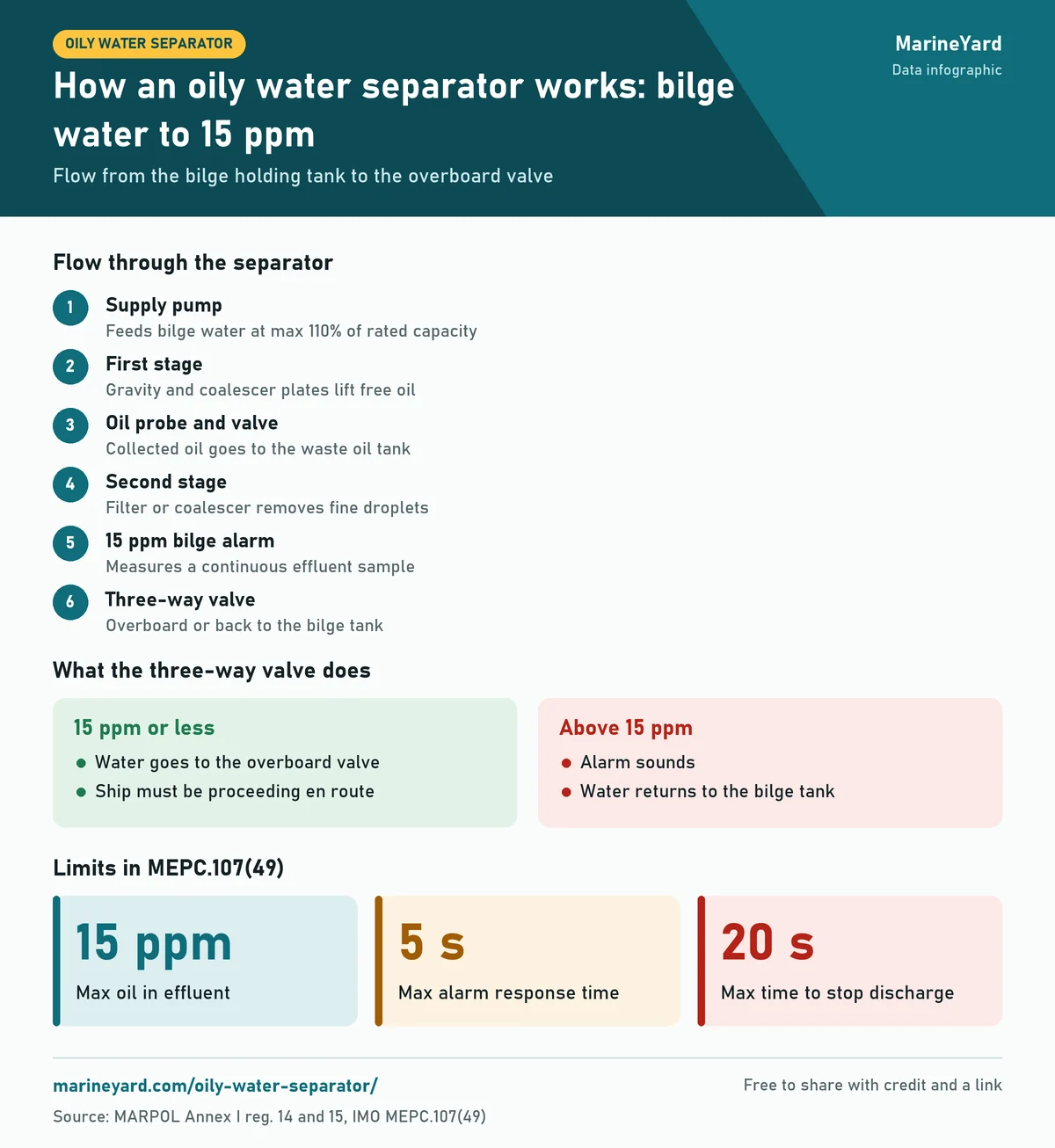
An oily water separator works in stages. Gravity and coalescer plates remove free oil first. A filter or coalescer then removes fine droplets. A bilge alarm measures the treated water continuously. A three-way valve sends the water overboard only while the reading is 15 ppm or less.
- Bilge water drains to the bilge wells and is pumped to the bilge holding tank.
- The supply pump feeds the separator at a rate of not more than 110% of the rated capacity.
- Free oil rises to the top of the first-stage chamber. Small droplets join on the coalescer plates and follow.
- The oil level probe detects the oil layer and opens the oil discharge valve. The oil flows to the waste oil tank.
- The water passes through the second-stage filter or coalescer, which removes fine droplets.
- The sample line feeds a continuous sample of the effluent to the 15 ppm bilge alarm.
- At 15 ppm or less, the three-way valve directs the water to the overboard discharge valve.
- Above 15 ppm, the alarm sounds and the three-way valve returns the water to the bilge or bilge tank within 20 seconds.
What do MARPOL Annex I regulations 14 and 15 require?
MARPOL Annex I regulation 14 requires approved oil filtering equipment on every ship of 400 GT and above. Regulation 15 prohibits any discharge of oily mixture from these ships unless the ship is proceeding en route, the mixture has passed through the equipment, and the oil content without dilution is 15 ppm or less.
- 400 GT to under 10,000 GT. The equipment must keep the discharge at 15 ppm or less (regulation 14.6).
- 10,000 GT and above. The equipment must also have an alarm and an automatic stop above 15 ppm (regulation 14.7).
- Special areas. A ship of 400 GT and above may discharge only through equipment with the alarm and automatic stop (regulation 15.3).
- Antarctic area. Any discharge of oil or oily mixture from any ship is prohibited (regulation 15.4).
- Under 400 GT. The ship retains oily mixtures on board or discharges en route through approved equipment at 15 ppm or less (regulation 15.6).
The wording is in the revised MARPOL Annex I, resolution MEPC.117(52), which entered into force on 1 January 2007. The IMO list of special areas under Annex I includes the Mediterranean Sea, the Baltic Sea, the Black Sea, the Red Sea and North West European Waters.
Regulation 17 requires an Oil Record Book Part I on every ship of 400 GT and above and every oil tanker of 150 GT and above. The crew records each overboard discharge or other disposal of bilge water and any failure of the oil filtering equipment. The book is kept for three years after the last entry.
What does MEPC.107(49) require for 15 ppm bilge separators and alarms?
MEPC.107(49) is the IMO type approval standard for 15 ppm bilge separators and 15 ppm bilge alarms. The resolution was adopted on 18 July 2003. The standard applies to equipment on ships with a keel laid on or after 1 January 2005 and to new installations fitted on older ships from that date.
Resolution MEPC.107(49) tests each separator with a residual fuel oil, a distillate fuel oil and an oil-in-water emulsion that contains a surfactant and iron oxide.
- The bilge alarm records date, time, alarm status and separator operating status, and stores the data for at least 18 months.
- Access to the alarm beyond routine checks requires the breaking of a seal.
- The alarm is always activated when clean water is used for cleaning or zeroing.
- The alarm activates if the instrument fails, warms up or loses power.
Resolution MEPC.285(70), adopted on 28 October 2016, sets the calibration rule. The maker or a person authorised by the maker checks the alarm at intervals of not more than five years after commissioning, or within the maker's term if shorter. The calibration certificate stays on board and is checked at IOPP annual, intermediate and renewal surveys.
What causes a 15 ppm alarm and other oily water separator faults?
A 15 ppm alarm is caused most often by emulsified bilge water, a dirty measuring cell, a clogged filter or a fouled oil probe. Detergents and other cleaning agents create stable emulsions that gravity cannot separate. Solids in the sample give a false high reading.
| Fault | Common cause | Symptom | Action |
|---|---|---|---|
| Emulsified bilge water | Detergents, solvents, pump shear | Reading stays above 15 ppm; water recirculates | Stop surfactant cleaners in the bilges; allow settling |
| Dirty measuring cell | Oil film or solids on the cell glass | Alarm with clean water in the cell | Clean the cell as the manual states; flush with fresh water |
| Clogged filter or coalescer | Sludge, soot, rust | Low flow; high pressure drop | Renew the element; clean the plates |
| Fouled oil probe | Sludge coating on the probe | Oil valve does not open, or stays open | Clean and test the probe |
| No sample flow to the alarm | Closed valve or blocked sample line | Reading does not follow the effluent | Clear the line; remove any manual valve |
The Wärtsilä encyclopedia entry on oily water separators names cleaning agents in the bilge water as a main cause of malfunction. An ABS letter to industry from June 2025 reports port state control detentions where a closed valve in the sample line left the overboard valve open with no sample flow.
What is a magic pipe?
A magic pipe is an unauthorised pipe or hose that bypasses the oily water separator and sends untreated bilge water overboard. A magic pipe is a violation of MARPOL Annex I. Port states prosecute the ship operator and the engineers involved, usually together with false entries in the Oil Record Book.
Which oily water separator spare parts are ordered most often?
Oily water separator spare parts ordered most often are coalescer and filter elements, measuring cells and desiccant for the bilge alarm, solenoid valves, oil level probes, pump stators and rotors, and gasket sets. Filter elements and desiccant are consumables. A measuring cell can be exchanged for a calibrated cell at the calibration date.
A correct order states the following data:
- Ship name and IMO number.
- Maker and model of the separator, and the rated capacity in m³/h.
- Serial number from the nameplate.
- Type approval certificate number and the standard, for example MEPC.107(49).
- Maker, model and serial number of the 15 ppm bilge alarm, for a cell or desiccant order.
- Part number from the manual.
Gaskets and other general consumables may carry an IMPA code and can come from a ship chandler. Elements and measuring cells are ordered by the maker's part number.
Who makes oily water separators?
Oily water separators are made by specialist marine equipment companies. Alfa Laval makes the PureBilge centrifugal system. Wärtsilä makes OWS units with emulsion-breaking stages. RWO, a Veolia company, makes coalescer-type separators. GEA and Marinfloc also make bilge water separators. Deckma Hamburg and Rivertrace make 15 ppm bilge alarms.
Where can oily water separator parts be bought or sold?
Oily water separator parts are bought from makers, authorised service companies and surplus stockists. MarineYard is a ship spare parts marketplace where sellers list new, reconditioned and used separators and purifiers and pumps and compressors. Sellers get 9 free listings per account. MarineYard takes no commission and is not a party to any sale. Buyers should confirm the model, serial number and type approval certificate with the seller before payment.
Frequently Asked Questions
What does 15 ppm mean on an oily water separator?
The figure 15 ppm means 15 parts of oil per million parts of water by volume. MARPOL Annex I allows a ship to discharge treated bilge water overboard only when the oil content of the effluent, without dilution, is 15 ppm or less.
Can an oily water separator discharge overboard in port?
An oily water separator cannot discharge overboard from a stationary ship under MARPOL Annex I. Regulation 15 requires the ship to be proceeding en route during the discharge. A ship in port keeps bilge water in the holding tank or delivers it to a reception facility.
How often is a 15 ppm bilge alarm calibrated?
A 15 ppm bilge alarm is calibrated at intervals of not more than five years after commissioning, or within the maker's term if shorter. Resolution MEPC.285(70) sets this rule. The maker or an authorised person does the check, and the certificate stays on board.
Why does the 15 ppm alarm activate during fresh water flushing?
The 15 ppm alarm activates during fresh water flushing because MEPC.107(49) requires it. The rule prevents manipulation of the reading with clean water. The three-way valve stays in the recirculation position during flushing, so no water goes overboard.
Is an oily water separator required on ships under 400 GT?
An oily water separator is not required by regulation 14 on ships under 400 GT. These ships keep oily mixtures on board for reception facilities, or discharge en route through equipment approved by the flag Administration that keeps the effluent at 15 ppm or less.
Where does the separated oil from an oily water separator go?
The separated oil from an oily water separator goes to a waste oil tank through the automatic oil discharge valve. The ship later delivers the oil residue to a shore reception facility and records the disposal in the Oil Record Book Part I.
Related guides
- Stern tube: parts, bearings, seals and lubrication
- IMPA code: meaning and structure
- Ship chandler: meaning and services
- Marine turbocharger: parts, working and surging
- Purifier in ship: working principle, parts and faults
Sources
- IMO, resolution MEPC.117(52), revised MARPOL Annex I (regulations 14, 15 and 17)
- IMO, resolution MEPC.107(49), pollution prevention equipment for machinery space bilges
- IMO, resolution MEPC.285(70), amendments on 15 ppm bilge alarm calibration
- IMO, Special Areas under MARPOL
- ABS Regulatory News No. 08/2025, oily water separator issues and flow switch
- US EPA, Oily Bilgewater Separators, EPA 800-R-11-007
- Wärtsilä Encyclopedia of Marine and Energy Technology, oily water separator
- Alfa Laval, PureBilge
Sign in to leave a comment and join the discussion.
 Ship Machinery
A purifier in a ship is a centrifugal separator that removes water and solid particles from fuel oil and lubricating oil. The purifier spins the oil in a...
 Ship Machinery
A marine turbocharger is an exhaust-driven air compressor fitted to a ship's diesel or dual-fuel engine. The exhaust gas turns a turbine, and the turbine...
 Ship Machinery
A stern tube is a hollow tube of cast or fabricated steel that passes through the aft end of a ship's hull, between the aft peak bulkhead and the stern...