Steering Gear on Ships: Parts, Types, SOLAS Rules and Tests
Marine engineers & industry writers
Updated
Nov 20, 2026
A steering gear is the machinery on a ship that turns the rudder on orders from the bridge. The steering gear comprises the rudder actuators, the power units, the control system and the means of applying torque to the rudder stock, such as a tiller. SOLAS chapter II-1 regulation 29 sets its performance and redundancy rules.
Most merchant ships use an electro-hydraulic steering gear of the ram type or the rotary vane type. The machinery stands in the steering gear compartment at the stern, above the rudder stock.
Key facts
| Attribute | Value |
|---|---|
| Main steering gear | 35° to 35°, and 35° to 30° in not more than 28 s, at deepest draught and maximum ahead service speed (SOLAS II-1/29.3) |
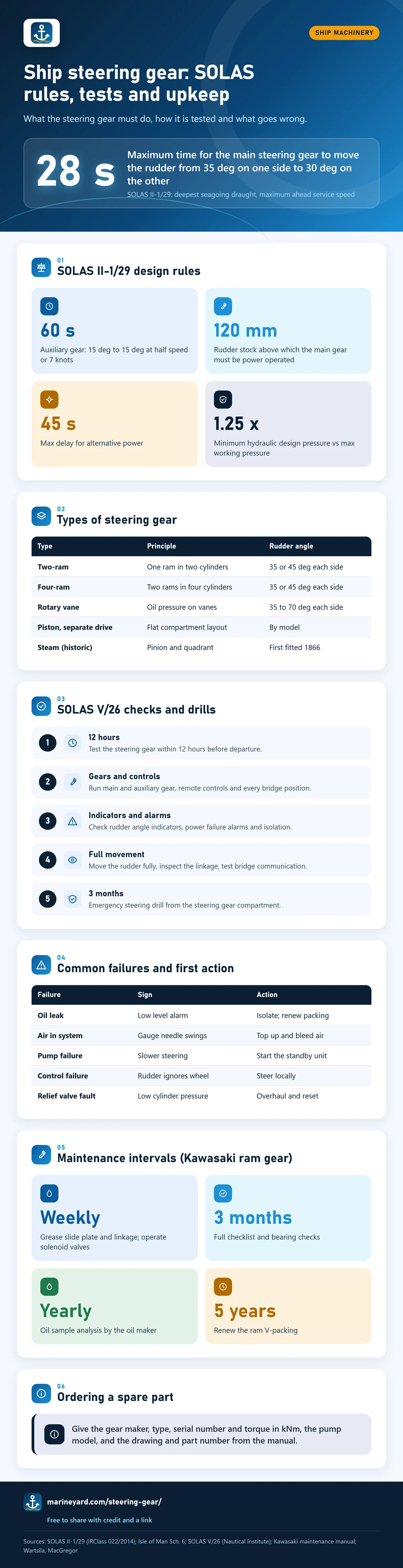
| Auxiliary steering gear | 15° to 15° in not more than 60 s at half service speed or 7 knots, whichever is greater (SOLAS II-1/29.4) |
| Power operation required | Main gear above 120 mm rudder stock diameter; auxiliary gear above 230 mm |
| Alternative power supply | Automatic within 45 s; 30 min capacity on ships of 10,000 GT and above, 10 min on others |
| Identical power units | Two or more on tankers of 10,000 GT and above and other ships of 70,000 GT and above |
| Hydraulic design pressure | At least 1.25 times the maximum working pressure |
| Pre-departure test | Within 12 hours before departure (SOLAS V/26) |
| Emergency steering drill | At least once every three months (SOLAS V/26) |
What is a steering gear on a ship?
A steering gear on a ship is the power system between the bridge steering position and the rudder. SOLAS divides it into a main steering gear, which steers the ship in normal service, and an auxiliary steering gear, which steers the ship if the main gear fails. The tiller or quadrant belongs to the main gear only.
A failure of one gear must not disable the other. Two identical power units can replace the auxiliary gear if they meet the main gear performance and a single failure can be isolated. The Wärtsilä encyclopedia entry on steering gear quotes both SOLAS definitions.
The steering gear compartment must be readily accessible and separated from the machinery spaces as far as practicable, under the Isle of Man Cargo Ship Construction Regulations, Schedule 6. Handrails and non-slip gratings are required in case of oil leakage.
What are the parts of a steering gear?
The parts of a steering gear are the rudder stock, the tiller, the rudder actuator (rams or a rotary vane unit), the hydraulic power units, the control system, the hunting gear, the rudder angle indicator, relief and isolating valves, a storage tank and the local emergency steering position.
| Part | Function |
|---|---|
| Rudder stock and tiller | The stock carries the rudder; the tiller takes the ram force |
| Rams and cylinders | Push the tiller through a Rapson slide or link mechanism |
| Rotary vane unit | Rotor on the rudder stock inside a stator, turned by oil pressure |
| Power unit | Electric motor and hydraulic pump, often of variable displacement |
| Control system | Carries the helm order from the bridge; electric, or a hydraulic telemotor on older ships |
| Hunting (feedback) gear | Reports the rudder position and stops the pump stroke at the ordered angle |
| Rudder angle indicator | Shows the angle on the bridge and in the compartment; independent of the control system |
| Relief valves | Protect any part that can be isolated; set no higher than the design pressure |
| Bypass and isolating valves | Separate a failed cylinder, pump or circuit |
| Storage tank and low level alarms | Tank recharges at least one power actuating system; alarms warn of oil loss |
| Emergency steering position | Local control in the steering gear compartment |
What are the types of steering gear?
The types of steering gear are the two-ram and four-ram electro-hydraulic gear, the rotary vane gear and the piston type with a separate drive unit. Steam steering engines were the historic type. Ram and rotary vane gears are the two types in common use on merchant ships.
| Type | Principle | Rudder angle | Typical use |
|---|---|---|---|
| Two-ram | One ram in two opposed cylinders moves the tiller | 35° or 45° each side (Kawasaki) | Small and medium ships |
| Four-ram | Two rams in four cylinders; one pair can be isolated | 35° or 45° each side (Kawasaki) | Large ships and tankers |
| Rotary vane | Oil pressure on vanes between stator and rotor | 35° to 70° each side, by model | Medium to large ships |
| Piston, separate drive | Cylinders in a flat compartment, drive unit apart | By model | RoRo ships up to about 30,000 dwt |
| Steam engine (historic) | Steam engine turned the stock through a pinion and quadrant | Not applicable | First fitted on the Great Eastern in 1866 |
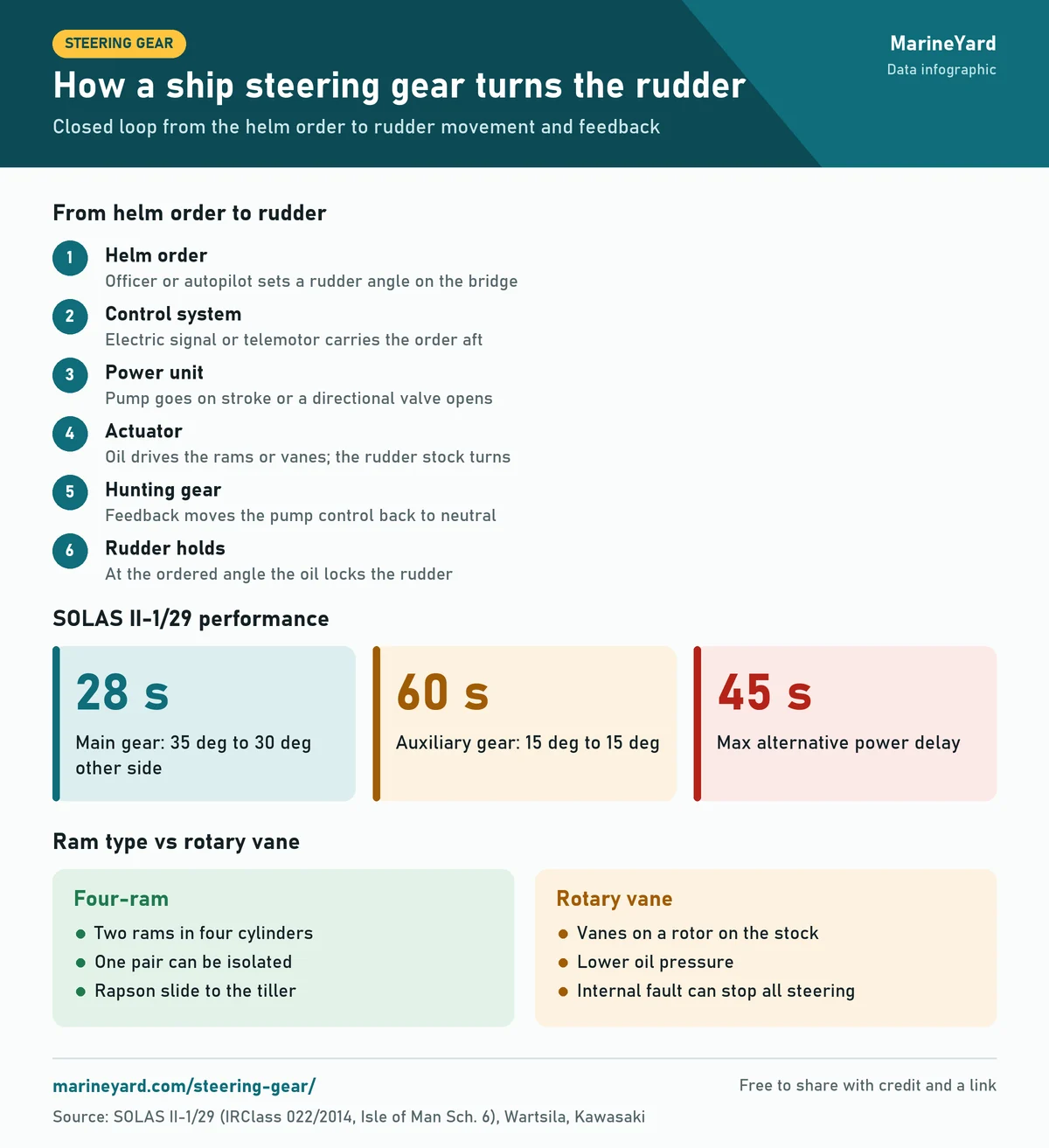
A fault inside a rotary vane unit can stop all steering. A four-ram gear keeps steering on one pair of rams.
How does a ship steering gear work?
A ship steering gear works as a closed loop. The bridge sends a rudder order, a pump moves oil to the actuator, the actuator turns the rudder stock, and the hunting gear reports the actual angle. The pump stops delivering oil when the actual angle equals the ordered angle.
- The officer or the autopilot sets a rudder angle on the bridge.
- The control system sends the order to the compartment, by electric signal or telemotor.
- The receiver puts the variable displacement pump on stroke, or opens a solenoid directional valve.
- Oil flows to one side of the rams or vanes, and the rudder stock rotates.
- The hunting gear moves the pump control back towards neutral as the rudder turns.
- At the ordered angle, the pump returns to zero stroke or the valve closes, and the oil holds the rudder.
What does SOLAS regulation II-1/29 require for steering gear?
SOLAS regulation II-1/29 requires every ship to have a main and an auxiliary steering gear, or duplicated power units. The main gear must move the rudder from 35° on one side to 30° on the other in not more than 28 s. The auxiliary gear must move it from 15° to 15° in not more than 60 s.
- Test conditions. Deepest seagoing draught at maximum ahead service speed for the main gear; half that speed or 7 knots for the auxiliary gear.
- Power units. Restart automatically after a power failure and alarm on the bridge.
- Hydraulics. Low level alarm on each reservoir, a fixed storage tank with a contents gauge, and means to keep the oil clean.
- Alternative power. Required where the rudder stock is over 230 mm; supplied within 45 s from the emergency source or an independent source.
- Tankers of 10,000 GT and above. After a single failure in one power actuating system, steering must be regained within 45 s.
Where a full-draught trial is impractical, amendments adopted at MSC 93 accept an even-keel trial or a calculated equivalent, as the IRClass technical circular on SOLAS II-1/29 shows. IACS unified requirement M42 sets the class rules.
What steering gear tests and drills does SOLAS V/26 require?
SOLAS regulation V/26 requires the crew to check and test the steering gear within 12 hours before departure. Emergency steering drills must take place at least once every three months. The dates of the tests and the date and details of each drill must be recorded.
- Operate the main and auxiliary steering gear.
- Test the remote control systems and every bridge steering position.
- Test the emergency power supply.
- Check the rudder angle indicators, power failure alarms and automatic isolation.
- Check full rudder movement, inspect the gear and linkage, and test bridge communication.
The drill includes direct control from the steering gear compartment, the communication procedure with the bridge and, where applicable, the alternative power supply. The Nautical Institute summary of SOLAS drill requirements reproduces the text.
What are common steering gear failures?
Common steering gear failures are hydraulic oil leaks, air in the system, pump or motor failure, control system failure, a rudder that does not follow the order, and faulty relief valves. Most faults show first as a low level alarm, slow rudder movement or a difference between ordered and actual angle.
| Failure | Cause | Sign | Action |
|---|---|---|---|
| Oil leak | Worn ram packing, damaged pipe | Oil on floor; low level alarm | Isolate the system; renew packing; recharge from the tank |
| Air in the system | Low oil level, pipe work without venting | Jerky movement; gauge needle swings | Top up and bleed air as the manual states |
| Pump or motor failure | Internal wear, electrical fault | Unit failure alarm; slower steering | Start the standby unit; overhaul the pump |
| Control or telemotor failure | Signal or power loss, telemotor leak | Rudder ignores the wheel | Change control system or steer locally |
| Rudder not following | Worn hunting gear, sticking valve | Ordered and actual angle differ | Check linkage, bearings and valves |
| Relief valve fault | Wrong setting, dirt on the seat | Low cylinder pressure | Clean or overhaul; reset to design value |
How is a ship steering gear maintained?
A ship steering gear is maintained by checking oil level and condition, cleaning filters, inspecting ram packing, greasing the linkages, measuring bearing clearances and overhauling pumps at the maker's intervals. The Kawasaki steering gear maintenance manual sets these intervals for its ram gears.
- Before leaving port and monthly. Check leakage at the ram V-packing and the ram surface.
- Weekly. Grease the slide plate, roller bearings and control linkage; operate the solenoid valves.
- Every three months. Full checklist inspection; measure roller bearing clearances; inspect the line filter.
- Every 6 months. Visual oil sample check; measure the guide bar clearance.
- Every year. Oil sample analysis by the oil maker.
- Every 5 years. Renew the ram V-packing.
- Every 5 to 7 years. Overhaul the pumps and solenoid valves.
Kawasaki sets an oil cleanliness target of ISO 4406 -/20/17 and an 80 °C oil temperature limit. The allowable clearance is 0.5 mm at the ram pin bearing and 3 mm at the guide bar.
Who makes ship steering gear?
Ship steering gear is made by specialist marine machinery companies. Neuver Maritime makes the former Kongsberg rotary vane range with Tenfjord and Frydenbø roots. MacGregor sells the Hatlapa and Porsgrunn brands. Kawasaki Heavy Industries makes ram-type electro-hydraulic gears. The Neuver IRV and Porsgrunn IMO series suit tankers above 100,000 dwt.
- Neuver Maritime. The Neuver RV/IRV rotary vane range covers 430 to 6,550 kNm; the SR series serves smaller ships with up to 70° rudder angle.
- MacGregor. The MacGregor steering gear portfolio includes the Porsgrunn rotary vane, the Hatlapa Poseidon ram type and the Neptune piston type.
- Kawasaki. The Kawasaki steering gear range covers 314 to 11,280 kNm (E series, pump control) and 105 to 844 kNm (V series, valve control).
Which steering gear spare parts are ordered and how are they specified?
Steering gear spare parts ordered most often are ram packing and seal kits, hydraulic pumps and pump parts, solenoid and directional valves, filter elements, relief valves and feedback units. A correct order identifies the gear by maker, type, serial number and torque rating, and each part by drawing and part number.
- Ship name and IMO number.
- Steering gear maker, type and serial number from the nameplate.
- Rated torque in kNm and maximum working pressure.
- Hydraulic pump maker, model and serial number.
- Drawing number and part number from the manual.
Hydraulic oil and grease may carry an IMPA code and can come from a ship chandler.
Where can steering gear parts be bought or sold?
Steering gear parts are bought from makers, authorised service companies and surplus stockists. MarineYard is a ship spare parts marketplace where sellers list new, reconditioned and used propulsion and steering parts and pumps and hydraulics. Sellers get 9 free listings per account. MarineYard takes no commission and is not a party to any sale. Buyers should confirm the model, serial number and part number before payment.
Frequently Asked Questions
What is the 28 second rule for steering gear?
The 28 second rule is the SOLAS II-1/29 limit for the main steering gear. The gear must put the rudder from 35° on either side to 30° on the other side in not more than 28 seconds, at deepest seagoing draught and maximum ahead service speed.
What is the difference between main and auxiliary steering gear?
The main steering gear steers the ship in normal service at maximum ahead service speed. The auxiliary steering gear steers the ship if the main gear fails and needs only 15° to 15° in 60 seconds. The tiller and quadrant belong to the main gear.
What is hunting gear in a steering gear?
Hunting gear is the feedback linkage between the rudder stock and the pump control. The hunting gear moves the pump control back to neutral as the rudder turns. The pump stops delivering oil at the ordered angle, so the rudder holds that angle.
What is a telemotor on a ship?
A telemotor is the system that transmits the helm order from the bridge wheel to the steering gear. A hydraulic telemotor has a transmitter on the bridge and a receiver in the steering gear compartment. Modern ships mostly use electric control systems instead.
How is emergency steering done on a ship?
Emergency steering is done from the local control position in the steering gear compartment. The crew takes orders from the bridge by the fixed communication system and reads the local rudder angle indicator. SOLAS V/26 requires an emergency steering drill at least once every three months.
Why does a rotary vane steering gear need less pressure than a ram type?
A rotary vane steering gear needs less pressure because its vanes give a larger working area than the rams of an equivalent ram gear. The same torque therefore needs lower oil pressure. The unit is also usually smaller, and the rudder carrier is often built in.
Related guides
- Stern tube: parts, bearings, seals and lubrication
- IMPA code: meaning and structure
- Ship chandler: meaning and services
- Oily water separator: working, parts and the 15 ppm rule
- Marine turbocharger: parts, working and surging
- Purifier in ship: working principle, parts and faults
- Cylinder liner: function, wear and gauging
- Ship boiler: types, mountings and water treatment
- Anchor windlass: parts, working and class rules
- Bow thruster: how it works, types and failures
- Marine air compressor: starting air, parts and safety
Sources
- Indian Register of Shipping, Technical Circular 022/2014, amendments to SOLAS regulation II-1/29
- Isle of Man Ship Registry, Merchant Shipping (Cargo Ship Construction) Regulations 1998, Schedule 6 Steering gears
- The Nautical Institute, SOLAS onboard drill requirements (SOLAS V/26)
- Wärtsilä Encyclopedia of Marine and Energy Technology, steering gear
- Kawasaki Heavy Industries, electro-hydraulic steering gear
- Kawasaki, Steering Gear Maintenance Manual, 1st edition
- MacGregor, steering gear (Hatlapa and Porsgrunn)
- Neuver Maritime, RV/IRV 4-vane rotary vane steering gear
Sign in to leave a comment and join the discussion.
 Ship Machinery
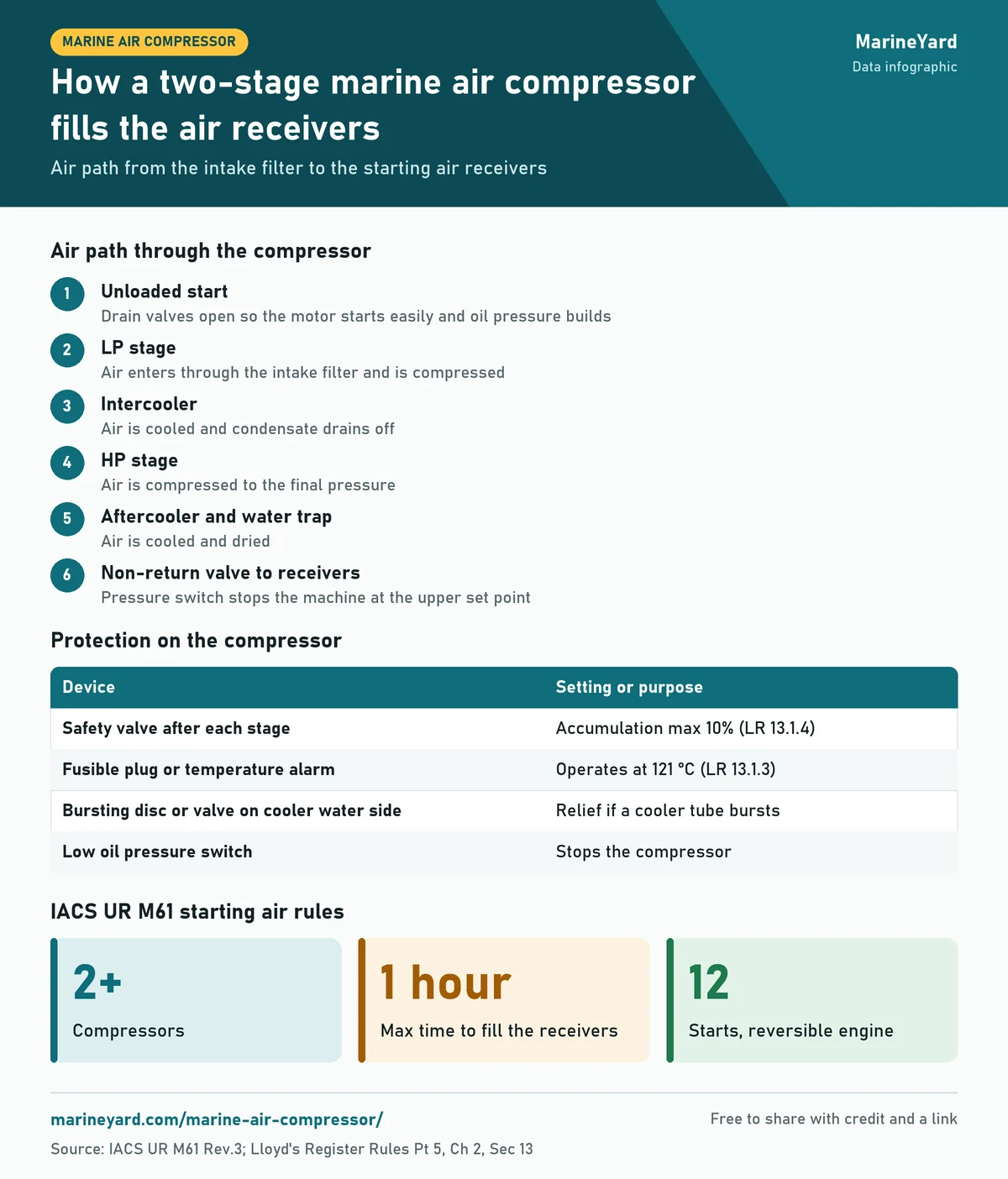
A marine air compressor is the machine in a ship's engine room that compresses atmospheric air and stores it in air receivers. The stored air starts the...
 Ship Machinery
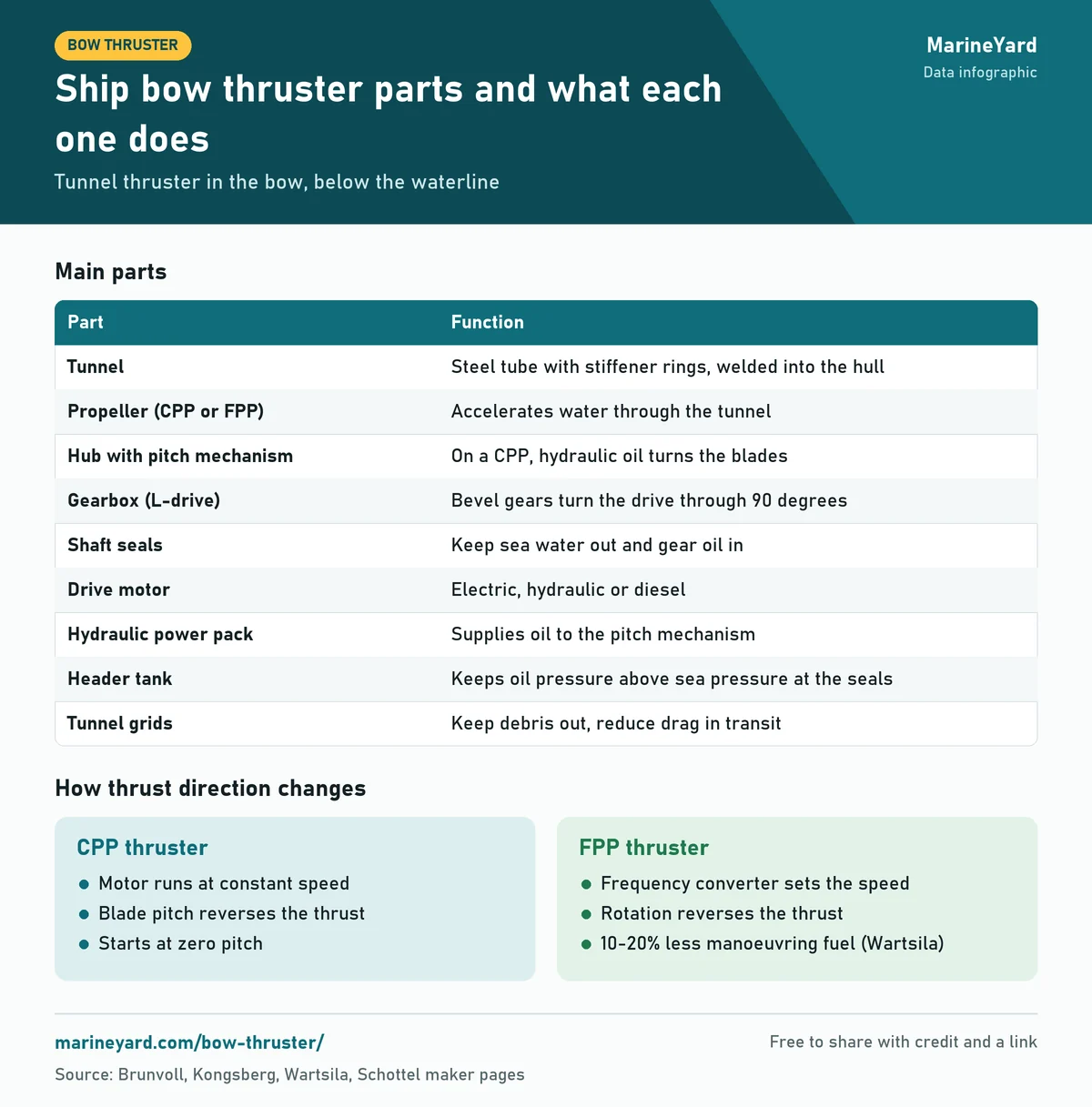
A bow thruster is a propeller unit mounted in a transverse tunnel through the bow of a ship, below the waterline, that pushes the bow sideways to port or...
 Ship Machinery
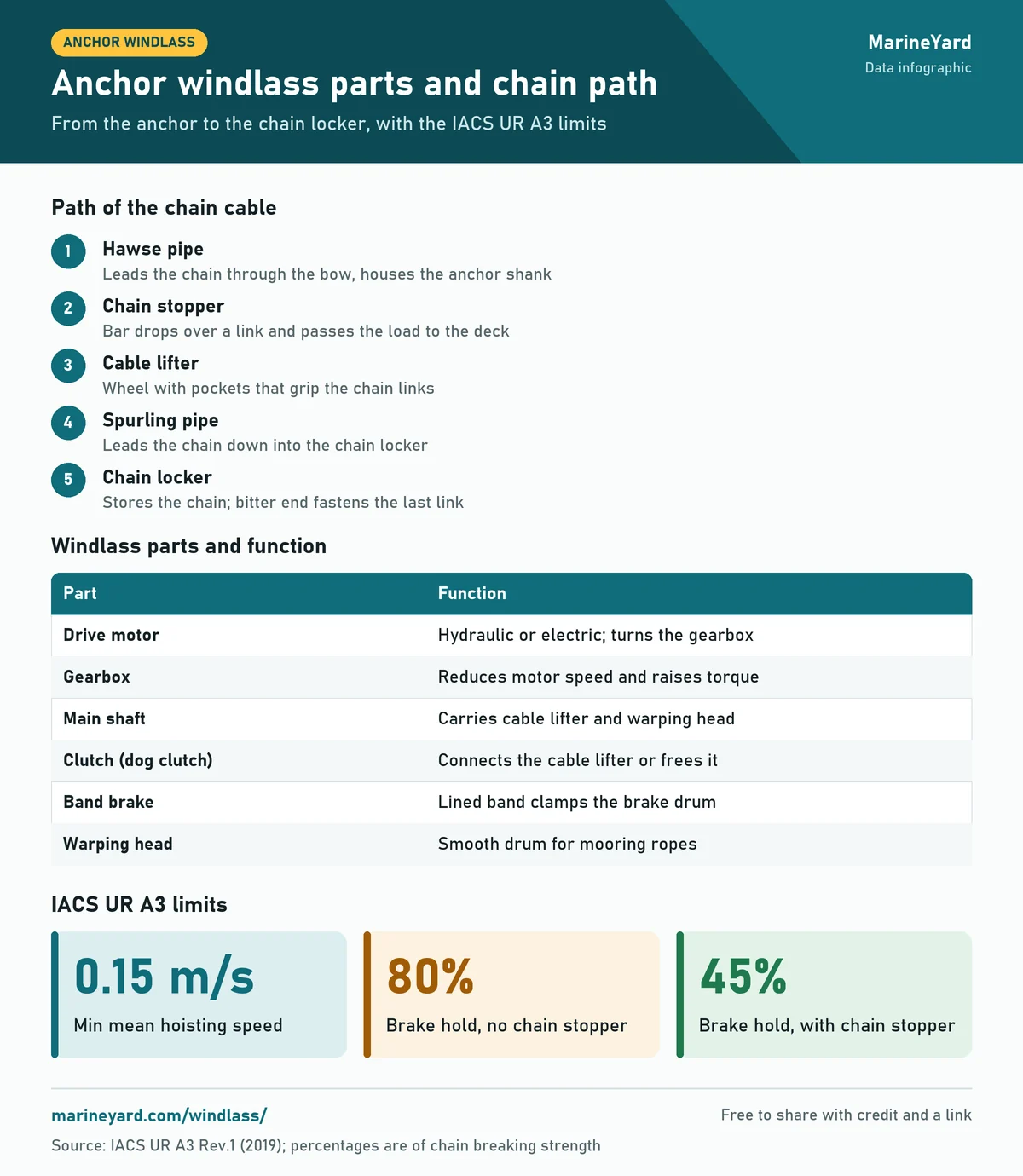
A windlass is the deck machine on a ship that heaves up, lowers and holds the anchor and its chain cable. The windlass stands on the forecastle deck. A...