Main Engine Parts of a Ship: Names, Functions and Spares
Marine engineers & industry writers
Updated
Nov 27, 2026
Main engine parts are the components of the diesel engine that turns a ship's propeller. The main engine of a large merchant ship is usually a slow-speed two-stroke crosshead engine. The main parts are the bedplate, frame box, cylinder frame, tie rods, crankshaft, connecting rod, crosshead, piston, cylinder liner, cylinder cover, exhaust valve, fuel injection equipment and turbocharger.
Everllence (MAN B&W engines, formerly MAN Energy Solutions) and WinGD are two designers of these engines. The names of some parts differ. The frame box is also called the column or A-frame, the tie rod the stay bolt, and the stuffing box the piston rod gland.
Key facts
| Attribute | Value |
|---|---|
| Engine type | Single-acting two-stroke diesel engine of crosshead design (WinGD X62-B operation manual) |
| Main structure | Bedplate, frame box and cylinder frame, tightened together by stay bolts (MAN B&W engine description) |
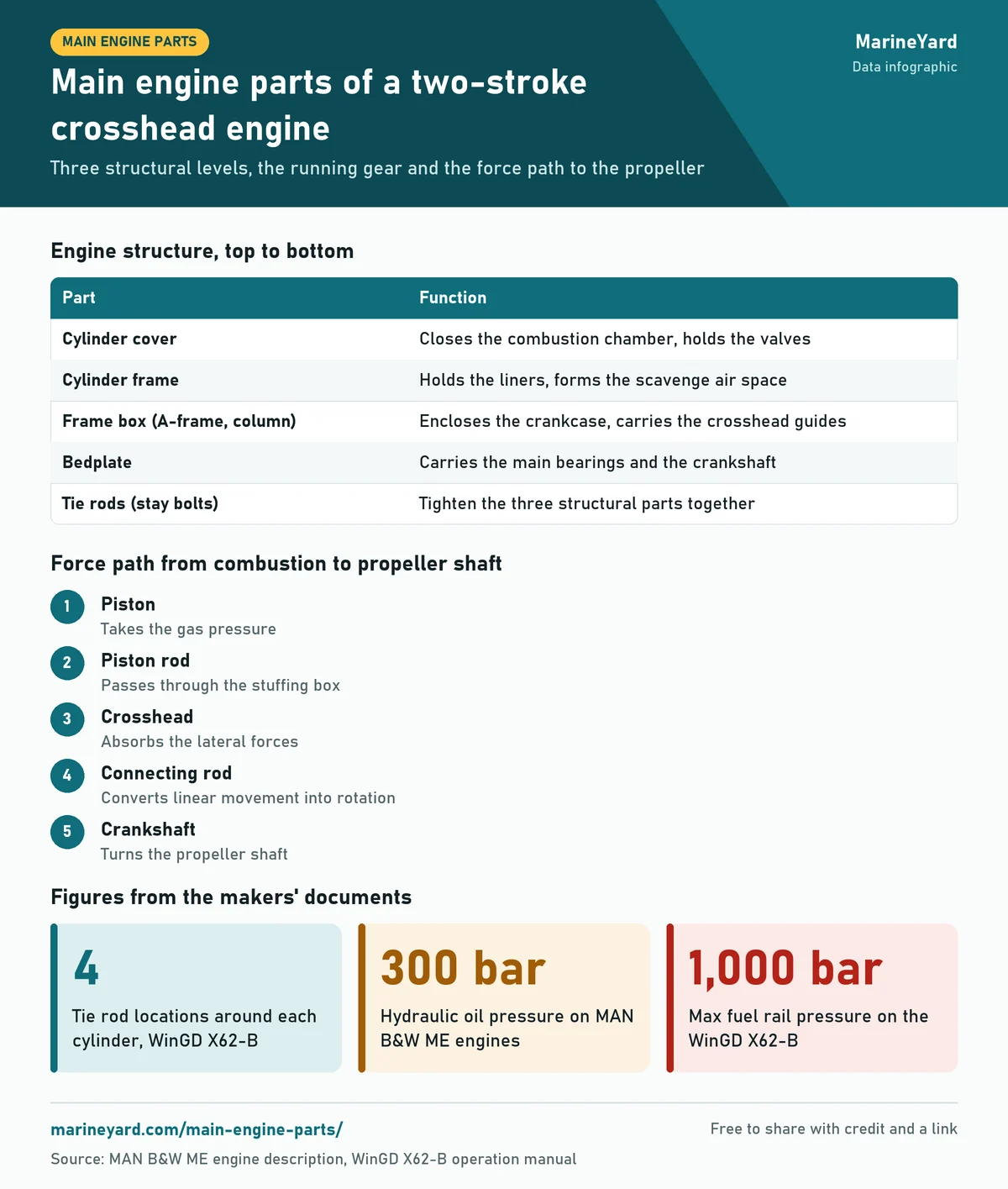
| Tie rod positions | Four locations around each cylinder (WinGD X62-B) |
| Crankshaft | Semi-built type with forged or cast steel throws (MAN B&W ME engines) |
| Hydraulic oil pressure, electronic engine | 300 bar from the hydraulic power supply (MAN B&W ME engines) |
| Fuel rail pressure, common rail engine | Up to 1,000 bar (WinGD X62-B) |
| Spare exhaust valves in the generic class list | 2 sets (IACS Recommendation No. 26, Rev.2, November 2023) |
| Class certificate | Society Certificate for the crankshaft, crosshead, connecting rod and tie rods (IACS UR M72) |
What is the main engine of a ship?
The main engine of a ship is the engine that supplies the propulsion power. A two-stroke crosshead main engine burns fuel in a row of vertical cylinders and turns one crankshaft. The crankshaft passes the power to the propeller shaft. Each cylinder completes one working cycle in one crankshaft revolution.
The engine is built in three levels: the bedplate at the bottom, the frame box on the bedplate, and the cylinder frame on the frame box.
What are the main engine parts and their functions?
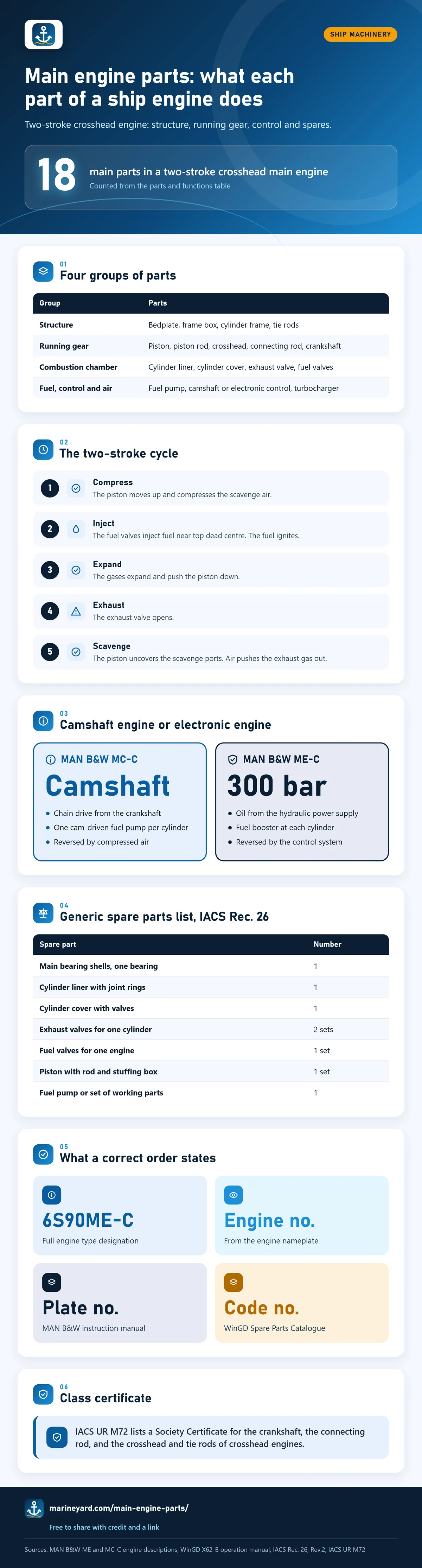
The main engine parts fall into four groups: the engine structure, the running gear, the combustion chamber parts, and the fuel, control and air systems. The table lists each part with its location in the engine and its main function.
| Part | Location | Function |
|---|---|---|
| Bedplate | Bottom of the engine | Carries the main bearings and the crankshaft; collects return oil |
| Main bearing | Cross girders of the bedplate | Holds the crankshaft |
| Thrust bearing | Aft end of the bedplate | Passes the propeller thrust to the hull |
| Frame box (A-frame, column) | On the bedplate | Encloses the crankcase and carries the crosshead guides |
| Cylinder frame (cylinder block) | On the frame box | Holds the cylinder liners and forms the scavenge air space |
| Tie rods (stay bolts) | Through the three structural parts | Tighten the three structural parts together |
| Crankshaft | In the main bearings | Turns the propeller shaft |
| Connecting rod | Between crosshead and crankpin | Converts linear piston movement into rotation |
| Crosshead | Between piston rod and connecting rod | Guides the piston rod and absorbs the lateral forces |
| Piston rod | Between piston and crosshead | Carries the piston force and the piston cooling oil |
| Piston | Inside the cylinder liner | Takes the gas pressure; piston rings seal the chamber |
| Stuffing box (piston rod gland) | Bottom of the cylinder frame | Seals the scavenge air space from the crankcase |
| Cylinder liner | In the cylinder frame | Forms the cylinder wall; has scavenge ports |
| Cylinder cover | On top of the liner | Closes the combustion chamber and holds the valves |
| Exhaust valve | Centre of the cylinder cover | Releases the exhaust gas to the exhaust gas receiver |
| Fuel pump and fuel valves | Valves in the cylinder cover | Raise the fuel pressure and inject the fuel |
| Camshaft or electronic control | Along the engine, or at each cylinder | Times the fuel injection and the exhaust valve |
| Turbocharger | On the cylinder frame | Uses exhaust gas energy to compress the scavenge air |
What are the structural parts of a main engine?
The structural parts of a main engine are the bedplate, the frame box, the cylinder frame and the tie rods. The bedplate carries the crankshaft. The frame box carries the crosshead guides. The cylinder frame carries the liners. The tie rods tighten the three parts together into one rigid structure.
- Bedplate. The MAN B&W ME engine description specifies welded longitudinal girders and cross girders with cast steel bearing supports. Long elastic holding-down bolts fix the bedplate to the engine seating.
- Frame box. The frame box is welded and bolted to the bedplate. The Wärtsilä encyclopedia entry on the A-frame describes a fabricated steel element that stands on the bedplate above the main bearings.
- Tie rods. The tie rods of the WinGD X62-B sit at four locations around each cylinder.
What are the running gear parts of a main engine?
The running gear parts of a main engine are the piston, piston rod, crosshead, connecting rod and crankshaft. The piston and piston rod move in a straight line. The crosshead joins the piston rod to the connecting rod. The connecting rod turns the crankshaft. The stuffing box seals the piston rod where the rod enters the crankcase.
- Piston and piston rod. The piston has a crown of heat-resistant steel and a cast iron skirt. The piston rod is forged steel with a surface-hardened running surface for the stuffing box.
- Crosshead. The crosshead is forged steel. Cast steel guide shoes with white metal faces slide on the guides of the frame box.
- Connecting rod and crankshaft. The connecting rod is forged or cast steel. The crankshaft is of the semi-built type.
What are the combustion chamber parts of a main engine?
The combustion chamber parts of a main engine are the cylinder liner, the piston crown, the cylinder cover, the exhaust valve and the fuel valves. The liner forms the wall. The piston crown forms the bottom. The cylinder cover closes the top and holds the exhaust valve, the fuel valves and the starting air valve.
The cylinder liner is alloyed cast iron and hangs in the cylinder frame. The cylinder cover is one piece of forged steel with bores for cooling water. Each cover carries two or three fuel valves. Hydraulic oil pressure opens the exhaust valve, and an air spring closes the valve.
How do the main engine parts work together?
The main engine parts work together in a two-stroke cycle. The piston compresses scavenge air, the fuel valves inject fuel, and the expanding gas pushes the piston down. The piston rod, crosshead and connecting rod pass the force to the crankshaft. The WinGD X62-B operation manual describes the sequence:
- The piston moves up and compresses the scavenge air. The air temperature rises above the self-ignition temperature of the fuel.
- The fuel valves inject fuel at very high pressure near top dead centre. The fuel ignites.
- The gases expand and push the piston down.
- The exhaust valve opens.
- The piston uncovers the scavenge ports in the liner. Scavenge air enters the cylinder and pushes the exhaust gas out through the exhaust valve.
- The piston covers the scavenge ports again, the exhaust valve closes, and the cycle starts again.
The exhaust gas flows through the exhaust gas receiver to the turbocharger. The turbocharger delivers air through the air cooler and the scavenge air receiver to the scavenge ports. A separate guide covers the marine turbocharger.
How do camshaft engines and electronically controlled engines differ?
Camshaft engines time the fuel injection and the exhaust valve with cams on a chain-driven camshaft. Electronically controlled engines do the same work with high-pressure hydraulic oil and valves that the engine control system operates. The fuel pump, the exhaust valve actuator and the reversing method change.
| Item | MAN B&W MC-C (camshaft) | MAN B&W ME-C (electronic) | WinGD X62-B (common rail) |
|---|---|---|---|
| Timing | Fuel cams and exhaust cams on the camshaft | Cylinder control units of the engine control system | Engine control system (ECS) |
| Fuel pressure | One cam-driven fuel pump per cylinder | Fuel booster at each cylinder, driven by hydraulic oil at 300 bar | Fuel pumps on the supply unit feed a fuel rail at up to 1,000 bar |
| Exhaust valve opening | Hydraulic, from a piston actuator driven by a cam | Hydraulic, from the hydraulic cylinder unit | Hydraulic servo oil from the exhaust valve control unit |
| Exhaust valve closing | Air pressure | Air spring | Air spring |
The MAN B&W MC-C engine description states that a chain drive from the crankshaft turns the camshaft. Compressed air reverses the MC-C engine by moving a roller in the fuel pump drive. The ME engine control system reverses the engine by changing the timing of fuel injection, exhaust valve and starting air valves.
Which main engine spare parts are carried on board?
Main engine spare parts carried on board are set by the engine maker's list, the classification society and the owner. IACS Recommendation No. 26 (Rev.2, November 2023) prefers a risk assessment for each engine type. The recommendation keeps a generic example list for conventionally fuelled engines.
| Spare part (generic example, IACS Rec. 26) | Number |
|---|---|
| Main bearing shells for one bearing of each size and type | 1 |
| Cylinder liner with joint rings and gaskets | 1 |
| Cylinder cover with valves, joint rings and gaskets | 1 |
| Exhaust valves, complete, for one cylinder | 2 sets |
| Fuel valves of each size and type, for one engine | 1 set |
| Crosshead type piston with piston rod, stuffing box, skirt and rings | 1 set |
| Fuel pump, complete, or a set of working parts for one pump | 1 |
Each IACS member society decides whether to adopt the recommendation. The MAN B&W list of spare parts for unrestricted service (edition of September 2022) adds parts for the electronic engine, such as controller modules and an exhaust valve position sensor. The owner and the engine builder or yard agree the final scope.
What certificates do main engine parts need?
Main engine parts need the documents listed in IACS Unified Requirement M72, as each classification society applies it. IACS UR M72 names three documents: the Society Certificate (SC), the Work's Certificate (W) and the Test Report (TR). Revision 3 applies to engines with an application for certification dated on or after 1 July 2024.
UR M72 lists a Society Certificate for the welded bedplate, the welded frame box, the crankshaft, the connecting rod, and the crosshead and tie rods of crosshead engines.
How are main engine parts identified and ordered?
Main engine parts are identified by the engine type designation, the engine number and the part number from the maker's spare parts documentation. MAN B&W spare parts lists refer to plate numbers in the instruction manual. WinGD marks every spare part with a unique code number in the Spare Parts Catalogue, also called the code book.
The MAN B&W engine type designation is a code. In 6S90ME-C9.2, 6 is the number of cylinders, S is super long stroke, 90 is the piston diameter in cm, E is electronically controlled, C is compact engine and 9 is the mark number. A correct order states:
- Ship name and IMO number.
- Engine designer, engine builder and full engine type designation.
- Engine number from the engine nameplate.
- Plate number and item for a MAN B&W engine, or code number for a WinGD engine.
- Part name, quantity and condition (new, reconditioned or used).
- Certificate required by the classification society.
Licensees build MAN B&W engines. The designer states that all spare parts are interchangeable with parts of the designer's own design. General consumables may carry an IMPA code.
Where can main engine parts be bought or sold?
Main engine parts are bought from engine designers, licensed engine builders, reconditioning workshops and surplus stockists. MarineYard is a ship spare parts marketplace where sellers list new, reconditioned and used main engine parts and marine turbochargers and parts. Sellers get 9 free listings per account. MarineYard takes no commission and is not a party to any sale. Buyers should confirm the engine type, the part number and the certificate with the seller before payment.
Frequently Asked Questions
What is the function of tie rods in a marine engine?
Tie rods in a marine engine tighten the cylinder frame, the frame box and the bedplate together into one structure. MAN B&W calls the rods stay bolts. The WinGD X62-B has tie rods at four locations around each cylinder.
What is the difference between a bedplate and an A-frame?
A bedplate is the bottom structure of the engine that carries the main bearings and the crankshaft. An A-frame is the steel structure that stands on the bedplate above the main bearings. MAN B&W uses a welded frame box in this position, and WinGD uses a monoblock column.
Why does a two-stroke marine engine have a crosshead?
A two-stroke marine engine has a crosshead to guide the piston rod and absorb the lateral forces from the connecting rod. The straight-moving piston rod can then pass through a stuffing box, which separates the scavenge air space from the crankcase.
What does the stuffing box do in a main engine?
The stuffing box seals the piston rod at the bottom of the cylinder frame. Sealing rings stop scavenge air from reaching the crankcase. Scraper rings remove oil from the rod, so dirty cylinder oil stays out of the crankcase oil and crankcase oil stays out of the scavenge space.
How many spare exhaust valves are recommended for a main engine?
Two sets of complete exhaust valves for one cylinder are recommended in the generic example list of IACS Recommendation No. 26. The recommendation asks for at least two spares of any part that is exchanged periodically in normal operation, unless a risk assessment concludes otherwise.
What does ME-C mean on a MAN B&W engine?
ME-C on a MAN B&W engine means an electronically controlled engine of compact design. In the type designation, E stands for electronically controlled and C after the hyphen stands for compact engine. MC-C is the camshaft controlled version, and ME-B has an exhaust valve controlled by a camshaft.
Related guides
- Fresh Water Generator on Ships: Working, Parts and Types
- Ballast Water Treatment System: Types, Parts and D-2 Rules
- Sewage Treatment Plant on Ship: Working, Parts and MARPOL Rules
- Marine Incinerator on Ships: Parts, Working and MARPOL Rules
- Oil Mist Detector on Ships: Working, Rules and Alarm Levels
- ISSA Code: Meaning, Catalogue and Difference from IMPA Code
- Crankcase Explosion: Causes, Relief Valves and Alarm Actions
- Scavenge Fire: Causes, Indications, Actions and Prevention
- Stern tube: parts, bearings, seals and lubrication
- IMPA code: meaning and structure
- Ship chandler: meaning and services
- Oily water separator: working, parts and the 15 ppm rule
- Marine turbocharger: parts, working and surging
- Purifier in ship: working principle, parts and faults
- Cylinder liner: function, wear and gauging
- Ship boiler: types, mountings and water treatment
- Anchor windlass: parts, working and class rules
- Bow thruster: how it works, types and failures
- Steering gear: parts, types and SOLAS tests
- Marine air compressor: starting air, parts and safety
Sources
- Everllence (MAN B&W), project guide section 1.06, ME engine description
- MAN B&W, project guide section 1.06, MC-C engine description
- MAN B&W, project guide section 1.02, engine type designation
- MAN B&W, project guide section 19.06, list of spare parts, unrestricted service
- WinGD, X62-B operation manual
- IACS, Recommendation No. 26, spare parts for main internal combustion engines
- IACS, UR M72, certification of engine components
- Wärtsilä Encyclopedia of Marine and Energy Technology, A-frame
Sign in to leave a comment and join the discussion.
 Ship Machinery
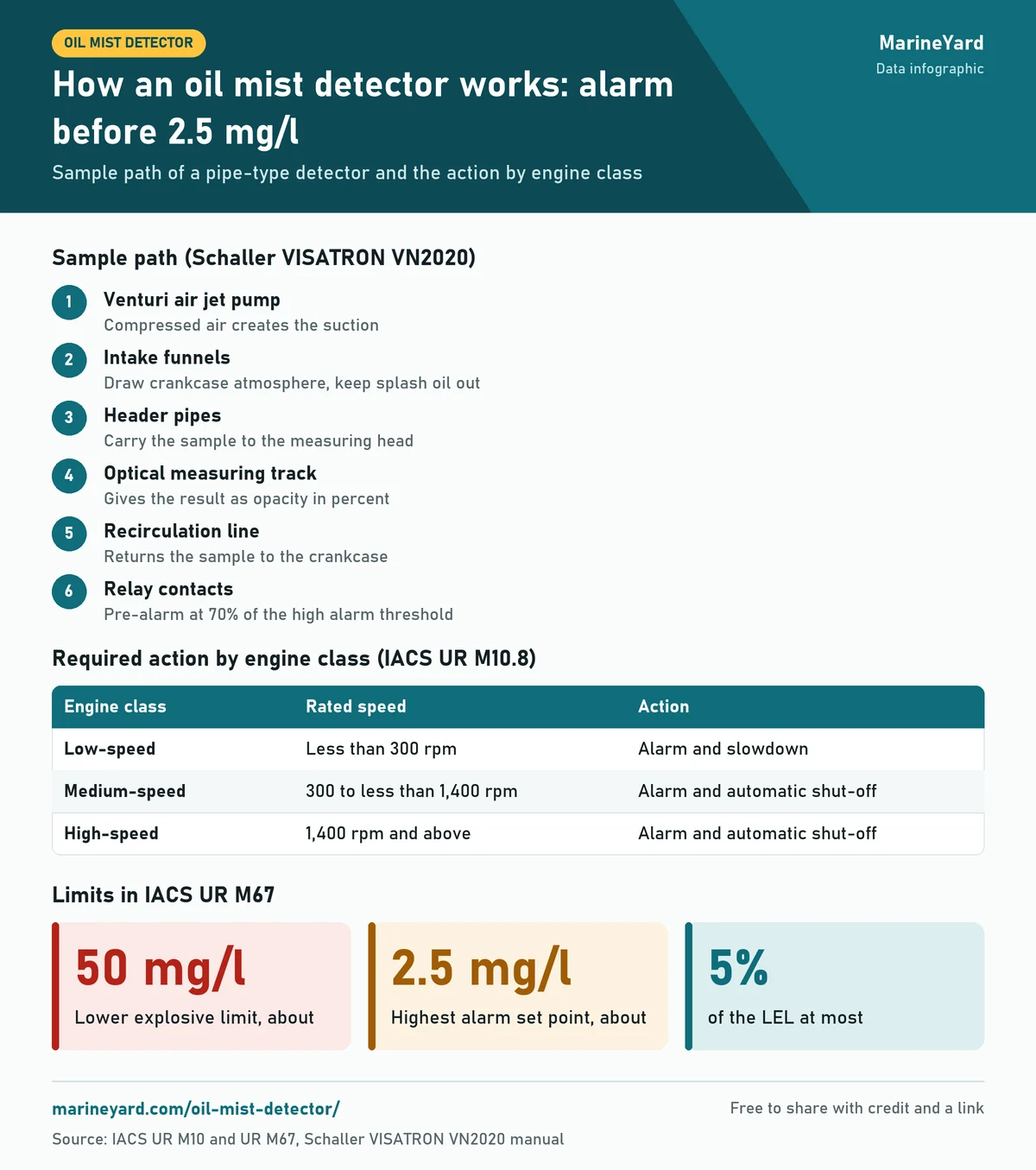
An oil mist detector (OMD) is a safety instrument on a marine diesel engine that measures the concentration of oil mist in the crankcase. The oil mist...
 Ship Machinery
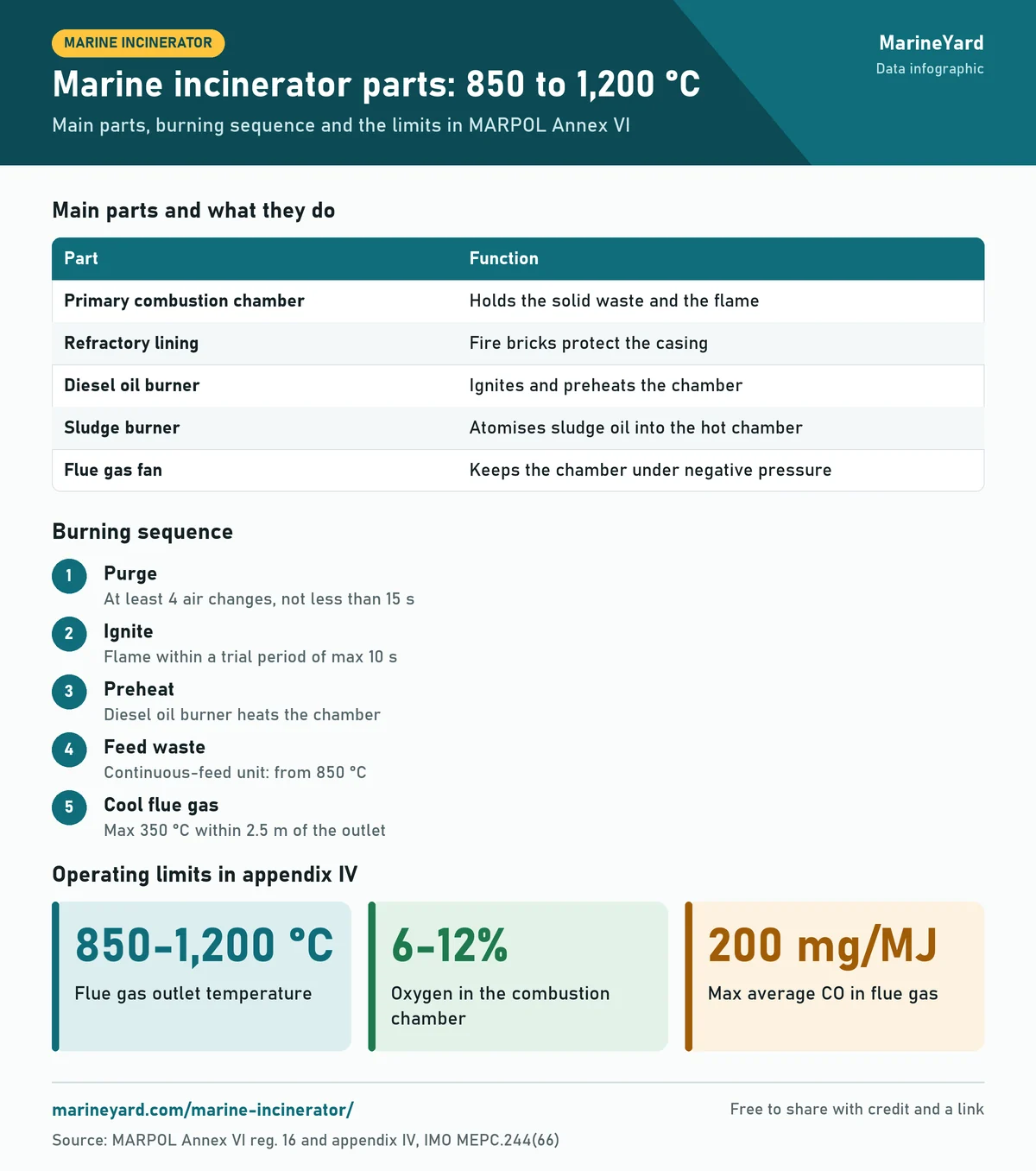
A marine incinerator is a shipboard furnace that burns waste generated during the normal operation of the ship, mainly sludge oil and solid garbage. MARPOL...
 Ship Machinery
A sewage treatment plant on a ship is the machine that treats toilet and medical drainage with aerobic bacteria, settles the solids and disinfects the water...