Marine Air Compressor: Parts, Working, Rules and Safety Devices
Marine engineers & industry writers
Updated
Nov 20, 2026
A marine air compressor is the machine in a ship's engine room that compresses atmospheric air and stores it in air receivers. The stored air starts the main and auxiliary diesel engines and supplies control air and service air. Most starting air compressors are reciprocating two-stage piston machines with an intercooler and an aftercooler.
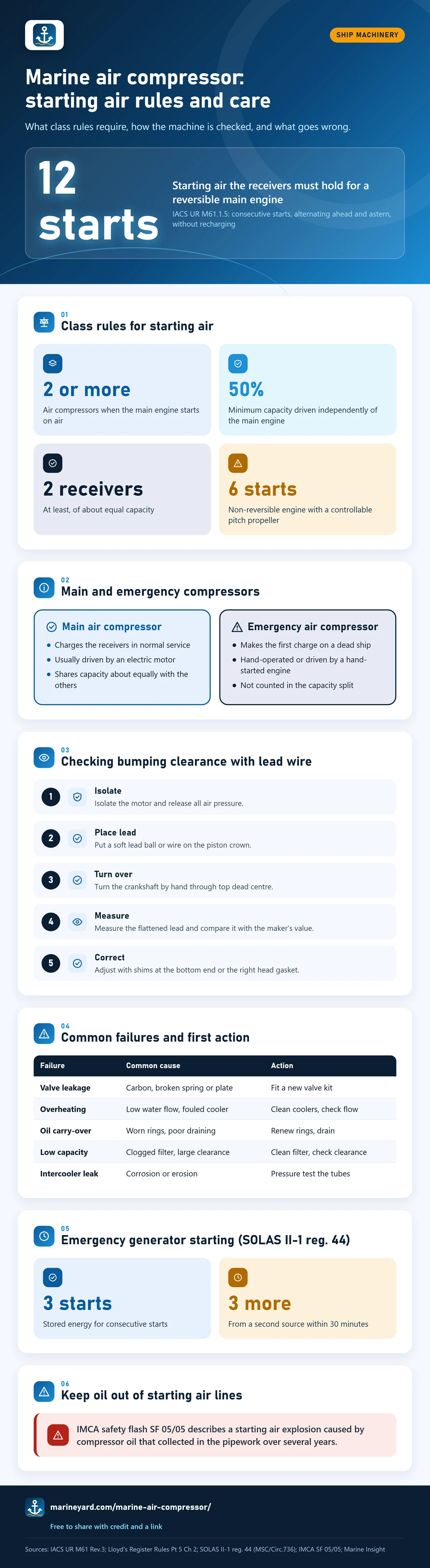
Class rules based on IACS unified requirement M61 require two or more air compressors when the main engine starts on compressed air. The receivers must hold enough air for 12 consecutive starts of a reversible main engine without recharging.
Key facts
| Attribute | Value |
|---|---|
| Number of compressors | Two or more; at least one driven independently of the main engine (IACS UR M61.1.2) |
| Charging time | All compressors together fill the receivers from atmospheric pressure within one hour (M61.1.3) |
| Starting air receivers | At least two of about equal capacity, usable independently (M61.1.4) |
| Starts, reversible engine | Not less than 12 consecutive starts, alternating ahead and astern (M61.1.5) |
| Starts, non-reversible engine | Not less than 6 starts with a controllable pitch propeller or similar device (M61.1.5) |
| Discharge air temperature | Should not substantially exceed 93 °C; fusible plug or alarm at 121 °C (Lloyd's Register Pt 5, Ch 2, 13.1.3) |
| Stage safety valve | Accumulation with the outlet closed not above 10% of maximum working pressure (LR 13.1.4) |
| Emergency generator starting | Stored energy for 3 consecutive starts, plus a second source for 3 more within 30 minutes (SOLAS II-1, regulation 44) |
| Typical maker rating | Tanabe H series 2.45 to 2.94 MPa; Sperre HL2/77A rated at 30 bar |
What is an air compressor on a ship used for?
An air compressor on a ship produces compressed air for three duties: starting air for the main engine and the diesel generators, control air for pneumatic instruments and valves, and service air for tools, cleaning and deck work. Starting air is stored at high pressure. Control air and service air are usually taken at reduced pressure.
The compressors stand in the engine room next to the starting air receivers. Under IACS UR M61, air taken from the receivers for control systems or the whistle counts in the receiver capacity.
- Main and topping-up compressors. Two or more main machines share the charging capacity; some ships add a small topping-up unit.
- Emergency air compressor. A unit that makes the first air charge without external aid. Lloyd's Register rules on starting arrangements accept a hand-operated compressor or one driven by a hand-started engine.
What are the parts of a marine air compressor?
The parts of a marine air compressor are the crankcase and crankshaft, low-pressure (LP) and high-pressure (HP) cylinders with pistons, suction and delivery valves, an intercooler and an aftercooler, a cooling system, unloader and drain valves, a safety valve after each stage, a lubrication system, an intake filter and a non-return valve.
| Part | Function |
|---|---|
| Crankcase and crankshaft | Carry the bearings and drive the pistons |
| LP cylinder and piston | Compress atmospheric air to the intermediate pressure |
| HP cylinder and piston | Compress the cooled air to the delivery pressure |
| Suction and delivery valves | Spring-loaded plate valves; some makers combine both in one valve |
| Intercooler and aftercooler | Cool the air after each stage and condense water |
| Unloader and drain valves | Unload the stages at start and blow out water and oil |
| Safety valve after each stage | Limits stage pressure |
| Fusible plug or temperature switch | Acts on high discharge air temperature |
| Lubrication system | Gear pump or splash oil to bearings, with oil pressure switch |
| Intake filter | Keeps dust out of cylinders and valves |
| Non-return valve | Stops air flowing back from the receivers |
| Air receivers (air bottles) | Store the air; carry stop valves, safety valve, pressure gauge and drain |
Why is a marine air compressor two-stage with intercooling?
A marine air compressor is built in two stages because compression heats the air, and one stage to starting air pressure would give a very high discharge temperature. Cooling the air between the stages brings the process closer to isothermal compression, which needs the least work. Intercooling also condenses water, which the drains remove.
The Wikipedia article on gas compressors explains why gas is cooled between stages. Sauer states that air-cooled compressors were long limited to about 80 m³/h because compression temperatures exceeded 250 °C.
How does a marine air compressor work?
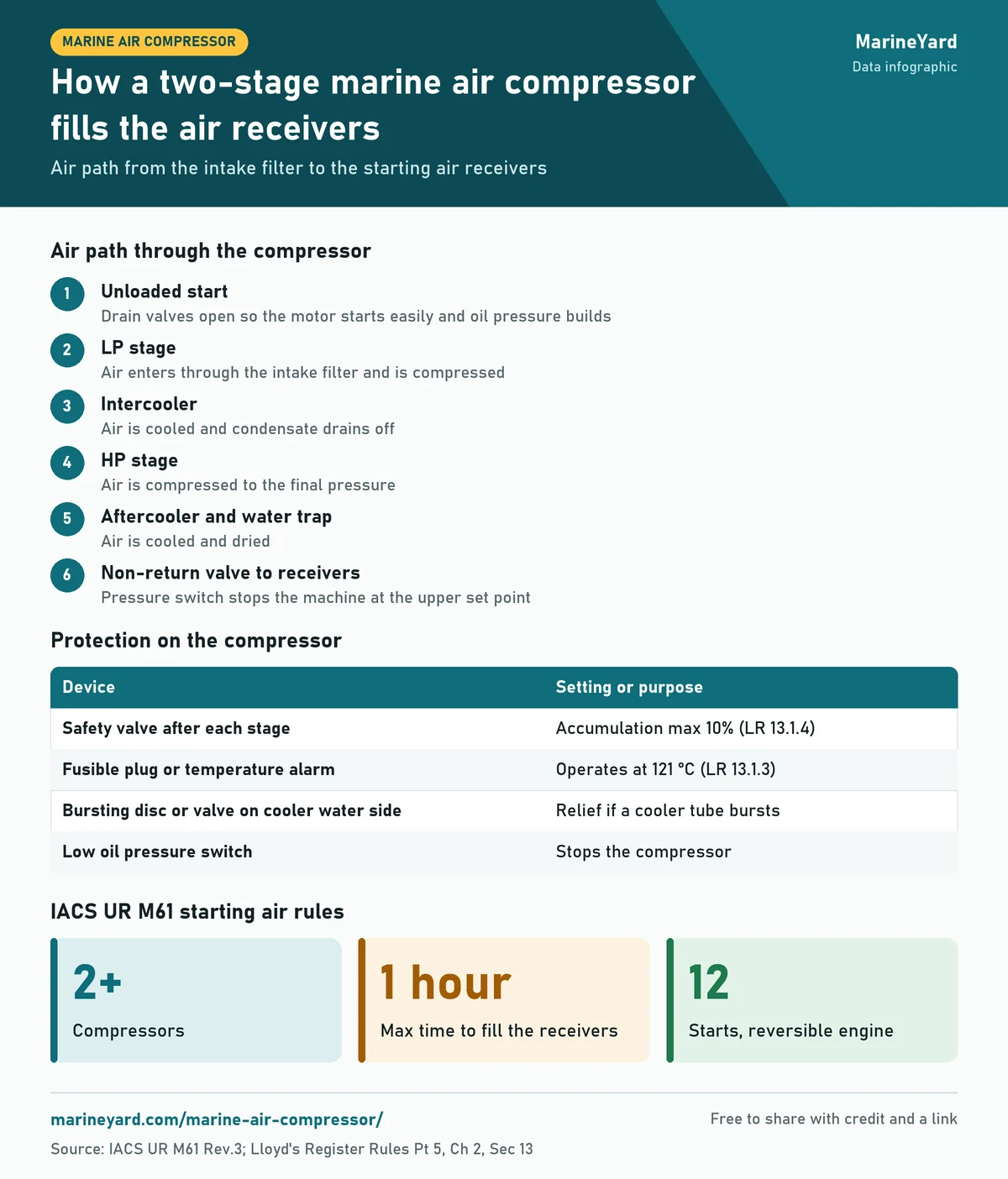
A marine air compressor works by drawing air through a filter into the LP cylinder, compressing it, cooling it in the intercooler, compressing it again in the HP cylinder, cooling it in the aftercooler and delivering it through a non-return valve to the air receivers. A pressure switch starts and stops the machine between set limits.
- The receiver pressure switch starts the compressor.
- The compressor starts unloaded with the drain valves open, so the motor starts easily and oil pressure builds up.
- The drain valves close and the LP piston draws air through the intake filter.
- The LP stage compresses the air and delivers it to the intercooler.
- The intercooler cools the air, and condensate drains off at its lowest point.
- The HP stage compresses the air to the final pressure.
- The aftercooler and water trap cool and dry the air, which passes the non-return valve into the receivers.
- The drains open at intervals, and the pressure switch stops the compressor at the upper set point.
What do class rules require for starting air receivers and compressors?
Class rules require at least two starting air receivers of about equal capacity, enough air for 12 consecutive starts of each reversible main engine or 6 starts of each non-reversible engine, and two or more compressors that refill the receivers from atmospheric pressure within one hour. These rules come from IACS unified requirement M61.
- At least one compressor is driven independently of the main engine, with not less than 50% of the required capacity (M61.1.2).
- An emergency compressor is not counted in the capacity split (M61.1.3).
SOLAS chapter II-1, regulation 44, requires an automatically started emergency generator to have stored energy for three consecutive starts and a second source for three more within 30 minutes, unless manual starting is effective. IMO MSC/Circ.736 reproduces the text. The emergency generator receiver may be charged from the main receivers through a non-return valve.
An air receiver is a pressure vessel with a safety valve, a pressure gauge and a drain valve at the lowest point. The receivers are examined at class machinery surveys.
What is bumping clearance in an air compressor?
Bumping clearance in an air compressor is the small gap between the top of the piston at top dead centre and the cylinder head. Too small a gap lets the piston strike the head, mainly when the machine runs unloaded. Too large a gap leaves compressed air in the cylinder, which re-expands and lowers the delivered air quantity.
- Isolate the motor and release all air pressure.
- Remove a valve to reach the piston crown.
- Place a soft lead ball or lead wire on the piston crown.
- Turn the crankshaft by hand through top dead centre.
- Measure the flattened lead with a micrometer or vernier caliper and compare it with the maker's value.
- Correct the gap with shims at the connecting rod bottom end or a head gasket of the right thickness.
The Marine Insight guide to bumping clearance names a wrong head gasket as a common cause.
What safety devices and alarms does a marine air compressor have?
A marine air compressor has a safety valve after each stage, a fusible plug or high temperature switch on the discharge, a safety valve or bursting disc on the cooling water side of the coolers, a low lubricating oil pressure trip, and a cooling water alarm. The air receivers carry their own safety valves.
| Device | Protects against | Rule or note |
|---|---|---|
| Safety valve after each stage | Overpressure, for example a closed outlet valve | Accumulation not above 10% (LR 13.1.4) |
| Fusible plug or temperature alarm | High discharge air temperature | Operates at 121 °C (LR 13.1.3) |
| Safety valve or bursting disc on cooler water casing | Air entering the water side through a burst cooler tube | LR 13.1.4 |
| Low oil pressure switch | Bearing damage | Stops the compressor |
| Cooling water switch | Overheating of cylinders and coolers | Alarm or stop on water-cooled units |
| Receiver safety valve | Receiver overpressure | One per receiver |
The values come from the Lloyd's Register rules for reciprocating air compressors.
What are the common marine air compressor failures?
The common marine air compressor failures are leaking or broken valves, overheating, oil carry-over into the air, low delivery capacity, intercooler tube leaks and worn piston rings. Oil carry-over is the most dangerous fault, because oil collected in starting air pipes can ignite and cause a starting air line explosion.
| Failure | Common cause | Symptom | Action |
|---|---|---|---|
| Valve leakage or breakage | Carbon, broken spring or plate | Wrong stage pressure | Fit a new valve kit |
| Overheating | Low water flow, fouled cooler | High temperature trip | Clean coolers, check flow |
| Oil carry-over | Worn rings, too much oil, poor draining | Oil at drains and in receivers | Renew rings, drain, fit coalescing filters |
| Low capacity | Clogged filter, worn rings, large bumping clearance | Receivers fill slowly | Clean filter, check clearance |
| Intercooler tube leak | Corrosion or erosion | Air in cooling water, burst disc | Pressure test, plug or renew tubes |
| Starting air line explosion | Oil in air pipes, leaking engine starting valve | Hot starting air pipe | Drain, keep oil out, maintain starting valves |
The IMCA safety flash SF 05/05 describes a starting air explosion caused by compressor oil collected in the pipework over several years. IMCA recommended coalescing filters on the compressor outlets.
How is a marine air compressor maintained?
A marine air compressor is maintained by overhauling the suction and delivery valves, renewing the intake filter, changing the lubricating oil, cleaning the coolers, checking piston rings and bumping clearance, and testing the safety valves and trips. The running hour intervals for each task come from the maker's maintenance schedule for the model.
- Daily. Check oil level, stage pressures and discharge temperature; drain the receivers.
- Valves. Clean, renew plates and springs, and check seats.
Sperre sells service kits for each overhaul routine and guarantees 30 years of spare parts availability.
Who makes marine air compressors?
Marine air compressors are made by specialist makers. Sperre in Norway makes the Classic and X-Range two-stage compressors. J.P. Sauer & Sohn in Germany makes the two-stage Mistral and Typhoon and the three-stage Passat and Levante. Tanabe Pneumatic Machinery in Japan makes the H series. Hatlapa and Atlas Copco also make starting air compressors.
The Tanabe marine compressor range lists the H series as vertical two-stage, fresh-water-cooled machines for main engine starting, from 60 to 610 m³/h at 2.45 to 2.94 MPa.
Which marine air compressor spare parts are ordered most often?
Marine air compressor spare parts ordered most often are suction and delivery valve kits, piston rings, gasket sets, bearings, unloader and drain valve parts, safety valves, intake filter elements and cooler tube bundles. Makers sell overhaul kits matched to running hours.
- Ship name and IMO number.
- Compressor maker and model, for example Sperre HL2/77A.
- Serial number from the nameplate.
- Capacity in m³/h and final pressure.
- Stage of the part (LP or HP).
- Part or kit number from the maker's manual, and set pressure for a safety valve.
Gaskets and filter elements may carry an IMPA code and can come from a ship chandler.
Where can marine air compressor parts be bought or sold?
Marine air compressor parts are bought from makers, authorised service companies and surplus stockists. MarineYard is a ship spare parts marketplace where sellers list new, reconditioned and used pumps and compressors and main engine parts. Sellers get 9 free listings per account. MarineYard takes no commission and is not a party to any sale. Buyers should confirm model, serial number and stage with the seller.
Frequently Asked Questions
How many air compressors are required on a ship?
A ship whose main engine starts on compressed air needs two or more air compressors under IACS UR M61. At least one compressor is driven independently of the main engine. Together the compressors must fill the receivers from atmospheric pressure within one hour.
How many starts must the starting air receivers give?
The starting air receivers must give not less than 12 consecutive starts, alternating ahead and astern, of each reversible main engine without recharging. A non-reversible engine with a controllable pitch propeller needs not less than 6 starts. IACS UR M61.1.5 sets both figures.
Why does an air compressor start unloaded?
An air compressor starts unloaded so the motor starts against little resistance and the lubricating oil pressure can build up before the stages take load. The open unloader and drain valves also blow out water that collected in the coolers while the machine stood still.
What is the difference between a main air compressor and an emergency air compressor?
A main air compressor charges the starting air receivers in normal service and is usually driven by an electric motor. An emergency air compressor produces the first charge on a dead ship without external aid. Lloyd's Register accepts a hand-operated compressor or one driven by a hand-started engine.
What is the purpose of the fusible plug on an air compressor?
The fusible plug on an air compressor melts and releases air when the discharge air temperature becomes too high. Lloyd's Register rules require a small fusible plug or an alarm device operating at 121 °C on each compressor, except the emergency compressor.
Why must oil be kept out of starting air lines?
Oil must be kept out of starting air lines because oil collected in the pipes can ignite when hot gas leaks back from an engine cylinder. The result is a starting air line explosion. Regular draining, sound piston rings, coalescing filters and tight starting valves reduce the risk.
Related guides
- Stern tube: parts, bearings, seals and lubrication
- IMPA code: meaning and structure
- Ship chandler: meaning and services
- Oily water separator: working, parts and the 15 ppm rule
- Marine turbocharger: parts, working and surging
- Purifier in ship: working principle, parts and faults
- Cylinder liner: function, wear and gauging
- Ship boiler: types, mountings and water treatment
- Anchor windlass: parts, working and class rules
- Bow thruster: how it works, types and failures
- Steering gear: parts, types and SOLAS tests
Sources
- IACS UR M61 Rev.3 (2024), Starting arrangements of internal combustion engines
- Lloyd's Register Rules for Ships, Pt 5, Ch 2, Section 13, reciprocating air compressors
- Lloyd's Register Rules for Ships, Pt 5, Ch 2, Section 9, starting arrangements
- IMO MSC/Circ.736, SOLAS chapter II-1 including regulation 44
- IMCA Safety Flash SF 05/05, starting air system incident
- Wikipedia, Gas compressor
- Tanabe Pneumatic Machinery, marine compressors
- Marine Insight, clearance volume or bumping clearance in air compressors
Sign in to leave a comment and join the discussion.
 Ship Machinery
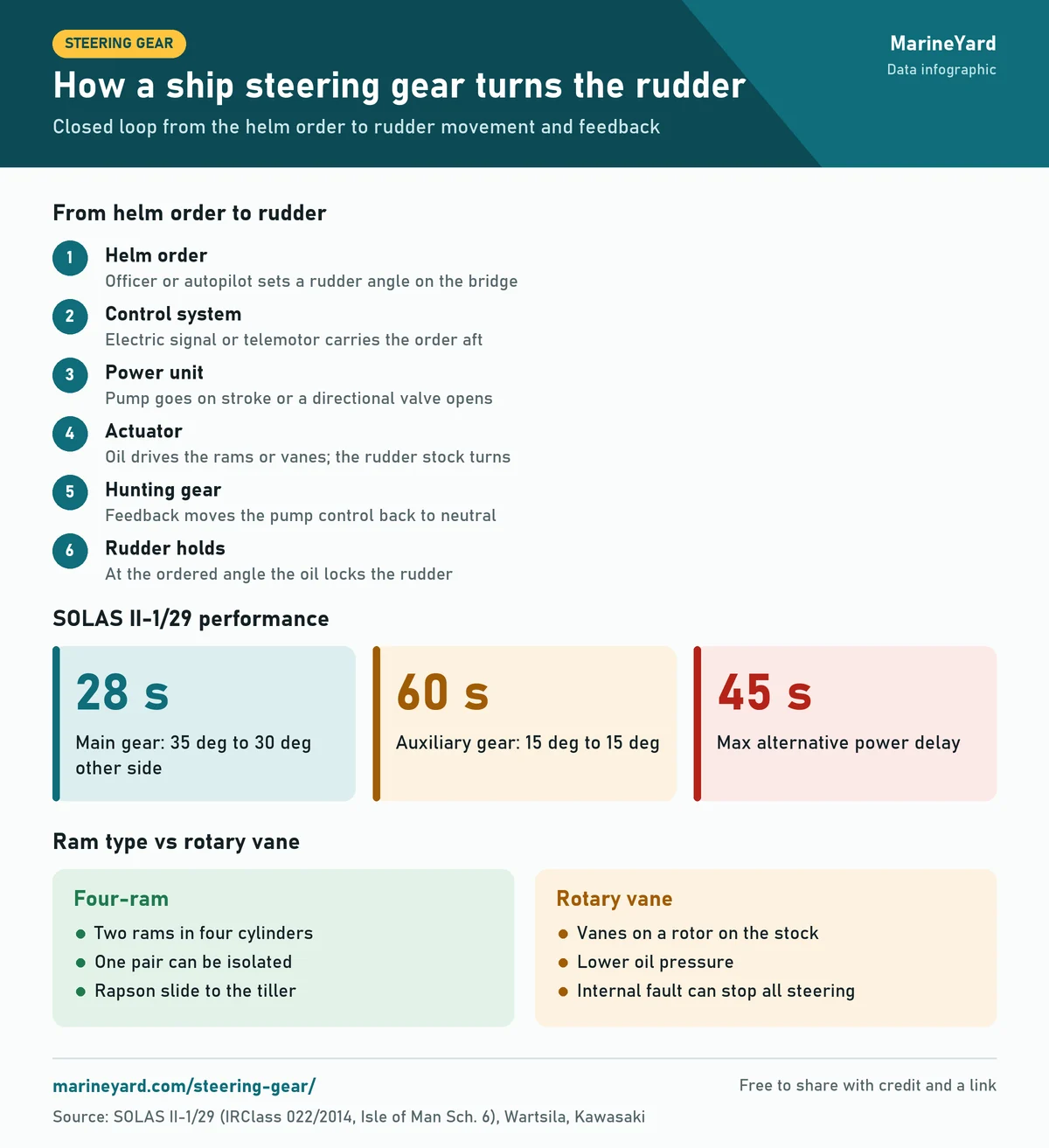
A steering gear is the machinery on a ship that turns the rudder on orders from the bridge. The steering gear comprises the rudder actuators, the power...
 Ship Machinery
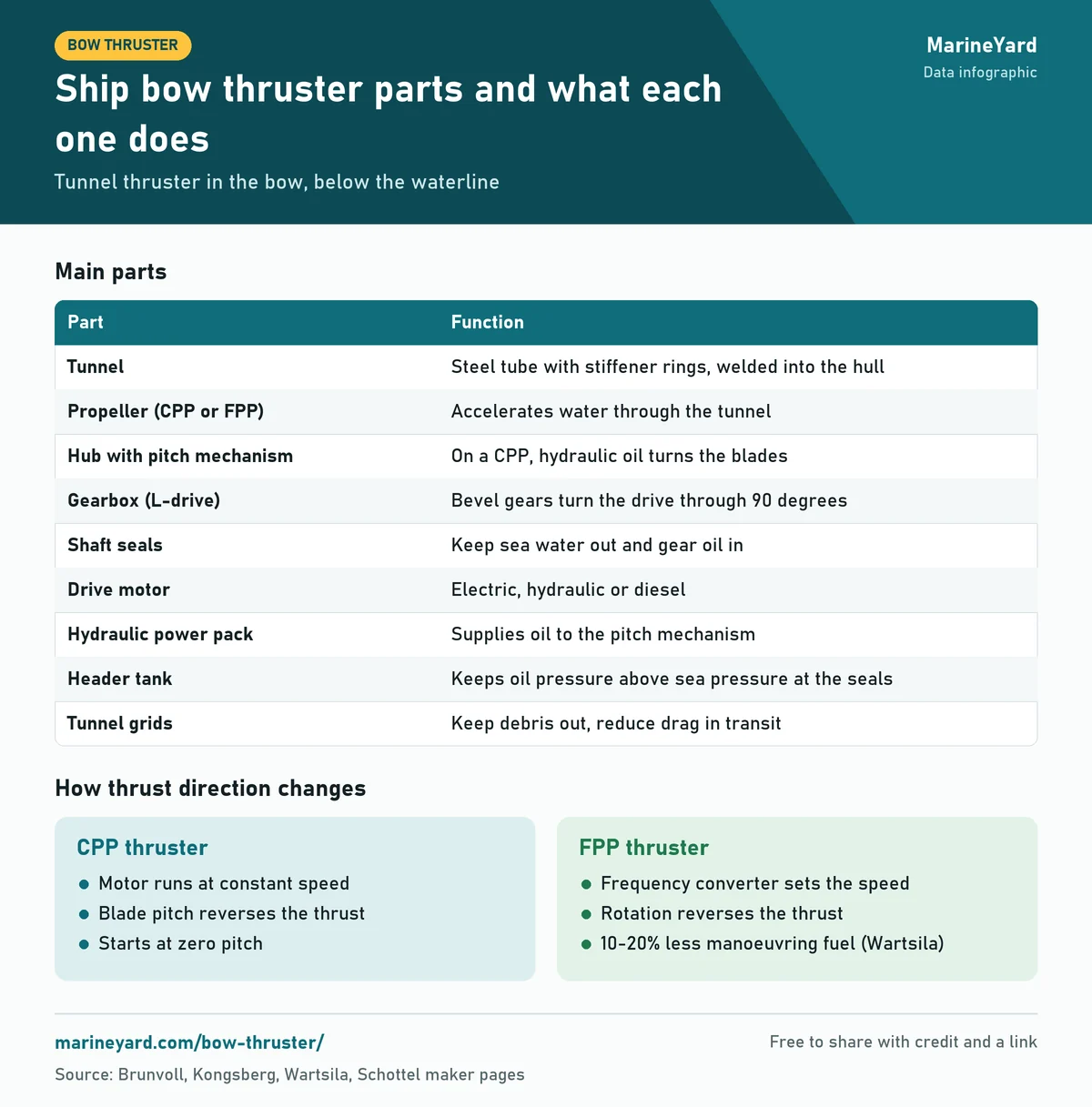
A bow thruster is a propeller unit mounted in a transverse tunnel through the bow of a ship, below the waterline, that pushes the bow sideways to port or...
 Ship Machinery
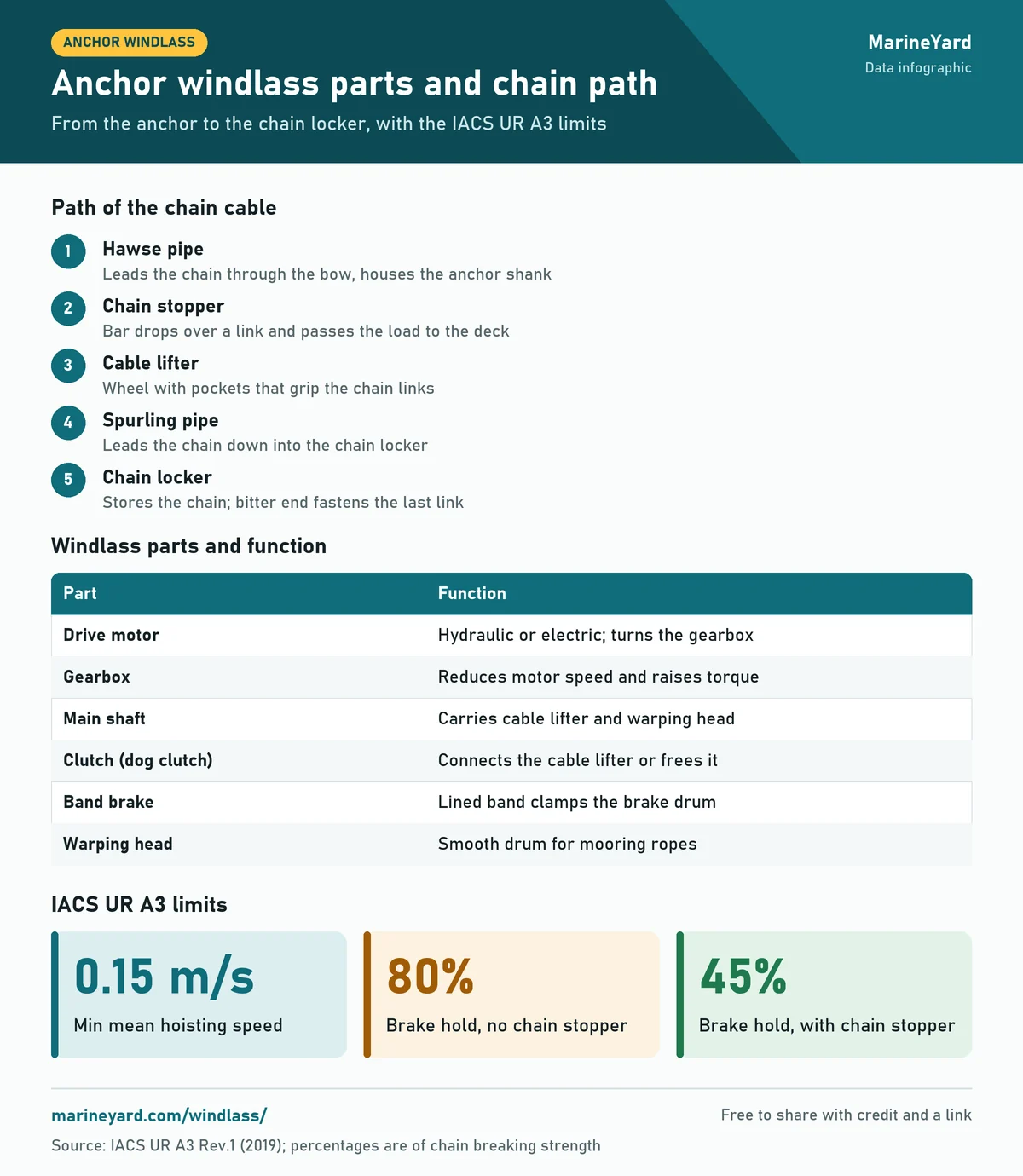
A windlass is the deck machine on a ship that heaves up, lowers and holds the anchor and its chain cable. The windlass stands on the forecastle deck. A...