Ballast Water Treatment System: Types, Parts and D-2 Rules
Marine engineers & industry writers
Updated
Nov 21, 2026
A ballast water treatment system (BWTS) is the equipment on a ship that removes or kills aquatic organisms in ballast water before the water is discharged. The ballast water treatment system must meet the D-2 discharge standard of the IMO Ballast Water Management (BWM) Convention, which entered into force on 8 September 2017.
IMO texts call the same equipment a ballast water management system (BWMS). Each system is type-approved under the IMO BWMS Code, and a system used for discharge in United States waters is approved by the US Coast Guard.
Key facts
| Attribute | Value |
|---|---|
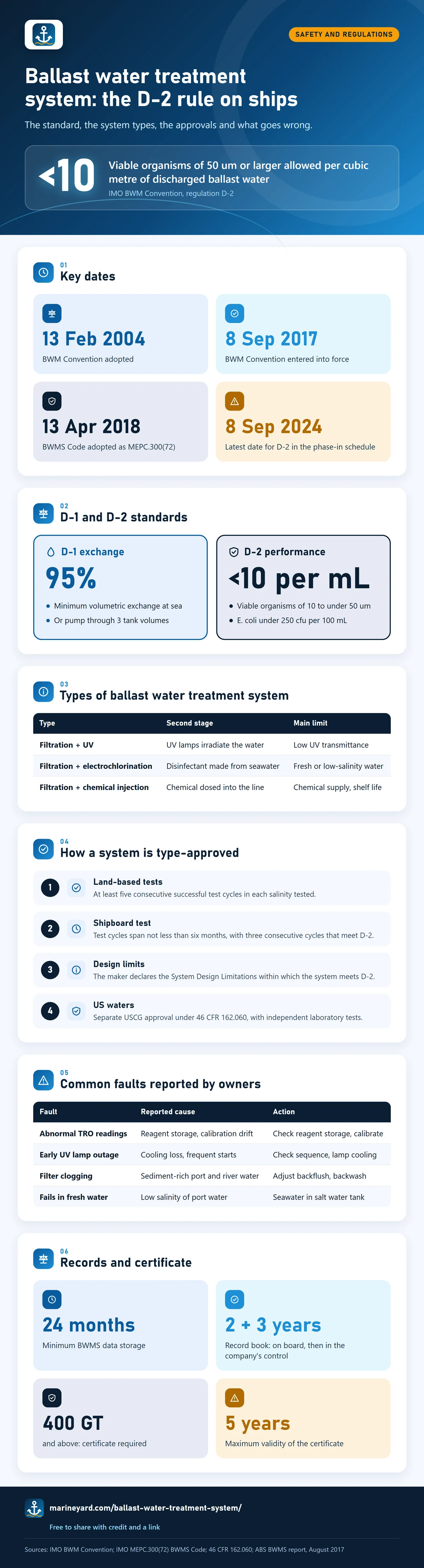
| Governing treaty | BWM Convention, adopted 13 February 2004, in force 8 September 2017 (IMO) |
| D-1 standard (exchange) | At least 95% volumetric exchange of ballast water |
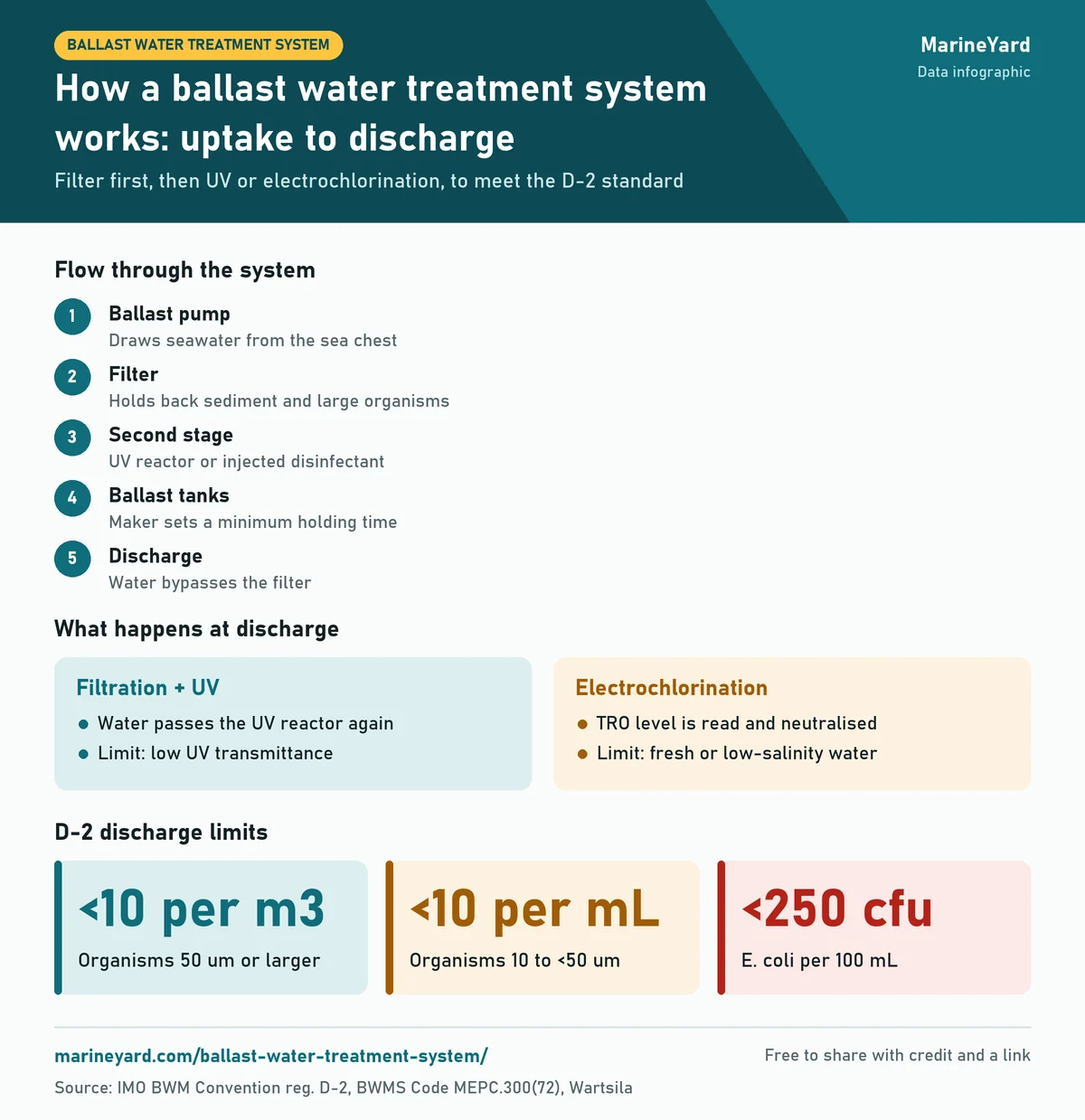
| D-2 standard (performance) | Fewer than 10 viable organisms per m³ of 50 µm or larger; fewer than 10 per mL of 10 µm to under 50 µm |
| D-2 final date | No later than 8 September 2024 for ships under the phase-in schedule (IMO) |
| IMO type approval | BWMS Code, resolution MEPC.300(72), adopted 13 April 2018 |
| US type approval | 46 CFR 162.060, issued by the USCG Marine Safety Center |
| Data storage in the control equipment | At least 24 months (BWMS Code, paragraph 4.20) |
| Ballast Water Record Book retention | 2 years on board, then 3 years in the company's control (regulation B-2) |
| Certificate | International Ballast Water Management Certificate, ships of 400 GT and above, maximum 5 years |
What is a ballast water treatment system on a ship?
A ballast water treatment system on a ship is a set of filters, disinfection units, sensors and controls fitted in the ballast piping. The system treats seawater during ballast uptake, during discharge, or both, so that the discharged water contains fewer organisms than the D-2 limits allow.
The BWMS Code defines the treatment rated capacity (TRC) as the maximum continuous flow in m³/h for which the system is type-approved. The TRC is measured at the inlet of the system.
What is the difference between the D-1 and D-2 standards?
The D-1 standard is a ballast water exchange standard, and the D-2 standard is a ballast water performance standard. D-1 requires an exchange of at least 95% of the ballast water volume at sea. D-2 sets maximum numbers of viable organisms and indicator microbes in the discharged water.
| Item | D-1 | D-2 |
|---|---|---|
| Method | Exchange of ballast water at sea | Treatment by an approved BWMS |
| Main requirement | At least 95% volumetric exchange; pumping through 3 tank volumes is accepted | Fewer than 10 viable organisms per m³ (50 µm or larger) |
| Smaller organisms | No limit stated | Fewer than 10 viable organisms per mL (10 µm to under 50 µm) |
| Indicator microbes | No limit stated | Vibrio cholerae under 1 cfu per 100 mL; E. coli under 250 cfu per 100 mL; intestinal Enterococci under 100 cfu per 100 mL |
The IMO summary of the BWM Convention gives both standards. The IMO phase-in schedule made D-2 apply to new ships from 8 September 2017. Existing ships moved from D-1 to D-2 at an International Oil Pollution Prevention (IOPP) renewal survey. The IMO implementation page for the BWM Convention gives 8 September 2024 as the latest date.
What are the types of ballast water treatment system?
The types of ballast water treatment system in common use are filtration with ultraviolet (UV) treatment, filtration with electrochlorination, and filtration with chemical injection. The second stage kills or inactivates the organisms that pass the filter.
| Type | Second stage | When it treats | Main limit |
|---|---|---|---|
| Filtration + UV | UV lamps in a reactor irradiate the water | Uptake and again at discharge | Water with low UV transmittance; lamp replacement |
| Filtration + electrochlorination (in-line or side-stream) | An electrolysis cell makes disinfectant from seawater | Uptake; neutralisation at discharge | Fresh or low-salinity water; hydrogen gas from the cells |
| Filtration + chemical injection | A stored or generated chemical is dosed into the ballast line | Uptake | Chemical supply, shelf life and handling |
An ABS report on BWMS operation from August 2017 collected data on 220 installed systems. Full-flow electrochlorination was 32% of the systems, and filtration with UV was 16%.
A system that uses an Active Substance, such as chlorine, also needs IMO Basic Approval and Final Approval under procedure G9, resolution MEPC.169(57). Regulation D-3 of the Convention sets this requirement.
What are the parts of a ballast water treatment system?
The parts of a ballast water treatment system are an automatic backflushing filter, a disinfection unit, sensors, a flow meter, a bypass arrangement with alarm, sampling facilities and control and monitoring equipment. An electrochlorination system adds a rectifier, a total residual oxidant (TRO) sensor, a neutralisation unit and gas detection.
| Part | Function |
|---|---|
| Automatic backflushing filter | Removes sediment and large organisms; 40 µm screens are common (ABS, Wärtsilä) |
| UV reactor, lamps and quartz sleeves | Irradiate the water; the sleeves separate the lamps from the water |
| UV intensity sensor | Measures the UV output that reaches the water |
| Electrolysis cell and rectifier | Produce disinfectant from seawater with direct current |
| TRO sensor | Measures the oxidant level for dosing and for neutralisation |
| Neutralisation unit | Doses a neutralising agent, for example sodium bisulfite, at discharge |
| Control and monitoring equipment | Controls the dose or intensity, logs alerts and bypass events, and stores data for at least 24 months |
The ship's own ballast pumps feed the system. Replacement ballast pumps are listed with other pumps and compressors.
How does a ballast water treatment system work?
A ballast water treatment system works in two phases. During uptake, the filter removes sediment and large organisms and the second stage disinfects the water. During discharge, a UV system treats the water a second time, and an electrochlorination system measures and neutralises the remaining oxidant.
- The ballast pump draws seawater from the sea chest and delivers it to the filter.
- The filter holds back sediment and large organisms. The filter backflushes automatically and sends the backflush water overboard.
- The second stage treats the filtered water. A UV reactor irradiates the full flow. An electrochlorination system injects disinfectant from the electrolysis cell.
- The treated water enters the ballast tanks. The maker specifies a minimum holding time in the tank for the system.
- At discharge, the water bypasses the filter.
- A UV system passes the water through the UV reactor again. An electrochlorination system reads the TRO level and injects the neutralising agent if needed.
The Wärtsilä encyclopedia entry on Aquarius plants describes both sequences. The Aquarius EC system doses to a maximum of 10 ppm of disinfectant in the treated ballast water. Alfa Laval states that the PureBallast 3 UV system runs at full flow in water with a UV transmittance as low as 42%.
How is a ballast water treatment system type-approved?
A ballast water treatment system is type-approved by a flag Administration under the IMO BWMS Code, resolution MEPC.300(72). The Code requires land-based tests, a shipboard test, environmental tests of the components and a review of the documentation. The US Coast Guard runs a separate approval under 46 CFR 162.060.
The BWMS Code, resolution MEPC.300(72), was adopted on 13 April 2018 and replaced the earlier G8 guidelines. Systems approved under the older G8 guidelines of MEPC.174(58) could be installed only before 28 October 2020.
- Land-based tests. The Code defines test water as fresh (under 1 PSU), brackish (10 to 20 PSU) and marine (28 to 36 PSU). The system must complete at least five consecutive successful test cycles in each salinity tested.
- Shipboard test. The test cycles span not less than six months. Three consecutive test cycles must comply with D-2.
- System Design Limitations (SDL). The maker declares the water quality and operating limits within which the system meets D-2.
The USCG procedure in 46 CFR 162.060-10 requires testing by an independent laboratory that the Coast Guard has accepted. The Marine Safety Center reviews the application and issues the approval certificate. The US discharge standard in 33 CFR 151.2030 uses the same numerical limits as D-2.
What records and surveys does a ballast water treatment system need?
A ballast water treatment system needs a ship-specific Ballast Water Management Plan, a Ballast Water Record Book, an International Ballast Water Management Certificate and a commissioning test. The plan and record book apply under regulations B-1 and B-2. The certificate applies to ships of 400 GT and above.
- Record book entries. The officer in charge signs each entry, and the master signs each completed page. The entries stay on board for at least two years and then in the company's control for at least three years.
- Record book form. Resolution MEPC.369(80) changed the form of the record book from February 2025. Resolution MEPC.383(81) added rules on electronic record books from October 2025.
- Commissioning test. Resolution MEPC.325(75) made commissioning testing of the BWMS mandatory from June 2022.
The IMO list of BWM Convention amendments and guidelines gives the resolutions and dates. The record book has the same role for ballast water that the Oil Record Book has for the oily water separator.
What are the common faults of a ballast water treatment system?
The common faults of a ballast water treatment system are unstable TRO sensor readings, UV lamp failures, filter clogging and failed treatment in low-salinity water. The ABS report of August 2017 found that 57% of 220 installed systems were in operation or operational on demand.
| Fault | Cause reported by owners (ABS) | Action reported or advised (ABS) |
|---|---|---|
| Abnormal TRO sensor readings | Reagents stored or handled incorrectly; calibration drift | Store reagents as the maker states; track shelf life; calibrate the sensor |
| UV lamp outage before the expected life | Cooling water interruptions; frequent start and stop sequences | Check the start-up and shut-down sequence and the lamp cooling |
| Filter clogging, high differential pressure | Sediment-rich water in some ports and rivers | Adjust the backflush; run a manual backwash cycle |
| No treatment in fresh water (electrochlorination) | Low salinity of the port water | Keep seawater in the dedicated salt water tank |
The actions above are owner reports. The crew follows the maker's manual and the ship's Ballast Water Management Plan for every fault. ABS advises a written contingency plan, agreed with the flag State and the ports concerned, for a system that cannot operate.
Who makes ballast water treatment systems?
Ballast water treatment systems are made by marine equipment companies with IMO and USCG type approvals. Alfa Laval makes the PureBallast 3 filter and UV system. Optimarin makes a filter and UV system that received the first USCG type approval in December 2016. Wärtsilä makes Aquarius UV and Aquarius EC.
Techcross makes the ECS electrolysis system. Erma First makes the FIT system. Ecochlor makes a filtration and chemical injection system, with USCG approval since 2017.
Which ballast water treatment system spare parts are ordered most often?
Ballast water treatment system spare parts ordered most often are UV lamps, quartz sleeves, wiper seals, UV intensity sensors, filter screens or candles, backflush solenoid valves, TRO reagents, TRO sensors, rectifier parts and valve actuators.
A correct order states the following data:
- Ship name and IMO number.
- BWMS maker and type designation.
- Serial number of the system.
- Treatment rated capacity in m³/h.
- Type approval certificate number and the approving Administration.
- Part number from the maker's manual.
A buyer should match each replacement part to the part number in the maker's manual. General consumables such as gaskets may carry an IMPA code and can come from a ship chandler.
Where can ballast water treatment system parts be bought or sold?
Ballast water treatment system parts are bought from makers, authorised service companies and surplus stockists. MarineYard is a ship spare parts marketplace where sellers list new, reconditioned and used equipment, including electrical and automation parts such as sensors and rectifiers. Sellers get 9 free listings per account. MarineYard takes no commission and is not a party to any sale. Buyers should confirm the type designation, serial number and part number with the seller before payment.
Frequently Asked Questions
Is a ballast water treatment system mandatory on ships?
A ballast water treatment system is the normal way to meet the D-2 standard, which the BWM Convention requires. The IMO phase-in schedule ended on 8 September 2024. A ship under the Convention that discharges ballast water to the sea must now keep below the D-2 organism limits.
What does TRO mean in ballast water treatment?
TRO means total residual oxidant. A TRO sensor measures the oxidant that remains in chemically treated ballast water. The control system uses the reading to control the neutralising agent during discharge. Some systems also use the reading to set the disinfectant dose during uptake.
Why does an electrochlorination ballast system fail in fresh water?
An electrochlorination ballast system makes its disinfectant from the salt in seawater. Owners in the ABS report of August 2017 could not treat ballast in fresh water ports. Some side-stream systems feed the electrolysis cell from a dedicated salt water tank instead.
How long is a Ballast Water Record Book kept?
A Ballast Water Record Book is kept on board for at least two years after the last entry. The entries then stay in the company's control for at least three more years. Regulation B-2 of the BWM Convention sets both periods.
Does IMO type approval cover a ballast system in US waters?
IMO type approval does not replace US Coast Guard approval. A ballast water management system for US waters is tested by a USCG-accepted independent laboratory under 46 CFR 162.060. The USCG Marine Safety Center issues a separate type approval certificate.
How long must a ballast water treatment system store its data?
A ballast water treatment system must store its recorded data for at least 24 months. Paragraph 4.20 of the BWMS Code sets this period. Data recorded before a replacement of the control equipment must also stay available on board for 24 months.
Related guides
- Fresh Water Generator on Ships: Working, Parts and Types
- Stern tube: parts, bearings, seals and lubrication
- IMPA code: meaning and structure
- Ship chandler: meaning and services
- Oily water separator: working, parts and the 15 ppm rule
- Marine turbocharger: parts, working and surging
- Purifier in ship: working principle, parts and faults
- Cylinder liner: function, wear and gauging
- Ship boiler: types, mountings and water treatment
- Anchor windlass: parts, working and class rules
- Bow thruster: how it works, types and failures
- Steering gear: parts, types and SOLAS tests
- Marine air compressor: starting air, parts and safety
Sources
- IMO, International Convention for the Control and Management of Ships' Ballast Water and Sediments (BWM)
- IMO, Implementing the Ballast Water Management Convention
- IMO, BWM Convention and Guidelines
- IMO, resolution MEPC.300(72), Code for Approval of Ballast Water Management Systems (BWMS Code)
- US Code of Federal Regulations, 46 CFR 162.060-10, BWMS approval procedures
- ABS, Best Practices for Operation of Ballast Water Management Systems, August 2017
- Wärtsilä Encyclopedia of Marine and Energy Technology, Aquarius ballast water treatment plants
- Alfa Laval, PureBallast 3
Sign in to leave a comment and join the discussion.
 Ship Machinery
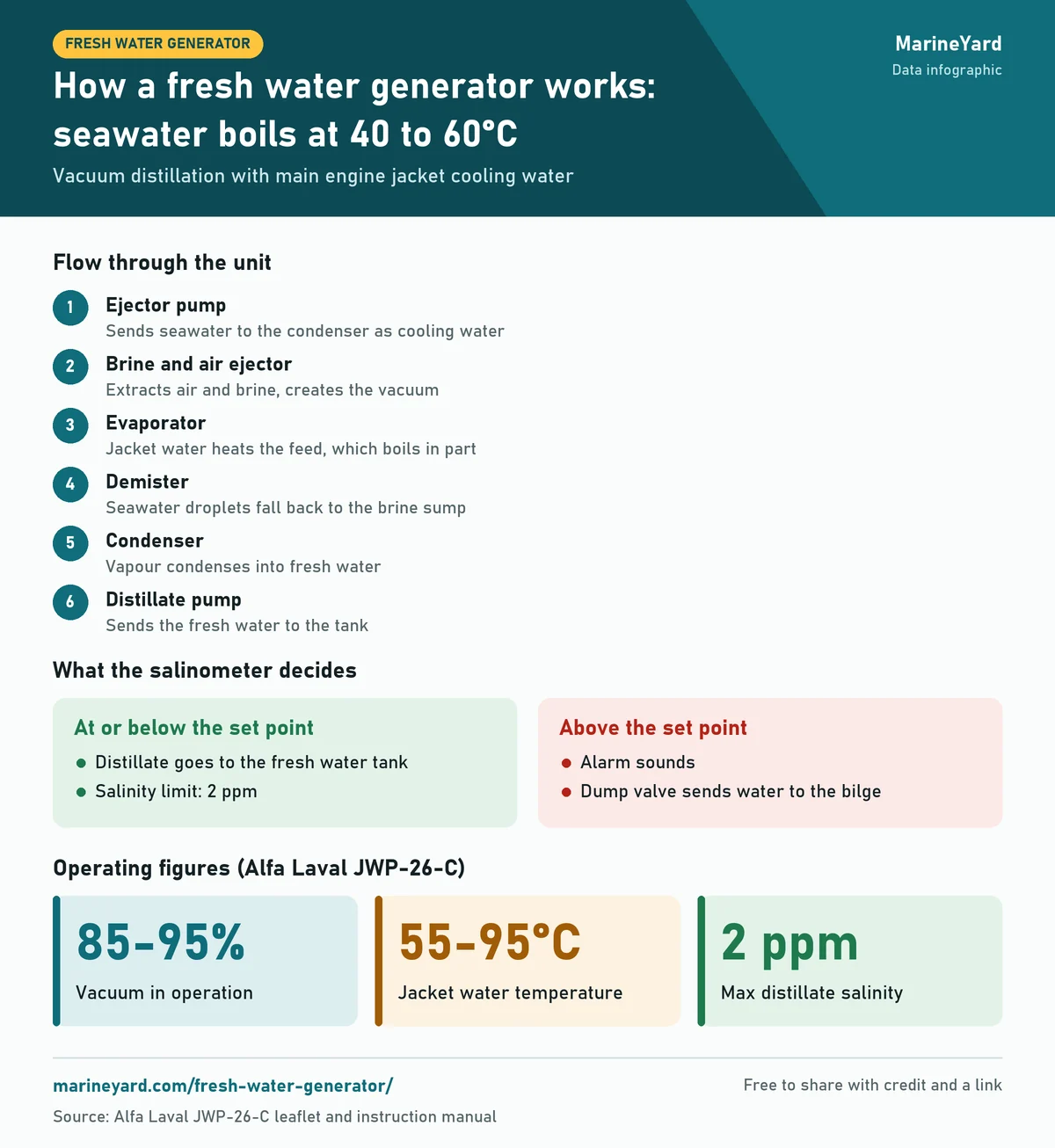
A fresh water generator is the machine on a ship that turns seawater into fresh water by vacuum distillation. The fresh water generator boils seawater at...
 Ship Machinery
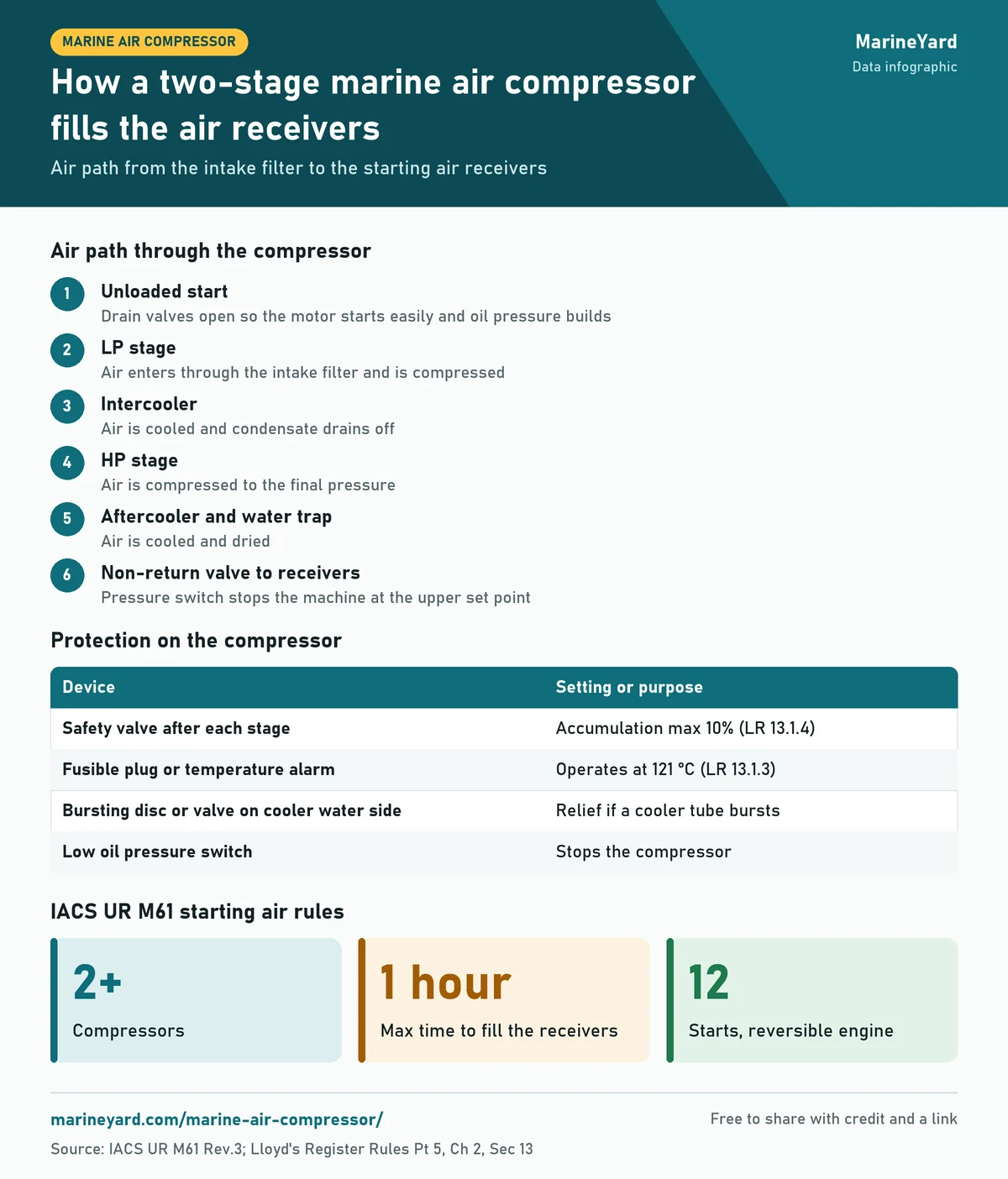
A marine air compressor is the machine in a ship's engine room that compresses atmospheric air and stores it in air receivers. The stored air starts the...
 Ship Machinery
A steering gear is the machinery on a ship that turns the rudder on orders from the bridge. The steering gear comprises the rudder actuators, the power...