Cylinder Liner in Marine Engines: Types, Wear and Gauging
Marine engineers & industry writers
Updated
Nov 19, 2026
A cylinder liner is the replaceable cylindrical sleeve that forms the wall of an engine cylinder. The cylinder liner closes the side of the combustion space, guides the piston, holds the lubricating oil film for the piston rings and passes combustion heat to the cooling water. Marine diesel engine liners are made of alloyed cast iron.
Two-stroke crosshead main engines have long liners with scavenge ports and separate cylinder lubrication. Four-stroke trunk piston engines have shorter liners that are lubricated with crankcase oil.
Key facts
| Attribute | Value |
|---|---|
| Material | Alloyed cast iron (MAN B&W two-stroke engines); centrifugally cast grey cast iron alloy (Wärtsilä 32) |
| Main types | Wet liner (in contact with coolant) and dry liner (no coolant contact) |
| Two-stroke cylinder oil feed rate | 0.6 to 1.2 g/kWh set feed rate (WinGD); absolute minimum 0.60 g/kWh (MAN B&W) |
| Cylinder oil base number (BN) | BN 40 for fuel up to 0.50% sulphur; BN 100 to 140 above 0.50% sulphur (MAN B&W Mark 9 and higher) |
| Scavenge drain oil analysis | Every 1,500 running hours or every third month (MAN SL2023-738) |
| Example wear limit | 620 mm nominal bore, 625.50 mm maximum bore (WinGD X62-B clearance table) |
| Estimated service life | Up to 90,000 operating hours (WinGD X62-B maintenance manual) |
| Class documentation | Work certificate for material properties on engines with a bore above 300 mm (IACS UR M72) |
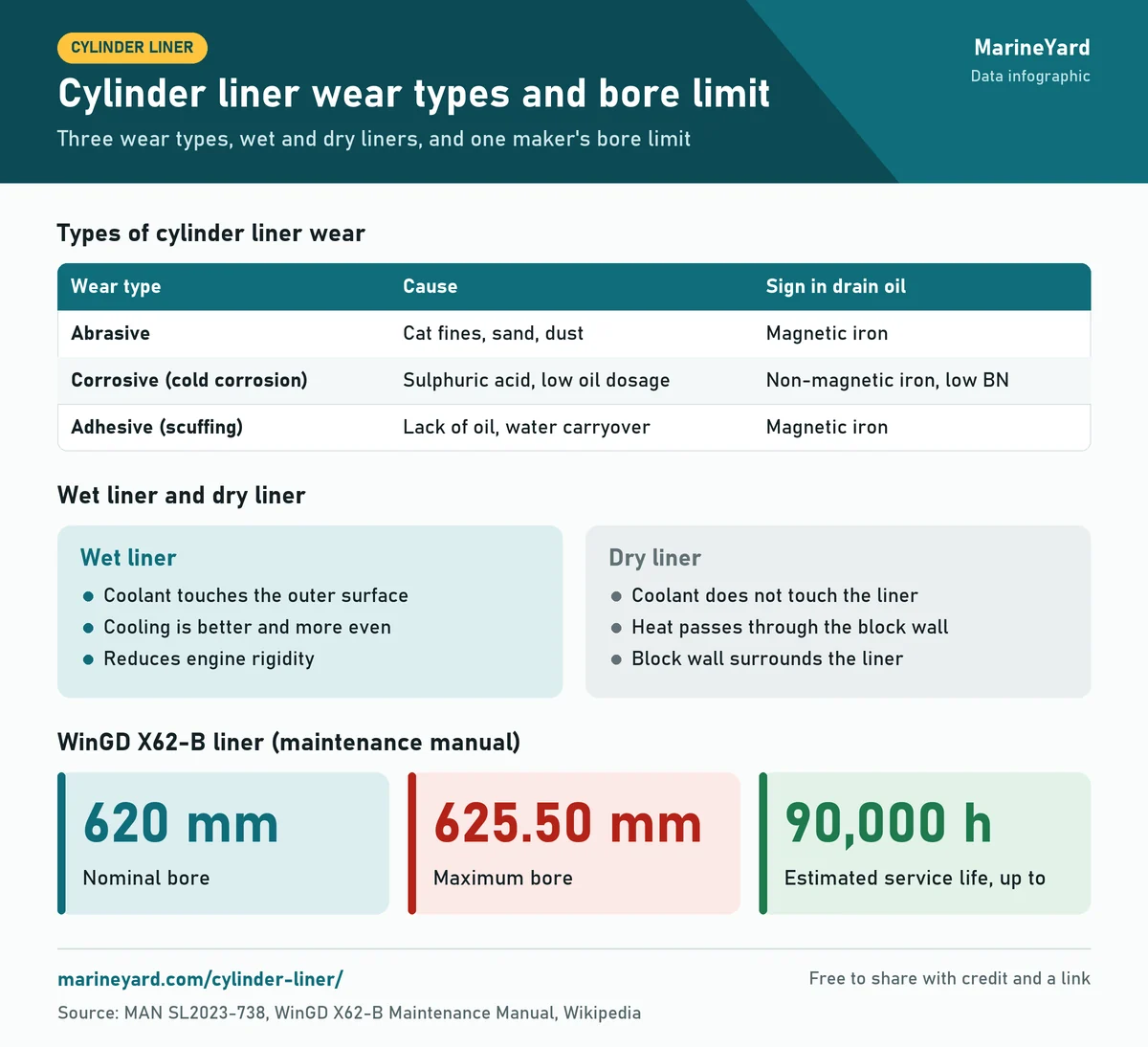
What is a cylinder liner in a marine diesel engine?
A cylinder liner in a marine diesel engine is a cast iron sleeve fitted into the cylinder frame or engine block. The piston moves inside the liner, and the cylinder cover closes the top. The liner is a wear part that can be renewed without replacing the frame or block. The liner has four functions:
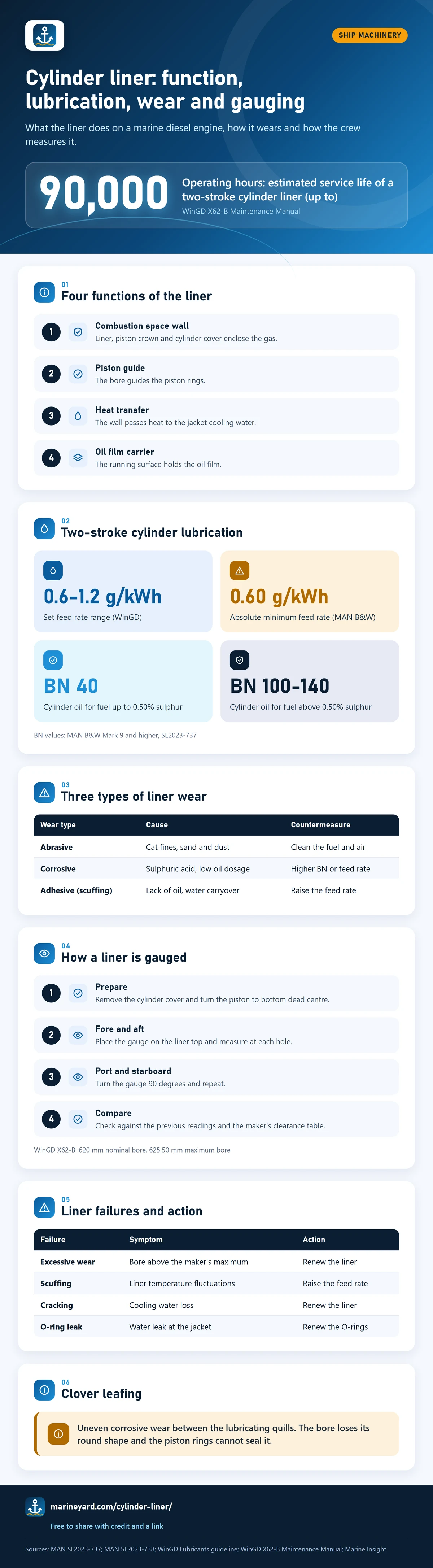
- Combustion space wall. The liner, piston crown and cylinder cover enclose the combustion gas.
- Piston guide. The bore guides the piston rings and, on trunk engines, the piston skirt.
- Heat transfer. The wall passes combustion heat to the jacket cooling water.
- Oil film carrier. The running surface holds the oil film under the piston rings.
What is the difference between a wet and a dry cylinder liner?
A wet cylinder liner has its outer surface in direct contact with the cooling water. A dry cylinder liner is surrounded by the engine block, so the coolant does not touch the liner. The Wikipedia article on engine cylinders notes that wet liners cool better and give a more even temperature distribution.
| Feature | Wet liner | Dry liner |
|---|---|---|
| Contact with coolant | Direct, on the outer surface | None; the block wall is between liner and coolant |
| Cooling | Better and more even | Heat passes through liner and block wall |
| Effect on the block | Reduces the rigidity of the engine | Block wall surrounds the liner |
Air-cooled engines have finned cylinders and no water jacket. Marine diesel engines use water-cooled liners. The Wärtsilä 32 liner has cooling water around its upper part, and the lower part is dry.
What are the parts of a marine cylinder liner?
The parts of a marine cylinder liner are the liner body, the collar or flange that supports it, the cooling jacket, the sealing O-rings, the lubricating quills with oil grooves and a deposit-scraping ring at the top. Two-stroke liners also have scavenge ports in the lower part.
| Part | Function |
|---|---|
| Liner body | Alloyed cast iron sleeve with the running surface for the piston rings |
| Collar or flange | Supports the liner; MAN B&W liners hang in the cylinder frame on a low-situated flange |
| Cooling jacket (water guide jacket) | Leads cooling water around the top of the liner |
| Cooling bores | Drilled water passages in the collar of a bore-cooled liner |
| O-rings | Seal the cooling water spaces; WinGD renews the O-rings at each liner removal |
| Scavenge ports (two-stroke) | Admit scavenge air when the piston uncovers the ports |
| Lubricating quills and grooves (two-stroke) | Inject cylinder oil through drilled holes and spread the oil around the bore |
| Piston cleaning ring or anti-polishing ring | Scrapes ash and carbon from the piston top land |
The MAN B&W ME engine description calls the top ring a piston cleaning ring. WinGD manuals use antipolishing ring. The Wärtsilä 32 Product Guide states that the anti-polishing ring removes the risk of bore polishing.
How is a two-stroke cylinder liner lubricated?
A two-stroke cylinder liner is lubricated by a separate cylinder oil that lubricators inject through quills in the liner wall. The cylinder oil is consumed and not recovered. The oil lubricates the piston rings, keeps them clean and neutralises the sulphuric acid that forms from fuel sulphur.
The base number (BN) is the alkalinity of the oil in mg KOH/g. The WinGD Lubricants guideline states that higher sulphur fuels need a higher BN and that low-sulphur fuels need a lower BN to avoid deposits. The WinGD set feed rate range is 0.6 to 1.2 g/kWh.
For MAN B&W engines, MAN service letter SL2023-737 recommends BN 40 oil for fuels up to 0.50% sulphur and BN 100 to 140 oil for high-sulphur fuel on Mark 9 and newer engines. For high-sulphur fuel, the feed rate in g/kWh equals the feed rate factor multiplied by the fuel sulphur percentage. MAN advises a higher BN oil when the factor must exceed 0.32. The absolute minimum feed rate is 0.60 g/kWh.
Four-stroke trunk engines have no separate cylinder oil. The Wärtsilä 32 piston skirt is pressure lubricated, and this oil reaches the liner.
What are the types of cylinder liner wear?
The types of cylinder liner wear are abrasive wear, corrosive wear and adhesive wear. Abrasive wear comes from hard particles. Corrosive wear, called cold corrosion on two-stroke engines, comes from sulphuric acid. Adhesive wear, called scuffing, comes from metal contact when the oil film fails.
| Wear type | Cause | Sign | Countermeasure |
|---|---|---|---|
| Abrasive | Cat fines in the fuel; sand and dust in the air | Magnetic iron in the scavenge drain oil | Clean the fuel; maintain the air filters |
| Corrosive (cold corrosion) | Sulphuric acid; cylinder oil dosage too low | Non-magnetic iron and low residual BN in the drain oil | Higher BN oil or higher feed rate |
| Adhesive (scuffing) | Lack of cylinder oil; water carryover | Magnetic iron in the drain oil; liner temperature fluctuations | Raise the feed rate; keep scavenge air drains open |
The causes and iron types come from MAN service letter SL2023-738. For high-sulphur fuel at a feed rate of 1.0 g/kWh, the letter rates total iron up to 100 mg/kg as normal and above 800 mg/kg as alert. The fuel oil purifier removes cat fines from the fuel.
A WinGD paper for the CIMAC Congress 2016 explains that frequent low-load operation in slow steaming lets sulphuric acid condense on the liner running surface.
What is clover leafing of a cylinder liner?
Clover leafing of a cylinder liner is uneven corrosive wear around the bore of a two-stroke liner. The liner wears more in the zones between the lubricating quills, where less alkaline cylinder oil arrives. The bore loses its round shape, and a cross-section of the worn bore resembles a clover leaf.
The cause is acid that the cylinder oil does not neutralise evenly around the bore. Marine Insight's guide to liner wear describes the pattern and links it to a low BN or a low feed rate. Piston rings cannot seal an uneven bore.
What causes cavitation erosion on a wet cylinder liner?
Cavitation erosion on a wet cylinder liner is caused by liner vibration during combustion. The vibration forms low-pressure vapour bubbles in the coolant on the outside of the liner. The bubbles collapse and pit the metal. Repeated pitting in one area can break through the liner wall.
The Goetze service bulletin SB2116 places the damage in vertical bands in line with the piston thrust face or just above the liner sealing rings. The bulletin advises strict use of the engine maker's coolant and coolant additives. Wärtsilä makes an approved corrosion inhibitor mandatory in the cooling water of the Wärtsilä 32.
How is a cylinder liner gauged?
A cylinder liner is gauged with an inside micrometer and a gauge bar that fixes the measuring heights. The crew measures the bore at each height in the fore-and-aft direction and in the port-starboard direction, records the values and compares them with the earlier readings. Gauging is also called liner calibration.
The WinGD X62-B Maintenance Manual requires a bore measurement before each piston removal. The steps are:
- Remove the cylinder cover and turn the piston to bottom dead centre.
- Free the cylinder of gas, lock the cooling water valve closed and clean the area above the running surface.
- Place the gauge on the top face of the liner in line with the longitudinal axis of the engine.
- Measure at the top hole, which is above the wear ridge, and at each hole below it. Record every value.
- Turn the gauge 90 degrees to the transverse axis and repeat the measurements.
- Compare the values with the previous readings and calculate the wear rate in mm per 1,000 hours.
- Check the largest diameter against the maker's clearance table.
The maximum wear is the limit in the engine maker's manual. The X62-B clearance table gives a nominal bore of 620 mm and a maximum of 625.50 mm.
What causes cylinder liner failure?
Cylinder liner failure is caused by excessive wear, scuffing, cracking or leaking seals. Wear and scuffing start on the running surface. Cracks and O-ring leaks involve the cooling water side. Drain oil analysis, liner temperatures and cooling water losses give the first warning.
| Failure | Common cause | Symptom | Action |
|---|---|---|---|
| Excessive wear | Cold corrosion or abrasive particles | Bore above the maker's maximum; high iron in drain oil | Renew the liner; correct oil BN and feed rate |
| Scuffing | Oil film failure; worn piston ring coating | Liner temperature fluctuations | Raise the feed rate (MAN safe setting 1.2 g/kWh); inspect rings and liner |
| Cracking | Thermal overload or loss of cooling | Cooling water loss; water in the cylinder | Renew the liner |
| O-ring leak | Hardened or damaged O-rings | Cooling water leak at the jacket or below the liner | Renew the O-rings at liner removal |
Who makes marine cylinder liners?
Marine cylinder liners are supplied by the engine designers and their licensed engine builders. Everllence, the former MAN Energy Solutions, designs MAN B&W two-stroke engines. WinGD designs the X-series two-stroke engines. Wärtsilä designs four-stroke engines such as the Wärtsilä 32.
The Everllence licensee list names two-stroke engine licensees in China, Japan and South Korea. The list includes HD Hyundai Heavy Industries, Hanwha Engine, Mitsui E&S and CSSC-MES Diesel.
How is a spare cylinder liner specified?
A spare cylinder liner is specified by the engine maker and type, the bore, the engine serial number and the part number from the spare parts book. The order states whether the liner is bare or complete with cooling jacket, O-rings, lubricating quills and piston cleaning ring. A correct order states:
- Ship name and IMO number.
- Engine maker, licensee and engine type.
- Engine serial number from the nameplate.
- Cylinder bore in mm and cylinder number.
- Part number and plate number from the spare parts book.
- Scope: bare or complete liner.
- Material certificate. IACS UR M72 lists a work certificate for liners of engines with a bore above 300 mm.
O-ring sets and joint rings are ordered with the liner. General consumables may carry an IMPA code and can come from a ship chandler.
Is a reconditioned cylinder liner as good as a new one?
A reconditioned cylinder liner is usable when the bore is within the maker's maximum diameter and the running surface is restored. MAN service letter SL2023-737 applies the same breaking-in and running-in programme to new and reconditioned liners, and names honing as a repair for a damaged liner surface.
The breaking-in feed rate starts at 1.7 g/kWh for the first 5 hours. A buyer of a reconditioned liner should ask for the gauging record.
Where can cylinder liners be bought or sold?
Cylinder liners are bought from engine makers, licensees, reconditioning workshops and surplus stockists. MarineYard is a ship spare parts marketplace where sellers list new, reconditioned and used main engine parts and auxiliary engine parts. Sellers get 9 free listings per account. MarineYard takes no commission and is not a party to any sale. Buyers should confirm the part number, bore measurements and certificate with the seller.
Frequently Asked Questions
What material is a marine cylinder liner made of?
A marine cylinder liner is made of alloyed cast iron, as the MAN B&W engine description states. Wärtsilä 32 liners are centrifugally cast from a grey cast iron alloy developed for wear resistance and strength.
What is the maximum wear of a cylinder liner?
The maximum wear of a cylinder liner is the limit in the engine maker's clearance table. The WinGD X62-B manual gives a nominal bore of 620 mm and a maximum bore of 625.50 mm. A liner above the maximum diameter is renewed.
How long does a cylinder liner last on a ship?
A cylinder liner on a WinGD X62-B two-stroke engine has an estimated service life of up to 90,000 operating hours, according to the maintenance manual. Cold corrosion, scuffing or abrasive fuel particles shorten the life of a liner.
What is cold corrosion in a cylinder liner?
Cold corrosion in a cylinder liner is the attack of sulphuric acid on the liner running surface. The acid forms from fuel sulphur and condenses on a cool liner wall, mostly during low-load operation. A cylinder oil with enough BN and feed rate neutralises the acid.
Why does a two-stroke cylinder liner have scavenge ports?
A two-stroke cylinder liner has scavenge ports because the engine has no inlet valves. The piston uncovers the ports near the bottom of the stroke. Scavenge air then enters through the ports and pushes the exhaust gas out through the exhaust valve.
How often is cylinder liner wear measured?
Cylinder liner wear is measured at each piston removal on WinGD X62-B engines. MAN recommends a monthly inspection through the scavenge ports and a laboratory analysis of the scavenge drain oil every 1,500 running hours or every third month.
Related guides
- Stern tube: parts, bearings, seals and lubrication
- IMPA code: meaning and structure
- Ship chandler: meaning and services
- Oily water separator: working, parts and the 15 ppm rule
- Marine turbocharger: parts, working and surging
- Purifier in ship: working principle, parts and faults
- Ship boiler: types, mountings and water treatment
- Anchor windlass: parts, working and class rules
Sources
- MAN Energy Solutions, service letter SL2023-737/NHN, cylinder lubrication update (June 2023)
- MAN Energy Solutions, service letter SL2023-738/IKCA, sampling of scavenge drain oil (June 2023)
- Everllence, MAN B&W project guide, ME engine description
- WinGD, Lubricants guideline DTAA001621, revision B
- WinGD, X62-B Maintenance Manual, issue 2022-01
- WinGD, CIMAC Congress 2016 paper no. 67, ship operation and cylinder lubrication
- Wärtsilä, Wärtsilä 32 engine page and Product Guide
- IACS, Unified Requirements M, UR M72 certification of engine components
- Goetze (Tenneco), service bulletin SB2116, cavitation erosion of wet cylinder liners
- Everllence, list of licensees
- Marine Insight, reasons for cylinder liner wear and ways to measure it
- Wikipedia, Cylinder (engine)
Sign in to leave a comment and join the discussion.
 Ship Machinery
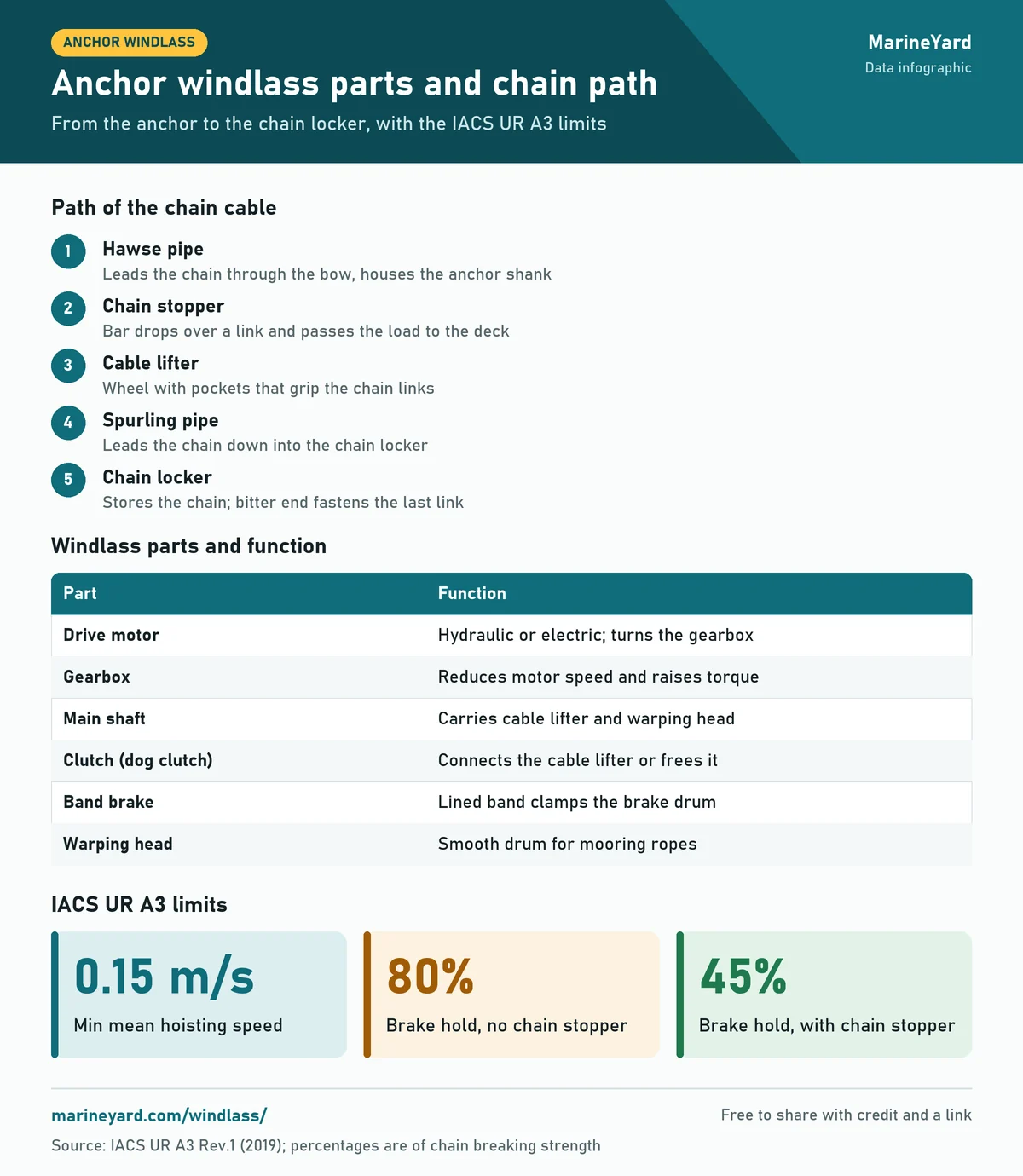
A windlass is the deck machine on a ship that heaves up, lowers and holds the anchor and its chain cable. The windlass stands on the forecastle deck. A...
 Ship Machinery
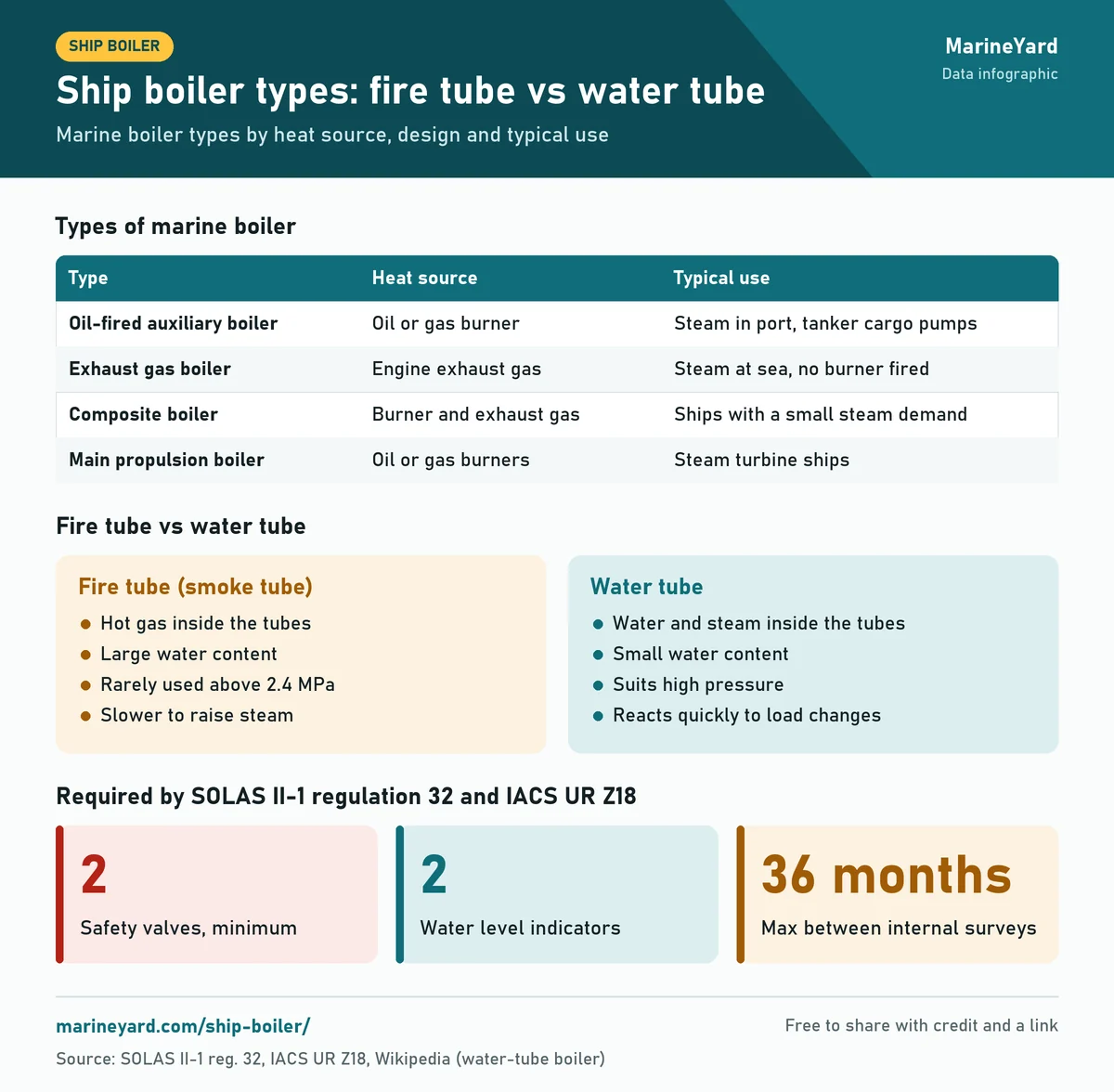
A ship boiler is a closed pressure vessel that turns feed water into steam with heat from an oil or gas burner, from engine exhaust gas, or from both. A...
 Ship Machinery
A purifier in a ship is a centrifugal separator that removes water and solid particles from fuel oil and lubricating oil. The purifier spins the oil in a...