Bow Thruster on a Ship: Parts, Types, Working and Maintenance
Marine engineers & industry writers
Updated
Nov 20, 2026
A bow thruster is a propeller unit mounted in a transverse tunnel through the bow of a ship, below the waterline, that pushes the bow sideways to port or starboard. The bow thruster lets a ship berth, unberth and turn in narrow water at low speed with less help from tugs.
Most commercial ships use an electric motor, a right-angle gearbox and a controllable pitch or fixed pitch propeller in the tunnel. A stern thruster works the same way at the aft end, and many larger ships carry both.
Key facts
| Attribute | Value |
|---|---|
| Location | Athwartships tunnel in the bow, below the waterline |
| Thrust direction | Port or starboard; the side force is largest at zero ship speed |
| Propeller | Controllable pitch (CP) or fixed pitch (FP) |
| Usual drive | Electric motor through an L-drive (right-angle) gearbox; hydraulic and diesel drives also exist |
| Power of maker ranges | Brunvoll FU series 75 to 5,100 kW; Wärtsilä WTT 400 to 5,500 kW (maker data) |
| Speed limit | Side force falls with forward speed; Royal IHC observed a significant loss at 5 knots on hopper dredgers (TU Delft, 2015) |
| Class rule (ABS) | Marine Vessel Rules 4-3-5; optional notation APS for athwartship thrusters |
| US rule | 2013 Vessel General Permit, Part 2.2.9: EAL in all oil-to-sea interfaces, including thruster bearings |
What is a bow thruster on a ship?
A bow thruster on a ship is a transverse thruster built into a tunnel that runs from one side of the bow to the other. The propeller inside the tunnel forces water through it, and the reaction pushes the bow to port or starboard. The rudder needs forward motion to steer, so the thruster gives control at low speed.
The same unit is also called a tunnel thruster, side thruster or transverse thruster. A stern thruster is the same machine at the stern. Offshore vessels also use tunnel thrusters for dynamic positioning (DP).
What are the parts of a bow thruster?
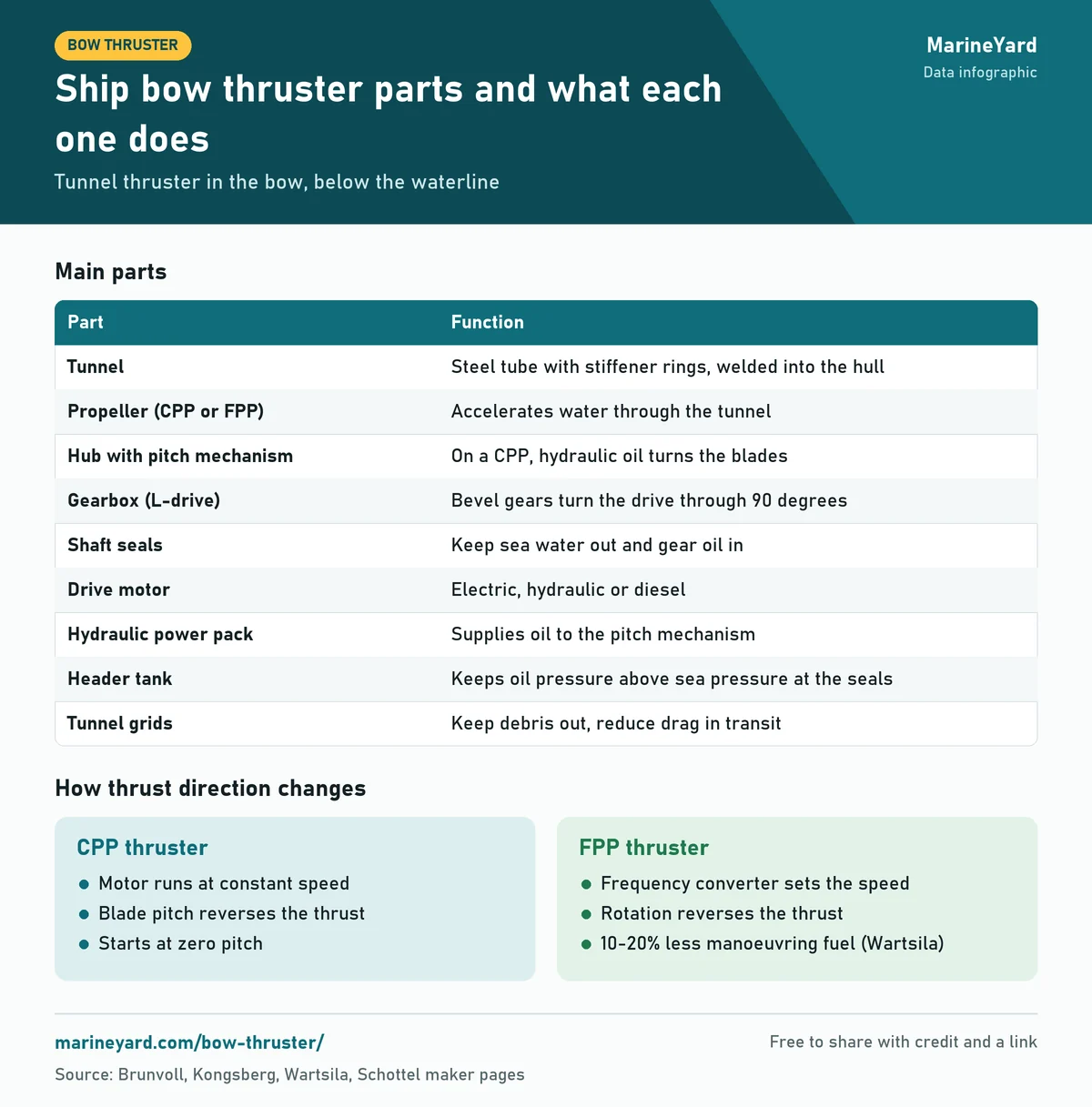
The parts of a bow thruster are the tunnel, the propeller with its hub, the gearbox, the shaft seals, the drive motor, the hydraulic power pack for pitch control, the bridge control system, the tunnel grids and the header tank for the gearbox oil. The motor stands above the tunnel.
| Part | Function |
|---|---|
| Tunnel | Steel tube with stiffener rings, welded into the hull |
| Propeller (CPP or FPP) | Accelerates water through the tunnel |
| Hub with pitch mechanism | On a CPP, hydraulic oil turns the blades to change pitch |
| Gearbox (L-drive or Z-drive) | Bevel gears turn the drive through 90 degrees to the propeller shaft |
| Shaft seals | Keep sea water out of the gearbox and oil out of the sea |
| Drive motor | Electric (asynchronous or permanent magnet), hydraulic or diesel |
| Hydraulic power pack | Pumps, valves and filters that supply oil to the pitch mechanism |
| Control system and bridge panel | Lever or joystick; shows pitch or rpm and alarms |
| Tunnel grids (gratings) | Keep debris out and reduce drag in transit |
| Header tank | Gravity tank above the waterline; keeps gearbox oil pressure above sea pressure at the seals |
Brunvoll's tunnel thruster page states that the gearbox can be removed from the tunnel with the blades in place. A trunk-mounted version can be lifted out without dry docking.
What are the types of bow thruster?
The types of bow thruster are tunnel thrusters with a controllable pitch propeller, tunnel thrusters with a fixed pitch propeller, retractable azimuth thrusters and water jet (pump-jet) thrusters. Most ship tunnel thrusters have an electric drive, and some are hydraulic.
| Type | How thrust direction changes | Typical use |
|---|---|---|
| Tunnel thruster, CPP | Blade pitch reverses; motor runs at constant speed | Cargo ships, ferries, offshore vessels |
| Tunnel thruster, FPP | Rotation reverses through a frequency converter | Ships with many manoeuvring hours |
| Hydraulic drive | Hydraulic motor fed by a power pack | Less common than electric on ships |
| Retractable azimuth thruster | Lowered below the hull and turned through 360 degrees | DP and take-home propulsion |
| Water jet (pump-jet) | A pump drives water through steerable nozzles | Hulls that need small openings |
A main azimuth thruster turns through 360 degrees and gives both propulsion and steering. A tunnel bow thruster gives side force only. The Schottel TransverseThruster (STT) is built on the underwater gearboxes of the maker's azimuthing Rudderpropellers.
How does a bow thruster work?
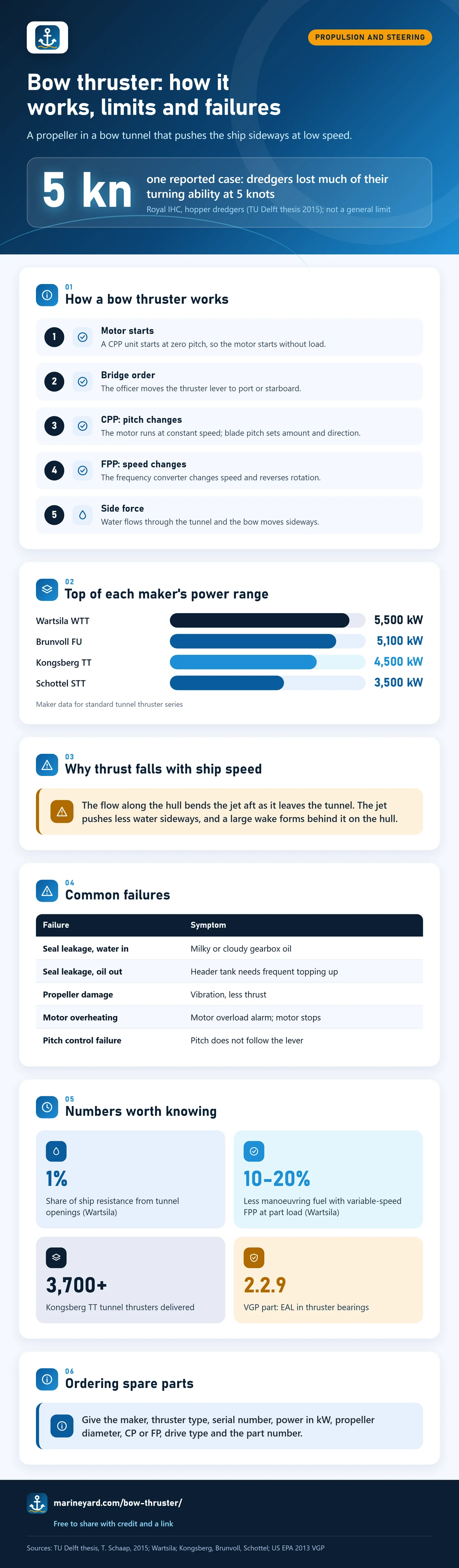
A bow thruster works by turning a propeller inside the tunnel so that water is drawn in on one side of the bow and forced out on the other. The reaction force pushes the bow away from the side where the jet leaves. The bridge sets the direction and amount of thrust with a lever or joystick.
- The drive motor starts. A CPP unit starts at zero pitch, so the motor starts without load.
- The officer on the bridge moves the thruster lever to port or starboard.
- On a CPP unit, the motor runs at constant speed. The hydraulic system turns the blades, and the pitch angle sets the amount and direction of thrust.
- On an FPP unit, the frequency converter changes the motor speed for more or less thrust and reverses the rotation for the opposite direction.
- Water flows through the tunnel and the side force moves the bow.
Is a controllable pitch or fixed pitch bow thruster better?
A controllable pitch bow thruster is usually the cheapest option to buy, while a fixed pitch bow thruster with a variable speed drive often costs less over its life. Wärtsilä's analysis of bow thruster selection gives this comparison for ships with many manoeuvring hours.
- CPP, constant speed. Lowest purchase cost. The motor turns at full speed even at zero thrust.
- FPP, variable speed. Higher purchase cost. Wärtsilä states 10 to 20% less manoeuvring fuel at part and low loads.
Tunnel openings account for about 1% of total ship resistance when the thruster is idle, according to the same article. Rounded tunnel edges, scallops and grids reduce this drag.
Who makes ship bow thrusters?
Ship bow thrusters are made by Kongsberg Maritime, Brunvoll, Wärtsilä and Schottel, among other propulsion makers. Each maker sells standard sizes defined by propeller diameter and maximum power. The final unit is chosen for the hull form and operating profile.
| Maker | Series | Propeller diameter | Power (maker data) |
|---|---|---|---|
| Kongsberg Maritime | TT, 11 sizes, CP or FP | 1,100 to 3,300 mm | 400 to 4,500 kW maximum |
| Brunvoll | FU 37 to FU 135, CP or FP | 850 to 3,500 mm | 75 to 5,100 kW |
| Wärtsilä | WTT; CP or FP up to WTT-40 | Not stated | 400 to 5,500 kW |
| Schottel | STT 60 to STT 610; CP for STT 1 to 7 | 620 to 3,200 mm | 90 to 3,500 kW |
The Kongsberg TT tunnel thruster has been delivered in more than 3,700 units.
Why does a bow thruster lose thrust as ship speed rises?
A bow thruster loses thrust as ship speed rises because the flow along the hull bends the jet aft as it leaves the tunnel. The jet then pushes less water sideways, and a large wake forms behind it on the hull. The ratio of ship speed to jet speed controls how strong this effect is.
A TU Delft thesis by T. Schaap (2015) reports that Royal IHC saw trailing suction hopper dredgers lose significant turning ability at 5 knots, compared with zero speed.
What do class rules require for bow thrusters?
Class rules apply to a manoeuvring bow thruster only if the owner asks for certification. The ABS Marine Vessel Rules, Part 4, Chapter 3, Section 5 make athwartship thrusters optional and assign the notation APS when the unit complies. Thrusters used for propulsion must comply.
- Control. An effective means of control from the navigation bridge.
- Bridge alarms. Motor overload, power supply failure, and CPP hydraulic oil low pressure, high pressure and high temperature.
Thrusters that also steer the ship fall under the steering gear rules for failure detection and response.
What are the common bow thruster failures?
The common bow thruster failures are shaft seal leakage, propeller damage from debris, motor overheating or overload trips, pitch control faults, and noise and vibration. Water that enters the gearbox oil is a main cause of gear and bearing damage.
| Failure | Common cause | Symptom | Action |
|---|---|---|---|
| Seal leakage, water in | Worn lip seals; rope or fishing line on the shaft | Milky or cloudy gearbox oil | Sample oil, drain water, plan seal renewal |
| Seal leakage, oil out | Worn seals or liner | Header tank needs frequent topping up | Measure consumption; renew seals in dry dock |
| Propeller damage | Debris, ice, missing grid bars | Vibration, less thrust | Inspect blades and grids |
| Motor overheating or trip | Long high-load running, cooling fault, low insulation | Motor overload alarm; motor stops | Check cooling and load; test insulation |
| Pitch control failure | Hydraulic pump, valve or filter fault | Hydraulic alarm; pitch does not follow lever | Check oil level, filters, pressure and feedback |
| Noise and vibration | Blade damage, bearing wear, cavitation | Rising noise in the thruster room | Inspect blades and bearings; sample oil |
Thruster seals face the same problems as a stern tube seal. The Schottel LeaCon system collects seal leakage in a separate chamber and measures it, so wear is seen early.
How is a bow thruster maintained?
A bow thruster is maintained by regular checks of the gearbox oil, the header tank level, the hydraulic system and the drive motor, and by a full inspection of the underwater parts in dry dock. The intervals come from the maker's manual and the ship's planned maintenance system.
- Check the header tank level and record any oil added. The amount added shows the seal leakage.
- Take gearbox oil samples for analysis of water and wear metals.
- Check the hydraulic power pack for level, pressure, filters and leaks.
- Test the motor insulation resistance and check its bearings and cooling.
- In dry dock, inspect the blades, hub, seals, grids and tunnel coating.
Do bow thrusters need environmentally acceptable lubricants?
Bow thrusters need environmentally acceptable lubricants (EALs) on ships covered by the US 2013 Vessel General Permit. Part 2.2.9 requires an EAL in all oil-to-sea interfaces unless technically infeasible. The heading of Part 2.2.9 names thruster hydraulic fluid and thruster bearings.
The 2013 Vessel General Permit asks for thruster maintenance in dry dock where possible. Kongsberg states that the TT is approved for EAL oil.
Which bow thruster spare parts are ordered most often?
Bow thruster spare parts ordered most often are shaft seal kits, propeller blades, bearings, gearbox parts such as bevel gears and pinions, pitch control parts such as pumps and valves, and motor parts. Thruster parts are ordered by the maker's part number.
A correct order states the following data:
- Ship name and IMO number.
- Maker and thruster type or size code.
- Serial number from the nameplate.
- Rated power in kW and input speed in rpm.
- Propeller diameter in mm, CP or FP.
- Drive type, with the motor maker and model.
- Part number from the maker's parts list.
General items such as filters, hoses and fasteners may carry an IMPA code.
What is a bow thruster on a yacht or small boat?
A bow thruster on a yacht or small boat is usually a small tunnel thruster with a reversible 12 V or 24 V DC electric motor that runs from the boat's batteries. Sleipner, formerly Side-Power, sells such units in both voltages.
Where can bow thruster parts be bought or sold?
Bow thruster parts are bought from the makers, authorised service companies and surplus stockists. MarineYard is a ship spare parts marketplace where sellers list new, reconditioned and used propulsion and steering parts and electrical and automation parts. Sellers get 9 free listings per account. MarineYard takes no commission and is not a party to any sale. Buyers should confirm the thruster type, serial number and part number with the seller.
Frequently Asked Questions
Can a bow thruster be used at sea speed?
A bow thruster cannot give useful side force at sea speed. The flow along the hull bends the jet aft, and the side force falls as speed rises. Royal IHC observed a significant loss of turning ability at 5 knots on hopper dredgers.
What is the difference between a bow thruster and a stern thruster?
A bow thruster and a stern thruster are the same type of machine in different places. The bow thruster sits in a tunnel at the fore end and moves the bow. The stern thruster sits in a tunnel at the aft end and moves the stern.
Why does a bow thruster have grids over the tunnel?
A bow thruster has grids over the tunnel openings to keep logs, ropes and other debris away from the propeller. Grids also reduce drag while the ship is under way, because tunnel openings add about 1% to ship resistance, according to Wärtsilä.
Why is there water in my bow thruster gearbox oil?
Water in bow thruster gearbox oil usually enters through a worn propeller shaft seal. Rope or fishing line on the shaft can cut the seal lips. The oil turns milky or cloudy, and the crew should drain the water and plan seal renewal.
How is the thrust of a CPP bow thruster controlled?
The thrust of a CPP bow thruster is controlled by the blade pitch. The motor runs at constant speed, and a hydraulic system in the hub turns the blades. Zero pitch gives no thrust, and reversed pitch reverses the thrust direction.
Do class rules make a bow thruster compulsory?
Class rules do not make a manoeuvring bow thruster compulsory under ABS. Under the ABS Marine Vessel Rules, a thruster used only to assist manoeuvring may be certified at the owner's request and then receives the optional APS notation. Thrusters used for propulsion must comply with the rules.
Related guides
- Stern tube: parts, bearings, seals and lubrication
- IMPA code: meaning and structure
- Ship chandler: meaning and services
- Oily water separator: working, parts and the 15 ppm rule
- Marine turbocharger: parts, working and surging
- Purifier in ship: working principle, parts and faults
- Cylinder liner: function, wear and gauging
- Ship boiler: types, mountings and water treatment
- Anchor windlass: parts, working and class rules
- Steering gear: parts, types and SOLAS tests
- Marine air compressor: starting air, parts and safety
Sources
- ABS, Marine Vessel Rules (January 2026), Part 4, Chapter 3, Section 5, Thrusters
- US EPA, 2013 Vessel General Permit, Part 2.2.9
- T. Schaap, Changing the cross-sectional geometry of a bow tunnel thruster, TU Delft, 2015
- Wärtsilä, How the right bow thruster can increase efficiency and save you money
- Wärtsilä, Transverse Thrusters (WTT)
- Kongsberg Maritime, Tunnel thruster type TT
- Brunvoll, Tunnel Thruster
- Schottel, TransverseThruster (STT)
Sign in to leave a comment and join the discussion.
 Ship Machinery
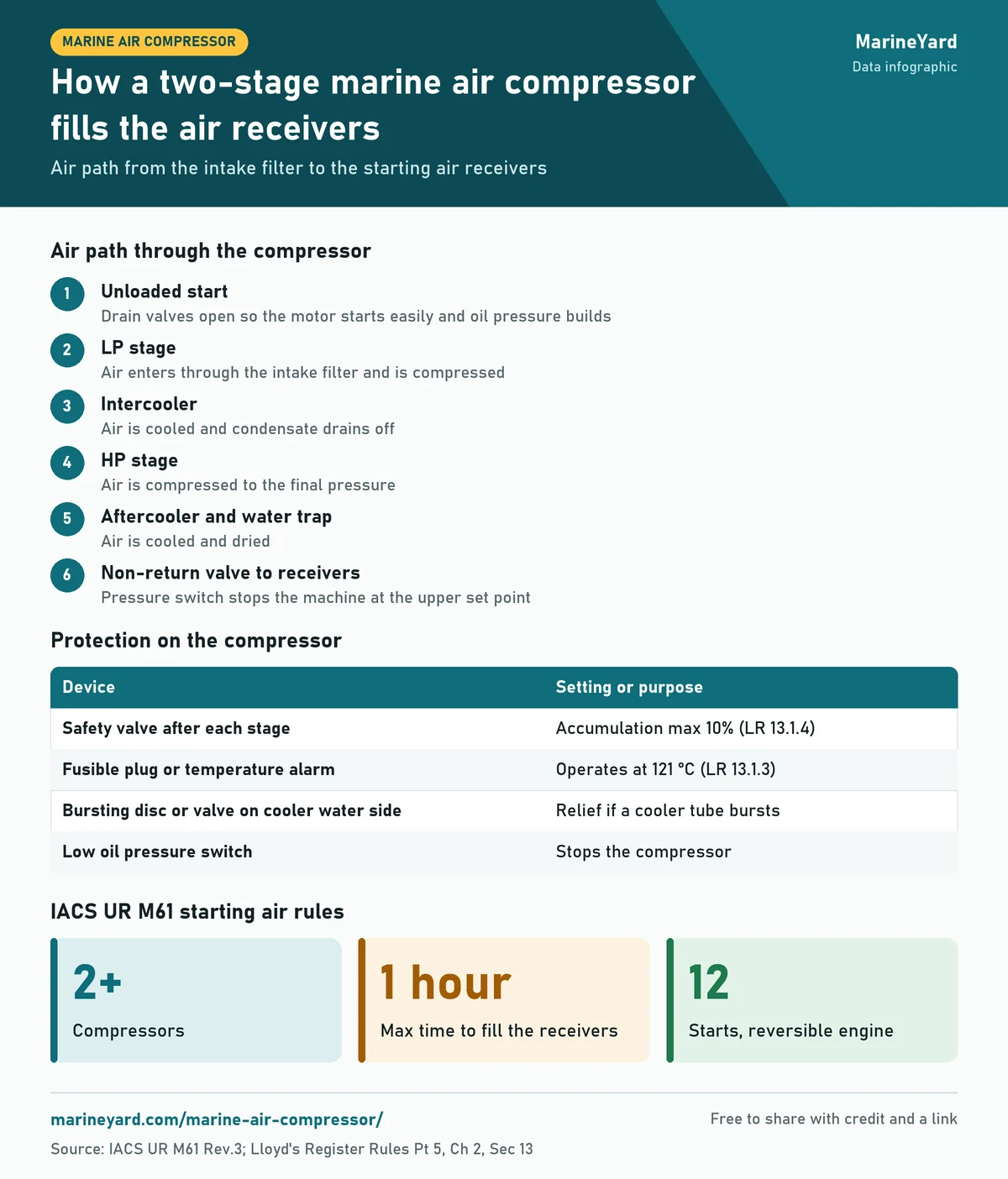
A marine air compressor is the machine in a ship's engine room that compresses atmospheric air and stores it in air receivers. The stored air starts the...
 Ship Machinery
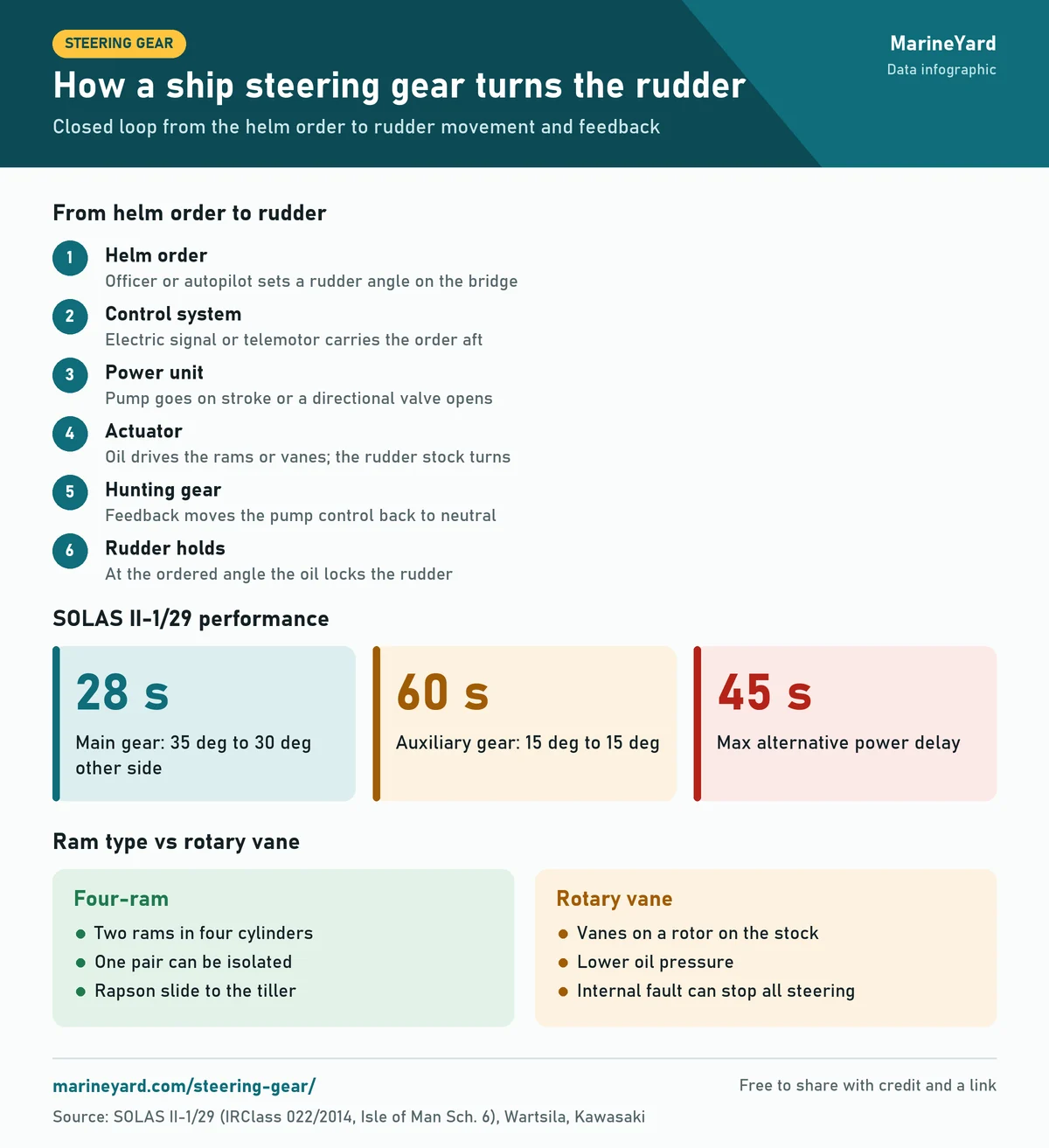
A steering gear is the machinery on a ship that turns the rudder on orders from the bridge. The steering gear comprises the rudder actuators, the power...
 Ship Machinery
A windlass is the deck machine on a ship that heaves up, lowers and holds the anchor and its chain cable. The windlass stands on the forecastle deck. A...