Crankcase Explosion: Causes, Relief Valves and Alarm Actions
Marine engineers & industry writers
Updated
Nov 25, 2026
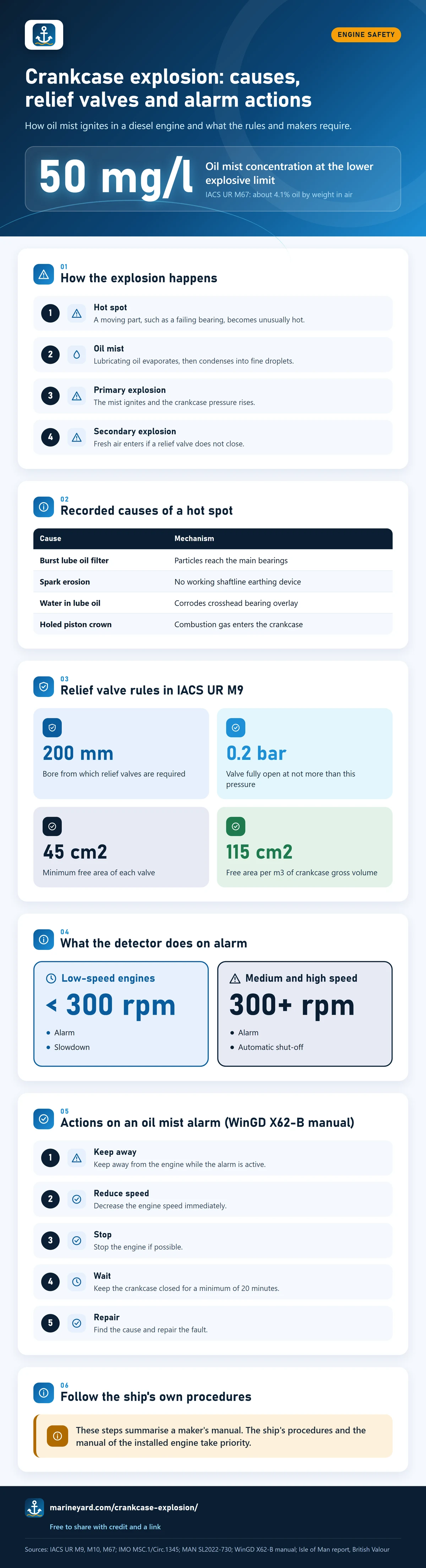
A crankcase explosion is the ignition of oil mist inside the crankcase of a diesel engine. A hot spot evaporates lubricating oil, the vapour condenses into a fine mist, and the mist can ignite when the concentration reaches the lower explosive limit, which IACS gives as about 50 mg of oil per litre of air.
A crankcase explosion can kill or injure the engine crew and can start an engine room fire. Ships use two lines of protection. Oil mist detectors or bearing monitors warn before the mist can ignite. Crankcase explosion relief valves limit the damage if ignition occurs.
Key facts
| Attribute | Value |
|---|---|
| Fuel of the explosion | Lubricating oil mist created by a hot spot (Wärtsilä encyclopedia) |
| Lower explosive limit (LEL) of oil mist | About 50 mg/l, about 4.1% oil by weight in air (IACS UR M67) |
| Oil mist alarm set point | Not more than 5% of the LEL, about 2.5 mg/l (IACS UR M67) |
| Engines that need relief valves | Cylinder bore of 200 mm and above, or crankcase volume of 0.6 m³ and above (IACS UR M9) |
| Relief valve fully open at | Not more than 0.02 N/mm² (0.2 bar) (IACS UR M9) |
| Relief valve free area | At least 45 cm² per valve and 115 cm² per m³ of crankcase gross volume (IACS UR M9) |
| Engines that need oil mist detection or bearing monitoring | 2,250 kW and above, or cylinder bore over 300 mm (IACS UR M10, IMO MSC.1/Circ.1345) |
| Waiting time before the crankcase is opened | Minimum 20 minutes after engine stop (WinGD X62-B operation manual) |
What is a crankcase explosion?
A crankcase explosion is a rapid combustion of oil mist and air in the closed space below the cylinders of a diesel engine. The Wärtsilä encyclopedia entry on crankcase explosion states that a hot spot evaporates lubricating oil and that the vapour condenses into the oil mist that ignites.
The same entry lists death, serious injury and extensive engine damage as possible results. Gear cases and chain cases can also hold an explosive mist. IACS requires extra relief valves on these separate spaces when the gross volume exceeds 0.6 m³.
Which parts are involved in a crankcase explosion?
The parts involved in a crankcase explosion are the overheated component that forms the hot spot, the crankcase and crankcase doors that contain the pressure, the relief valves and flame arresters that vent the pressure, and the oil mist detector and bearing sensors that give the early warning.
| Part | Role in a crankcase explosion |
|---|---|
| Main, crankpin and crosshead bearings | Form a hot spot when a bearing runs hot |
| Crankcase and crankcase doors | Must withstand the explosion pressure; doors must stay fastened (IACS UR M10) |
| Crankcase explosion relief valve | Opens to release the pressure, then closes to keep air out |
| Flame arrester | Lets the gas flow out and stops the flame from reaching the engine room |
| Oil mist detector | Measures the mist concentration and starts the alarm, slowdown or shutdown |
| Bearing temperature or bearing wear sensors | Detect a failing bearing before or instead of the mist signal |
| Crankcase vent pipe | Kept as small as practicable to limit the inrush of air after an explosion |
The door and vent pipe requirements come from IACS Unified Requirement (UR) M10. The Türk Loydu edition of the IACS machinery requirements reproduces UR M9, M10, M66 and M67 in full.
How does a crankcase explosion happen?
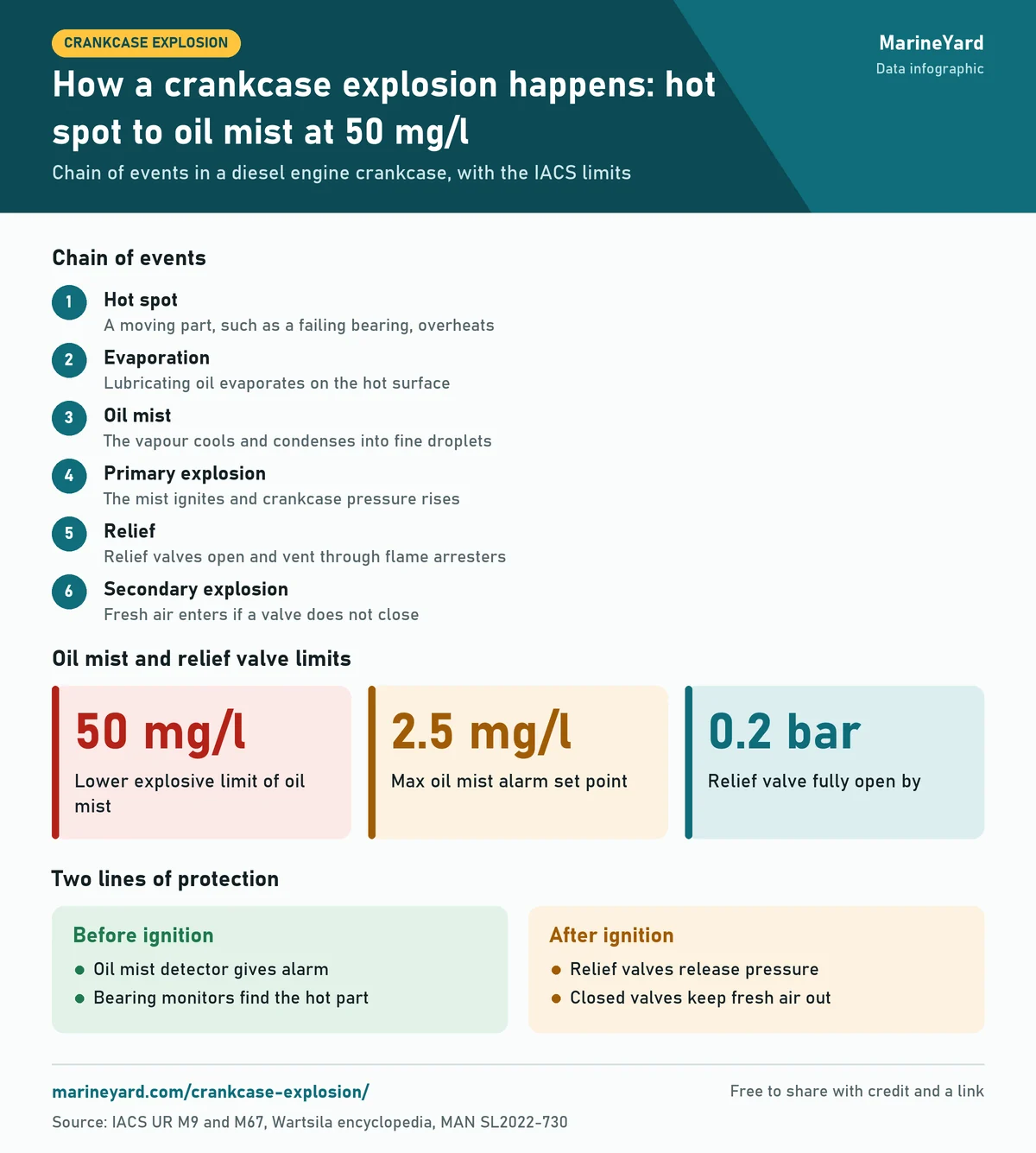
A crankcase explosion happens in a chain of events. A component overheats and forms a hot spot. Lubricating oil that touches the hot spot evaporates. The vapour cools and condenses into mist. The mist reaches an explosive concentration and ignites. A second explosion can follow if air enters the crankcase.
- Hot spot. A moving part becomes unusually hot, for example a failing bearing.
- Evaporation. Lubricating oil splashes on the hot surface and evaporates.
- Oil mist. The vapour cools and condenses into fine droplets.
- Explosive mixture. The mist concentration rises toward the LEL of about 50 mg/l.
- Primary explosion. The hot spot or another heat source ignites the mixture. The pressure in the crankcase rises.
- Relief. The relief valves open and release the pressure through the flame arresters.
- Secondary explosion. A relief valve that fails to close, or a displaced door, lets fresh air into the crankcase. The new mixture ignites.
MAN service letter SL2022-730 describes one such case. A relief valve did not close after the first explosion. Fresh air entered the crankcase, and the second explosion blew the crankcase doors off the engine and caused an engine room fire.
What causes a hot spot in a crankcase?
A hot spot in a crankcase is caused by a moving part that becomes unusually hot, such as a failing bearing. Lubricating oil that carries particles or water damages the bearing surface. Hot combustion gas that enters the crankcase through a damaged piston is a second cause that investigators have recorded.
| Cause | Mechanism | Source |
|---|---|---|
| Burst main lubricating oil filter | Retained particles reach the main bearings; hot running and bearing collapse follow | MAN SL2022-730 |
| Spark erosion | A shaftline without a working earthing device raises the main bearing wear rate | MAN SL2022-730 |
| Water in the lubricating oil | Water corrodes the lead overlay of crosshead bearings | MAN SL2022-730 |
| Holed piston crown | Combustion gas passes through the piston cooling oil passages into the crankcase | Isle of Man report, British Valour |
The Isle of Man casualty report on the tanker British Valour covers the piston case. The explosion happened on 18 March 2001 on a main engine of 750 mm bore. Three relief valves did not re-seat, and the flame arresters did not stop the ignition of the expelled mist. MAN lists the cleaning routine of the main lubricating oil filter among its precautions. The lubricating oil purifier removes water and particles from the system oil.
How does a crankcase relief valve work?
A crankcase relief valve works as a spring-loaded disc mounted on the crankcase, usually on a crankcase door. The disc lifts when the crankcase pressure rises, releases the gas through a flame arrester, and closes again by spring force. The closed valve keeps fresh air out and so reduces the risk of a secondary explosion.
IACS UR M9 sets the design rules and UR M66 sets the type test.
| Item | Requirement |
|---|---|
| Bore up to 250 mm | At least one valve near each end; one more near the middle above eight crankthrows |
| Bore over 250 mm up to 300 mm | At least one valve at each alternate crankthrow, minimum two valves |
| Bore over 300 mm | At least one valve at each main crankthrow |
| Opening | Fully open at not more than 0.2 bar |
| Free area | 45 cm² minimum per valve; 115 cm² per m³ of crankcase gross volume in total |
| Type test (UR M66) | Explosion tests with 9.5% ±0.5% methane in air |
| Tightness after the test explosion | Underpressure of at least 0.3 bar held for at least 10 seconds |
UR M66 applies to engines on ships contracted for construction on or after 1 July 2008. MAN names four type-approved valves for MAN B&W two-stroke engines in SL2022-730: Hoerbiger EVX, Mt. Halla CR52, Ziincheol HWG and Prosave ERV. The same letter states that a flame arrester must never be covered with plastic, paper or paint.
IACS published Revision 5 of UR M10 in 2024. The IACS notice on UR M10 Revision 5 adds requirements for engines that burn gas or low-flashpoint fuels.
How do oil mist detectors and bearing monitors prevent a crankcase explosion?
Oil mist detectors and bearing monitors prevent a crankcase explosion by finding the hot spot early. An oil mist detector measures the mist concentration and gives an alarm at not more than 2.5 mg/l, which is 5% of the LEL. A bearing monitor measures temperature or wear at the bearing.
IACS UR M10 requires oil mist detection, bearing temperature monitors or equivalent devices on engines of 2,250 kW and above or with a bore over 300 mm. IMO circular MSC.1/Circ.1345 of 2 June 2010 gives the same split as UR M10:
- Low-speed engines (under 300 rpm). The device starts the alarm and the slowdown.
- Medium-speed and high-speed engines (300 rpm and above). The device starts the alarm and the automatic shut-off.
The Wärtsilä encyclopedia calls oil mist detection "the prime protection for an engine". MAN recommends a bearing wear monitoring system connected to the alarm system and the slowdown function. That system has been mandatory since 2008 on MAN-designed engines with bore size 45 and above.
What are the actions on an oil mist alarm?
The actions on an oil mist alarm are to keep away from the engine, reduce the engine speed at once, stop the engine if possible, and leave the crankcase closed for at least 20 minutes. The steps below follow the WinGD X62-B operation manual (Issue 002, 2020-01).
- Keep away from the engine. WinGD warns of a risk of explosion while the alarm is active.
- Decrease the engine speed (power) immediately.
- Stop the engine if possible.
- Let the engine temperature decrease for a minimum of 20 minutes. Keep the crankcase doors and covers closed during this time, because air that enters the crankcase can cause an explosion.
- Find the cause and repair the fault.
WinGD adds that a portable fire extinguisher must be ready when the crankcase doors are opened, if no fire-extinguishing system is installed or in use.
The MAN B&W safety precautions in service letter SL2017-652 give matching advice. Persons must not stand near crankcase doors or relief valves, or in corridors near the engine room doors, during an oil mist alarm. MAN states that the crankcase is ventilated for about 30 minutes after engine stop before entry.
These steps are a summary of two makers' documents. The ship's own procedures and the manual of the installed engine take priority.
Which parts are replaced after a crankcase explosion?
Parts replaced after a crankcase explosion depend on the inspection findings. The list normally starts with the component that formed the hot spot, the relief valves and their seals, and any damaged flame arrester. IACS UR M9 requires the valve manual on board to state the actions after a crankcase explosion.
- Hot spot component. A damaged bearing, or the piston crown in the British Valour case.
- Relief valves and sealing rings. O-ring seals were displaced on British Valour.
- Flame arresters. A deformed arrester may not stop a flame.
- Oil mist detector. The detector on British Valour was found inoperable after the explosions.
A relief valve order states the engine maker and type, the valve maker, and the data marked on the valve. UR M9 requires four markings: manufacturer name and address, designation and size, month and year of manufacture, and approved installation orientation. O-rings and gaskets may carry an IMPA code and can come from a ship chandler.
Where can crankcase relief valves and engine parts be bought or sold?
Crankcase relief valves, bearings and detector parts are sold by engine makers, licensed service companies and surplus stockists. MarineYard is a ship spare parts marketplace where sellers list new, reconditioned and used main engine parts and auxiliary engine parts. Sellers get 9 free listings per account. MarineYard takes no commission and is not a party to any sale. Buyers should ask the seller for the type test certificate of a relief valve before payment.
Frequently Asked Questions
What is the difference between a primary and a secondary crankcase explosion?
A primary crankcase explosion is the first ignition of oil mist by a hot spot. A secondary crankcase explosion follows when fresh air enters the crankcase, for example through a relief valve that did not close, and forms a new explosive mixture.
At what oil mist concentration can a crankcase explosion occur?
A crankcase explosion can occur when the oil mist reaches the lower explosive limit of about 50 mg of oil per litre of air, the figure given in IACS UR M67. Oil mist detectors give the alarm far below that level, at not more than about 2.5 mg/l.
How long after an oil mist alarm can the crankcase be opened?
The crankcase stays closed for a minimum of 20 minutes after engine stop according to the WinGD X62-B operation manual. MAN B&W states about 30 minutes of ventilation before entry. The manual of the installed engine gives the figure that applies on board.
How many crankcase relief valves does an engine need?
An engine with a bore over 300 mm needs at least one relief valve at each main crankthrow under IACS UR M9. Smaller engines need fewer valves. The combined free area must be at least 115 cm² per cubic metre of crankcase gross volume.
Can a bearing temperature monitor replace an oil mist detector?
A bearing temperature monitor can replace an oil mist detector under IACS UR M10, which accepts oil mist detection, engine bearing temperature monitors or equivalent devices. The monitor must be of a type approved by the classification society for use as a safety device.
Do gear cases and chain cases need explosion relief valves?
Gear cases and chain cases need their own explosion relief valves when the gross volume of the separate space exceeds 0.6 m³. IACS UR M10 sets this rule for camshaft drive cases and similar spaces. Scavenge spaces in open connection to the cylinders also need relief valves.
Related guides
- Fresh Water Generator on Ships: Working, Parts and Types
- Ballast Water Treatment System: Types, Parts and D-2 Rules
- Sewage Treatment Plant on Ship: Working, Parts and MARPOL Rules
- Marine Incinerator on Ships: Parts, Working and MARPOL Rules
- Oil Mist Detector on Ships: Working, Rules and Alarm Levels
- ISSA Code: Meaning, Catalogue and Difference from IMPA Code
- Stern tube: parts, bearings, seals and lubrication
- IMPA code: meaning and structure
- Ship chandler: meaning and services
- Oily water separator: working, parts and the 15 ppm rule
- Marine turbocharger: parts, working and surging
- Purifier in ship: working principle, parts and faults
- Cylinder liner: function, wear and gauging
- Ship boiler: types, mountings and water treatment
- Anchor windlass: parts, working and class rules
- Bow thruster: how it works, types and failures
- Steering gear: parts, types and SOLAS tests
- Marine air compressor: starting air, parts and safety
Sources
- Türk Loydu, TL-R M (January 2023), reproducing IACS UR M9, M10, M66 and M67
- IACS, notice on Revision 5 of UR M10
- IMO, MSC.1/Circ.1345, unified interpretation of SOLAS regulation II-1/27.5
- MAN Energy Solutions, service letter SL2022-730, Prevention of crankcase explosions
- MAN Diesel & Turbo, service letter SL2017-652, Safety Precautions
- WinGD, X62-B Operation Manual, Issue 002 2020-01
- Isle of Man Ship Registry, casualty investigation, British Valour crankcase explosion
- Wärtsilä Encyclopedia of Marine and Energy Technology, crankcase explosion
Sign in to leave a comment and join the discussion.
 Spare Parts Guides
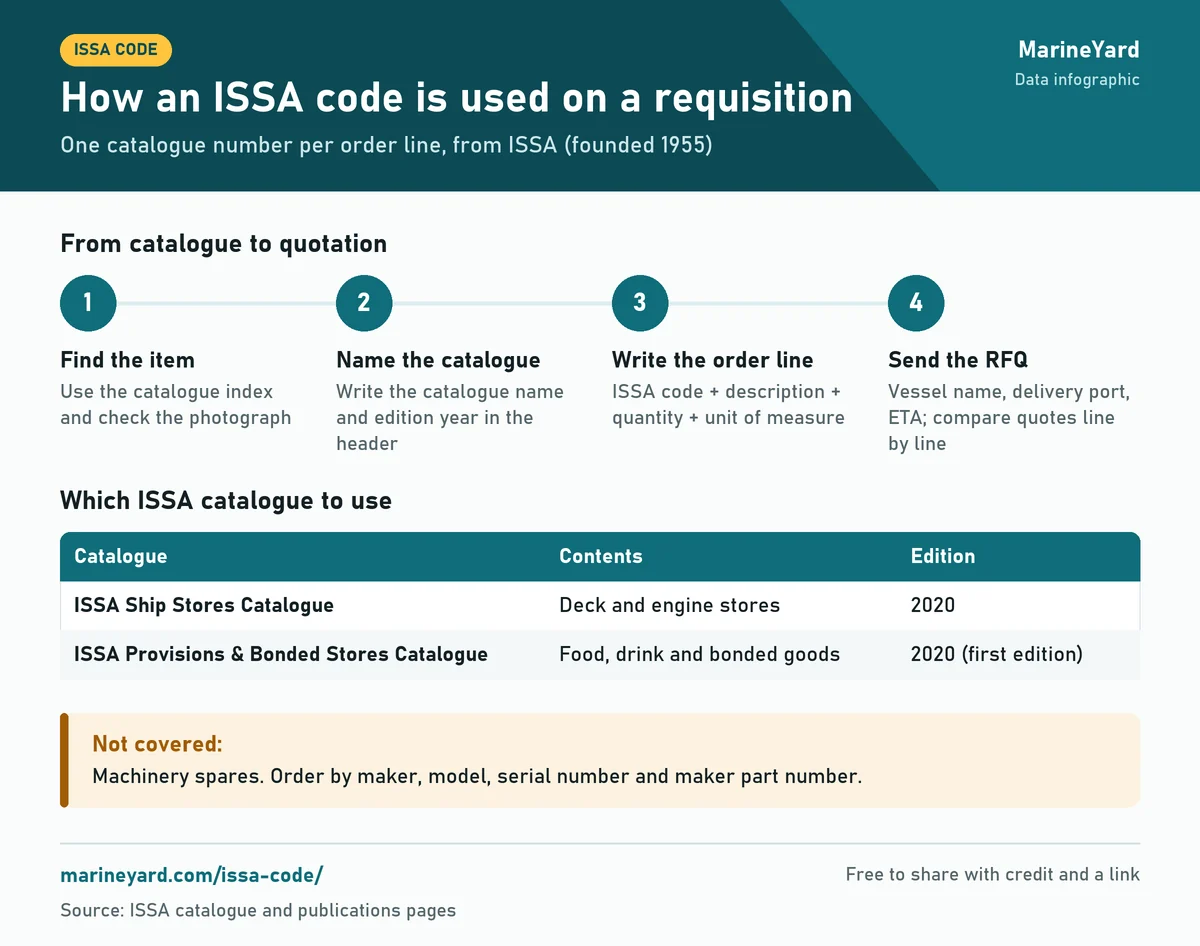
An ISSA code is the item number that identifies one product in the ISSA Ship Stores Catalogue, the illustrated catalogue published by the International...
 Ship Machinery
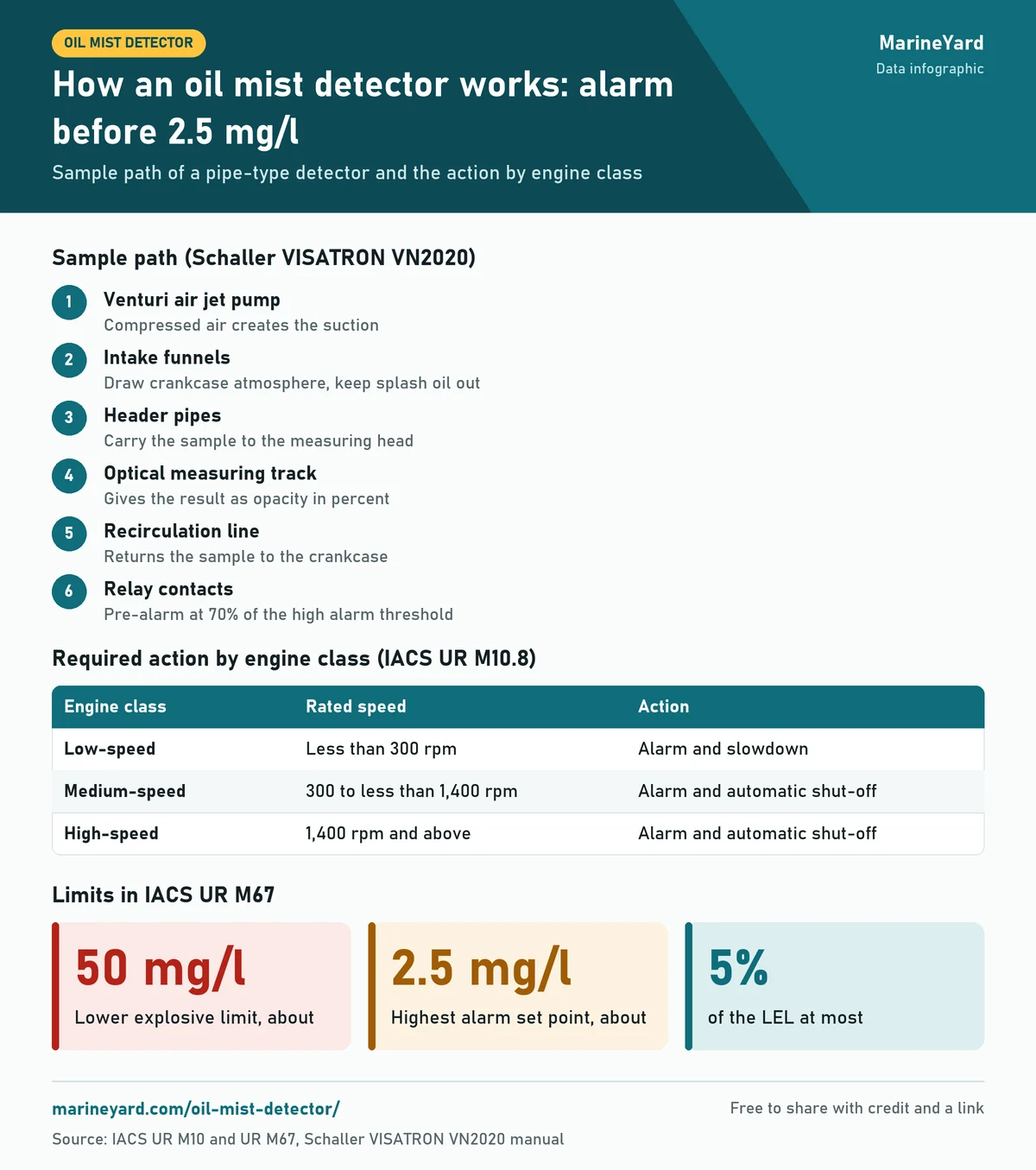
An oil mist detector (OMD) is a safety instrument on a marine diesel engine that measures the concentration of oil mist in the crankcase. The oil mist...
 Ship Machinery
A marine incinerator is a shipboard furnace that burns waste generated during the normal operation of the ship, mainly sludge oil and solid garbage. MARPOL...