Marine Turbocharger: Parts, Working, Surging and Maintenance
Marine engineers & industry writers
Updated
Nov 18, 2026
A marine turbocharger is an exhaust-driven air compressor fitted to a ship's diesel or dual-fuel engine. The exhaust gas turns a turbine, and the turbine drives a compressor wheel on the same shaft. The compressor delivers scavenge air or charge air to the cylinders at a pressure above atmospheric pressure.
More air lets the engine burn more fuel per cycle. Two-stroke main engines and four-stroke auxiliary engines both depend on it for rated power.
Key facts
| Attribute | Value |
|---|---|
| Share of engine power | Up to 75% of the engine's power (Accelleron) |
| Auxiliary blower start, two-stroke engine | Below approximately 25-35% engine load (MAN B&W project guide) |
| Turbine dry cleaning, two-stroke engine | Every 25 to 50 operating hours (Accelleron) |
| Turbine wet cleaning, four-stroke engine | Every 50 to 200 operating hours, gas below 430 °C before the turbine (Accelleron) |
| Compressor wet cleaning | Every 25 to 100 operating hours at 25 to 85% engine load (Accelleron) |
| Plain bearing design life, ABB TPL | At least 35,000 hours (ABB Review 1/1999) |
| Class requirement | IACS Unified Requirement M73, Turbochargers |
What is a marine turbocharger?
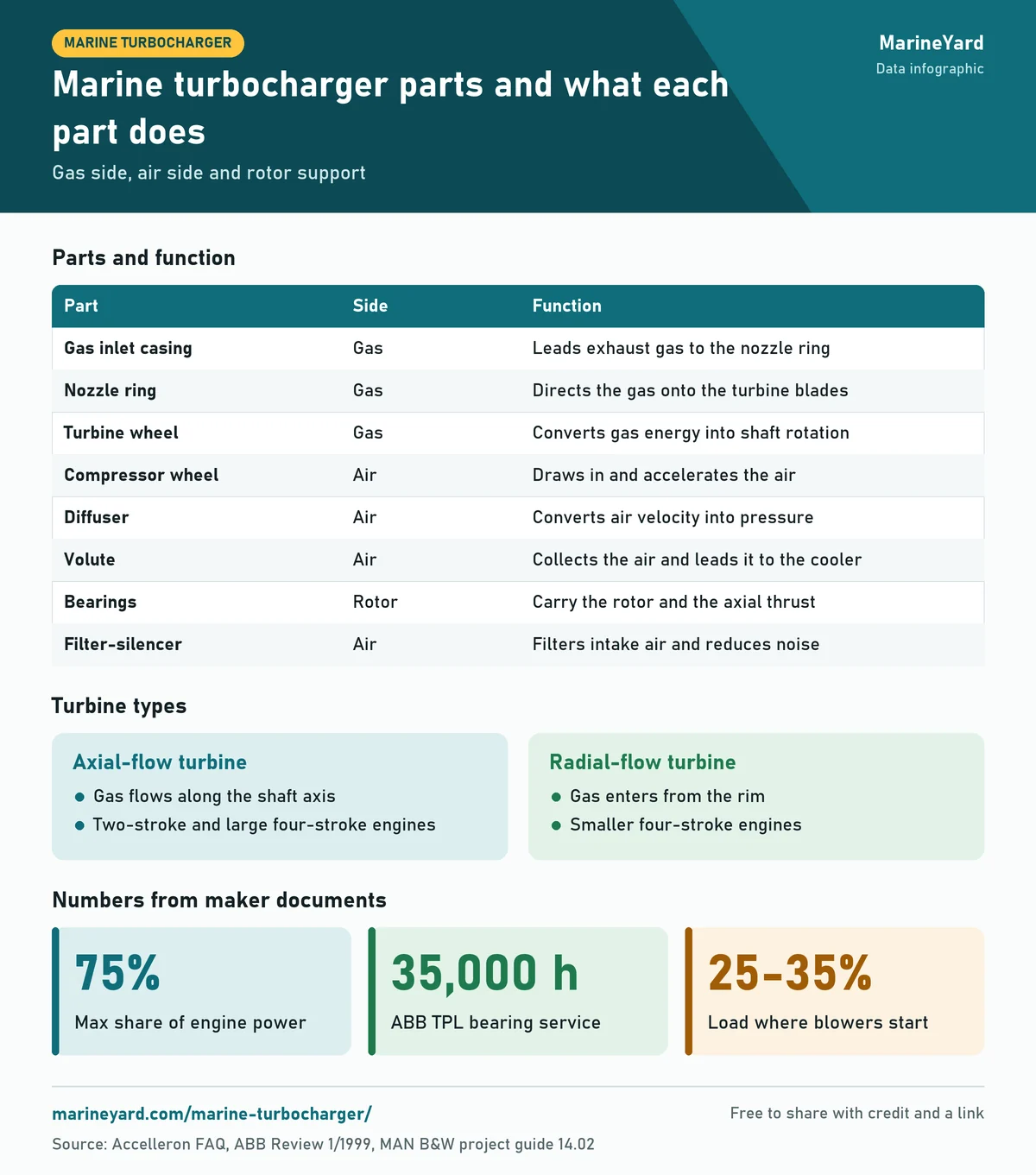
A marine turbocharger is a turbine and a centrifugal compressor on one shaft, mounted on the engine between the exhaust gas receiver and the air cooler. The turbine recovers exhaust gas energy that would otherwise be lost. The compressor uses that energy to raise the combustion air pressure.
The Accelleron turbocharging FAQ states that turbochargers on two-stroke and four-stroke engines can provide up to 75% of the engine's power.
What are the parts of a marine turbocharger?
The parts of a marine turbocharger are the rotor, the casings, the bearings, the seals and the air and gas guide parts. The ABB TPL series is built from six modules: filter-silencer, air volute, rotor block, gas inlet casing, nozzle ring and gas outlet casing.
| Part | Function |
|---|---|
| Gas inlet casing (turbine casing) | Leads exhaust gas to the nozzle ring |
| Nozzle ring | Directs the gas onto the turbine blades |
| Turbine wheel | Converts gas energy into shaft rotation |
| Rotor shaft | Joins turbine wheel and compressor wheel |
| Compressor wheel (impeller) | Draws in and accelerates the air |
| Diffuser | Converts air velocity into pressure |
| Volute (air outlet casing) | Collects the air and leads it to the cooler |
| Radial and thrust bearings | Carry the rotor and the axial thrust |
| Labyrinth seals and sealing air | Keep gas out of the bearings and oil out of the gas and air sides |
| Filter-silencer | Filters intake air and reduces noise |
| Lubricating oil system | Feeds the bearings from the engine oil circuit or a separate sump |
| Bearing casing | Holds the bearings; water-cooled on older designs, uncooled on current ones |
Accelleron VTR turbochargers use external anti-friction bearings. The ABB Review article on the TPL series describes inboard sleeve bearings lubricated by engine oil, uncooled casings and integrated washing nozzles. The article gives the TPL bearings at least 35,000 hours of service.
What are the types of marine turbocharger?
Marine turbochargers are classed by turbine flow direction, exhaust system and number of stages. Axial-flow turbines serve large two-stroke and medium-speed engines. Radial-flow turbines serve smaller four-stroke engines. Exhaust systems work on the constant pressure principle or the pulse principle.
| Type | How it works | Where used |
|---|---|---|
| Axial-flow turbine | Gas flows along the shaft axis | Two-stroke and large four-stroke engines; Everllence TCA: 5,400-32,400 kW |
| Radial-flow turbine | Gas enters from the rim and leaves along the axis | Smaller four-stroke engines; Everllence TCR: 600-6,850 kW |
| Constant pressure system | All cylinders exhaust into one large receiver | Modern two-stroke engines |
| Pulse system | Narrow pipes carry exhaust pulses to a multi-entry gas inlet casing | Four-stroke engines, older two-stroke engines |
| Two-stage (single-stage is standard) | A low-pressure unit feeds a high-pressure unit | High-output four-stroke engines |
| With waste gate or bypass | Diverts part of the gas past the turbine | Limits charge air pressure |
| With variable turbine geometry | Adjustable nozzle ring changes the inlet area | Part-load optimised engines |
The output figures come from the Everllence marine turbocharger range. Accelleron states that two-stage turbocharging exceeds 75% efficiency, against 65% for conventional turbochargers.
How does a marine turbocharger work?
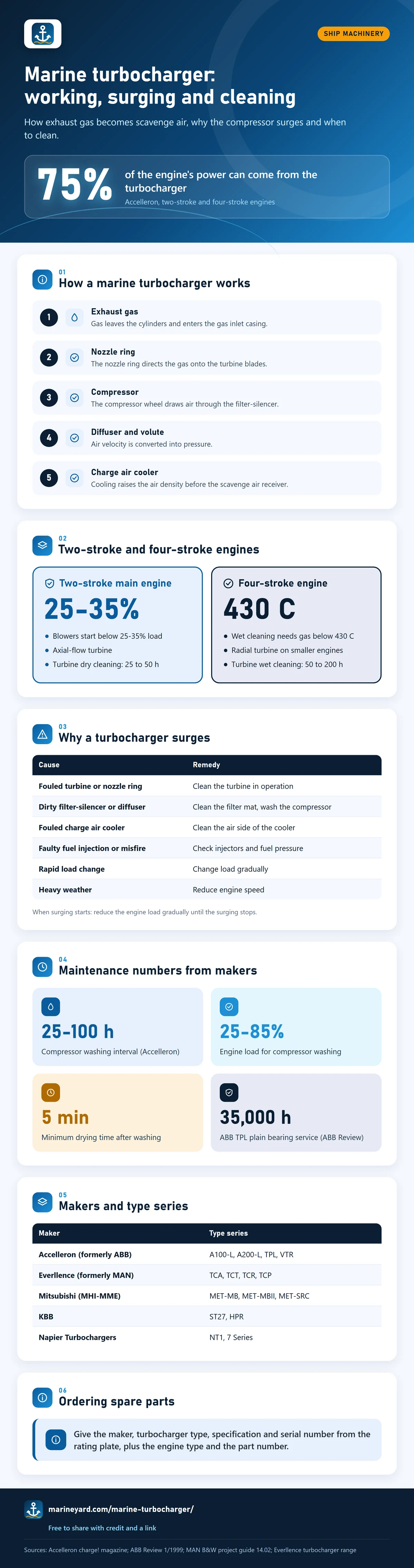
A marine turbocharger works by expanding hot exhaust gas through a turbine and using the shaft power to compress fresh air for the cylinders. No mechanical drive connects the rotor to the crankshaft. Air delivery therefore follows the engine load.
- Exhaust gas leaves the cylinders and enters the exhaust receiver or pipes.
- The gas inlet casing leads the gas to the nozzle ring.
- The nozzle ring directs the gas onto the turbine blades, and the rotor turns.
- The expanded gas leaves through the gas outlet casing.
- The compressor wheel draws engine room air through the filter-silencer.
- The diffuser and volute convert air velocity into pressure.
- The charge air cooler cools the compressed air and raises its density.
- The air enters the scavenge air receiver or the charge air manifold.
Why does a two-stroke engine need auxiliary blowers?
A two-stroke engine needs auxiliary blowers because the exhaust gas energy at starting and at low load is too small for the turbocharger to supply enough scavenge air. Electrically driven blowers supply the air until the turbocharger takes over. A four-stroke engine draws in air with its own pistons.
The MAN B&W project guide section on auxiliary blowers requires a minimum of two blowers per engine. In service the blowers start automatically when the blower inlet pressure falls below a preset value, at approximately 25-35% engine load. The blowers stop at approximately 30-40% load. Non-return valves after the scavenge air cooler close while the blowers run.
What is turbocharger surging?
Turbocharger surging is a breakdown of the air flow through the compressor. The compressor can no longer deliver against the pressure in the scavenge air receiver, and the air flow reverses for a moment. Accelleron defines surging as "a disruption of the airflow within the turbocharger". The signs are abnormal noise and vibration.
The operating point on the compressor map must stay on the stable side of the surge line. Fouling, engine faults and fast load changes move the operating point towards the line, as explained in the Accelleron article on turbocharger surging.
| Cause of surging | Remedy |
|---|---|
| Fouled turbine or nozzle ring | Clean the turbine in operation |
| Dirty filter-silencer or diffuser | Clean the filter mat; wash the compressor |
| Fouled or blocked charge air cooler | Clean the air side of the cooler |
| Faulty fuel injection or cylinder misfire | Check injectors, fuel pressure and water in fuel |
| Rapid load change, emergency stop | Change load gradually where possible |
| Heavy weather, propeller load swings | Reduce engine speed |
| Mismatch after damage or wrong parts | Inspection by the maker's service station |
The immediate action is to reduce the engine load gradually until the surging stops. Continuous or periodic surging can damage turbocharger parts.
How is a marine turbocharger maintained?
A marine turbocharger is maintained by cleaning the compressor and the turbine during operation, cleaning the air filter, keeping the lubricating oil clean and overhauling the unit at the maker's interval. Deposits lower the scavenge air pressure and raise the exhaust gas temperature.
| Task | Method | Interval and condition (Accelleron) |
|---|---|---|
| Compressor water washing | Water droplets strike the compressor wheel | Every 25 to 100 hours at 25 to 85% engine load; dry for at least 5 minutes |
| Turbine wet washing | Water is sprayed in ahead of the nozzle ring | Four-stroke engines, every 50 to 200 hours; gas below 430 °C |
| Turbine dry cleaning | Compressed air blows granules into the gas inlet | Two-stroke engines, every 25 to 50 hours at service load |
The figures come from the Accelleron guide to cleaning in operation. The turbocharger manual gives the exact values. Crews often call dry cleaning grit or nutshell cleaning.
Plain bearings on engine oil depend on the oil filter and the oil purifier. A rotor is balanced again after blade renewal, wheel replacement or shaft repair.
What causes a marine turbocharger to fail?
Marine turbocharger failures are caused mainly by dirty or insufficient lubricating oil, foreign objects in the gas or air flow, heavy fouling and rotor imbalance. Warning signs are higher exhaust gas temperature, vibration, abnormal noise and oil in the casings.
| Failure | Common cause | Action |
|---|---|---|
| Bearing failure | Contaminated oil, low oil pressure | Stop the engine; renew bearings; check the oil system |
| Blade damage | Foreign objects such as piston ring or valve fragments | Stop the engine, inspect the rotor and nozzle ring |
| Fouling | Combustion residues; oil mist and dust in the intake air | Clean in operation and at overhaul |
| Oil leakage | Worn sealing rings, blocked sealing air duct or oil drain | Clear the ducts, renew the seals |
| Vibration | Rotor imbalance from deposits or blade damage; worn bearings | Clean the turbine; inspect and balance the rotor |
Classification societies apply IACS Unified Requirement M73. The requirement sorts turbochargers by the engine power each unit serves: category A up to 1,000 kW, B up to 2,500 kW, and C above 2,500 kW.
Who makes marine turbochargers?
Marine turbochargers are made by a small group of specialist companies. Accelleron, Everllence and Mitsubishi Heavy Industries Marine Machinery and Equipment build axial units for two-stroke main engines and radial units for four-stroke engines. KBB and Napier Turbochargers build mainly for medium-speed engines. Each maker uses its own type designations and part numbers.
| Maker | Type series | Notes |
|---|---|---|
| Accelleron (formerly ABB Turbocharging) | A100-L and A200-L, TPL, VTR | A100-L and A200-L: two-stroke engines, 3,000 to 28,000 kW; VTR is the legacy series |
| Everllence (formerly MAN Energy Solutions) | TCA, TCT, TCR, TCP, older NA and NR | TCA and TCT are axial; TCR and TCP are radial |
| Mitsubishi (MHI-MME) | MET-MB and MET-MBII, MET-SRC | MET-MB: axial, two-stroke; MET-SRC: radial, four-stroke |
| KBB (Kompressorenbau Bannewitz) | ST27, HPR | Medium-speed engines |
| Napier Turbochargers | NT1, 7 Series (NA297 to NA397) | NT1 is single-stage axial; a Wabtec company |
ABB Turbocharging was renamed Accelleron in 2022. The company became independent when Accelleron shares started trading on the SIX Swiss Exchange on 3 October 2022.
Which marine turbocharger spare parts are ordered most often?
Marine turbocharger spare parts ordered most often are bearings, sealing rings, gaskets, filter mats and service kits for the planned overhaul. Nozzle rings and turbine blades are ordered when erosion or damage is found. Rotors and cartridges are ordered after a failure or as exchange units.
Turbocharger parts are identified by the maker's part number and not by an IMPA code. A ship chandler can supply consumables such as filter material. Listings for marine turbochargers and parts should state maker and type.
How do you specify marine turbocharger spares?
Marine turbocharger spares are specified by the data on the rating plate: maker, turbocharger type, specification and serial number. One frame size is built with different compressor wheels and nozzle rings to match each engine, so parts differ between specifications.
- State the ship name, IMO number, engine maker and engine type.
- Copy the turbocharger maker and full type from the rating plate.
- Copy the serial number; on ABB and Accelleron units the serial number starts with the letters HT.
- Give the specification or customer part number shown on the plate.
- Give the part name, part number and quantity.
What is the difference between new, reconditioned and exchange turbocharger cartridges?
A new cartridge is an unused rotor and bearing assembly from the maker. A reconditioned cartridge is a used assembly that has been cleaned, measured, repaired and balanced. An exchange cartridge is a new or reconditioned unit supplied in return for the removed unit, which goes back for overhaul.
A cartridge groups the bearing casing, the bearings and the balanced rotor in one unit. The exchange shortens the port stay because the removed unit is overhauled ashore. Buyers of reconditioned cartridges should ask for the balancing report.
Where can marine turbocharger parts be bought or sold?
Marine turbocharger parts are bought from makers, service stations, workshops and surplus stockists. Spares from sold or recycled ships are resold. MarineYard is a ship spare parts marketplace where sellers list new, reconditioned and used turbochargers next to other main engine parts. Sellers get 9 free listings per account. MarineYard takes no commission and is not a party to any sale. Buyers should confirm type, specification and serial number before payment.
Frequently Asked Questions
What is the function of the nozzle ring in a turbocharger?
The nozzle ring is a fixed ring of guide vanes between the gas inlet casing and the turbine wheel. The nozzle ring directs and accelerates the exhaust gas onto the turbine blades. A fouled nozzle ring can cause surging.
How much engine power comes from the turbocharger?
A turbocharger can provide up to 75% of the engine's power on two-stroke and four-stroke engines, according to Accelleron. Without the turbocharger the cylinders do not receive enough air to burn the full fuel charge.
What should the crew do when the turbocharger surges?
The crew should reduce the engine load gradually until the surging stops. The crew then checks the air filter, the charge air cooler and the fuel injection. Continuous surging needs inspection by a service station.
Why is turbine dry cleaning used on two-stroke engines?
Turbine dry cleaning is used on two-stroke engines because the granules clean by impact at normal service load. Accelleron gives an interval of every 25 to 50 operating hours. Wet cleaning of the turbine is the usual method on four-stroke engines.
Can a ship's engine run with a damaged turbocharger?
A ship's engine can run at reduced load with a damaged turbocharger when the maker's emergency procedure is followed. The rotor is locked or removed. On a two-stroke engine the auxiliary blowers then supply scavenge air.
When did ABB Turbocharging become Accelleron?
ABB Turbocharging became Accelleron in 2022. Accelleron shares started trading on the SIX Swiss Exchange on 3 October 2022. Accelleron still supplies original spare parts for the older VTR turbochargers.
Related guides
- Stern tube: parts, bearings, seals and lubrication
- IMPA code: meaning and structure
- Ship chandler: meaning and services
- Oily water separator: working, parts and the 15 ppm rule
- Purifier in ship: working principle, parts and faults
Sources
- Accelleron, charge! magazine turbocharging FAQ
- Accelleron, Fundamentals of turbocharging: surging
- Accelleron, Fundamentals of turbocharging: cleaning in operation
- Accelleron, press release on the spin-off from ABB
- ABB Review 1/1999, TPL turbocharger series
- MAN B&W project guide, section 14.02 Auxiliary Blowers
- Everllence, marine turbochargers
Sign in to leave a comment and join the discussion.
 Ship Machinery
A purifier in a ship is a centrifugal separator that removes water and solid particles from fuel oil and lubricating oil. The purifier spins the oil in a...
 Ship Machinery
An oily water separator (OWS) is the machine on a ship that removes oil from machinery space bilge water before the water is pumped overboard. The oily...
 Ship Machinery
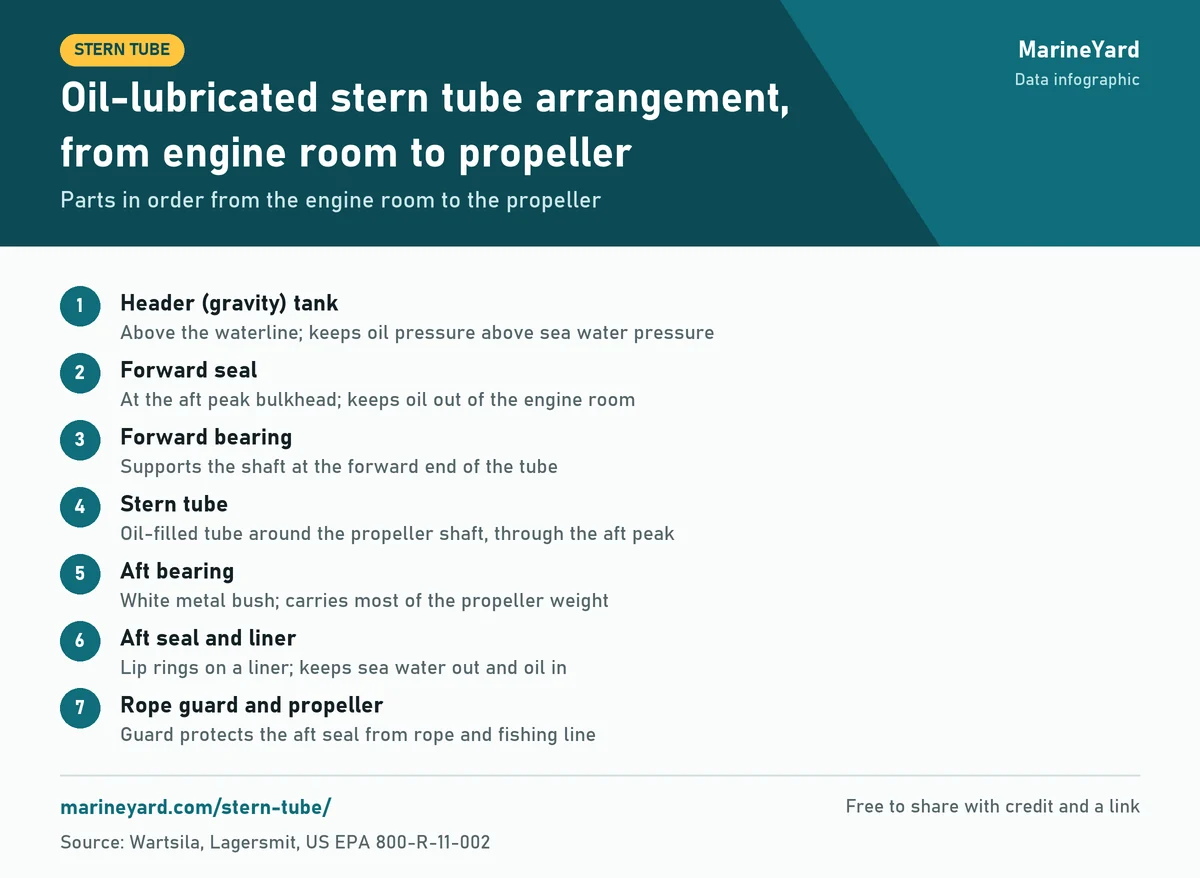
A stern tube is a hollow tube of cast or fabricated steel that passes through the aft end of a ship's hull, between the aft peak bulkhead and the stern...