OEM vs Genuine vs Aftermarket Ship Spare Parts: Differences
Marine engineers & industry writers
Updated
Nov 28, 2026
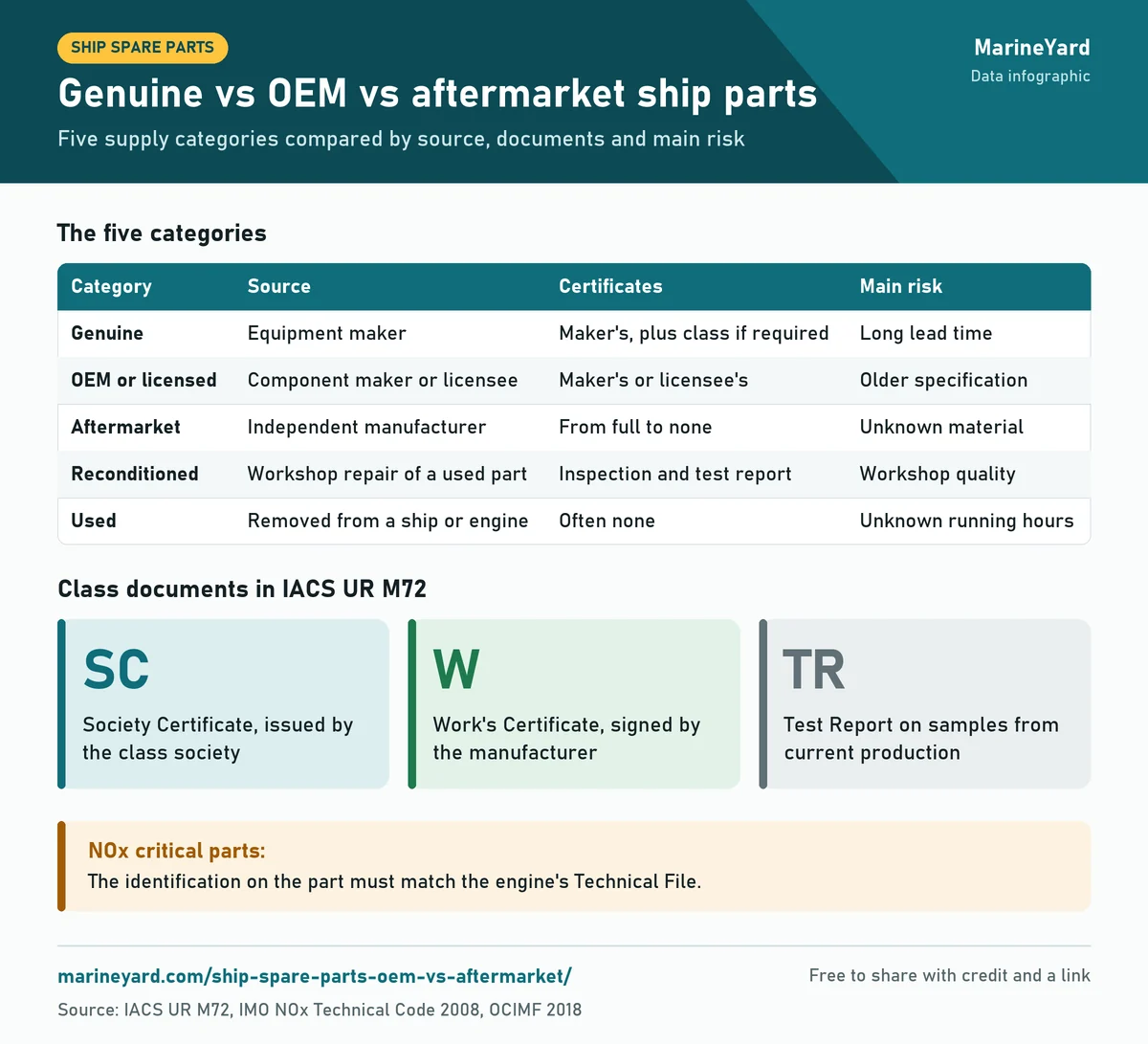
OEM, genuine and aftermarket ship spare parts are three supply categories for the same replacement component. A genuine part comes through the equipment maker's own sales channel. An OEM part comes from the company that manufactured the original component, or from a licensee. An aftermarket part, also called a pattern part, comes from an independent manufacturer.
Reconditioned and used parts form two further categories. The five categories differ in traceability, certificates, price level and risk. Class rules and the IMO NOx Technical Code limit the choice for some engine components.
Key facts
| Attribute | Value |
|---|---|
| Categories of new parts named by OCIMF | OEM spare parts, OEM-licensed spare parts and after-market spare parts (OCIMF guidance, first edition 2018) |
| Class documents for engine components | Society Certificate (SC), Work's Certificate (W) and Test Report (TR), defined in IACS UR M72 |
| Start of IACS UR M72 | Engines with an application for certification dated on or after 1 July 2016 |
| Hydraulic test pressure in UR M72 | 1.5 times the maximum working pressure |
| NOx Technical Code 2008 | Adopted on 10 October 2008 by resolution MEPC.177(58); in force from 1 July 2010 |
| NOx critical spare parts | Identified as given in the approved Technical File (NOx Technical Code, paragraph 4.3.7) |
| Record of replacements | Every change, including a like-for-like replacement, is entered in the record book of engine parameters (paragraph 6.2.2.7) |
What is the difference between genuine, OEM and aftermarket ship spare parts?
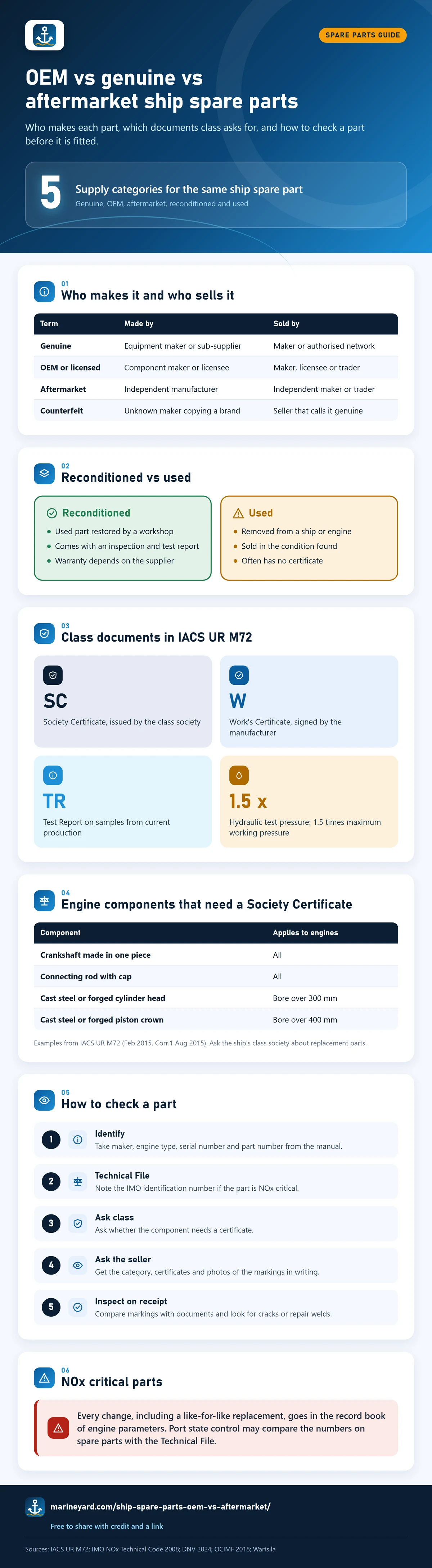
Genuine, OEM and aftermarket ship spare parts differ in who makes the part and who stands behind it. A genuine part is supplied and warranted by the equipment maker. An OEM part is made by the original component manufacturer or a licensee and is sold outside the maker's channel. An aftermarket part is an independent copy.
The three words are trade terms. The terms have no single formal definition, and sellers use them in different ways. The term OEM has two common meanings:
- The equipment maker. Engine designers such as Wärtsilä call themselves the OEM and call their own parts OEM parts.
- The component maker. Many traders use OEM for the factory that made the piston ring, bearing or valve for the engine maker, and that also sells the same product under its own name.
Wärtsilä states in its article on OEM spare parts that component makers are not OEMs and that the term is often used in a misleading way.
Licensees are a third source. The Everllence licensee list names engine builders in China, Japan, South Korea and other countries that build B&W two-stroke engines under licence from Everllence, the former MAN Energy Solutions. A part from a licensee is usually called an OEM-licensed part.
| Term | Who makes the part | Who sells the part |
|---|---|---|
| Genuine | Equipment maker or its approved sub-supplier | Equipment maker or its authorised network |
| OEM (component maker) or OEM-licensed | Original component manufacturer or licensed engine builder | Manufacturer, licensee or independent trader |
| Aftermarket, pattern or replica | Independent manufacturer, to its own drawings | Independent manufacturer or trader |
| Counterfeit | Unknown maker that copies a brand name, logo or packaging | Seller that presents the part as genuine |
A counterfeit part is not an aftermarket part. An aftermarket maker sells under its own name. A counterfeit carries a false origin.
What are reconditioned and used ship spare parts?
Reconditioned ship spare parts are used components that a workshop has restored to working condition. Used ship spare parts are components removed from a ship or engine and sold in the condition found, often from ship recycling or from surplus stock. A used part has service hours; a reconditioned part has service hours and a documented repair.
Wärtsilä describes reconditioning in its FAQ on reconditioned marine spare parts as disassembly, cleaning, inspection, repair or replacement of worn elements, reassembly and testing. Typical items are pistons, cylinder covers, exhaust valves and seats, piston rods and fuel injection equipment.
An exchange part is a reconditioned part supplied from stock. The buyer installs the exchange part and returns the old part to the supplier. Wärtsilä states that its Exchange Parts carry the same warranty as new parts when installed and operated according to the instructions. The same FAQ notes that some other providers give three to six months of warranty and some give none.
How do genuine, OEM, aftermarket, reconditioned and used parts compare?
Genuine, OEM, aftermarket, reconditioned and used parts compare on five points: source, traceability, certificates, price level and main risk. Genuine parts usually have the highest price and the most complete documents. Used parts usually have the lowest price and the least documentation. No category is free of risk.
| Category | Traceability | Certificates | Price level | Main risk |
|---|---|---|---|---|
| Genuine | Maker's part number, marking and delivery papers | Maker's certificate; class certificate where the rules require one | Usually the highest | Long lead time; counterfeit copies in the market |
| OEM or OEM-licensed | Component maker's own marking and batch records | Component maker's or licensee's certificate | Usually below genuine | Specification may be older than the maker's current design |
| Aftermarket (pattern) | Depends fully on the manufacturer | Varies from full material certificates to none | Usually lower again | Unknown material, tolerances and NOx compliance |
| Reconditioned | Workshop report plus the original marking | Inspection and test report from the workshop | Below a new part of the same origin | Quality depends on the workshop; short or no warranty |
| Used | Original marking; donor ship if the seller knows it | Often none; sometimes old certificates from the donor ship | Usually the lowest | Unknown running hours, wear and hidden cracks |
The price levels are general market tendencies, not fixed ratios. The real difference depends on the component, the engine type and the urgency. Wärtsilä argues that repairs and downtime can outweigh a lower purchase price.
Which certificates does class require for engine components?
Class requires three kinds of document for engine components under IACS Unified Requirement M72: a Society Certificate, a Work's Certificate or a Test Report. The required document depends on the engine type, the engine size and the criticality of the part. The largest and most highly loaded parts need a Society Certificate.
- Society Certificate (SC). The class society issues the document. The surveyor witnesses the tests, or an alternative certification scheme is in place.
- Work's Certificate (W). The manufacturer signs the document. The tests are made on the product itself or on samples of its raw material.
- Test Report (TR). The manufacturer signs the document. The tests are made on samples from current production.
The table shows examples from IACS UR M72, Certification of Engine Components (text of February 2015 with the August 2015 correction). D is the cylinder bore.
| Component | Applies to engines | Material and test documents | Component certificate |
|---|---|---|---|
| Crankshaft made in one piece | All | SC for material; W for ultrasonic testing and crack detection | SC |
| Connecting rod with cap | All | SC for material; W for ultrasonic testing and crack detection | SC |
| Cast steel or forged cylinder head | D over 300 mm | W for material, non-destructive tests and hydraulic test | SC |
| Cast steel or forged piston crown | D over 400 mm | W for material, ultrasonic testing and crack detection | SC |
| Cylinder liner | D over 300 mm | W for material and hydraulic test | Not listed |
UR M72 is written for the certification of engines. The text has no separate section on spare parts, and IACS has revised the requirement since 2015. Each class society sets its own rule for replacement components, so the owner should ask the ship's class society before a certified part such as a crankshaft or connecting rod is replaced. Turbochargers fall under UR M73, which matters for an order of marine turbocharger parts.
DNV states in its FAQ on certification of materials and components that uncertified products are not allowed on a classed vessel when the product is subject to mandatory class certification.
How does the NOx Technical Code affect the choice of spare parts?
The NOx Technical Code affects the choice of spare parts because each certified engine has a Technical File that identifies its NOx critical components. A replacement component must match the identification in the Technical File. A part without the correct identification can put the engine outside its approved configuration.
The NOx Technical Code 2008, resolution MEPC.177(58), contains four rules that concern spares:
- The Technical File contains the specifications of the spare parts and components that keep the engine within the NOx limit (paragraph 2.4.1.7).
- NOx critical spare parts supplied to a certified engine are identified as given in the approved Technical File (paragraph 4.3.7).
- Routine replacement by parts specified in the Technical File is not a substantial modification, whether one part or many parts are replaced (paragraph 1.3.2).
- The record book of engine parameters records all changes, including like-for-like replacements (paragraph 6.2.2.7).
The parameter list in the Code names the injection nozzle, injection pump, fuel cam, cylinder head, piston head, turbocharger and charge air cooler. The engine's own Technical File gives the exact list. A cylinder liner or another part is NOx critical only when the Technical File lists the part.
Port state control checks these numbers. A DNV technical news item of 19 December 2024 reports that officers may compare the IMO identification numbers on spare parts with the Technical File. DNV lists engine parts without the required IMO number among the main grounds for past detentions.
The Code does not name a category of supplier. A part from any source is acceptable for NOx purposes only when the identification matches the Technical File or an approved amendment.
What do OCIMF and the ISM Code say about spare parts quality?
OCIMF and the ISM Code place the decision on the ship operator. ISM Code section 10.3 requires the company to identify equipment whose sudden failure may cause a hazardous situation. OCIMF guidance asks the company to write a procurement policy for the spare parts of that equipment.
The OCIMF Safety Critical Equipment and Spare Parts Guidance says the policy should ensure parts of a verifiable quality. The policy should state the requirements for OEM, OEM-licensed and after-market safety critical spare parts. The guidance does not ban any category.
How is a ship spare part checked before purchase and on receipt?
A ship spare part is checked against the maker's part number, the marking on the part, the certificates and the physical condition. The check starts before the order and ends before the part is fitted.
- Identify the part from the instruction manual: maker, engine type, serial number, part number and drawing or plate number.
- Check the Technical File. Note the IMO identification number if the part is NOx critical.
- Ask the class society whether the component needs a certificate under its rules.
- Ask the seller in writing whether the part is genuine, OEM, licensed, aftermarket, reconditioned or used.
- Request copies of the certificates and reports, and photos of the markings and packaging, before payment.
- Ask the equipment maker to confirm an authorised reseller if the seller claims that status. Wärtsilä advises this step.
- Inspect on receipt. Compare the markings with the documents, measure the main dimensions and look for corrosion, cracks or repair welds.
- Enter a NOx critical replacement in the record book of engine parameters, and file the certificates.
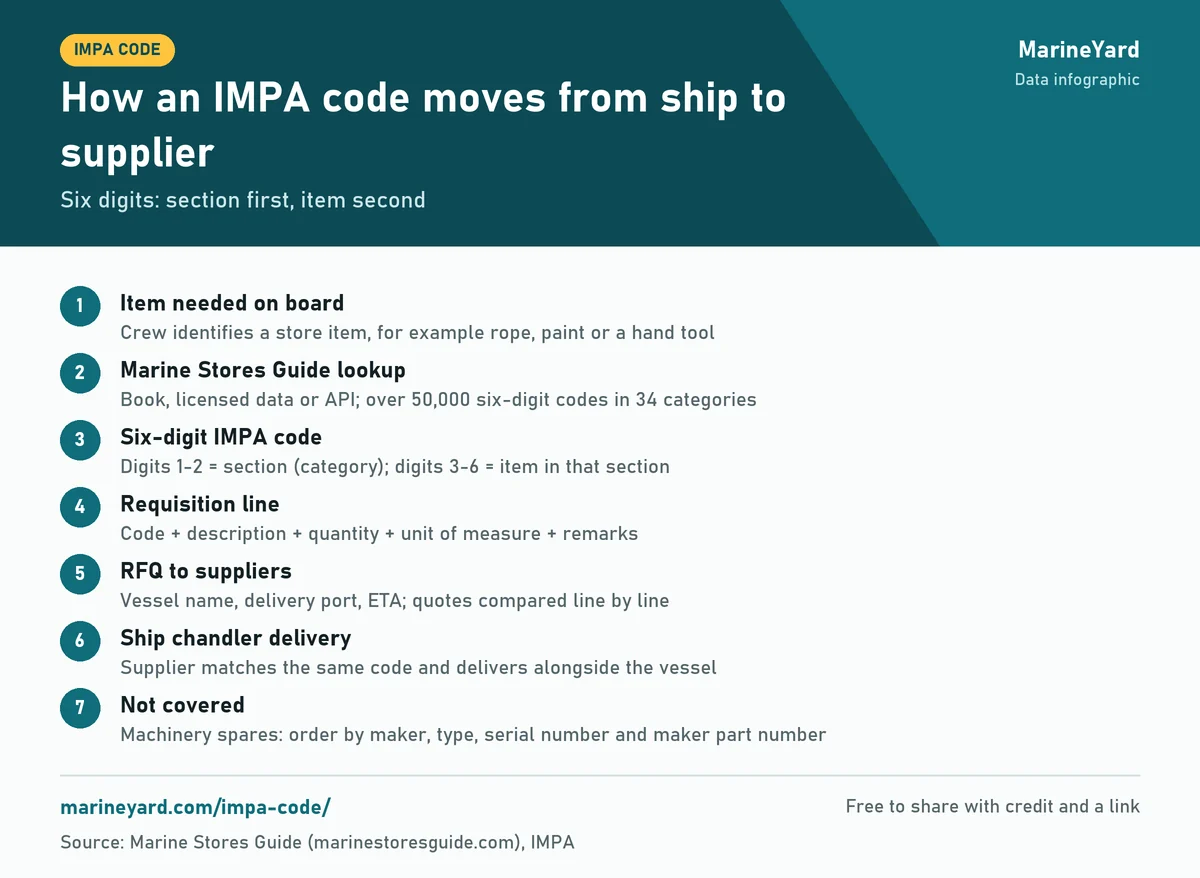
Wärtsilä marks genuine parts with its logo. General consumables are easier to specify, because an IMPA code describes the item for any supplier.
Where can OEM, aftermarket and used ship spare parts be bought or sold?
OEM, aftermarket and used ship spare parts are sold by makers, licensees, independent manufacturers, workshops, ship recyclers and surplus dealers. MarineYard is a ship spare parts marketplace where sellers list new, reconditioned and used main engine parts and auxiliary engine parts. Sellers get 9 free listings per account. MarineYard takes no commission and is not a party to any sale. Buyers should confirm the category, markings and certificates with the seller before payment.
Frequently Asked Questions
Is an OEM part the same as a genuine part?
An OEM part is not always the same as a genuine part. Engine makers use OEM for their own parts. Many traders use OEM for parts from the original component manufacturer, sold outside the engine maker's channel. The seller should state the meaning in writing.
Are aftermarket spare parts allowed on a classed ship?
Aftermarket spare parts are not banned by a general IMO rule. Two limits apply. A component subject to mandatory class certification needs the certificate the class society requires. A NOx critical component must carry the identification given in the engine's Technical File or an approved amendment.
What is a pattern part in marine engineering?
A pattern part in marine engineering is a replacement component made by an independent manufacturer that copies the form and function of the original. Other names are aftermarket, replica and non-OEM part. A pattern part is sold under the manufacturer's own name, not the engine maker's name.
What is an IMO number on an engine spare part?
An IMO number on an engine spare part is the identification marking that links a NOx critical component to the engine's approved Technical File. Port state control officers may compare the number on the part with the Technical File during an inspection.
Do reconditioned ship spare parts have a warranty?
Reconditioned ship spare parts have a warranty only when the supplier gives one. Wärtsilä states that its Exchange Parts carry the same warranty as new parts. Wärtsilä also notes that some other providers give three to six months and some give no warranty.
Which documents should come with a used ship spare part?
A used ship spare part should come with clear photos of the original markings, the part number, the donor engine type and any certificate that the seller holds. An inspection report with measured dimensions adds evidence. Many used parts have no certificate, so the buyer inspects on receipt.
Related guides
- Marine Incinerator on Ships: Parts, Working and MARPOL Rules
- Oil Mist Detector on Ships: Working, Rules and Alarm Levels
- ISSA Code: Meaning, Catalogue and Difference from IMPA Code
- Crankcase Explosion: Causes, Relief Valves and Alarm Actions
- Scavenge Fire: Causes, Indications, Actions and Prevention
- Main Engine Parts of a Ship: Names, Functions and Spares
- Two Stroke Marine Engine: Working, Uniflow Cycle, Designers
- Ship Generator: How It Works, Parts, Voltage and Paralleling
- Stern tube: parts, bearings, seals and lubrication
- IMPA code: meaning and structure
- Ship chandler: meaning and services
- Oily water separator: working, parts and the 15 ppm rule
- Marine turbocharger: parts, working and surging
- Purifier in ship: working principle, parts and faults
- Cylinder liner: function, wear and gauging
- Ship boiler: types, mountings and water treatment
- Anchor windlass: parts, working and class rules
- Bow thruster: how it works, types and failures
- Steering gear: parts, types and SOLAS tests
- Marine air compressor: starting air, parts and safety
Sources
- IACS, Unified Requirement M72, Certification of Engine Components (Feb 2015, Corr.1 Aug 2015), copy published by Türk Loydu
- IMO, resolution MEPC.177(58), NOx Technical Code 2008
- DNV, PSC focus on NOx technical files and machinery components, 19 December 2024
- DNV, Certification of materials and components, frequently asked questions
- OCIMF, Safety Critical Equipment and Spare Parts Guidance, first edition 2018
- Wärtsilä, 7 truths about OEM spare parts, 5 December 2023
- Wärtsilä, 17 FAQs about reconditioned marine spare parts
- Everllence, licensees
Sign in to leave a comment and join the discussion.
 Spare Parts Guides
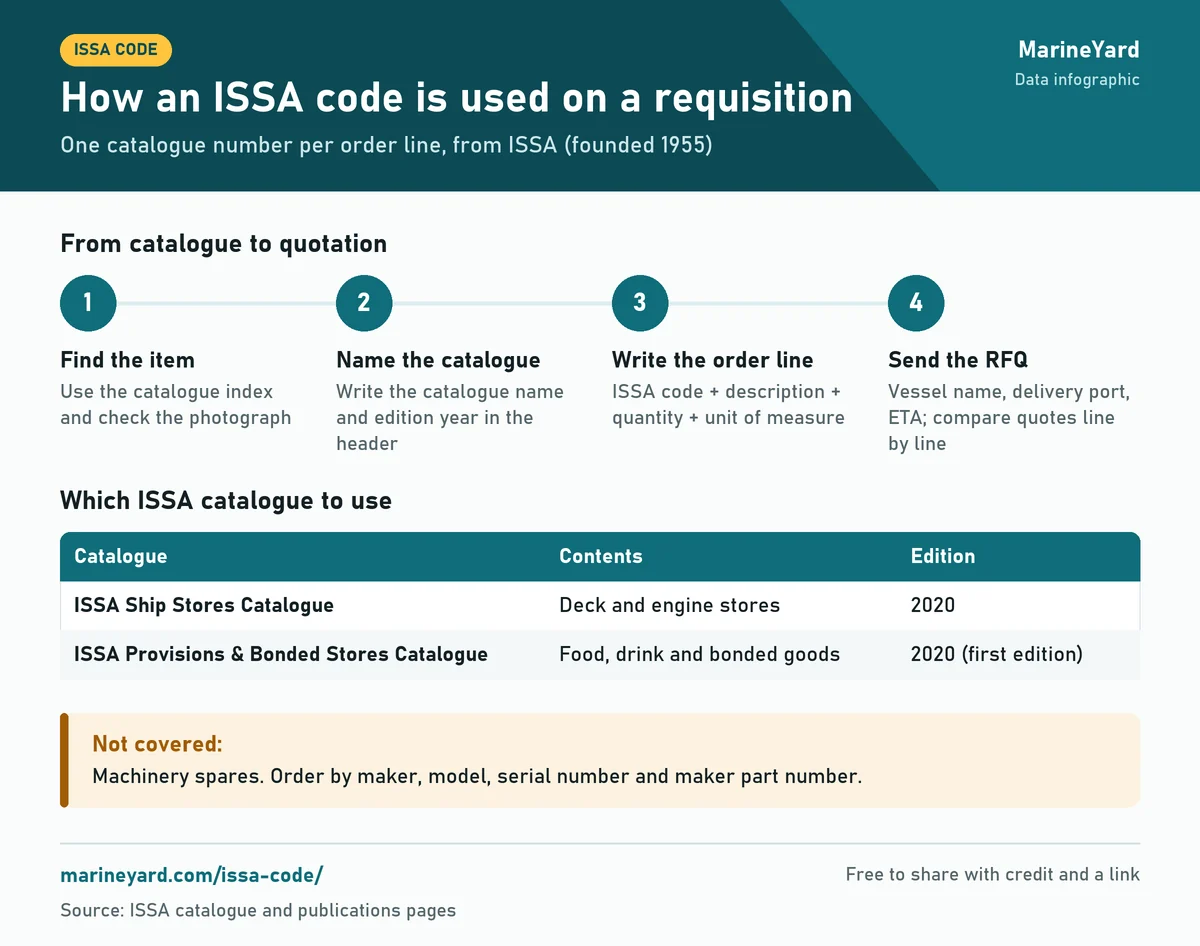
An ISSA code is the item number that identifies one product in the ISSA Ship Stores Catalogue, the illustrated catalogue published by the International...
 Spare Parts Guides
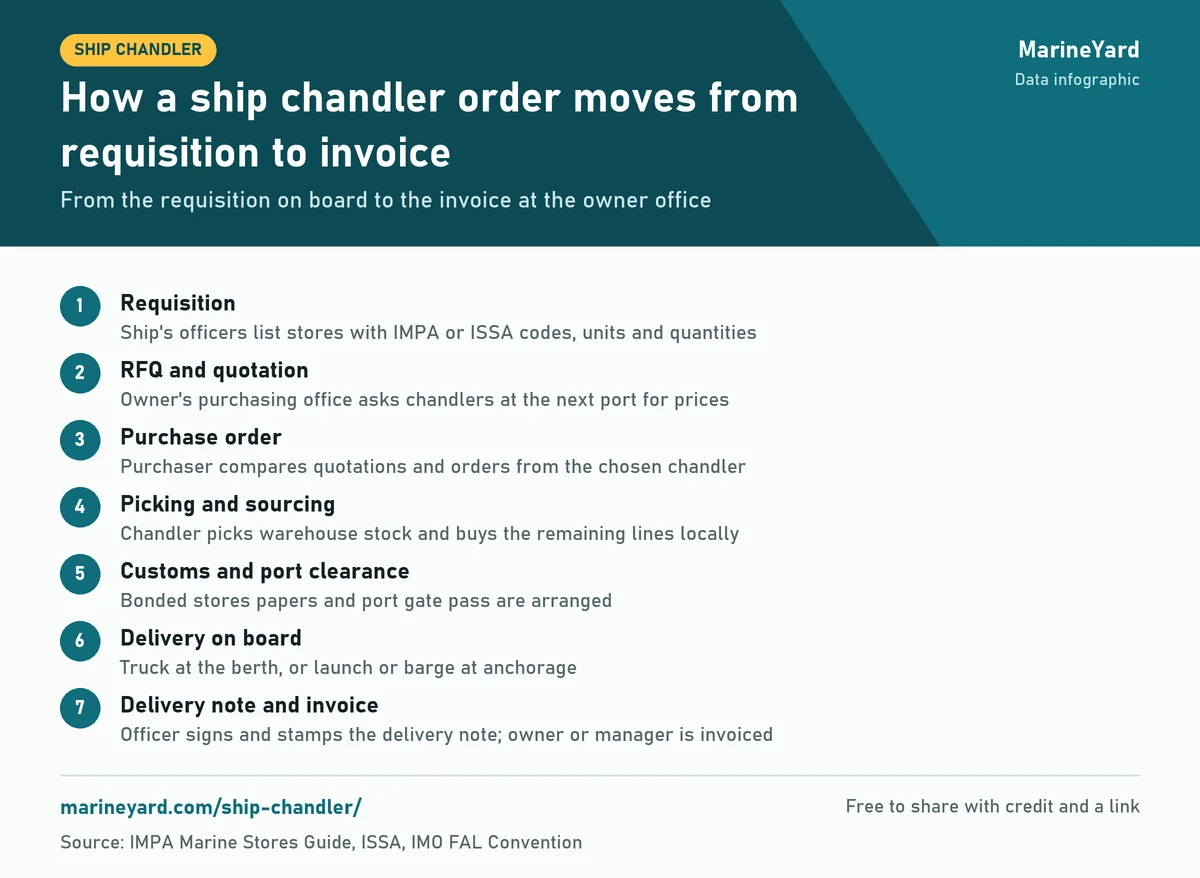
A ship chandler is a dealer that supplies commercial vessels in port with the stores they consume and use: provisions for the crew, bonded stores, deck,...
 Spare Parts Guides
An IMPA code is a six-digit number that identifies one item of ship stores in the Marine Stores Guide, the catalogue published by the International Marine...