Ship Generator: How It Works, Parts, Voltage and Paralleling
Marine engineers & industry writers
Updated
Nov 28, 2026
A ship generator is a machine set that produces the electrical power for a vessel. A ship generator consists of a prime mover, usually a four-stroke diesel engine called the auxiliary engine, and an alternator that the engine drives. The alternator supplies three-phase alternating current to the main switchboard.
Class rules require enough generating sets to carry the essential load with any one set in reserve. A separate emergency generator outside the engine room takes over the safety services when the main supply fails.
Key facts
| Attribute | Value |
|---|---|
| Recommended low voltages | 400 V, 440 V and 690 V three-phase (IEC 60092-201, Table 3) |
| Recommended high voltages | 3.3 kV, 6.6 kV and 11 kV three-phase (IEC 60092-201, Table 3) |
| Frequency | 50 Hz or 60 Hz |
| Steady voltage held by the AVR | Within ±2.5% of rated voltage; ±3.5% for emergency sets (ABS 4-8-3/3.13.2) |
| Frequency limits of the governor | ±5% permanent; ±10% transient with recovery in 5 seconds (IACS UR M3) |
| Load sharing in parallel | Within 15% of the rated power of the largest set, or 25% of the individual set, whichever is less (IACS UR M3) |
| Reverse power trip, diesel sets | 8% to 15% of rated power (ABS 4-8-2/9.11.4) |
| Emergency generator on load | Not more than 45 seconds after loss of main power (ABS 4-8-2/5.9) |
What is a ship generator?
A ship generator is a diesel generator set that converts fuel energy into electrical energy for the ship. The diesel engine turns the alternator at a constant speed. The alternator feeds the main switchboard, and the main switchboard distributes power to pumps, fans, compressors, lighting, navigation equipment and galley equipment.
The complete set is also called a diesel generator (DG) or genset. The main engine drives the propeller, and the auxiliary engine drives the alternator.
What are the parts of a ship generator?
The parts of a ship generator are the auxiliary engine with its governor, the alternator with its stator, rotor and exciter, the automatic voltage regulator, the generator circuit breaker and the protection relays. The engine and the alternator are normally mounted on one base frame and joined by a coupling.
| Part | Function |
|---|---|
| Auxiliary engine (prime mover) | Four-stroke diesel or dual-fuel engine that turns the alternator at constant speed |
| Governor | Controls the fuel supply, holds the speed and so holds the frequency |
| Stator | Fixed three-phase winding in which the output voltage is induced |
| Rotor | Rotating field magnet fed with direct current |
| Exciter | Supplies the direct current for the rotor field; a rotating exciter or a static exciter |
| Automatic voltage regulator (AVR) | Adjusts the excitation current to hold the terminal voltage |
| Generator circuit breaker | Connects the alternator to the switchboard busbars and opens on a fault |
| Protection relays | Trip the breaker on overcurrent, reverse power and undervoltage |
The ABS Marine Vessel Rules, Part 4 require an automatic voltage regulator for each generator.
What are the types of generator on a ship?
The types of generator on a ship are the diesel generator, the shaft generator, the steam turbine generator and the emergency generator. The diesel generator is the standard main source of power. The other types supply power at sea from the main plant or supply the safety services after a blackout.
| Type | Driven by | Typical use |
|---|---|---|
| Diesel generator | Auxiliary engine | Main source of electrical power at sea and in port |
| Shaft generator | Main engine or propeller shaft | Power at sea; a frequency converter holds voltage and frequency at variable shaft speed |
| Turbine generator | Steam turbine | Ships with a steam plant |
| Emergency generator | Small independent diesel engine | Emergency lighting, communication and other safety services after a blackout |
How does a ship generator make electricity?
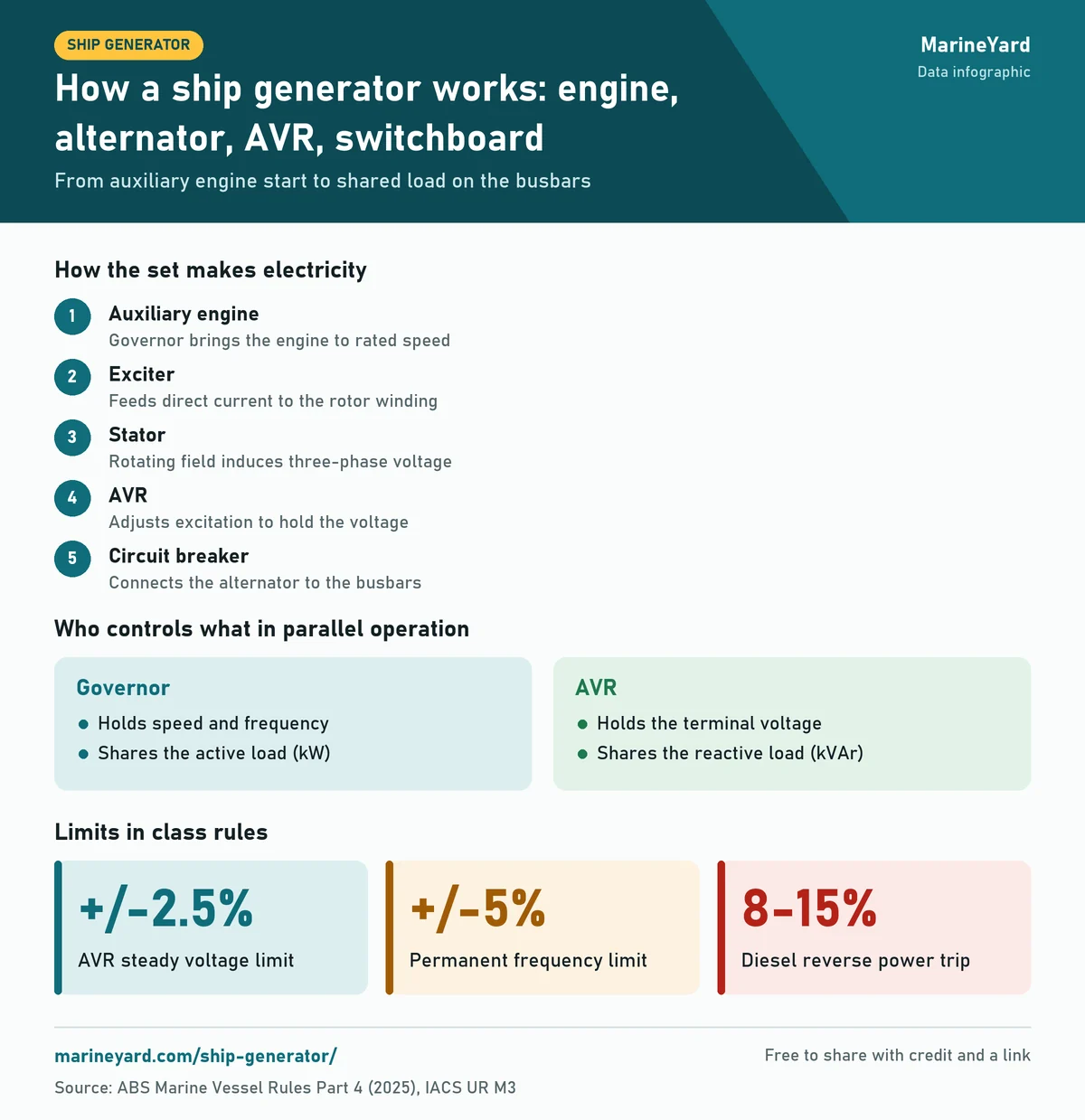
A ship generator makes electricity by electromagnetic induction. The auxiliary engine rotates a magnetised rotor inside the stator winding. The moving field induces a three-phase voltage in the stator. The governor fixes the frequency through the engine speed, and the automatic voltage regulator fixes the voltage through the rotor field current.
- The engine starts and the governor brings the engine to rated speed.
- The exciter supplies direct current to the rotor winding, and the rotor becomes a rotating magnet.
- The rotating field induces a three-phase voltage in the stator winding.
- The AVR measures the terminal voltage and raises or lowers the excitation current.
- The generator circuit breaker closes and connects the alternator to the busbars.
- The governor adds fuel as the load rises, so the speed and the frequency stay constant.
The frequency in hertz equals the number of poles multiplied by the speed in rpm, divided by 120. A 10-pole alternator at 720 rpm gives 60 Hz, and an 8-pole alternator at 750 rpm gives 50 Hz. Speeds of 720, 750, 900 and 1,000 rpm on the Wärtsilä generating set range follow from this relation.
What voltage and frequency does a ship generator supply?
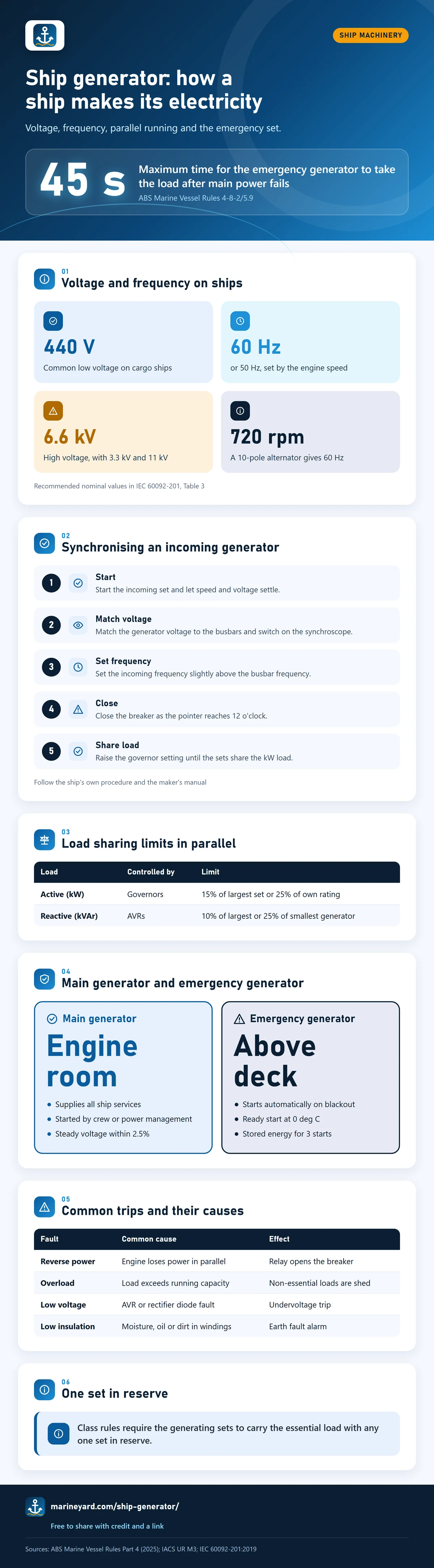
A ship generator supplies three-phase alternating current at 50 Hz or 60 Hz. IEC 60092-201 recommends nominal voltages of 400 V, 440 V and 690 V for low-voltage systems and 3.3 kV, 6.6 kV and 11 kV for high-voltage systems. A 440 V, 60 Hz system is a common choice on cargo ships.
The values come from Table 3 of IEC 60092-201:2019. ABS defines high voltage as above 1,000 V up to and including 15 kV. A Massachusetts Maritime Academy text on shipboard electric systems states that ships use high voltage, typically 3.3 kV, 6.6 kV or 11 kV, for motors of 400 kW or more, such as propulsion motors and thrusters.
How are ship generators synchronised and run in parallel?
Ship generators are synchronised by matching the incoming generator to the live busbars before the breaker closes. The incoming generator must have the same voltage, the same frequency, the same phase sequence and the same phase angle as the busbars. A synchroscope or synchronising lamps, which ABS requires on the switchboard, show the moment when the phase angles match.
The usual manual sequence is below. A power management system performs the same steps automatically on many ships. The ship's own procedure and the maker's manual take priority.
- Start the incoming set and let the speed and the voltage settle.
- Match the generator voltage to the busbar voltage and switch on the synchroscope.
- Adjust the governor so that the incoming frequency is slightly above the busbar frequency. The synchroscope pointer then turns slowly in the "fast" direction.
- Close the breaker as the pointer reaches the 12 o'clock position.
- Raise the governor setting of the incoming set until the sets share the active load (kW), then check the reactive load (kVAr).
The governors share the active load, and the AVRs share the reactive load. IACS Unified Requirement M3 sets the limits for the engine governors.
| Quantity | Controlled by | Limit in parallel operation | Source |
|---|---|---|---|
| Active load (kW) | Governors | Within 15% of the rated power of the largest set or 25% of the individual set, whichever is less, between 20% and 100% total load | IACS UR M3 |
| Reactive load (kVAr) | AVRs | Within 10% of the rated reactive output of the largest generator or 25% of the smallest, whichever is less | ABS 4-8-3/3.13.3 |
What is the difference between a main generator and an emergency generator?
A main generator supplies the whole ship in normal service, and an emergency generator supplies only the safety services after the main supply fails. The emergency generator is an independent set with its own fuel tank, starting system and switchboard. The emergency generator stands above the uppermost continuous deck, outside the machinery casing.
| Attribute | Main generator | Emergency generator |
|---|---|---|
| Location | Engine room, near the main switchboard | Above the uppermost continuous deck, with access from the open deck |
| Start | By the crew or the power management system | Automatic on loss of main power; on load in not more than 45 seconds |
| Supply period | Continuous | 18 hours for the listed services on cargo vessels of 500 GT and above (ABS); 36 hours for listed services on passenger ships (SOLAS II-1/42) |
| Cold start | No 0 °C rule | Ready start at 0 °C, or heating is fitted |
| Stored starting energy | Starting air or batteries | At least three consecutive starts, plus a second source for three more starts within 30 minutes unless manual starting is effective |
The 36-hour period for passenger ships is quoted in an IACS paper on SOLAS regulation II-1/42. Where one main generator normally carries the load, ABS requires a standby set to start and connect automatically after a blackout, in no case in more than 45 seconds.
What causes a ship generator to trip or fail?
A ship generator trips most often on reverse power, overload, overspeed or a loss of excitation. The protection opens the generator circuit breaker to protect the alternator and the other running sets. Most causes lie in the fuel system, the governor, the AVR or the winding insulation.
| Fault | Common cause | Effect | Action |
|---|---|---|---|
| Reverse power trip | Engine loses power in parallel operation: fuel starvation or governor fault | The alternator runs as a motor; the relay opens the breaker | Find the engine fault before the set is reconnected |
| Overload | Load exceeds the capacity of the running sets | Automatic load shedding of non-essential services | Start another set; restore the shed loads in steps |
| Low or unstable voltage | AVR fault, failed rectifier diode or loss of excitation | Undervoltage trip; unequal kVAr sharing | Test the AVR, the diodes and the exciter as the manual states |
| Low insulation resistance | Moisture, oil or dirt in the windings | Earth fault alarm | Clean and dry the windings; check the space heater |
Work on a generator or a switchboard follows the ship's own procedures and the maker's manual.
Which ship generator spare parts are ordered most often?
Ship generator spare parts ordered most often are engine wear parts: fuel injection nozzles, fuel pump elements, piston rings, exhaust valves, main and big-end bearings, gasket sets and filters. Each cylinder liner and the marine turbocharger are renewed or overhauled at the hours stated in the engine manual. Alternator spares are bearings, AVR units and rectifier diodes.
A correct order states the following data:
- Ship name and IMO number.
- Engine maker, engine type and number of cylinders, for example 6L23/30H.
- Engine serial number from the nameplate.
- For alternator parts: alternator maker, type, serial number, kVA, voltage and frequency.
- Part number and plate number from the maker's spare parts book.
Gaskets, filters and other general consumables may carry an IMPA code. Engine and alternator components are ordered by the maker's part number.
Who makes ship generators and auxiliary engines?
Ship generators and auxiliary engines are made by a small group of engine builders and their licensees. Wärtsilä, Everllence (the former MAN Energy Solutions), Yanmar, Daihatsu Infinearth (the former Daihatsu Diesel) and HD Hyundai Heavy Industries, with the HiMSEN brand, are the names found most often on cargo ships.
- Wärtsilä. Wärtsilä lists gensets from about 0.74 MW to 10.4 MW, based on the Wärtsilä 20, 25, 31 and 32 engines and dual-fuel versions.
- Everllence. The Everllence GenSet range includes the L23/30H, the L21/31 and the L27/38. The maker states that more than 12,000 units of the L23/30H type have been installed.
- Yanmar. The EY series includes the 6EY18 and the 6EY22.
- Daihatsu Infinearth. The DE and DK series include the 6DE-18 and the 6DK-20e.
- HD Hyundai Heavy Industries. The HiMSEN range includes the H21/32.
Where can ship generator parts be bought or sold?
Ship generator parts are bought from engine makers, licensed service companies and surplus stockists. MarineYard is a ship spare parts marketplace where sellers list new, reconditioned and used auxiliary engine parts and electrical and automation parts. Sellers get 9 free listings per account. MarineYard takes no commission and is not a party to any sale. Buyers should confirm the engine type, the serial number and the part number with the seller before payment.
Frequently Asked Questions
How many generators does a ship have?
A ship has at least two generators for the main source of power, and many cargo ships carry three. Class rules require the remaining sets to carry the essential services with any one generator in reserve. An emergency generator is fitted in addition.
Why do ships use 440 V and 60 Hz?
Ships use 440 V and 60 Hz because both are recommended nominal values for three-phase ship systems in IEC 60092-201. The same standard lists 400 V for 50 Hz systems. Ships with a high electrical load use 6.6 kV or 11 kV, because a higher voltage means a lower current.
What does the AVR do on a ship generator?
The AVR on a ship generator holds the terminal voltage by adjusting the excitation current of the rotor. ABS rules require the AVR to keep the steady voltage within ±2.5% of rated voltage from no load to rated load. The AVRs also share the reactive load between sets in parallel.
What is reverse power in a ship generator?
Reverse power in a ship generator is a flow of active power from the busbars into the alternator. Reverse power occurs when the engine of one set in parallel loses power. A reverse power relay opens the breaker at 8% to 15% of rated power on diesel sets.
How fast must an emergency generator start on a ship?
An emergency generator on a ship must start automatically and supply the emergency switchboard in not more than 45 seconds after the main power fails. The set must start at 0 °C and must hold stored energy for at least three consecutive starts.
What is the difference between kW and kVA on a ship generator?
The kW rating of a ship generator is the active power that the engine can deliver through the alternator. The kVA rating is the apparent power of the alternator, which includes the reactive power. The kW value equals the kVA value multiplied by the power factor.
Related guides
- Sewage Treatment Plant on Ship: Working, Parts and MARPOL Rules
- Marine Incinerator on Ships: Parts, Working and MARPOL Rules
- Oil Mist Detector on Ships: Working, Rules and Alarm Levels
- ISSA Code: Meaning, Catalogue and Difference from IMPA Code
- Crankcase Explosion: Causes, Relief Valves and Alarm Actions
- Scavenge Fire: Causes, Indications, Actions and Prevention
- Main Engine Parts of a Ship: Names, Functions and Spares
- Two Stroke Marine Engine: Working, Uniflow Cycle, Designers
- Stern tube: parts, bearings, seals and lubrication
- IMPA code: meaning and structure
- Ship chandler: meaning and services
- Oily water separator: working, parts and the 15 ppm rule
- Marine turbocharger: parts, working and surging
- Purifier in ship: working principle, parts and faults
- Cylinder liner: function, wear and gauging
- Ship boiler: types, mountings and water treatment
- Anchor windlass: parts, working and class rules
- Bow thruster: how it works, types and failures
- Steering gear: parts, types and SOLAS tests
- Marine air compressor: starting air, parts and safety
Sources
- ABS, Rules for Building and Classing Marine Vessels, Part 4, Vessel Systems and Machinery (July 2025)
- IACS, Unified Requirement M3, Speed governor and overspeed protective device (Rev.6)
- IEC 60092-201:2019, Electrical installations in ships, System design, General
- IACS, SDC 10/10, Draft unified interpretation of SOLAS regulation II-1/42.2.3.1
- Massachusetts Maritime Academy, Introduction to Marine Engineering, Shipboard electric systems
- Wärtsilä, Marine gensets and auxiliary engines
- Everllence, GenSet four-stroke engines
Sign in to leave a comment and join the discussion.
 Ship Machinery
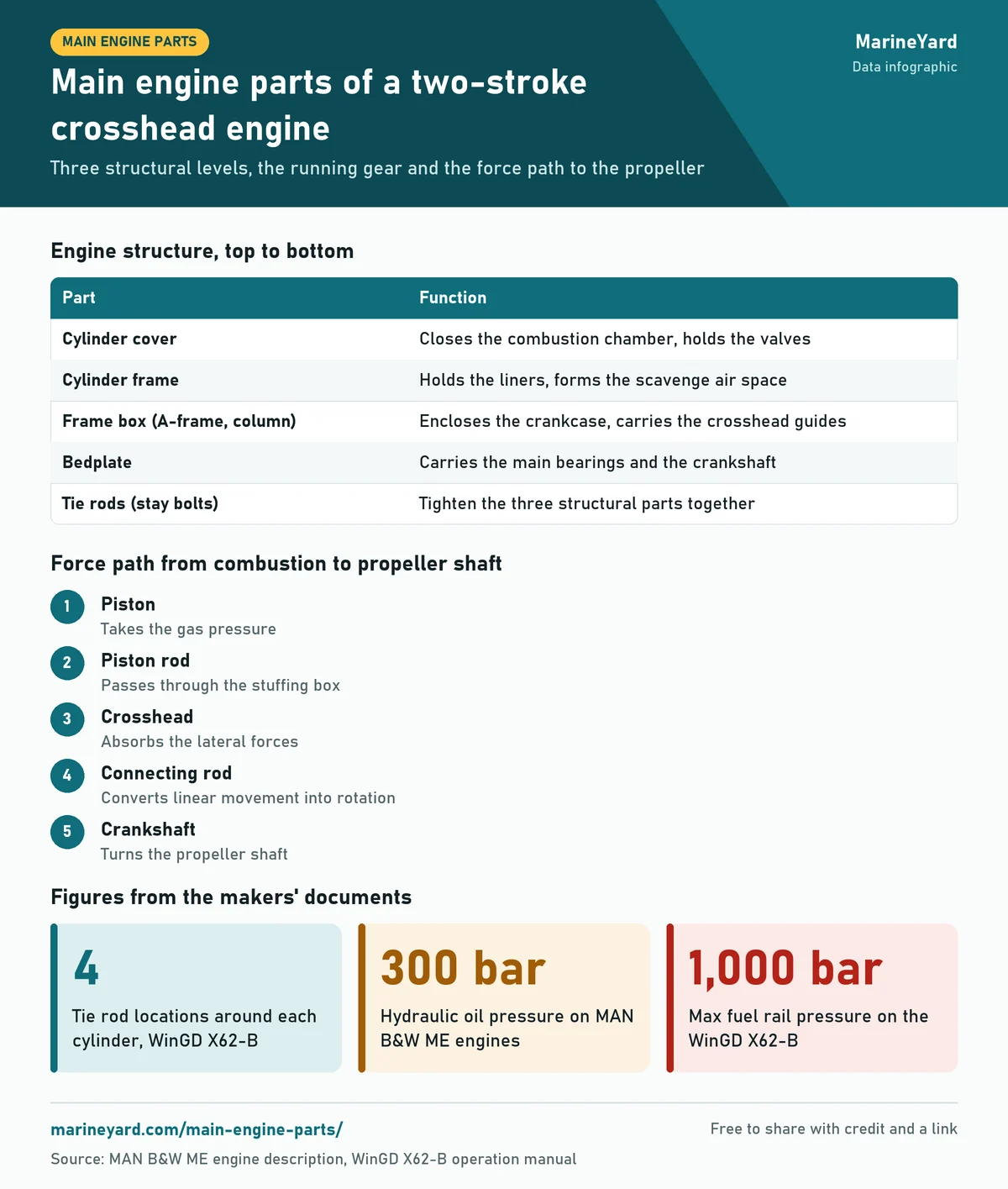
Main engine parts are the components of the diesel engine that turns a ship's propeller. The main engine of a large merchant ship is usually a slow-speed...
 Ship Machinery
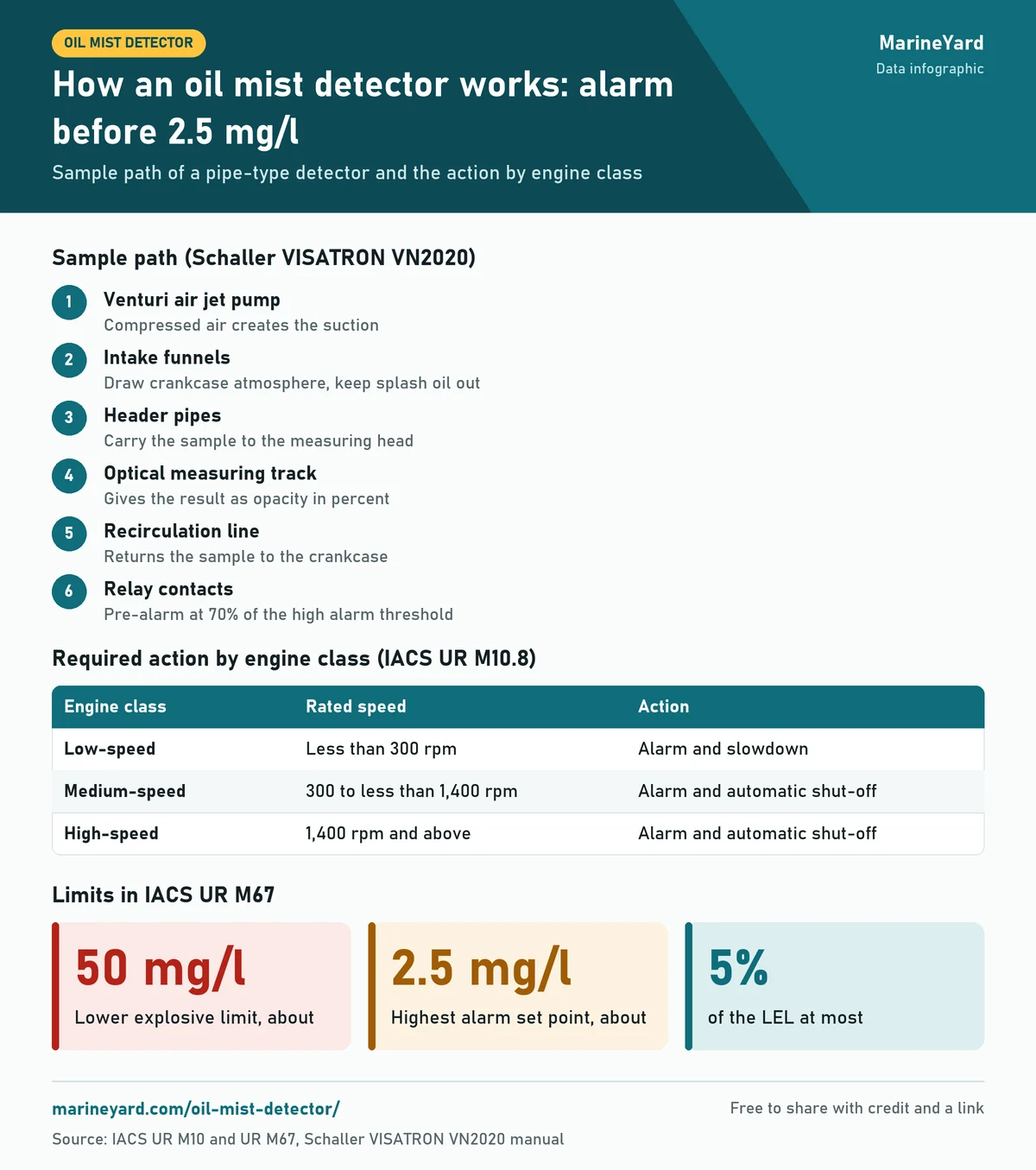
An oil mist detector (OMD) is a safety instrument on a marine diesel engine that measures the concentration of oil mist in the crankcase. The oil mist...
 Ship Machinery
A marine incinerator is a shipboard furnace that burns waste generated during the normal operation of the ship, mainly sludge oil and solid garbage. MARPOL...