Marine Fuel Injector: Parts, Working, Testing and Faults
Marine engineers & industry writers
Updated
Nov 28, 2026
A marine fuel injector is the valve in the cylinder cover of a ship's diesel engine that sprays fuel oil into the combustion chamber as a fine mist. The marine fuel injector, also called a fuel valve or injection valve, opens when the fuel pressure overcomes a spring and closes when the pressure falls.
The injector consists of a holder, a spring, a needle or spindle, and a nozzle with small spray holes. Engine makers give guiding overhaul intervals in running hours. MAN lists 8,000 hours for the fuel valves of MAN B&W two-stroke engines, depending on fuel quality.
Key facts
| Attribute | Value |
|---|---|
| Other names | Fuel valve (two-stroke engines), injection valve, fuel injection valve |
| Location | Cylinder cover; a MAN B&W two-stroke engine has one, two, three or more fuel valves per cylinder (Everllence project guide) |
| Example opening pressure | 400 bar for a new or reconditioned fuel valve on the MAN L16/24 (service letter SL2017-641) |
| Guiding overhaul interval, two-stroke | 8,000 hours, depending on fuel quality (MAN service letter SL2017-643) |
| Nozzle inspection, four-stroke | 2,000 hours on the Wärtsilä 32; expected nozzle life 4,000 to 6,000 hours (product guide 1/2018) |
| Slide fuel valve | Introduced by MAN around the year 2000; standard on new MAN B&W engines |
| Fire safety rule | SOLAS regulation II-2/4.2.2.5.2: jacketed high-pressure fuel pipes with leak collection and alarm |
What is a marine fuel injector?
A marine fuel injector is a spring-loaded valve that receives fuel oil at high pressure and atomises the fuel through small holes into the cylinder. The marine fuel injector sits in the cylinder cover. Makers of two-stroke engines call the component a fuel valve.
A four-stroke engine normally has one injector in the centre of each cylinder head. The fuel valves of a two-stroke crosshead engine sit around the central exhaust valve. The spare parts list in the Everllence G60ME-C10.5 project guide separates engines with one or two fuel valves per cylinder from engines with three or more.
The same project guide names fuel valve nozzles among the parts that depend on the specified maximum continuous rating (SMCR) of the engine.
What are the parts of a marine fuel injector?
The parts of a marine fuel injector are a holder or body, a fuel valve head with the fuel inlet, a non-return valve, a spring, a thrust spindle, a spindle guide with the needle or spindle, and a nozzle. O-rings seal the injector in the cylinder cover.
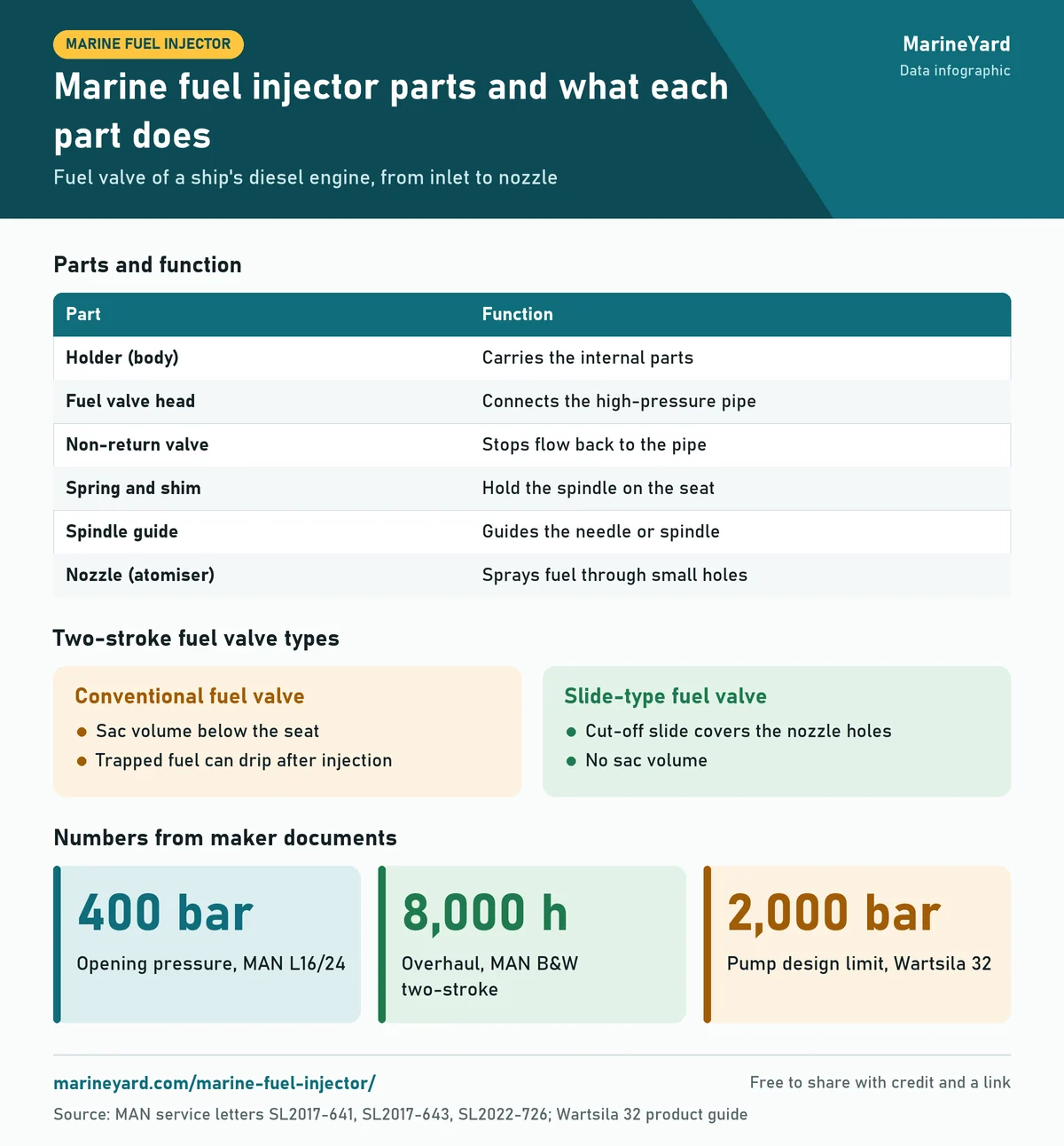
| Part | Function |
|---|---|
| Holder (body) | Carries all internal parts and clamps the injector in the cylinder cover |
| Fuel valve head | Connects the high-pressure pipe and leads the fuel into the valve |
| Non-return valve | Stops flow back toward the high-pressure pipe |
| Spring, thrust spindle and shim | Hold the needle or spindle on the seat; the shim sets the spring preload |
| Spindle guide with needle or spindle | Guides the moving part; the seat seals the fuel from the nozzle |
| Nozzle (atomiser) | Sprays the fuel through small holes; the hole number and size fix the spray pattern |
The part names for a MAN B&W two-stroke fuel valve come from MAN service letter SL2022-726. The Wärtsilä 32 cools the nozzles with lubricating oil on heavy fuel oil installations, and the nozzles on marine diesel fuel installations are not cooled.
What are the types of marine fuel injector?
The types of marine fuel injector are the conventional fuel valve with a sac volume, the slide-type fuel valve, the four-stroke injection valve with a nozzle element, and the electronically controlled injection valve of common-rail engines. The first three types open by fuel pressure against a spring.
| Type | Where used | Main feature |
|---|---|---|
| Conventional fuel valve | Older two-stroke engines | A small sac volume remains below the seat in the nozzle tip |
| Slide-type fuel valve | MAN B&W two-stroke engines | A cut-off slide on the spindle covers the nozzle holes; no sac volume |
| Four-stroke injection valve | Medium-speed main and auxiliary engines | One central injector per cylinder |
| Common-rail injection valve | Electronically controlled engines | A fuel rail holds the pressure; the control system times the opening |
What is a slide-type fuel valve?
A slide-type fuel valve is a two-stroke fuel valve in which the spindle carries a cut-off slide that reaches into the nozzle and covers the spray holes when the valve closes. The slide-type fuel valve removes the sac volume, the small space below the seat that stays full of fuel in a conventional nozzle.
MAN states that the slide fuel valve stops dripping from the nozzle, reduces fuel oil consumption and leaves fewer deposits in the gas ways. MAN also states lower emissions of hydrocarbons, NOx and particulate matter, and less visible smoke.
MAN introduced the slide fuel valve around the year 2000. The valve is standard on all new MAN B&W engines and can be retrofitted on MC engines. A MAN PrimeServ release from June 2013 reported the 20,000th retrofitted slide fuel valve.
What is the opening pressure of a fuel injector?
The opening pressure of a fuel injector is the fuel pressure at which the needle or spindle lifts from the seat against the spring. The opening pressure depends on the spring preload. The engine manual gives the correct value for each injector type.
MAN service letter SL2017-641 lowered the opening pressure of the L16/24 fuel valve from 450 bar to 400 bar in February 2017, because the lower value extends the nozzle lifetime considerably.
The opening pressure is lower than the peak injection pressure. The injection pumps of the Wärtsilä 32 are designed for injection pressures up to 2,000 bar.
How does a marine fuel injector work?
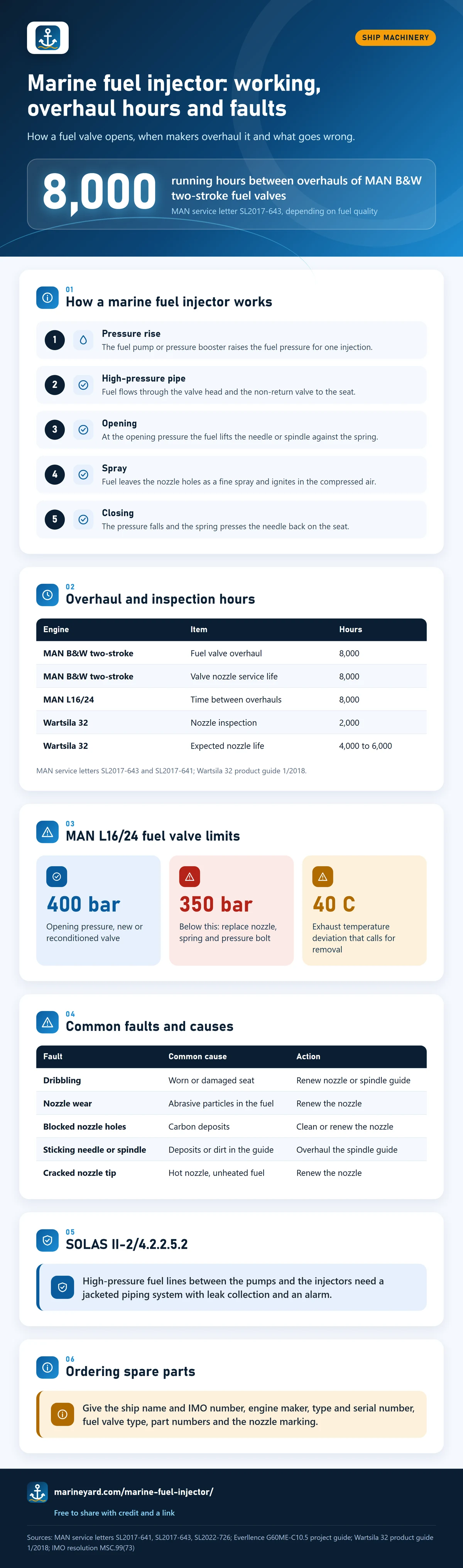
A marine fuel injector works as a pressure-operated valve. The fuel pump sends a metered charge of fuel through the high-pressure pipe. The pressure lifts the needle or spindle against the spring, the nozzle atomises the fuel into the hot compressed air, and the spring closes the valve when the pressure drops.
- The fuel injection pump, or the fuel oil pressure booster on a MAN B&W ME engine, raises the fuel pressure for one injection.
- The fuel flows through the high-pressure pipe, the fuel valve head and the non-return valve to the space above the seat.
- The fuel pressure reaches the opening pressure and lifts the needle or spindle.
- The fuel passes the seat, leaves the nozzle holes as a fine spray and ignites in the compressed air.
- The pump ends the delivery, the pressure falls and the spring presses the needle or spindle back on the seat.
The MAN B&W fuel valve has an automatic vent slide that lets heated fuel circulate through the valve and the high-pressure pipe while the engine is stopped.
How is a marine fuel injector tested and overhauled?
A marine fuel injector is tested on a test rig after removal from the cylinder cover. The test checks the opening pressure, the tightness of the seat and the condition of the nozzle holes. The work card in the engine manual gives the test values, and an injector outside the limits is dismantled and overhauled.
- Mount the cleaned injector on the test rig and compare the opening pressure with the work card.
- Check that all nozzle holes are open and that the seat does not leak below the opening pressure.
- Dismantle the injector and inspect the nozzle, the needle or spindle, the guide, the spring and the sealing faces.
- Renew worn parts and all O-rings, then set the opening pressure by the spring preload.
- Test the injector again and record the running hours.
The crew follows the maker's manual and the ship's own procedures for each step.
| Engine | Item | Hours | Source |
|---|---|---|---|
| MAN B&W two-stroke (ME, ME-C, ME-B, ME-GI) | Fuel valve overhaul interval | 8,000, depending on fuel quality | SL2017-643 |
| MAN B&W two-stroke | Expected service life of the valve nozzle | 8,000 | SL2017-643 |
| MAN L16/24 four-stroke | Time between overhauls of the fuel injection valves | 8,000 | SL2017-641 |
| Wärtsilä 32 four-stroke | Injection valve nozzle inspection | 2,000 | Product guide 1/2018 |
| Wärtsilä 32 four-stroke | Expected nozzle life | 4,000 to 6,000 | Product guide 1/2018 |
The two-stroke figures come from the guiding overhaul tables in MAN service letter SL2017-643. The four-stroke figures come from the Wärtsilä 32 product guide.
MAN gives a condition rule for the L16/24. Between overhauls, the crew removes an injection valve only if the exhaust gas temperature deviation after the cylinders exceeds 40 °C, the temperature at the turbocharger inlet rises to 10 °C below the alarm limit, or black smoke appears at steady load. A valve above 350 bar with all nozzle holes open is reused without readjustment.
What are the common faults of a marine fuel injector?
The common faults of a marine fuel injector are dribbling from a leaking seat, worn or blocked nozzle holes, a sticking needle or spindle, a weak spring and a cracked nozzle tip. The usual signs are a changed exhaust gas temperature on one cylinder and black smoke.
| Fault | Common cause | Symptom | Action |
|---|---|---|---|
| Dribbling | Worn or damaged seat | Fuel drips after injection; carbon on the nozzle tip | Renew the nozzle or spindle guide |
| Nozzle wear | Abrasive particles in the fuel | Enlarged holes; poor atomisation | Renew the nozzle |
| Blocked nozzle holes | Carbon deposits | Exhaust gas temperature deviation on the cylinder | Clean with the nozzle tools or renew the nozzle |
| Sticking needle or spindle | Deposits, dirt or overheating in the guide | Valve stays open or closed | Overhaul or renew the spindle guide |
| Low opening pressure | Weak spring; worn seat | Poor atomisation | MAN L16/24: below 350 bar, replace the nozzle, spring and pressure bolt |
| Cracked nozzle tip | Large temperature difference between the hot nozzle and unheated fuel | Crack found at overhaul | Renew the nozzle |
Catalytic fines in residual fuel are hard, abrasive particles that wear nozzles, needles and guides. The fuel oil purifier reduces these particles before the fuel reaches the engine. Particles that pass the injector can lodge between the piston rings and the cylinder liner and cause abrasive wear.
MAN service letter SL2022-726 reports nozzle tip cracks with fuels in use since the 2020 sulphur limit. Heavy fuel oil typically reaches the engine at 130 to 140 °C, and many newer fuels need no heating.
What does SOLAS require for fuel injection pipes?
SOLAS regulation II-2/4.2.2.5.2 requires a jacketed piping system on the external high-pressure fuel lines between the high-pressure fuel pumps and the fuel injectors. The jacket must contain the fuel from a pipe failure. The system must collect the leakage and give an alarm when a fuel line fails.
The text is in IMO resolution MSC.99(73), adopted on 5 December 2000 and in force from 1 July 2002.
The injection nozzle is also a NOx-relevant component. The Wärtsilä encyclopedia entry on the engine Technical File lists the injection nozzle among the critical components that carry an IMO number under the NOx Technical Code.
Which fuel injector spare parts are ordered, and how are they specified?
Fuel injector spare parts ordered most often are nozzles, spindle guides complete with nozzle, springs, thrust spindles, non-return valves, O-rings and guide rings, and complete fuel valves. The Everllence project guide lists these items in the spare parts lists for an ME-C engine.
MAN supplies the L16/24 nozzle, spring and pressure bolt only as one kit. A correct order states the following data:
- Ship name and IMO number.
- Engine maker, engine type and engine serial number.
- Fuel valve type and the part numbers from the spare parts plate in the manual.
- Nozzle marking, including the IMO number stated in the engine Technical File.
- Condition wanted (new, reconditioned or used) and quantity.
O-rings and other general consumables may carry an IMPA code. Nozzles and spindle guides are ordered by the engine maker's part number.
Where can marine fuel injector parts be bought or sold?
Marine fuel injector parts are bought from engine makers, licensed workshops, reconditioning companies and surplus stockists. MarineYard is a ship spare parts marketplace where sellers list new, reconditioned and used main engine parts and auxiliary engine parts. Sellers get 9 free listings per account. MarineYard takes no commission and is not a party to any sale. Buyers should confirm the engine type, the part number and the nozzle marking with the seller before payment.
Frequently Asked Questions
What is the difference between a fuel injector and a fuel valve on a ship?
A fuel injector and a fuel valve on a ship are the same component. Makers of two-stroke engines use the name fuel valve. Makers of four-stroke engines use injection valve or injector.
How often are fuel valves overhauled on a two-stroke main engine?
Fuel valves on MAN B&W two-stroke main engines have a guiding overhaul interval of 8,000 running hours, depending on fuel quality. MAN service letter SL2017-643 gives this figure and the same expected service life for the valve nozzle.
What is sac volume in a fuel injector nozzle?
Sac volume is the small space in the nozzle tip between the seat and the spray holes. Fuel trapped in the sac volume enters the cylinder after injection ends and burns badly. The slide-type fuel valve covers the spray holes and removes the sac volume.
What are the signs of a faulty fuel injector on a marine diesel engine?
The signs of a faulty fuel injector are an exhaust gas temperature on one cylinder that deviates from the other cylinders and black smoke at steady load. MAN uses a deviation of more than 40 °C as a removal limit on the L16/24.
Why are fuel injector nozzles cooled on heavy fuel oil engines?
Fuel injector nozzles are cooled on heavy fuel oil engines to control the nozzle temperature in the combustion chamber. The Wärtsilä 32 cools the nozzles with lubricating oil as standard on heavy fuel oil installations.
Can a marine fuel injector nozzle be replaced with a different type?
A marine fuel injector nozzle is replaced only with the type stated for the engine. The nozzle is matched to the engine rating, and the injection nozzle is a NOx-relevant component identified by an IMO number in the engine Technical File. The replacement nozzle must match that file.
Related guides
- Oil Mist Detector on Ships: Working, Rules and Alarm Levels
- ISSA Code: Meaning, Catalogue and Difference from IMPA Code
- Crankcase Explosion: Causes, Relief Valves and Alarm Actions
- Scavenge Fire: Causes, Indications, Actions and Prevention
- Main Engine Parts of a Ship: Names, Functions and Spares
- Two Stroke Marine Engine: Working, Uniflow Cycle, Designers
- Ship Generator: How It Works, Parts, Voltage and Paralleling
- OEM vs Genuine vs Aftermarket Ship Spare Parts: Differences
- Stern tube: parts, bearings, seals and lubrication
- IMPA code: meaning and structure
- Ship chandler: meaning and services
- Oily water separator: working, parts and the 15 ppm rule
- Marine turbocharger: parts, working and surging
- Purifier in ship: working principle, parts and faults
- Cylinder liner: function, wear and gauging
- Ship boiler: types, mountings and water treatment
- Anchor windlass: parts, working and class rules
- Bow thruster: how it works, types and failures
- Steering gear: parts, types and SOLAS tests
- Marine air compressor: starting air, parts and safety
Sources
- Everllence, MAN B&W G60ME-C10.5 project guide (fuel oil injection, spare parts and tools lists)
- MAN service letter SL2017-643, guiding overhaul intervals for two-stroke engines
- MAN service letter SL2017-641, fuel valve adjustment on the L16/24
- MAN service letter SL2022-726, service experience with 2020-compliant fuels, fuel equipment
- MAN PrimeServ release on slide fuel valves, published by The Maritime Executive
- Wärtsilä 32 product guide, issue 1/2018 (fuel injection equipment, overhaul intervals)
- IMO, resolution MSC.99(73), SOLAS chapter II-2, regulation 4.2.2.5.2
- Wärtsilä Encyclopedia of Marine and Energy Technology, Technical File of an engine
Sign in to leave a comment and join the discussion.
 Ship Machinery
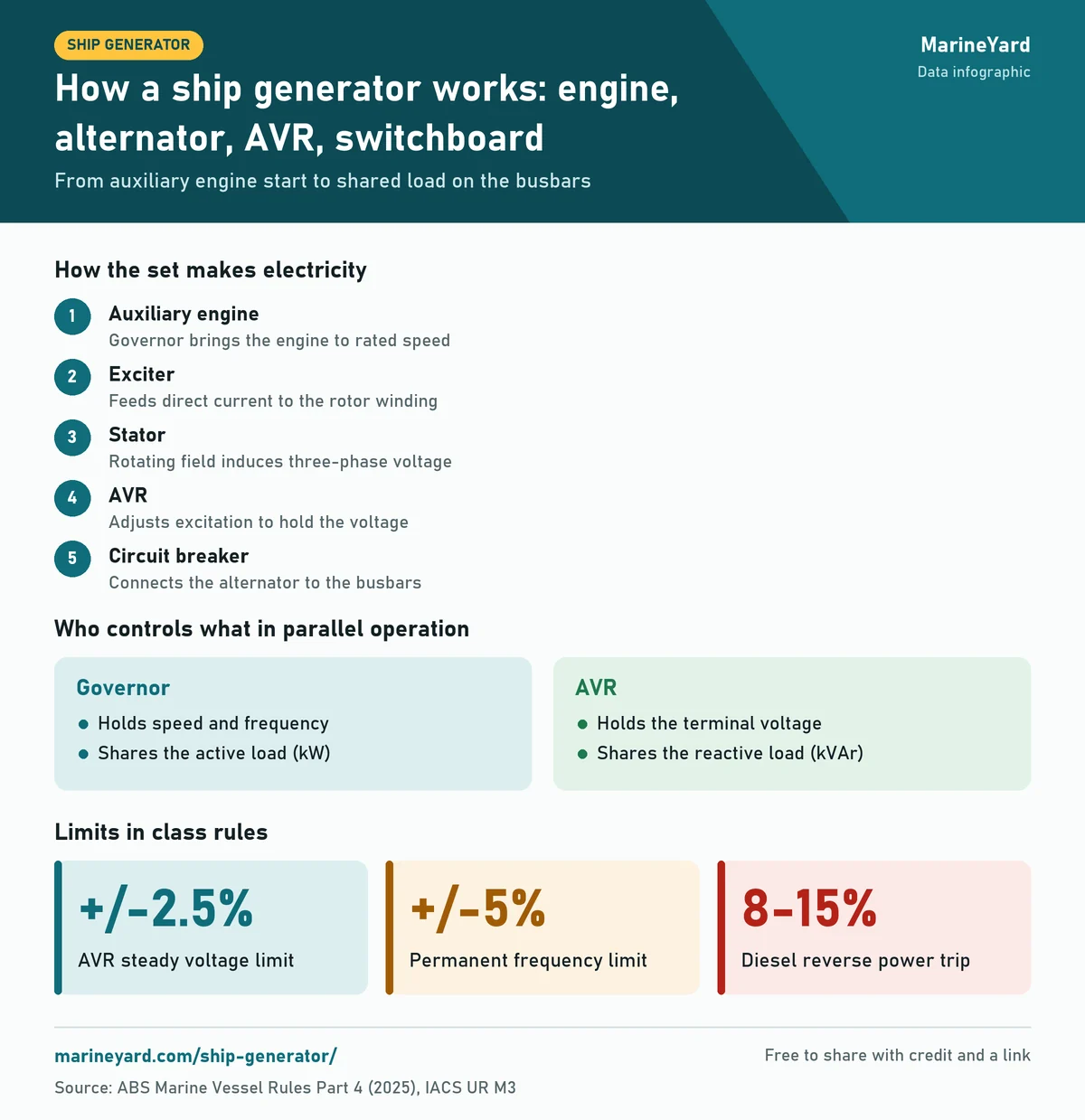
A ship generator is a machine set that produces the electrical power for a vessel. A ship generator consists of a prime mover, usually a four-stroke diesel...
 Ship Machinery
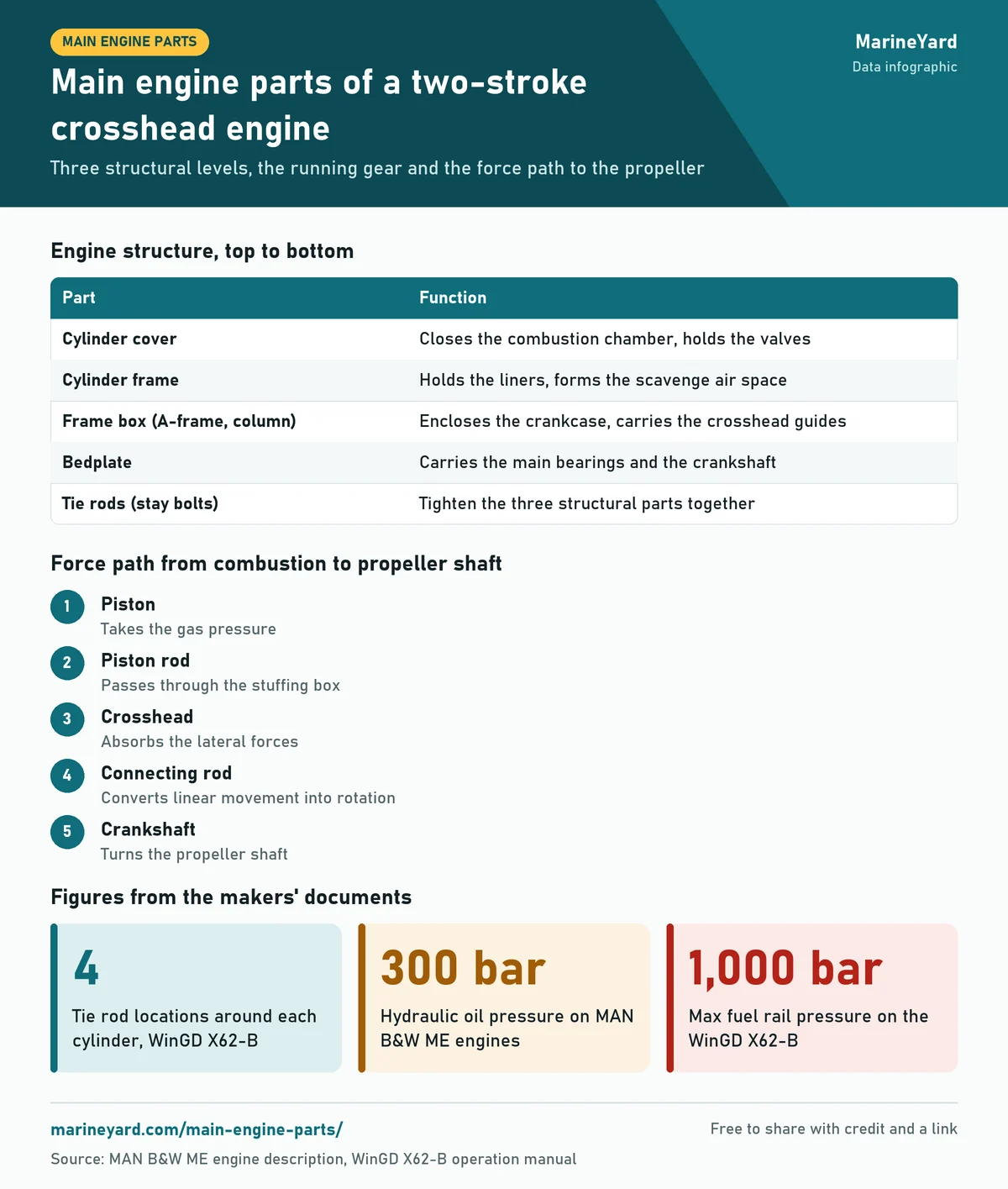
Main engine parts are the components of the diesel engine that turns a ship's propeller. The main engine of a large merchant ship is usually a slow-speed...
 Ship Machinery
An oil mist detector (OMD) is a safety instrument on a marine diesel engine that measures the concentration of oil mist in the crankcase. The oil mist...