Fresh Water Generator on Ships: Working, Parts and Types
Marine engineers & industry writers
Updated
Nov 21, 2026
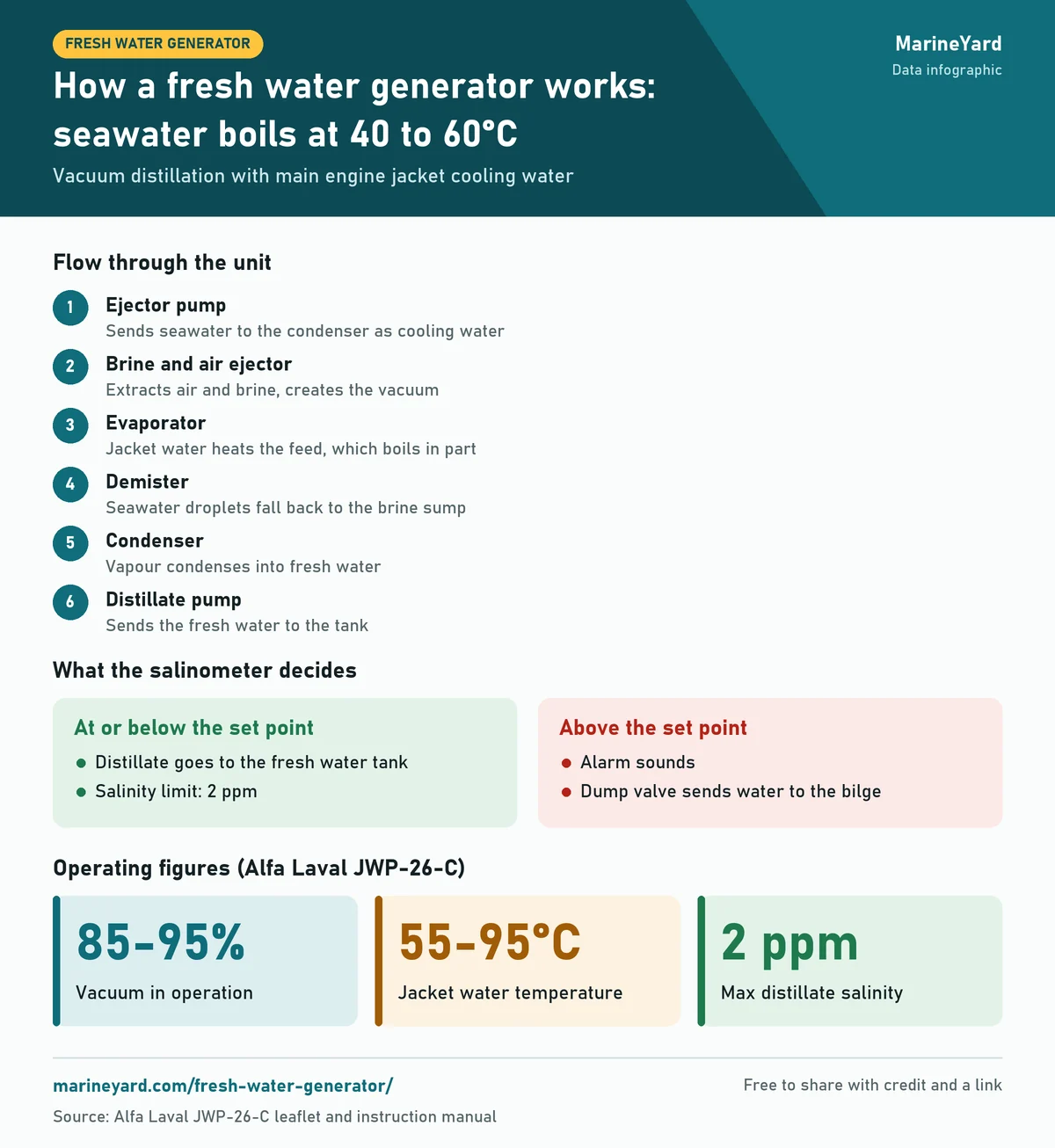
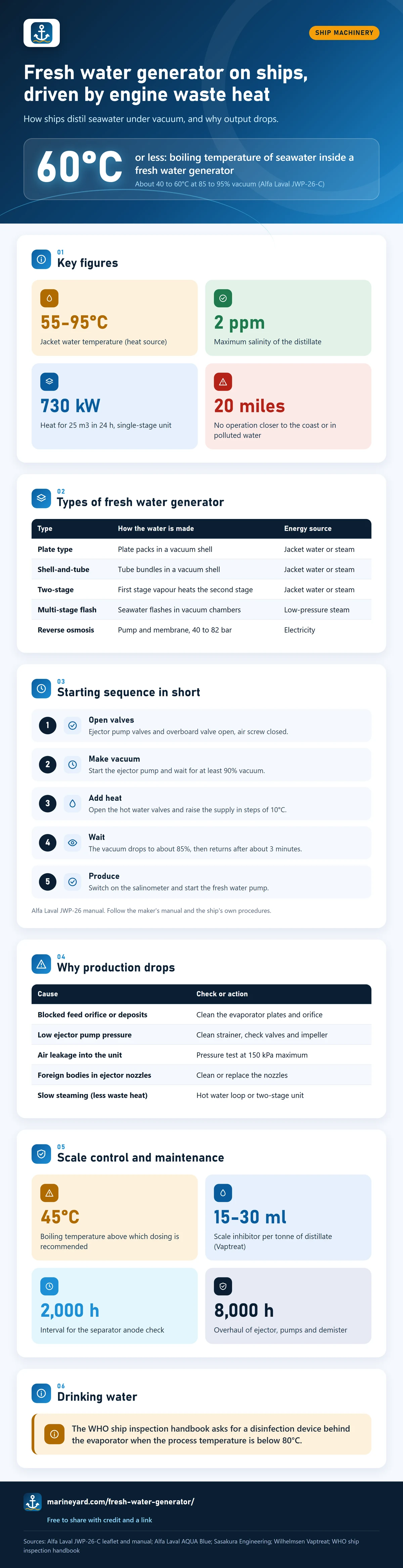
A fresh water generator is the machine on a ship that turns seawater into fresh water by vacuum distillation. The fresh water generator boils seawater at about 40 to 60 °C under a vacuum of 85 to 95%, uses the heat of the main engine jacket cooling water, and condenses the vapour into distillate.
The distillate has a salinity of 2 ppm or less in the common plate-type units. The crew uses the water as drinking water after treatment, as boiler feed water and as technical water in the engine room.
Key facts
| Attribute | Value |
|---|---|
| Evaporation temperature | About 40 to 60 °C at 85 to 95% vacuum (Alfa Laval JWP-26-C) |
| Heating water temperature | 55 to 95 °C jacket water (Alfa Laval JWP-26-C) |
| Distillate salinity | Maximum 2 ppm (Alfa Laval JWP and AQUA Blue) |
| Capacity of single-stage units | 4 to 35 m³/24 h (JWP-26-C); 10 to 50 tonnes/day (Sasakura X series) |
| Heat consumption | 730 kW for 25 m³/24 h, single stage (Alfa Laval AQUA Blue E1 C80) |
| Start-up vacuum | Minimum 90%, reached within 10 minutes (JWP-26 manual) |
| Operating area | Not in polluted water and not within 20 miles of the coast (JWP-26 manual) |
What is a fresh water generator on a ship?
A fresh water generator on a ship is a vacuum evaporator installed in the engine room and connected to the jacket cooling water circuit of the main engine. The fresh water generator takes seawater as feed, evaporates part of the feed, condenses the vapour and pumps the distillate to the fresh water tanks.
The unit is also called an evaporator, a distiller or an FWG. The heat source is waste heat, so the evaporation needs no extra fuel while the main engine runs. Alfa Laval states that the low salinity allows direct use of the distillate as make-up water for a steam ship boiler.
What are the parts of a fresh water generator?
The parts of a fresh water generator are an evaporator, a separator vessel with a demister, a condenser, a combined brine and air ejector, an ejector pump, a distillate pump, a salinometer with a dump valve, a chemical dosing unit and a control panel. Evaporator and condenser are plate or tube heat exchangers.
| Part | Function |
|---|---|
| Evaporator | Transfers jacket water heat to the seawater feed, which boils under vacuum |
| Separator vessel (shell) | Holds the vacuum and separates the brine from the vapour |
| Demister | Removes seawater droplets from the vapour |
| Condenser | Condenses the vapour into fresh water on surfaces cooled by seawater |
| Combined brine and air ejector (eductor) | Extracts brine and incondensable gases and so creates the vacuum |
| Ejector pump | Supplies cooling water to the condenser, jet water to the ejector and feed water |
| Distillate (fresh water) pump | Pumps the fresh water from the condenser to the tank |
| Salinometer and dump valve | Measure the salinity of the distillate; water above the alarm set point goes to the bilge |
| Chemical dosing unit | Adds a scale inhibitor to the feed water |
The Alfa Laval JWP-26-C product leaflet lists titanium plates for the evaporator and the condenser. The alarm level of the DS-20 salinometer on the JWP-26 is adjustable from 0.5 to 20 ppm.
What are the types of fresh water generator?
The types of fresh water generator are plate-type vacuum evaporators, shell-and-tube (submerged tube) vacuum evaporators, multi-effect and flash evaporators, and reverse osmosis plants. The first three types distil seawater with heat. A reverse osmosis plant uses pressure and a membrane.
| Type | How the water is made | Energy source | Maker data |
|---|---|---|---|
| Plate type (shell-and-plate) | Plate packs for evaporation and condensation inside a vacuum shell, divided by a demister | Jacket water or steam | Smaller than shell-and-tube, with better heat transfer (Alfa Laval) |
| Shell-and-tube (submerged tube) | Tube bundles for heating and condensing inside a vacuum shell | Jacket water or low-pressure steam | Dual and triple effect units: 40 to 200 tonnes/day (Sasakura) |
| Two-stage or double effect | Vapour heat from the first stage heats the second stage | Jacket water or steam | 415 kW instead of 730 kW for 25 m³/24 h (AQUA Blue E2 against E1) |
| Multi-stage flash | Heated seawater flashes into vapour in a series of vacuum chambers | Low-pressure steam | 100 to 1,000 tonnes/day (Sasakura) |
| Reverse osmosis | A pump presses seawater through a semi-permeable membrane | Electricity | Seawater needs 40 to 82 bar |
The Alfa Laval white paper on two-stage freshwater generation calls plate-based vacuum distillation the standard on marine vessels. The Alfa Laval AQUA Blue series places evaporation, separation and condensation in one titanium plate pack without a shell.
Seawater has a natural osmotic pressure of about 27 bar, and a reverse osmosis pump must exceed that pressure, as the Wikipedia article on reverse osmosis explains. Alfa Laval states on its AQUA Blue product page that reverse osmosis becomes less efficient for every degree of seawater temperature below 25 °C.
How does a fresh water generator work?
A fresh water generator works by low-pressure evaporation. The ejector lowers the pressure in the unit to a vacuum of 85 to 95%. Seawater then boils at about 40 to 60 °C instead of 100 °C. Jacket cooling water at 55 to 95 °C supplies the heat, and seawater cools the condenser.
- The ejector pump delivers seawater to the condenser as cooling water.
- The seawater leaves the condenser. One part drives the ejector as jet water. Another part enters the evaporator as feed water.
- The ejector extracts air and brine from the separator vessel and creates the vacuum.
- Hot jacket water flows through every second plate channel of the evaporator and heats the feed water.
- The feed water evaporates in part. The rest becomes brine.
- The vapour passes the demister. Seawater droplets fall back to the brine sump.
- The vapour condenses into fresh water on the condenser plates.
- The distillate pump sends the fresh water to the tank. The salinometer checks the salinity.
How is a fresh water generator started and stopped?
A fresh water generator is started in three phases: vacuum, evaporation and condensation. The ejector pump first creates a vacuum of at least 90%. The hot water supply is then opened in steps. The salinometer and the distillate pump follow. The maker's manual and the ship's own procedures always apply.
The Alfa Laval JWP-26 instruction manual gives this starting sequence:
- Open the suction and discharge valves of the ejector pump.
- Open the overboard valve for the combined brine and air ejector.
- Close the air screw on the separator.
- Start the ejector pump. The ejector inlet pressure must be at least 300 kPa (3 bar).
- Wait for a vacuum of at least 90% (10 minutes at most). Open the valve for feed water treatment.
- Open the hot water inlet and outlet valves.
- Raise the hot water supply in steps of 10 °C. The vacuum drops to about 85% when evaporation starts.
- Open the valve to the fresh water tank after about 3 minutes, when the normal vacuum has returned.
- Switch on the salinometer and start the fresh water pump.
To stop the unit, the crew stops the hot water supply first, then the feed water treatment, the fresh water pump, the salinometer and the ejector pump, and opens the air screw. The same manual prohibits operation in polluted water and within 20 miles of the coast.
What causes low production in a fresh water generator?
Low production in a fresh water generator is caused most often by scale or sludge on the heat transfer surfaces, a weak vacuum from low ejector pressure or air leaks, a blocked feed water orifice, worn or blocked ejector nozzles, or a hot water temperature and flow outside the specified values.
| Cause | Check or action (Alfa Laval JWP-26 manual) |
|---|---|
| Blocked feed water orifice or deposits in the evaporator | Dismantle the evaporator section; clean the plates and the orifice |
| Ejector pump pressure too low (below 300 kPa at the ejector inlet) | Clean the suction strainer; check valves, impeller and seal ring |
| Air leakage into the unit | Pressure test at 150 kPa maximum |
| Foreign bodies in the ejector nozzles | Inspect and clean the nozzles; replace damaged nozzles |
Engine load also sets the output. Slow steaming lowers the waste heat in the jacket water. Alfa Laval names a steam-heated hot water loop and a two-stage unit as answers.
High salinity is a separate fault. The manual lists a wrongly fitted demister, a defective front cover gasket, insufficient brine extraction, a dirty electrode unit and a condenser leak as causes of salinity above 2 ppm.
How is scale controlled in a fresh water generator?
Scale in a fresh water generator is controlled by continuous dosing of a scale inhibitor into the feed water, by a correct feed water ratio and by a moderate boiling temperature. Scale that still forms is removed with an inhibited acid, either in a bath or by cleaning in place.
Scale lowers the heat transfer of the evaporator plates. The feed water ratio is the amount of feed water divided by the amount of fresh water produced. A lower ratio raises the brine concentration and the scale risk, so the JWP-26 manual tells operators not to adjust the feed water system or exceed the rated production.
- Alfa Laval recommends chemical dosing at boiling temperatures above 45 °C. A dosing unit is necessary at heating water temperatures above 75 °C.
- The Wilhelmsen Vaptreat product page gives a standard dose of 15 to 30 ml per tonne of distillate, based on the rated capacity.
- Evaporator plates are cleaned in an inhibited acid bath at 50 °C maximum.
Is fresh water generator distillate safe to drink?
Fresh water generator distillate is very low in salt, but the evaporation takes place far below 100 °C. The WHO handbook for ship inspection asks for a disinfection device behind the evaporator when the process temperature is below 80 °C, and for remineralisation before the water reaches consumers.
The WHO Handbook for Inspection of Ships and Issuance of Ship Sanitation Certificates treats water production in ports, on rivers and at anchorage as production in unsafe areas.
Who makes fresh water generators?
Fresh water generators are made by Alfa Laval, Sasakura Engineering and Wärtsilä, among others. Alfa Laval makes the JWP plate-type series and the AQUA Blue series. Sasakura makes the plate-type Aquario, the X series and the double effect WX series. Wärtsilä makes single-stage, tube and multi-stage flash evaporators.
Sasakura was founded in 1949 as a maker of marine fresh water generators and reports more than 17,000 delivered units of the X series in its marine equipment product list.
Which fresh water generator spare parts are ordered most often?
Fresh water generator spare parts ordered most often are plate gaskets and front cover gaskets, heat exchanger plates, ejector nozzles and diffusers, mechanical seals, impellers and seal rings for the two pumps, anodes, demisters, salinometer electrode units, non-return valves and dosing pump parts.
The JWP-26 manual recommends a check of the separator anodes every 2,000 operating hours and an overhaul of the ejector, both pumps and the demister every 8,000 hours. The salinometer is tested at least once a month.
A correct order states the following data:
- Ship name and IMO number.
- Maker and type of the unit, for example JWP-26-C80.
- Serial number from the nameplate.
- Number of plates in the evaporator and condenser, because the plate count sets the capacity.
- Part number and plate code from the manual.
General consumables such as descaling chemicals may carry an IMPA code and can come from a ship chandler. Plates, gaskets and ejector parts are ordered by the maker's part number.
Where can fresh water generator parts be bought or sold?
Fresh water generator parts are bought from makers, authorised service companies and surplus stockists. MarineYard is a ship spare parts marketplace where sellers list new, reconditioned and used boilers and heat exchangers and pumps and compressors. Sellers get 9 free listings per account. MarineYard takes no commission and is not a party to any sale. Buyers should confirm the type, serial number and plate count with the seller before payment.
Frequently Asked Questions
Why is a fresh water generator not used near the coast?
A fresh water generator is not used near the coast because coastal and harbour water can be polluted. The Alfa Laval JWP-26 manual prohibits operation in polluted water and within 20 miles of the coast.
What vacuum does a fresh water generator need?
A fresh water generator needs a vacuum of at least 90% at start-up, according to the Alfa Laval JWP-26 manual. In operation the unit boils seawater at about 40 to 60 °C under a vacuum of 85 to 95%, with jacket cooling water as the heat source.
What is the salinity limit of fresh water generator distillate?
The salinity limit of the distillate is 2 ppm for Alfa Laval JWP and AQUA Blue units. The salinometer measures the salinity continuously. Above the set point, the alarm sounds and the dump valve sends the water to the bilge.
Can a fresh water generator run when the main engine is stopped?
A fresh water generator can run with the main engine stopped when steam from the auxiliary boiler replaces the jacket water heat. Alfa Laval and Sasakura offer a hot water loop, a steam injector or a steam booster unit for this purpose.
How much heat does a fresh water generator use?
A single-stage fresh water generator uses about 730 kW of heat to produce 25 m³ of water in 24 hours, according to Alfa Laval data. The two-stage AQUA Blue E2 uses 415 kW for the same output.
How often is a fresh water generator cleaned?
A fresh water generator has no fixed cleaning interval for the evaporator. The Alfa Laval JWP-26 manual states "as required" for acid cleaning of the evaporator section. Correct chemical dosing extends the period between cleanings.
Related guides
- Stern tube: parts, bearings, seals and lubrication
- IMPA code: meaning and structure
- Ship chandler: meaning and services
- Oily water separator: working, parts and the 15 ppm rule
- Marine turbocharger: parts, working and surging
- Purifier in ship: working principle, parts and faults
- Cylinder liner: function, wear and gauging
- Ship boiler: types, mountings and water treatment
- Anchor windlass: parts, working and class rules
- Bow thruster: how it works, types and failures
- Steering gear: parts, types and SOLAS tests
- Marine air compressor: starting air, parts and safety
Sources
- Alfa Laval, Desalt JWP-26-C Series product leaflet
- Alfa Laval, instruction manual for freshwater generator type JWP-26-C80/100
- Alfa Laval, AQUA Blue single-stage freshwater generator
- Alfa Laval, white paper on two-stage freshwater generation
- Sasakura Engineering, marine equipment product list
- Wilhelmsen Ships Service, Vaptreat evaporator treatment
- WHO, Handbook for Inspection of Ships and Issuance of Ship Sanitation Certificates
- Wikipedia, Reverse osmosis
Sign in to leave a comment and join the discussion.
 Ship Machinery
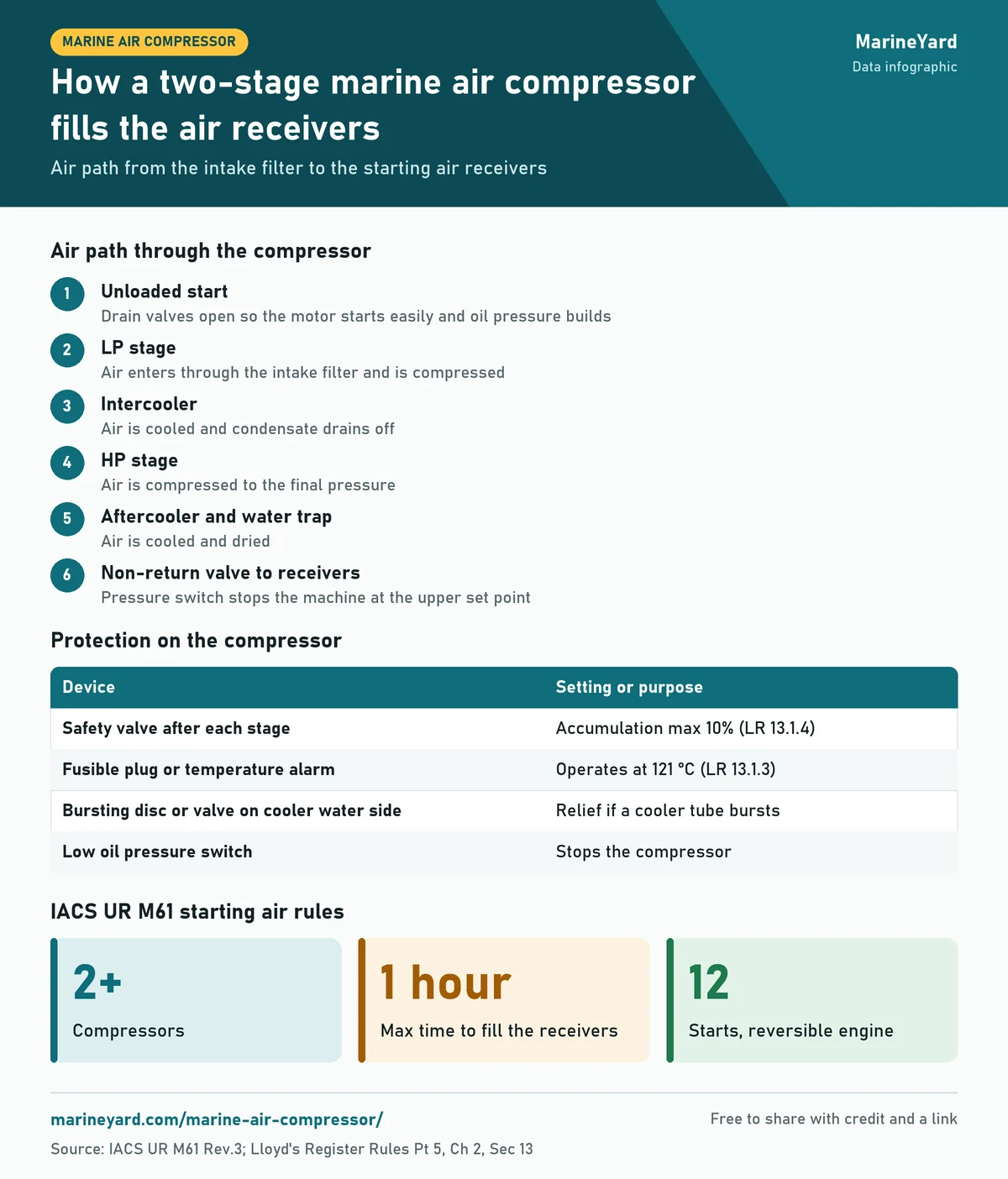
A marine air compressor is the machine in a ship's engine room that compresses atmospheric air and stores it in air receivers. The stored air starts the...
 Ship Machinery
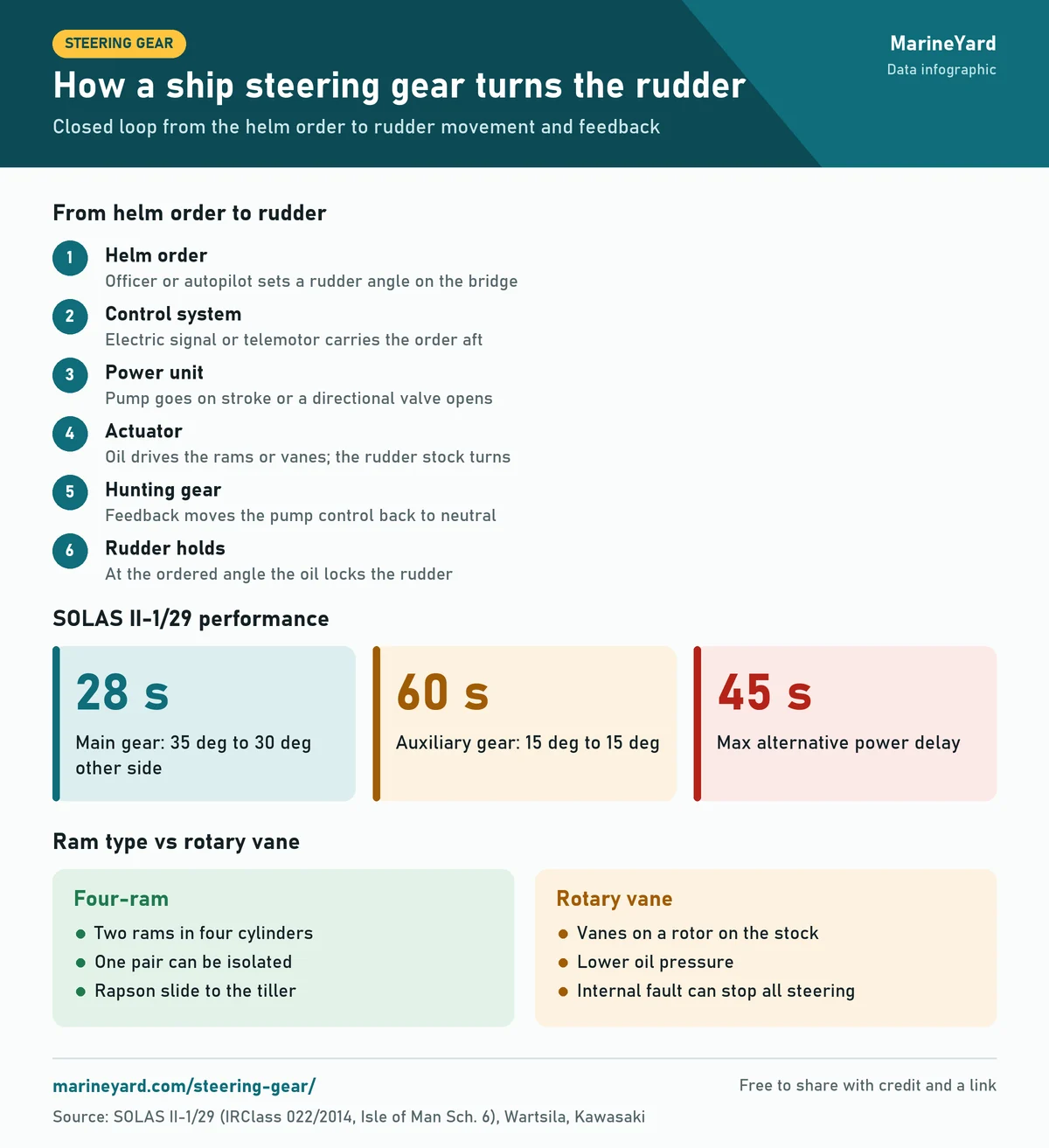
A steering gear is the machinery on a ship that turns the rudder on orders from the bridge. The steering gear comprises the rudder actuators, the power...
 Ship Machinery
A bow thruster is a propeller unit mounted in a transverse tunnel through the bow of a ship, below the waterline, that pushes the bow sideways to port or...